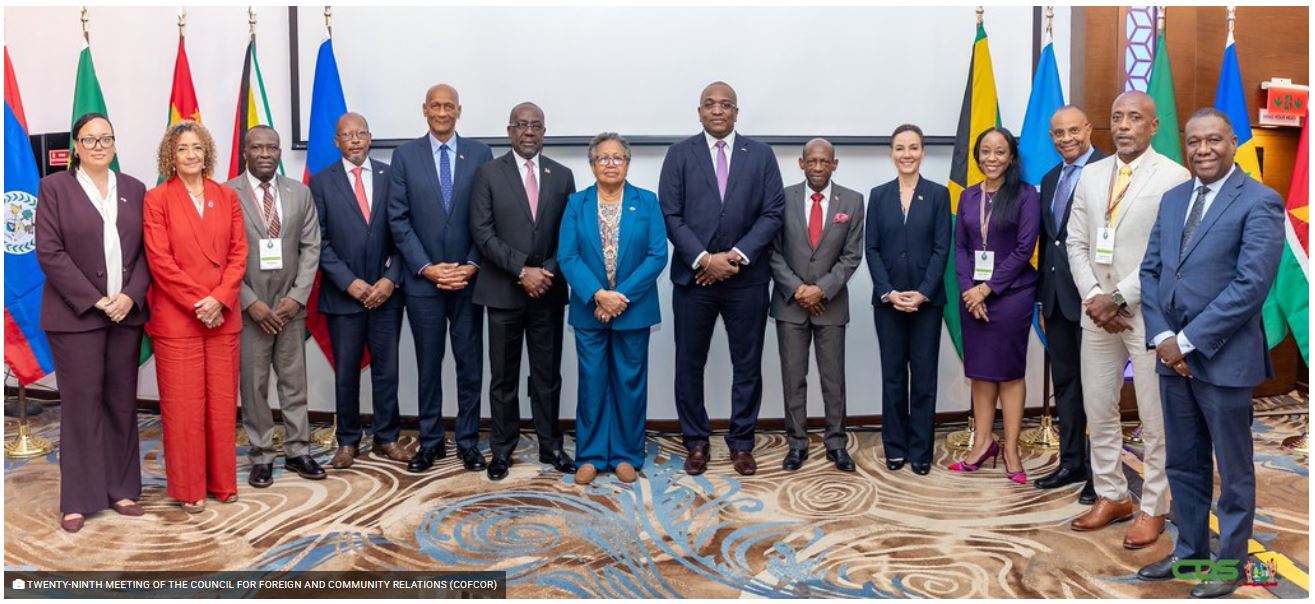
As great power competition re-emerges to reshape the global order, the 15-member Caribbean Community (CARICOM) finds itself grappling with a decades-long question: how can small post-colonial states preserve their sovereign autonomy amid shifting regional and international pressures? This tension took center stage at the recently concluded 29th Meeting of the Council for Foreign and Community Relations (COFCOR), held May 20-21 in Suriname, where CARICOM foreign ministers formally called for unified collective action to navigate an increasingly unpredictable global landscape. The meeting’s communique outlined a two-pronged “dual approach” to protect regional sovereignty: intensifying foreign policy coordination to align bloc positions amid great power rivalry, and accelerating implementation of the CARICOM Single Market and Economy (CSME) to shore up regional food and energy security.
But beneath the official call for unity lies a deep, consequential rift among member states, rooted in clashing approaches to regional foreign policy in the face of a renewed U.S. focus on the Western Hemisphere. At the heart of the divide is the so-called “Trump Corollary” to the 19th-century Monroe Doctrine – a framework that has shifted U.S. hemispheric strategy from a development-focused model of influence to a militarized, deterrence-first approach centered on counter-criminal operations and great power competition. Trinidad and Tobago, one of CARICOM’s founding members, has emerged as the most vocal backer of this new doctrine, aligning its foreign policy closely with Washington’s interventionist posture in the Caribbean. Prime Minister Kamla Persad-Bissessar has explicitly rejected the longstanding regional principle of the Caribbean as a Zone of Peace, justifying the shift by pointing to rising transnational drug trafficking, gang violence and homicides linked to instability in neighboring Venezuela. Port of Spain has since deepened security and economic cooperation with Washington to counter what it frames as malign influence in the region.
Oil-rich Guyana has taken a more nuanced stance, balancing its critical security and energy interests to avoid overt alignment, but the gap between Trinidad and Tobago’s position and that of nearly all other CARICOM member states remains wide. The resulting policy disagreements have not only deepened mistrust across the bloc, but also opened the door to new questions about the future of regional governance: Trinidad and Tobago raised a slate of bloc-level governance reforms at COFCOR, and the country was not represented at the ministerial level at the recent meeting, highlighting the depth of the current diplomatic rift.
To understand the stakes of this current divide, it is necessary to contextualize CARICOM’s long-standing pursuit of strategic autonomy – defined as the ability for small states to act independently to advance their national interests, while adapting to shifting global geopolitics. Most of CARICOM’s sovereign members gained independence between the 1960s and 1980s, following centuries of British colonial rule. When the Pax Britannica collapsed and the Pax Americana took hold, the Caribbean was already framed by Washington as America’s “backyard,” a status formalized by the 19th-century Monroe Doctrine, expanded by the Roosevelt Corollary’s “big stick” assertion of U.S. primacy, and cemented during the Cold War. As the U.S. built out a network of naval and air bases to counter Soviet influence in the region following the Cuban Revolution, the Caribbean became a major Cold War flashpoint, bringing small island states directly into great power rivalry.
It was in this context that the founding leaders of post-independence Caribbean states articulated a core doctrine of strategic autonomy. Errol Barrow, the father of Barbadian independence, famously outlined the “Friends of All, Satellites of None” framework when Barbados joined the United Nations in 1966, a non-aligned approach that rejected ideological alignment with any great power, centered on the diplomacy of peace and prosperity rather than power competition. This principle has remained a foundational touchstone for regional foreign policy, rooted in three core values: respect for sovereign equality of all states, non-interference in internal affairs, and adherence to international law and the UN Charter.
Today, as great powers revive a spheres-of-influence order that erodes the U.S.-led liberal internationalism of the post-Cold War era, Caribbean leaders warn that this strategic autonomy is under unprecedented threat. The rise of geopolitical fragmentation and multipolarity has strained multilateral institutions, including the UN – the primary platform through which small CARICOM states amplify their voices and defend their interests on the global stage. But the most pressing challenge to regional strategic autonomy is not external: it is coming from within the bloc itself.
Trinidad and Tobago’s full-throated endorsement of the Trump Corollary has upended long-standing regional consensus on security. For decades, CARICOM has framed the Caribbean as a Zone of Peace, with a regional approach to security that extends beyond traditional border defense to include human, economic and environmental security, reflected in the 2023 Caribbean Maritime Security Strategy. This framework, aligned with the UN Convention on the Law of the Sea (UNCLOS), rejects large-scale militarization of the region’s waters, prioritizing peaceful economic development of the blue economy – a core lifeline for small island states dependent on fishing, shipping, tourism and maritime trade. UNCLOS also provides critical legal protection for CARICOM states’ Exclusive Economic Zones, enshrining their sovereign right to develop marine resources and resist interference from larger powers.
By contrast, the U.S. military deployments in the region that Trinidad and Tobago supports target drug trafficking networks but have been documented to disrupt local fishing, shipping and tourism industries – harms that Barbadian Prime Minister Mia Mottley and other regional leaders have publicly decimated. For small, low-lying coastal CARICOM states that rely on open maritime trade routes for survival, these operations pose an existential economic threat. The region’s long-standing commitment to the Zone of Peace principle, backed by UNCLOS, is designed precisely to avoid this outcome, by framing the Caribbean as a space for cooperation rather than great power competition.
The current rift has already played out in high-stakes diplomatic moments. Both Guyana and Trinidad and Tobago refused to endorse a recent COFCOR statement expressing deep concern over intensified U.S. economic, commercial and financial sanctions on Cuba, and reaffirming the Caribbean Zone of Peace principle – a statement issued as the Trump administration ramps up pressure on the Cuban government, including open threats of military action for regime change. More recently, both countries joined an American-orchestrated joint statement condemning China over alleged economic coercion related to detained Panama-flagged vessels, pulling them directly into the middle of escalating Sino-U.S. rivalry. Nine CARICOM states have active development partnerships with China under the Belt and Road Initiative, making U.S. pressure on these ties an added strain on regional unity.
While COFCOR Chair Melvin Bouva’s call for unified action to navigate geopolitical uncertainty has been widely praised across the region, analysts note that growing divergence over what strategic autonomy actually means for member states has blocked progress toward that goal. The upcoming 51st Regular Meeting of the CARICOM Conference of Heads of Government, scheduled for July 5-8, is expected to take up the question of regional unity and strategic autonomy as a core agenda item. Ultimately, regional leaders will need to confront a new reality: the shifting global geopolitical order has already reshaped CARICOM, and competing visions of strategic autonomy among member states will define the bloc’s trajectory for years to come.