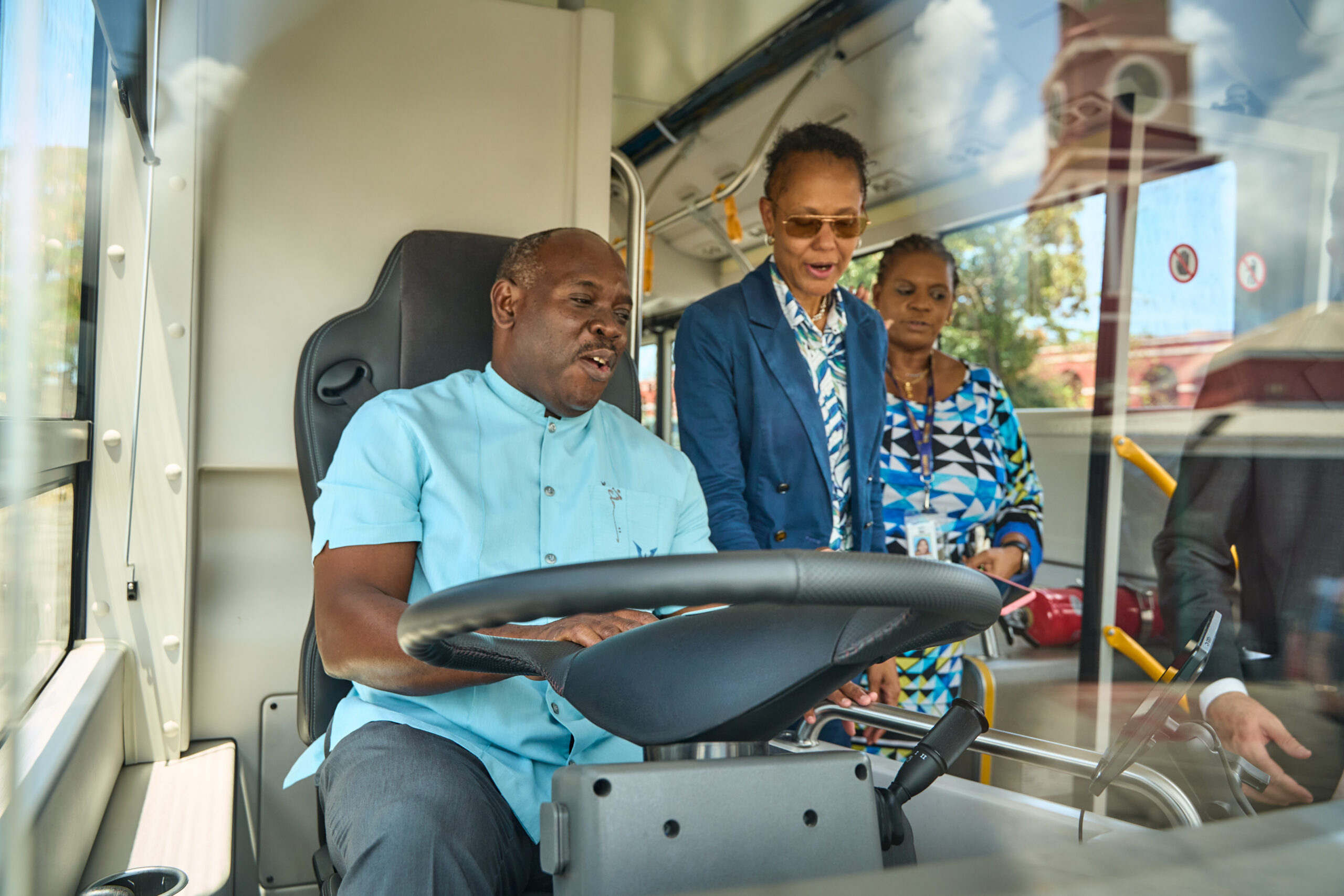
On a Friday launch event held at the Garrison, the Caribbean nation of Barbados introduced an innovative public outreach tool: a custom-branded ‘moving classroom’ designed to bridge the gap between policymakers and local communities when it comes to marine conservation and sustainable ocean management. The core mission of this mobile initiative is to expand public understanding of the Barbados Marine Spatial Plan, a national framework that will shape the future of the island’s ocean resources, and make conversations about marine policy accessible to people across every corner of the country, rather than limiting them to closed-door conference rooms and technical consultations.
Speaking at the official unveiling, Deputy Prime Minister and Minister of the Environment Santia Bradshaw emphasized that the initiative is far more than a simple branded vehicle. For Bradshaw and the government team behind the project, the bus is a mobile educational hub that brings discussions of ocean stewardship directly to Barbadians, regardless of their location or connection to marine policy. ‘This bus is more than a vehicle. It is what we consider a moving classroom, bringing the ocean to the people of this island and to those who visit,’ Bradshaw stated during her address.
She explained that the project will break down the barriers that have long kept discussions of marine sustainability, climate resilience, and ocean governance confined to technical documents and elite policy circles. By traveling to communities across Barbados, the bus will create space for ordinary residents to learn about the national plan, ask questions of policymakers, and contribute input that shapes how the island’s marine resources are used and protected in the decades ahead. ‘Every journey that this bus makes is another opportunity to raise awareness, to learn more about the Barbados Marine Spatial Plan, and also to look at how we can help to shape the future of our ocean space,’ Bradshaw added.
The environment minister stressed that marine spatial planning is not an abstract technical policy that only affects industry or scientists – it is a framework that touches the daily life of every single Barbadian. As a small island nation, Barbados’ entire economy and cultural way of life are inextricably linked to the surrounding ocean, supporting critical sectors from tourism and commercial fishing to food security and household livelihoods. Effective marine planning is essential to balancing the competing demands for ocean space, from conservation and recreation to renewable energy development and economic growth. ‘At its core, the marine spatial plan is about ensuring that we use our marine space responsibly, sustainably and fairly, balancing conservation, tourism, fisheries, recreation, renewable energy, economic opportunity and climate resilience,’ Bradshaw noted.
Minister of Finance Ryan Straughn reinforced this perspective during the event, underlining the deeply intertwined relationship between environmental stewardship and long-term national economic development. Straughn pushed back against the long-held idea that environmental protection and economic growth must be addressed as separate, often competing priorities, noting that Barbados has embraced an integrated, cross-cutting approach to national policy that recognizes the value of natural assets as the foundation of economic prosperity.
‘There’s no separation between finance and environmental sustainability,’ Straughn said. He pointed out that Barbados’ marine territory supports nearly every pillar of the national economy, from tourism and the fast-growing blue economy to shipping, coastal protection, private investment, recreation, and widespread livelihoods across communities. As a small island developing state that is disproportionately vulnerable to the impacts of climate change and sea-level rise, Straughn argued that Barbados has no choice but to both protect its irreplaceable marine assets and use them responsibly to support current and future generations.
‘We have to treasure our assets, protect those assets, but also utilise those assets to ensure that our citizens can sustain themselves and their families and communities,’ Straughn said. He concluded by noting that how Barbados manages its marine resources as an independent republic will be a defining factor in building national climate resilience and ensuring that all future development is rooted in long-term sustainability that benefits all Barbadians.