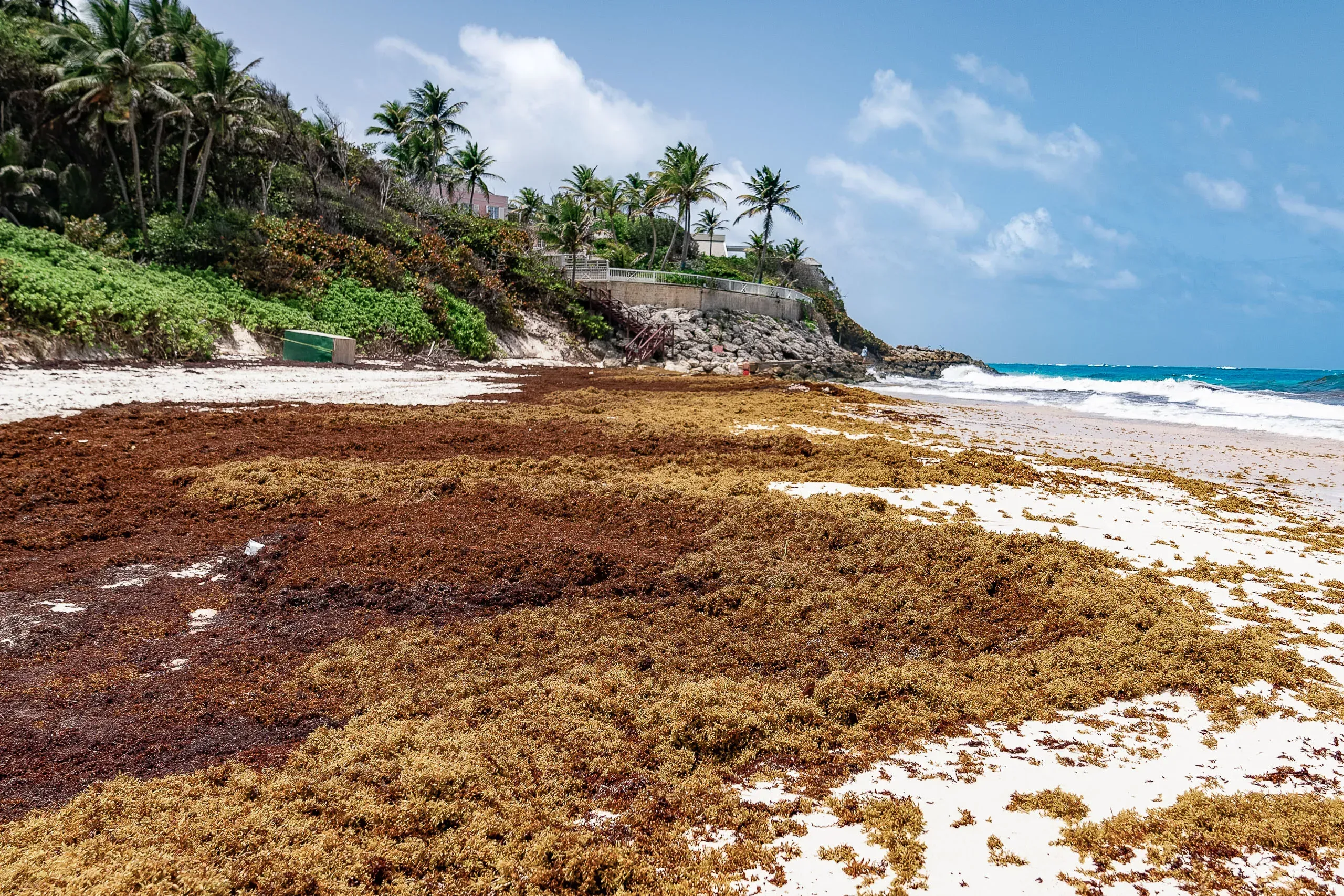
As a massive annual sargassum seaweed bloom continues to endanger key coastal sectors across Barbados, the island nation’s government is accelerating its mitigation strategy – with a new focus on intercepting the invasive algae before it reaches shore. Deputy Prime Minister and Minister of the Environment Santia Bradshaw outlined the expanded response during Friday’s launch of an educational outreach bus focused on Barbados’ Marine Spatial Plan at the Garrison, where she emphasized the growing environmental and economic toll the persistent influx has placed on the island.
Bradshaw noted that the recurring sargassum blooms, which have plagued Barbados’ waters since 2011, pose far-reaching threats to the country’s most valuable marine and coastal assets. “This valuable marine space also faces very real threats,” she explained. “Sargassum seaweed influxes continue to impact our beaches, fisheries, coastal communities, and tourism product, while coastal erosion exacerbated by accumulated blooms threatens our infrastructure, our ecosystems, and our vulnerable shorelines across the island. These challenges remind us why careful planning and sustainable management of our marine environment are so critical.”
To date, the Barbadian government has already rolled out a series of coordinated onshore interventions to address the crisis. This includes hiring contract workers to carry out regular beach cleanups, and partnering with international organizations and foreign governments to scale up mechanized removal efforts for more efficient, large-scale clearance. “This includes engaging contract workers to support the cleanup efforts and collaborating with international agencies such as the UNDP and countries such as Japan to increase the use of mechanized equipment for more efficient and large-scale sargassum removal,” Bradshaw said.
Moving beyond immediate cleanup actions, the government has spent years pursuing long-term, locally tailored solutions to the decade-long problem. Since Bradshaw took on the environment portfolio, her team has held consultations with partner nations, multilateral development bodies including the Inter-American Development Bank (IDB), and local industry and community stakeholders to develop homegrown strategies that fit Barbados’ unique coastal context.
The next major pillar of the national strategy will be offshore collection, a proactive measure designed to cut down the volume of sargassum that actually washes up on Barbados’ coastlines. Bradshaw confirmed that government officials have already entered discussions with a team of specialized marine experts, who will work alongside local stakeholders to map out the most cost-effective, efficient operational model for offshore interception, with implementation expected to begin in the coming months.
The shift to expanded, proactive action comes as officials warn that 2024’s sargassum bloom is on track to be one of the most severe on record. “It is clear that more systematic action is needed, especially as this year’s bloom is expected to reach record levels, affecting lives, livelihoods, and coastal communities,” Bradshaw added.
Alongside the mitigation strategy updates, Friday’s event marked the launch of a mobile educational bus centered on Barbados’ Marine Spatial Plan. The outreach vehicle will travel across the island to raise public awareness of marine conservation issues, and reinforce the critical importance of protecting Barbados’ coastal resources for current and future generations.