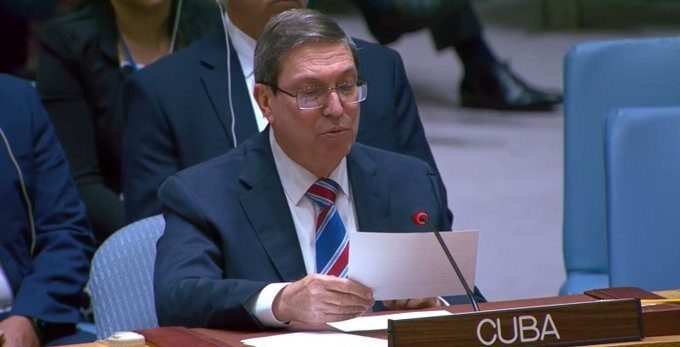
On May 26, 2026, during an open UN Security Council debate focused on upholding the core principles and purposes of the United Nations Charter, Cuban Foreign Minister Bruno Rodríguez Parrilla delivered a sweeping address that linked global order-building to urgent threats facing his small island nation. The address, released officially via Cuba’s embassy, saw Rodríguez Parrilla open by thanking China for leading the initiative to convene the debate, praising Beijing’s commitment to strengthening multilateralism, reforming the UN system to be more democratic and effective, and building a global order rooted in sovereign equality and justice.
Turning to the challenges facing global peace, Rodríguez Parrilla called out unaddressed conflicts from Palestine to the Middle East, before turning to what he framed as long-standing U.S. aggression against Cuba that directly violates international law and undermines regional stability. He reserved sharp criticism for the recent U.S. criminal indictment of retired Cuban leader Raúl Castro Ruz, calling the move a legally baseless, politically motivated fraud designed 30 years after the 1996 downing of two rogue aircraft to manufacture support for U.S. military intervention and regime change in Cuba. He noted that the indictment relies on deliberate distortions of fact: the aircraft were shot down in Cuban sovereign airspace, were conducting illegal terrorist operations against Cuba that violated U.S. law itself, and Cuba was exercising its legitimate right to self-defense, facts the U.S. proceedings systematically conceal.
Beyond the indictment, Rodríguez Parrilla detailed the catastrophic humanitarian toll of the decades-long U.S. trade embargo and the newly tightened “energy blockade” that has restricted Cuban access to fuel and critical oil supplies. He called the energy siege an act of war equivalent to a naval blockade, pointing to alarming public health data that underscores its deadly impact: Cuba’s infant mortality rate has more than doubled from 4.0 to 9.2 per 1,000 live births, while five-year survival rates for children with cancer have fallen from 85 percent to 65 percent. This deliberate pressure on ordinary Cubans, he argued, is a form of collective punishment that already constitutes a humanitarian crisis, and is being cynically exploited by the U.S. to justify foreign intervention.
Rodríguez Parrilla pushed back against long-standing U.S. claims that Cuba poses a threat to American national security, calling the narrative logically absurd for a small island facing a nuclear superpower. He reaffirmed that Cuba has no desire to be an enemy of the U.S., maintains deep cultural and people-to-people ties with the American public, and remains open to bilateral dialogue and cooperation on issues of mutual concern—including counterterrorism, drug trafficking, organized crime, and migration—so long as discussions are conducted on the basis of sovereignty, equality, and non-interference in Cuba’s internal affairs.
He issued a direct appeal to the U.S. public, particularly young Americans, to reject elite manipulation by pro-interests factions in Miami that do not represent the views of most Americans or Cuban expatriates. He warned that any U.S. military aggression against Cuba would unleash an unprecedented bloodbath, killing thousands of Cubans defending their homeland and needlessly sacrificing young American troops for an imperialist agenda of plunder and domination. Any U.S. leader who orders such an attack, he stressed, would be remembered in history as a war criminal responsible for crimes against humanity.
Closing his address, Rodríguez Parrilla called for unified global action to prevent further escalation, appealing to the UN Security Council to fulfill its core mandate of maintaining international peace by addressing the military threat and blockade against Cuba. He urged Latin American and Caribbean nations to protect their region’s status as a zone of peace, and called on the Global South to speak with one united voice to oppose hegemonic interference and show solidarity with Cuba, a nation that has consistently extended solidarity to other developing countries across decades. He closed with Cuba’s defiant rallying cry: “Homeland or death, we shall overcome!” reaffirming that the Cuban people will fight to defend their sovereignty to the end if forced.