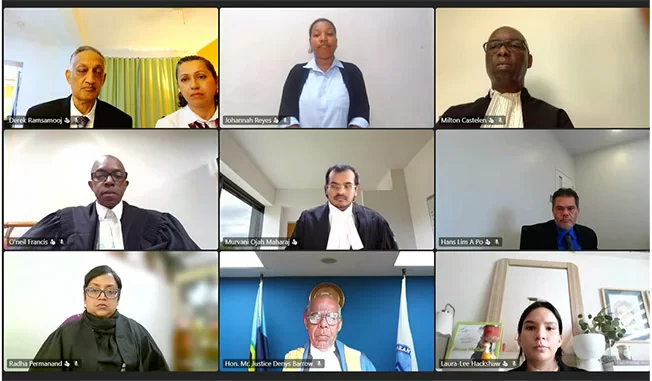
A landmark ruling delivered by the Caribbean Court of Justice (CCJ) is set to reshape the future of Suriname’s national legal framework, according to legal counsel representing a Trinidadian political consultant at the center of the case.
Milton Castelen, the attorney for Derek Ramsamooj, has outlined the far-reaching implications of the CCJ’s decision, which found Suriname in violation of Ramsamooj’s right to free movement within the Caribbean Community (CARICOM) bloc. The violation stemmed from Suriname’s prolonged detention of Ramsamooj without providing him effective access to legal representation.
Castelen explained that the ruling unlocks a long-dormant power granted to Surinamese judges under Article 137 of the country’s constitution, which explicitly authorizes the judiciary to review whether national legislation aligns with binding international treaty obligations. Prior to this ruling, that constitutional power had been far less frequently invoked, Castelen noted.
“Going forward, Surinamese judges will have to exercise this power more actively than ever before to verify that all national laws meet the human rights and procedural standards set out in international agreements that Suriname has ratified,” Castelen emphasized in his remarks on the ruling.
Beyond judicial review, Castelen added that the ruling places a clear responsibility on Suriname’s legislative branch to update and amend existing national laws that conflict with international legal obligations. Judges, he confirmed, now have clear precedent to set aside conflicting national provisions in specific individual cases when they violate international standards.
The CCJ’s ruling rested on three core legal questions the court was asked to resolve, all of which were decided in Ramsamooj’s favor. First, the court confirmed that minimum universal human rights standards apply to all citizens of CARICOM member states under the bloc’s community law. Second, it ruled that these baseline standards are a necessary prerequisite for the effective exercise of core CARICOM rights, including the free movement of people and cross-border provision of services. Third, the court found that Article 40, Paragraph 2 of Suriname’s Code of Criminal Procedure constitutes an unlawful restriction on rights protected under the revised Treaty of Chaguaramas, the foundational agreement governing CARICOM.
Castelen was careful to clarify that the CCJ did not make any judgment on the underlying criminal charges brought against Ramsamooj, as that issue was not part of the scope of the case brought before the regional court. The legal challenge focused solely on how Suriname’s Public Prosecution Service applied Article 40 Paragraph 2 during the criminal investigation into Ramsamooj.
During the investigation, Ramsamooj was held for multiple weeks without any access to contact with his legal team or family members. This practice, internationally defined as incommunicado detention, is explicitly prohibited under binding global human rights standards, Castelen said. “That is exactly what was done to Mr. Ramsamooj, and it is a clear violation of fundamental legal norms,” he added.
In its final judgment, the CCJ formally ruled that by holding Ramsamooj in these conditions, Suriname had violated his rights as enshrined in CARICOM community law. Legal analysts across the Caribbean widely view the ruling as a watershed moment for human rights enforcement and the harmonization of national laws with regional and international standards in the CARICOM bloc.