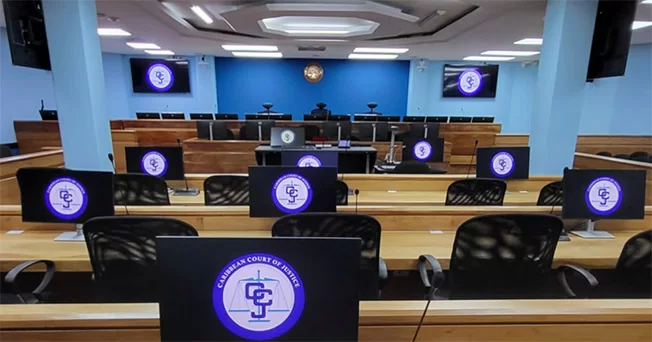
A recent landmark ruling from the Caribbean Court of Justice (CCJ) in the case of Trinidadian national Derek Ramsamooj has delivered a urgent wake-up call to Suriname, laying bare a troubling cultural and institutional gap between the country’s international human rights commitments and on-the-ground practice when it comes to the treatment of detainees. Across much of Surinamese public discourse, a pervasive dismissive attitude has taken root: once a person is taken into custody, their rights are widely seen as forfeit, with many holding the hardline view that detainees deserve no consideration beyond their cell walls. But this perspective betrays a fundamental misunderstanding of the purpose of human rights, which exist not only to protect law-abiding citizens, but to guard all individuals against the overreach of state power.
In its ruling delivered Monday, the CCJ issued a sharp rebuke to Suriname over Ramsamooj’s prolonged pre-trial detention, during which he was denied meaningful access to legal counsel. The court did not characterize the violation as a minor procedural error; it ruled that the breach of Ramsamooj’s fundamental rights was a serious violation of protections enshrined across CARICOM frameworks. This was a weighty, unambiguous rebuke that carries implications far beyond a single individual’s case.
Milton Castelen, Ramsamooj’s defense attorney, is correct to frame this ruling as a broader indictment of Suriname’s rule of law. If an international judicial body must step in to remind Suriname that universal human rights standards apply within its borders, the country has a systemic crisis as a constitutional democracy. That crisis is compounded by a stunning institutional failure: Suriname’s Constitutional Court, the body tasked with protecting citizens from laws and government actions that violate the national constitution, has remained non-functional since May 2025. No urgent action has been taken to restore it, and there has been no widespread national outcry over its absence, with only isolated voices raising alarm. This inaction stems from a dangerous, widespread misperception that human rights are a niche concern only for lawyers, non-governmental organizations and international bodies, not a protection that directly impacts ordinary citizens.
This complacency carries grave risks. Today, the violation may befall a suspect in a police cell. Tomorrow, it could target a journalist, a community activist, a business owner, or any ordinary citizen who finds themselves in conflict with the state. A functioning rule of law does not only prove its worth during periods of stability; it demonstrates its value most when it places clear checks on potential abuse of state power.
Suriname’s criminal justice system has been a source of international concern for decades. Reports from the Organization of American States (OAS) and the U.S. Department of State have long documented systemic flaws: severely overcrowded prison facilities, inadequate sanitation, lack of access to essential medical care, and routine prolonged pre-trial detention. It is common for suspects to spend one to two years in pre-trial custody before their case is ever heard substantively, with court hearings delayed indefinitely. In far too many cases, detainees spend more time behind bars awaiting trial than the maximum sentence they would receive if convicted.
No reasonable observer disputes that those who commit crimes must be held accountable, and no one is arguing for lawlessness. But pre-trial detention was never intended to function as a hidden, unaccountable punishment. Nor do suspects automatically forfeit their fundamental human rights the moment the cell door locks behind them. On the contrary, the rule of state law must be most visible within prison walls, because that is where individuals hold the least power relative to the state. When a detainee is blocked from accessing their attorney for weeks on end, it creates a conditions ripe for coercion, abuse, and further rights violations, a fact clearly acknowledged by all international human rights standards.
Public discourse too often brushes off these concerns with casual justifications: the detainee must have done something wrong, criminals do not deserve special treatment, they deserve to be locked away. This attitude persists until the injustice touches someone close: a son, a daughter, a sibling, a friend, a relative, or a colleague. In that moment, the need for access to counsel, an independent judiciary, and protection from arbitrary state power becomes undeniable. That is the core purpose of human rights: they exist not to protect only popular, well-connected people, but to prevent arbitrary state action against anyone.
Despite Suriname being a signatory to multiple international treaties that guarantee fundamental due process protections, the country has long operated as if it is detached from these obligations when it comes to upholding rule of law principles. Suriname’s own constitution enshrines these rights: Article 10 guarantees every person the right to a fair, public hearing before an independent judiciary, and Article 12 explicitly protects the right to legal representation. Beyond national law, Suriname has been a party to the International Covenant on Civil and Political Rights since 1976, acceded to the American Convention on Human Rights in 1987, recognizes the jurisdiction of the Inter-American Court of Human Rights, and joined the Treaty of Chaguaramas in 2003. All of these agreements make international fair trial standards legally binding on the Surinamese state.
The CCJ’s ruling should not be misinterpreted as an attack on Suriname’s sovereignty. Instead, it is a painful, clear mirror held up to the country, revealing that critical reforms to policing, the judiciary, and the detention system have been delayed for far too long. Perhaps that is Suriname’s most persistent failing on this front: the country only acts when international bodies publicly rebuke it for violations. Human rights do not stop at the prison gate, and the rule of law means nothing if it does not protect even the most marginalized and unpopular people in society.