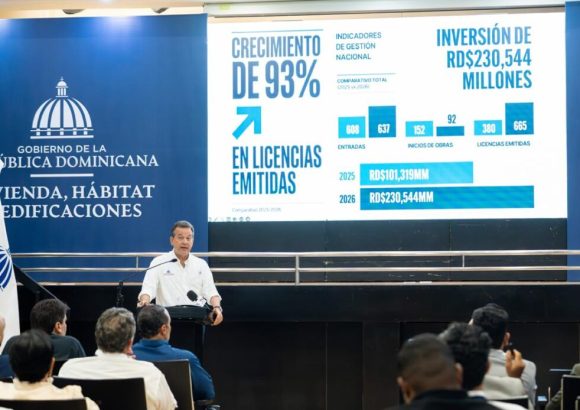
In Santo Domingo, the Dominican Republic’s Ministry of Housing, Habitat and Buildings (MIVHED) has reported a dramatic 93% year-over-year increase in construction permits issued through the first four months of 2026, a milestone that underscores the success of the government’s sweeping efforts to streamline permitting workflows and upgrade institutional operations.
The new data was presented by Housing Minister Víctor “Ito” Bisonó at the official launch of “MIVHED en Marcha,” a new regular media outreach program designed to keep the public informed about the ministry’s institutional progress, ongoing digital transformation efforts and major strategic infrastructure projects across the country.
Between January and April 2026, MIVHED approved a total of 594 construction permits, which are tied to more than 230 billion Dominican pesos (RD$) in private sector investment. That represents a 126% jump in the total value of approved investment compared to the same four-month period in 2025, when just RD$101 billion in projects received permits.
Bisonó explained that the series of administrative and regulatory reforms driving this growth were crafted to resolve longstanding public and industry complaints about lengthy permit approval delays, limited institutional operational capacity and low administrative efficiency. He also shared complementary positive indicators for the national construction sector: the industry grew 6.6% in the first quarter of 2026, while cement sales rose 6% year-over-year to hit a total of 1.5 million tons, signaling expanding on-the-ground construction activity.
As a core component of its broader modernization strategy, MIVHED has already launched “MIVHED Intelligence,” a new digital platform that gives applicants and the public the ability to track permit applications online, bringing greater transparency and accessibility to the permitting process. The ministry also confirmed that its highly anticipated new Single Window for Construction system is currently 50% complete. Once launched, the system will feature updated technical evaluation frameworks aligned with the country’s latest construction regulations.
Beyond permitting reforms, Bisonó outlined the wide range of ongoing national public works projects being advanced under the ministry’s “Route of Works that Unite” initiative. These projects include new correctional facilities across the country, affordable housing developments and urban renewal programs, new hospital construction, and targeted upgrades to sports infrastructure in preparation for the 2026 Central American and Caribbean Games.