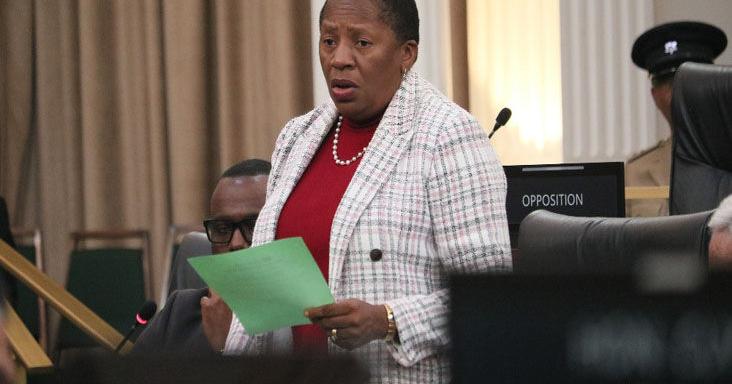
Public anger and uncertainty have surged across Trinidad and Tobago following Thursday’s confirmation that arrest warrants have been issued for Kaia Sealy, the widow of January 20 shooting victim Joshua Samaroo. At the center of growing national unrest, Opposition Leader Pennelope Beckles is pushing for immediate legislative changes to bolster the investigative authority of the country’s Police Complaints Authority (PCA), demanding decisive action from the sitting prime minister.
In a viral social media statement published over the weekend, Beckles declared “Trinidad and Tobago is on fire”, emphasizing that the public would not accept anything less than immediate intervention from Prime Minister Kamla Persad-Bissessar. Her call for reform has been backed by a growing coalition of senior legal practitioners, leading criminologists and fellow political figures, who have all joined the expanding public debate over police accountability in officer-involved fatal shootings.
The controversy stems from a January 20 confrontation at the intersection of College Road and Bassie Street Extension in St Augustine. The Trinidad and Tobago Police Service (TTPS) confirmed this week that acting on formal guidance from the Office of the Director of Public Prosecutions (DPP), it has issued warrants for Sealy on charges of manslaughter and discharging a firearm with intent to cause grievous bodily harm to responding officers. The incident sparked national outrage after user-shared security footage circulated widely across social media, showing officers opening fire on the vehicle occupied by Samaroo and Sealy. Samaroo was pronounced dead shortly after the encounter, while Sealy was hospitalized for her injuries and remains at large as of this report.
Beckles argues that the latest procedural twist in the high-profile case has amplified long-simmering national concerns over police transparency, accountability, and the effectiveness of the country’s months-long state of emergency (SoE). While she acknowledged that the Opposition respects the institutional independence of the DPP’s office, she noted that large segments of the public are openly questioning the legal and procedural foundation for the recent decision to charge Sealy. “Society is now confronted with more questions than answers regarding the rationale behind this sudden development,” Beckles said, adding that public anxiety has been further stoked by the steady rise in police-involved shootings throughout the SoE, even as the PCA’s own independent probe into the Samaroo killing remains ongoing.
The Opposition Leader stressed that while the government must respect the integrity of active criminal proceedings, the state carries a non-negotiable responsibility to safeguard the constitutional rights of all citizens. “Many have been stunned and are calling for clarity on the outcome and direction of the Samaroo investigation,” she added.
Beyond the Samaroo case, Beckles launched a broad critique of the administration’s crime-fighting strategy under the extended state of emergency, which has been in place for multiple months. She contended that despite sweeping expanded security powers that have allowed police to detain hundreds of people, violent criminal activity has continued unabated across the archipelago nation. “Home invasions remained rampant, and murders and violent crime continued unabated in broad daylight,” Beckles said. “The country was left to conclude that both of the States of Emergency had failed.”
She also raised red flags over the government’s proposed Zones of Special Operations framework, warning that the policy would grant security forces expanded authority without implementing sufficient checks and independent oversight mechanisms. Beckles added that the administration has also failed to release key public information about detentions carried out during the SoE, including how many of those detained have ultimately faced formal criminal charges.
For Beckles and the Opposition, the ongoing controversy surrounding the Samaroo case underscores a critical need for stronger independent oversight of all police operations. “In these circumstances, living under a perpetual State of Emergency and witnessing the deeply unsettling developments in the Samaroo matter, the Opposition holds the view that it is imperative for the Government to move swiftly to strengthen the Police Complaints Authority through legislative reform,” she said. The Opposition is calling for the PCA to be granted the same broad investigative powers held by Jamaica’s Independent Commission of Investigations (Indecom), a model for independent police oversight in the Caribbean. “The rights and privileges of citizens must be protected and guaranteed,” Beckles added.
Beckles also pressed the government for clarity on its future emergency plans, questioning whether the administration intends to extend the current SoE or roll out a new state of emergency once the current authorization expires. She called on Prime Minister Persad-Bissessar, who also serves as chair of the National Security Council, to deliver a public address addressing the full suite of outstanding questions surrounding national security policy and police accountability.
In its own statement released Thursday, the PCA confirmed that its independent investigation into the shooting of Samaroo and Sealy remains active. The authority also noted that high-profile cases like this one highlight the urgent need for mandatory body-worn cameras for all frontline police officers, a policy the PCA has long advocated for. “Incidents of this nature highlight why the PCA has consistently advocated for the use of body-worn cameras by police officers to provide an objective record of events and help reduce discrepancies and speculation such as in this matter,” the PCA said.