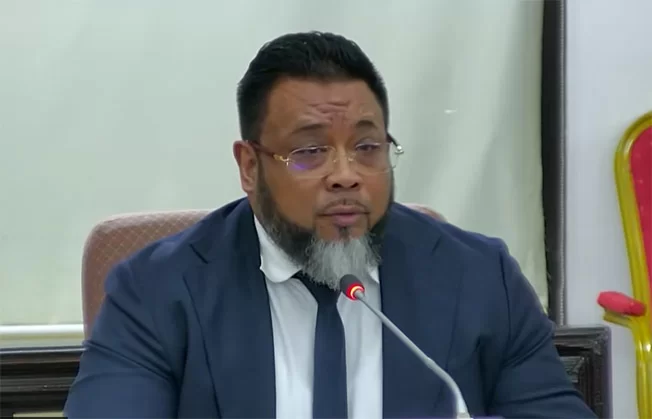
On May 22, a high-stakes public hearing was held for former Surinamese Minister of Internal Affairs Bronto Somohardjo, convened by the parliamentary committee tasked with examining allegations against sitting and former political officeholders. The hearing was called after the country’s Prosecutor General submitted a formal request under the existing law that governs the prosecution of political officials.
Prosecutors have put forward two core allegations against Somohardjo from his time leading the interior ministry. First, they claim that ministry staff, equipment and budget resources were improperly diverted for partisan political purposes. Second, they argue that a construction company tied to the former minister received unfair preferential treatment during the bidding and payment processes for public contracts.
During the hearing, Somohardjo forcefully rejected every accusation, framing himself as only politically responsible for the broad policy direction of the ministry while routine administrative and operational decisions were managed by the department’s civil service leadership. “I never gave any order to act outside the bounds of the law,” Somohardjo told the committee.
The former minister went on to note that he had never been questioned by police or the Public Prosecution Service over the claims, stating that the only official inquiry conducted into the case was completed by the Central National Audit Service (CLAD). He claimed that CLAD’s own investigation cleared him of any embezzlement or misconduct.
Committee members and sitting members of the National Assembly put a series of detailed questions to Somohardjo, covering everything from public tender procedures to protocols governing overtime payments and the deployment of ministry staff outside of regular working hours. In response, the former minister explained that overtime hours are first reviewed and approved by department heads and senior management before he signs off on the final documentation, and he denied ever approving or signing the so-called collective summary documents cited in the allegations.
The hearing also touched on conflicting claims over who initiated the CLAD investigation. Somohardjo asserted that former President Chan Santokhi ordered the inquiry, while politician Ronnie Brunswijk countered that Somohardjo himself requested the probe. The former minister declined to engage further in the dispute during the session.
Multiple committee members have emphasized that the panel’s role is not to determine guilt or innocence, but only to assess whether to uphold the Prosecutor General’s request for formal prosecution. Committee member Dew Sharman warned the National Assembly against stepping onto “slippery ground” by making substantive judgments on the case’s facts, noting that it is ultimately the role of the courts to determine where the truth lies.
In a key exchange, lawmaker Krishna Mathoera asked Somohardjo if he would be willing to let the courts adjudicate the case to clear his name. The former minister responded that he has confidence in the parliamentary committee and will leave the final decision on next steps to the full National Assembly.
The public hearing was chaired by National Assembly Speaker Ashwin Adhin after committee chair Rabin Parmessar transferred the leadership role for the session. The proceedings were not without friction, including a debate over the right of attending assembly members who are not on the committee to ask questions of the witness.
The committee now faces a final decision on whether to approve the Prosecutor General’s request and open the door to formal prosecution against Somohardjo. This same process is already underway for two other former Surinamese ministers, Riad Nurmohamed and Gillmore Hoefdraad, whose own hearings were held behind closed doors.