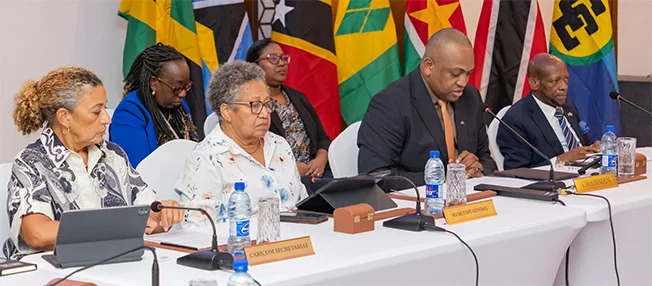
The 29th plenary meeting of the Council for Foreign and Community Relations (COFCOR), the key diplomatic body of the Caribbean Community (CARICOM), wrapped up its two-day session in Suriname on Thursday, closing with a unanimous, urgent call for deepened cross-regional integration and coordinated collective action.
Outgoing host and incoming COFCOR chair Melvin Bouva, Suriname’s foreign affairs minister, framed Caribbean regional unity not as an optional policy priority, but as an existential strategic imperative in the face of a rapidly evolving global geopolitical order. During the closing press briefing, Bouva emphasized that CARICOM member states must align their positions and act collectively if the bloc hopes to retain its international relevance and influence. “If we fail to stand together, we risk being pushed to the margins of the emerging global system,” he warned.
Suriname welcomed delegations of foreign ministers and senior representatives from across CARICOM’s 15 member states for the conference, where discussions centered on three core pillars: strengthening internal regional cooperation, expanding strategic international partnerships, and addressing pressing global challenges that disproportionately impact small Caribbean nations. Bouva confirmed that talks with prospective and existing international partners yielded productive outcomes that are poised to deliver tangible benefits to the entire Caribbean region.
Among the key partnership advances discussed was the development of a joint cooperation mechanism between CARICOM and Saudi Arabia, alongside plans to deepen existing strategic ties with the United Kingdom. Bouva also highlighted Austria’s formal offer to host and facilitate a dedicated CARICOM liaison office in Vienna, a facility designed to strengthen the bloc’s collective presence and voice in multilateral forums based in the Austrian capital. Discussions also advanced toward a potential comprehensive cooperation agreement with the United Arab Emirates, which Bouva said would dramatically expand CARICOM producers’ market access to fast-growing economies across the Middle East, Africa and Asia.
Separate talks with Japan focused on technical collaboration in high-priority areas for the Caribbean: climate disaster risk management, mitigation of harmful sargassum blooms that disrupt coastal economies, and support for regional industrial diversification. Throughout these discussions, delegates reaffirmed the unique structural vulnerability of Small Island Developing States (SIDS) and emphasized that sustained international support remains critical to their resilience. Conversations with Singapore, meanwhile, centered on shared challenges and opportunities for small states globally, with delegates agreeing that collective, coordinated action is the most effective path to strengthening small nations’ bargaining power in international negotiations.
Beyond new international partnerships, the conference centered key multilateral governance issues, including ongoing reform processes at the United Nations. COFCOR delegates issued a formal warning that efforts to centralize UN operations through regional hubs must not come at the cost of weakening in-country technical expertise or reducing institutional focus on region-critical priorities such as climate adaptation, disaster preparedness and emergency response.
The ongoing political and humanitarian crisis in Haiti also retained its spot as a top priority for the bloc. CARICOM reaffirmed its unwavering support for Haitian-led political solutions to restore lasting peace and stability to the country, while calling attention to the urgent unmet need for additional international humanitarian assistance to address the country’s worsening humanitarian catastrophe.
The bloc also expressed formal solidarity with member states Belize and Guyana amid their ongoing border disputes, confirming that CARICOM will continue to advocate actively for the security, sovereignty and territorial integrity of both nations. Finally, delegates held preliminary discussions on the future expansion of the Caribbean Community, reviewing applications for membership from Bermuda, which is seeking full membership, and French Guiana, which has applied for associate member status. No final votes on the applications were held during this session.