The Caribbean Community (CARICOM) is facing a growing internal rift over the planned reappointment of incumbent Secretary-General Dr. Carla Barnett, with a leading regional international relations scholar calling for a do-over of the selection process rooted in consensus and performance assessment. The dispute comes ahead of the end of Dr. Barnett’s first five-year term, which is scheduled to conclude this July.
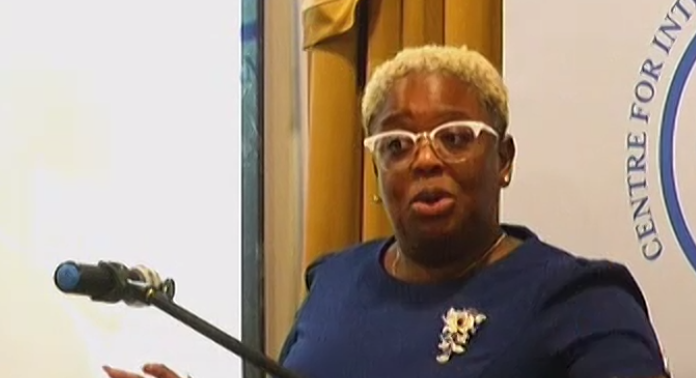
Dr. Kai-Ann Skeete, a trade research fellow at the Shridath Ramphal Center for International Trade, Law, Policy and Services at the University of the West Indies (UWI) Cave Hill Campus in Barbados, laid out her stance on the contentious issue Thursday during an international conference hosted by the Centre for International and Border Studies. The event, themed “Navigating The Future: Guyana, the Caribbean and Latin America in a Changing Global Environment”, provided a platform to address the leadership crisis unfolding within the 15-member regional bloc.
Dr. Skeete stressed that any decision on the top CARICOM leadership post must be reached through full consensus among all member states, rather than the majority vote that was used to approve Dr. Barnett’s second term. Her position directly contradicts the announcement made in March by CARICOM Chairman and St. Kitts and Nevis Prime Minister Dr. Terrance Drew, who confirmed that leaders had approved Dr. Barnett’s reappointment for a second five-year term starting this August at their February 24–27 summit, citing that the vote met the bloc’s required majority threshold.
“For CARICOM, such a critical decision needs buy-in from every member,” Dr. Skeete argued. “If we rely on majority rule, you will inevitably have a faction that feels disenfranchised, and that fracture undermines the very foundation of regional integration. Consensus means no winners and no losers — it means we all move forward together.”
Beyond the procedural dispute, Dr. Skeete also pushed for selection criteria that prioritize tangible performance over institutional tradition or political negotiation. She acknowledged that she entered Dr. Barnett’s first term with high hopes: as a woman, a former CARICOM Secretariat staffer, and a former vice president of the Barbados-based Caribbean Development Bank, Dr. Barnett entered office with intimate firsthand knowledge of the long-running tensions between the bloc’s more developed countries (MDCs) and its least developed countries (LDCs). Dr. Skeete had expected Dr. Barnett to leverage that experience to bridge divides and unify member states around shared regional goals.
Unfortunately, Dr. Skeete said that expectation went unmet. Over the past five years, the gap between richer and poorer CARICOM members has actually widened, leaving the bloc more fragmented than it was when Dr. Barnett took office in 2021. She attributed this underperformance to the overriding influence of regional politics that constrained Dr. Barnett’s ability to act as a unifying leader, noting that “politics stepped in and Dr. Barnett stayed in her lane.”
Against this backdrop, Dr. Skeete called for an urgent revisit of the reappointment question to resolve the dispute quickly, warning that the bloc cannot afford to be distracted by internal leadership conflict when it faces a host of pressing collective challenges to grapple with by the end of 2026. “Regional integration is non-negotiable for the Caribbean,” she emphasized. “The core question we need to answer is simple: can this candidate unite the region, deepen integration, and advance our shared goals? If the answer is no, it is time to give another candidate the opportunity.”
The call for a revised process comes as the bloc remains deeply split over the 2026 reappointment. Trinidad and Tobago, one of CARICOM’s largest economies, has been the most vocal opponent, vowing it will not recognize Dr. Barnett’s second term because it was excluded from the heads of government forum that approved the appointment. Trinidad and Tobago has been joined by Antigua and Barbuda, Jamaica, and the Premier of Nevis in calling for the issue to be reopened for discussion. On the opposing side, Guyana, Belize and Dominica have publicly thrown their support behind the original reappointment process and Dr. Barnett’s second term.
The dispute is unfolding under the framework of the Revised Treaty of Chaguaramas, the legal document that governs CARICOM operations. Article 24 of the treaty states only that the Secretary-General shall be appointed by the Conference of Heads of Government on the recommendation of the Community Council, for a term no longer than five years, and may be reappointed by the Conference — it does not explicitly require a consensus vote for reappointment, leaving the procedural question open to interpretation amid the current rift.