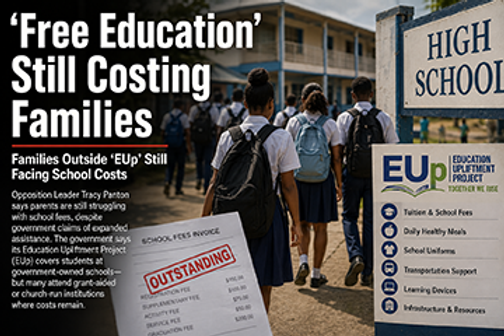
A heated political clash has erupted in Belize over the country’s flagship education access reform, with the opposition demanding accountability for hundreds of families trapped in a bureaucratic and financial limbo that threatens students’ academic progress. Opposition Leader Tracy Panton made the explosive allegations this week in a formal press statement, arguing that the ruling government’s repeated claims of expanding free education mask a broken system that still leaves thousands of households grappling with crippling school-related costs.
Panton revealed that her constituency office in Albert Division has been flooded with urgent appeals from desperate parents over the past weeks. Dozens of families reported their children face being barred from graduation or withheld final report cards because of unpaid outstanding school fees, a penalty that upends years of academic work for young learners. What makes the situation more egregious, Panton emphasized, is that many of these families had already completed the full application process for government tuition assistance through the Ministry of Education. In a number of cases, they even received official commitment letters confirming the government would pay all eligible fees directly to their children’s schools.
Yet according to the families’ accounts shared with Panton, the schools have yet to receive a single cent of the promised funding, leaving minors and their caregivers caught between unresponsive government bureaucracy and rigid institutional fee policies. Panton pointed out that most of these families are already stretched thin by overlapping cost-of-living crises, navigating skyrocketing grocery prices, rising rent and utility bills, and a host of other unexpected education-related expenses on top of basic needs.
Beyond the broken payment promises, the opposition leader also called out the proliferation of extra charges that fall outside the scope of the government’s tuition coverage. These additional fees range from mandatory registration and supplementary material costs to graduation fees, institutional mission fees, and required summer program charges, all of which add up to substantial sums that low-income households cannot absorb. Panton also raised alarms about the new online application portal the Ministry of Education rolled out for assistance requests, arguing that the digital system introduces unnecessary red tape and creates new barriers for families without reliable internet access or digital literacy, defeating the purpose of expanding support.
Framing the crisis as a systemic failure of national priorities, Panton argued that Belize is abandoning its young people and working families if access to quality education remains contingent on a household’s ability to pay.
For its part, the ruling government has defended its signature policy, the Education Upliftment Project (EUp), marketed under the slogan “Together We Rise,” maintaining that the initiative has dramatically expanded tuition-free access to secondary education across the country, especially at state-run campuses. According to the Ministry of Education, the program launched in the 2022/23 academic year as a pilot at four government-owned secondary schools in southside Belize City, before rolling out to southern Belize and other districts across the nation. By the start of the upcoming 2024/25 academic term, the government projects the program will extend coverage to nearly half of all secondary school students in Belize.
Education Minister Francis Fonseca confirmed that all students enrolled in government secondary schools now pay no tuition under the EUp initiative, adding that the program also includes extra support for low-income learners: free school uniforms, on-campus meals, transportation stipends, internet access, and personal digital learning devices to close the digital divide.
The core of the disagreement, however, stems from a critical gap in the program’s design: the Education Upliftment Project primarily extends benefits to government-owned secondary schools, while a large share of Belize’s student population attends grant-aided and church-managed institutions, which operate with separate funding frameworks and retain the authority to set their own fee requirements. This gap leaves thousands of students ineligible for the full free tuition benefits the government repeatedly touts.
Economists also add a broader contextual layer to the debate: the term “free education” is often a misnomer, as the model is more accurately described as taxpayer-funded or government-subsidized education. All program costs are ultimately covered by Belize’s public revenues drawn from national taxes, so expanding assistance naturally increases the fiscal burden on the country’s national budget and ordinary taxpayers.