A Dutch-language Surinamese court ruling delivered on May 14 has delivered a major legal victory to organized labor in the country, turning down a request from state-owned utility N.V. Energie Bedrijven Suriname (EBS) to terminate the employment contract of Marciano Hellings, a long-serving EBS employee and leader of the company’s primary workers’ union. This latest decision marks the second time EBS has failed to secure judicial approval to remove Hellings from his role, with the full written judgment made public the day after the ruling.
The legal battle is the most recent development in a years-long bitter conflict between EBS’ executive leadership and Hellings, who has worked at the state-run energy provider since 2011 and currently serves as president of the EBS workers’ union Organisatie van Werknemers Suriname (OWOS). Tensions between the two sides have flared repeatedly over the past several years, resulting in disciplinary action, multiple administrative suspensions, union-led work stoppages, and a series of overlapping legal disputes.
The most recent chapter of the conflict began in July 2025, when EBS’ executive board fired Hellings on the spot. Company leadership justified the immediate dismissal by citing a series of Facebook posts and public comments Hellings made that harshly criticized EBS management, particularly its chief executive officer Leo Brunswijk. In one post, Hellings referred to Brunswijk as a “clown” — a description EBS classified as a severe personal insult that destroyed the professional trust required for the working relationship.
However, Suriname’s Labor Inspectorate immediately challenged the dismissal. The regulatory body argued that Hellings’ critical comments were made in his formal capacity as a union president, not as an ordinary rank-and-file employee, and that union activity and protected speech within that role carry enhanced legal protections under Surinamese labor law. Following the Inspectorate’s objection, the national Dismissal Commission also rejected EBS’ application for a formal termination permit, ruling that the company had failed to provide sufficient credible evidence to justify ending Hellings’ employment.
Unwilling to accept the prior rulings, EBS escalated the dispute to the cantonal court, filing a new petition to secure a court-ordered termination of Hellings’ employment contract. The company reiterated its claim that the professional trust between management and Hellings had been irreparably broken by his public criticism, social media activity, and alleged workplace-related incidents.
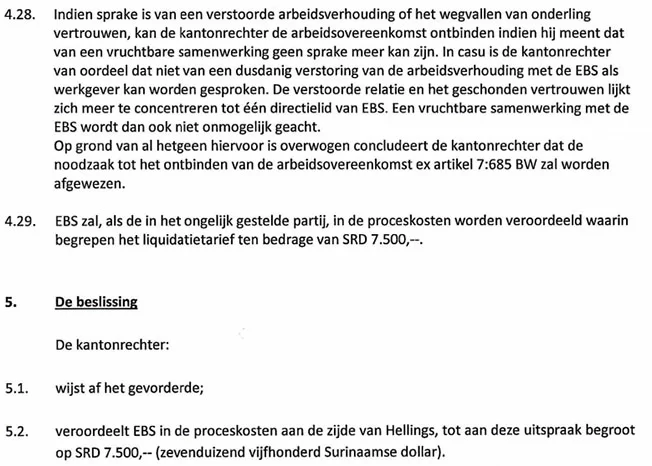
In its final judgment, the cantonal court conducted a critical review of every element of EBS’ case, finding major flaws in the company’s argument. The judge noted that many of the historical incidents EBS cited to support termination were either too old to be considered valid grounds or had already been resolved through prior legal proceedings and mediation efforts. The court also emphasized that both sides contributed to the escalating conflict, not just Hellings.
The ruling pointed out that EBS itself took a series of aggressive actions against Hellings that deteriorated the working relationship over time, including reassigning his job role, imposing multiple disciplinary penalties, restricting his access to company property, and placing him on repeated unpaid suspensions. Because of this, the court found that the current tense situation cannot be blamed solely on Hellings.
The judge also weighed Hellings’ 15-year tenure at EBS, his valuable technical expertise in the energy sector, and his legitimate role as an elected workers’ representative in its final deliberation. The court concluded that EBS had failed to prove the existence of an urgent, compelling reason that would make continuing Hellings’ employment impossible.
In the final outcome, the cantonal court ruled that terminating Hellings’ employment contract was not legally justified, rejected EBS’ petition in full, and ordered the state-owned energy company to cover all legal costs associated with the case.
This ruling marks the second consecutive legal win for Hellings in his ongoing dispute with EBS management, and it underscores the persistent deep tensions between the OWOS union and the leadership of one of Suriname’s most critical state-owned infrastructure providers.