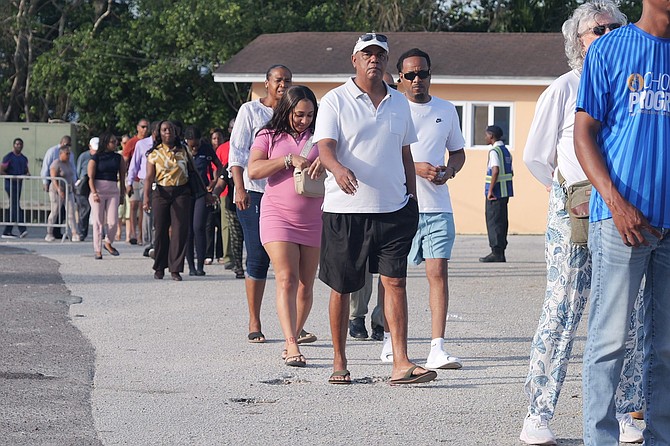
In the wake of Tuesday’s general election in the Bahamas, an alarming projected voter turnout of just 58 percent has sent shockwaves through the nation’s political landscape, with senior electoral officials warning the figure would mark an unprecedented collapse in civic participation if officially confirmed. Geoffrey McPhee, an election consultant with the country’s Parliamentary Registration Department, told reporters Wednesday that the unofficial estimate — which remains subject to confirmation as recounts proceed across 25 contested constituencies — points to voter turnout falling even lower than the 2021 snap election held at the height of the COVID-19 pandemic.
McPhee emphasized that the 58 percent figure is still preliminary, drawn from preliminary on-the-night assessments by election staff, but called the projected drop a devastating blow to the country’s democratic culture. “Our folks, we have gone south with respect to excitement about elections. That is really, really, that’s horrible,” he said, adding that the 2021 COVID-era turnout, already a historic low, outperforms the current projection. “That’s tragic, because with elections, once they miss the election, they don’t feel the urgency to reengage.”
The projected slump represents a staggering break from the Bahamas’ strong post-independence voting tradition. For decades after the nation gained independence, general election turnout routinely exceeded 88 percent, and regularly climbed above 90 percent through the first three decades of self-governance. The 1977 inaugural post-independence general election recorded an 88.6 percent turnout, with numbers rising to 90.4 percent in 1982 and holding above 90 percent through 1987. Turnout stayed consistently high even as power shifted between major parties: it hit 91 percent when the Free National Movement (FNM) ended the Progressive Liberal Party’s (PLP) decades-long hold on government in 1992, and reached 93.2 percent when the FNM secured a landslide second term in 1997. Through 2002, 2007 and 2012, turnout remained firmly above 90 percent, and even in 2017, the first election to show a clear downward trend, participation still hit 88.4 percent.
The first historic rupture came in 2021, when turnout fell sharply to 64.9 percent. If the current 58 percent projection holds, Tuesday’s election will set a new post-independence low for voter engagement. The low turnout coincided with the PLP securing a commanding second consecutive term in office, with unofficial results showing the party winning 32 of 41 seats, nearly matching its 2021 landslide victory that ousted the FNM from power.
Prime Minister Philip “Brave” Davis, leader of the PLP, acknowledged the unexpectedly low turnout, noting that weak participation is never healthy for a democratic society and that more work must be done to help all voters feel that their ballots carry meaningful weight. So far, the highest recorded local turnout is expected in the New Providence constituency of Fort Charlotte, where former Island Luck CEO Sebas Bastian defeated FNM candidate Travis Robinson by more than 2,300 votes on an estimated 72 percent turnout, according to local insiders.
Civil society leaders have joined electoral officials in sounding the alarm, stressing that the projected low turnout should concern all Bahamians regardless of partisan alignment. Matt Aubry, head of the nonpartisan Organisation for Responsible Governance (ORG), said that weak participation does not necessarily equal voter apathy. Instead, he argued, many disengage because they do not feel their concerns are being addressed or that voting will lead to tangible change in their daily lives.
During the organization’s voter education outreach across the election cycle, Aubry said, ORG teams heard repeated frustration, particularly from young and first-time voters, who criticized campaigns for focusing heavily on personality politics and sensationalized rhetoric instead of the bread-and-butter issues affecting most Bahamian households. These include persistent struggles with the cost of living, limited economic opportunity, rising crime, high energy costs, inadequate housing and eroding public trust in political leadership.
Voters also repeatedly raised concerns about longstanding gaps in governance transparency, accountability, public procurement, campaign finance reform and access to information, even as more residents recognize how directly policy choices impact their daily lives and opportunities. Beyond policy grievances, Aubry noted that issues during the advanced voting process — including reported gaps in preparedness and efficiency — combined with ongoing public anger over the violation of campaign laws around candidate treat-giving by multiple parties, may have further eroded motivation to participate. The delayed and partial rollout of new biometric voter identification cards, paired with widespread misinformation and speculation on social media, also created confusion that may have undermined public confidence in the integrity of the electoral process for some voters, he added.