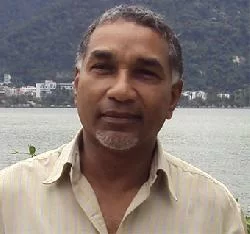
Suriname remains trapped in a neocolonial stranglehold under what commentator Jack Menke terms “mamio-regeringen” — coalition governments that prioritize patronage over national progress, perpetuating what is widely known as the resource curse across the small South American nation. Writing in a critical opinion piece published May 12, Menke argues that after decades of exploitation centered on sugar, bauxite and gold extraction, a new term of mamio-led government would put even the potential economic gains from offshore oil development completely out of reach for ordinary Surinamese people.
Menke defines a mamio government as a fragmented “patchwork failure”: a loose coalition of competing political parties that never coalesce into a unified, functional administration with a clear development vision. According to his analysis, this pattern of failed coalition governance has repeated consistently across successive Surinamese administrations, dating back to the adoption of the country’s 1987 constitution. A troubling core dynamic, Menke notes, is that political parties have steadily accumulated more power over the decades even as public trust in these institutions has collapsed to near-zero among the Surinamese population.
Legislative changes have only reinforced this imbalance of power, Menke argues. The 1988 Political Organizations Act, the 2005 recall law, and the 2024 ban on pre-electoral coalitions have all consolidated control over government formation in the hands of large established parties and their financial backers. Smaller parties, which often maintain more robust internal democratic practices, have been systematically squeezed out of meaningful representation in the political system.
Against this backdrop, state-owned enterprises (SOEs) have become a central locus of corruption, mismanagement and patronage, Menke says. The public has been repeatedly confronted with high-profile scandals in SOEs spanning agriculture, forestry and transportation sectors, yet almost all of these cases fade away without meaningful accountability after temporary, half-baked fixes from politicians and self-styled experts. While the current governing coalition inherits most of these conflicts from previous administrations, Menke documents that endless infighting, embezzlement and mismanagement persist across both governing coalition partners and opposition parties within the current system.
At the root of the crisis, Menke explains, is the practice of dividing up leadership positions in government agencies and state-owned enterprises as political spoils for coalition party members, rather than appointing qualified, competent leaders. He outlines three core factors that sustain the “mamio curse” on Suriname’s SOE sector: first, the flawed legacy of pre-independence strategies that relied on unproductive state-owned entities and joint ventures with foreign multinational corporations; second, the failure to address systemic problems, which Menke attributes to short-term political self-preservation and competing economic interests that allow scandals to fester without resolution; and third, the ongoing pattern of visonless mamio governments leaving mountains of unresolved problems for successive administrations to muddle through. As of 2026, Menke notes, more than 150 Surinamese state-owned enterprises are effectively looted, drained and operating at a sustained loss. He points to the Suriname Landbouw Maatschappij (SLM) as a notable example: decades of chaos, mismanagement and financial scandal have left the state agricultural firm a poorly grounded experiment that continues to operate without any sustainable foundation.
The exposed scandals that reach public attention are only the tip of the iceberg, Menke emphasizes: the entire mamio political system is structured to perpetuate itself, regardless of whether parties hold power in coalition or sit in opposition. The core function of a mamio government is the deliberate division of control over central government ministries, directorates, overseas diplomatic posts and SOEs, with positions filled by unqualified party loyalists and political opportunists seeking personal gain rather than public good.
Menke argues that the long-term cost of clinging to this colonial-era economic model, which centers resource extraction as the core policy priority for all mamio governments, is stunted development and entrenched systemic inequality. By delaying progress on collective land rights while facilitating multinational exploitation along neocolonial lines, successive governments have fueled persistent conflict with Indigenous and Maroon communities across the country. The outsized legal power granted to political parties, combined with their deep ties to illegal activity, failing SOEs and private economic interests, blocks the formation of functional, productive coalitions and derails any path to sustainable national development. Even well-intentioned, honest government leaders are ground down by the system, Menke says, eventually falling back on counterproductive micromanagement within this rotten neocolonial political structure.
In Menke’s view, there is only one path to meaningful development for Suriname: the entire existing political system must be fundamentally rebuilt. To achieve this overhaul, he argues that targeted extra-parliamentary pressure from the Surinamese public is the only viable lever for change. Menke outlines that voters frustrated with the status quo have multiple options to exercise their opposition: casting a regular ballot for change, submitting a blank protest vote, discarding their ballot or joining collective direct action to push for systemic reform.