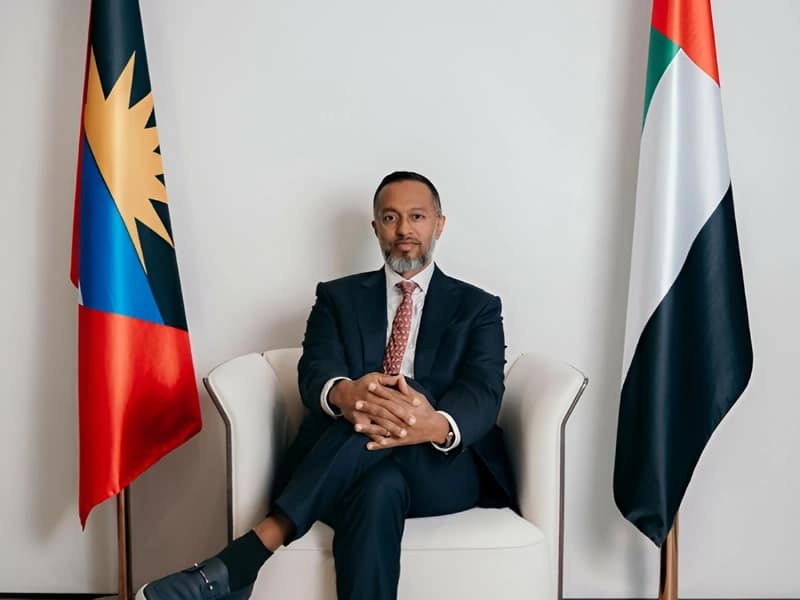
Last week’s final vote count in St. John’s delivered a decisive outcome that has shaken up expectations across Caribbean political circles: the Antigua and Barbuda Labour Party secured a commanding landslide win, granting incumbent Prime Minister Gaston Browne a fourth consecutive term in office. Against a regional backdrop where frequent leadership turnover regularly reshapes executive agendas, this result locks in long-term policy continuity at the highest level of the island nation’s government.
For the United Arab Emirates and the broader Gulf region, the re-election of Browne’s administration preserves the steady diplomatic trajectory that has defined Antigua and Barbuda’s bilateral relationship with the UAE over recent years. Ongoing high-level talks spanning cross-border investment, civil aviation connectivity, renewable energy development, and technology partnership will move forward without disruption, a stability that carries particular weight for long-term bilateral projects requiring years of sustained coordination and consistent policy commitment.
Over the past decade, ties between the UAE and Antigua and Barbuda have expanded gradually and intentionally, rooted in deliberate diplomatic engagement, targeted investment dialogue, and collaborative work on shared priorities ranging from climate resilience to tourism development and cross-border financial services. Antigua and Barbuda has emerged as an influential regional voice for climate action and economic diversification within the Caribbean Community (CARICOM), while the UAE has continued to deepen its diplomatic and economic footprint across fast-growing emerging small island markets.
One of the most advanced collaborative initiatives currently moving forward is the push to establish direct air links between the two nations, a priority that has moved far beyond early exploratory talks, according to Antigua and Barbuda’s Ambassador Theon Ali. “This is not a new ambition or just a hopeful line in a feasibility study,” Ali explained. “It is an active, ongoing policy file that has required navigating complex air service agreements, working through route economic modeling, and addressing the unique operational realities of long-haul travel to a small island market. This is the invisible infrastructure of international partnership—unglamorous, slow to build, and absolutely essential to unlocking deeper engagement.”
Direct flight connectivity would deliver widespread mutual benefits, boosting two-way tourism flows while supporting increased business travel, cross-border educational exchanges, and broader economic integration. Antigua and Barbuda’s luxury tourism sector, anchored by its pristine white-sand beaches, world-class yachting infrastructure, and premium hospitality offerings, aligns perfectly with the rapidly growing outbound travel demand from Gulf region tourists seeking high-end Caribbean getaways.
Beyond connectivity, digital transformation and artificial intelligence cooperation have emerged as a fast-growing area of shared interest. Antigua and Barbuda has ramped up investment in national digital upgrade initiatives in recent years, including rolling out modern e-governance systems, launching AI-assisted supply chain and logistics programs, and building data-driven infrastructure to support the tourism sector. National policymakers are actively seeking international partnerships to support technical implementation and build local digital capacity across government agencies.
With its own rapid expansion of national AI infrastructure and globally recognized smart government services, the UAE is uniquely positioned to serve as a key technical partner for Caribbean states working to modernize their digital ecosystems. The country’s high-profile developments in AI and sustainable technology—from the innovation hub of Masdar City to national government AI deployment initiatives, and ongoing work with leading regional technology firms like G42—have drawn growing international attention from governments seeking digital development partners.
Climate action and renewable energy cooperation remain the most deeply rooted pillar of the bilateral relationship, a priority shaped by the existential climate vulnerability that defines life across the Caribbean. The region has faced increasingly destructive hurricane seasons in recent decades, with Barbuda suffering near-total devastation during Hurricane Irma in 2017, when an estimated 95 percent of the island’s infrastructure and built environment sustained severe damage.
In March 2024, the Green Barbuda renewable energy project was officially inaugurated through funding from the UAE-Caribbean Renewable Energy Fund, a landmark initiative designed to cut the island’s reliance on imported fossil fuels. The project’s hybrid solar facility combines 720 kilowatts of solar photovoltaic capacity with industrial-scale battery storage and a diesel backup system engineered to withstand hurricane-force winds up to 265 kilometers per hour.
Project data shows the facility will cut Barbuda’s annual diesel consumption by roughly 406,000 liters, reducing annual carbon dioxide emissions by more than one million kilograms. Launched in 2017, the UAE-Caribbean Renewable Energy Fund now supports renewable energy access projects across 16 Caribbean nations. Looking forward, stakeholders expect the Green Barbuda facility to serve as a replicable model for future renewable energy expansion across Antigua and Barbuda and the wider Caribbean, as regional governments continue working to transition away from costly, carbon-intensive diesel dependency.