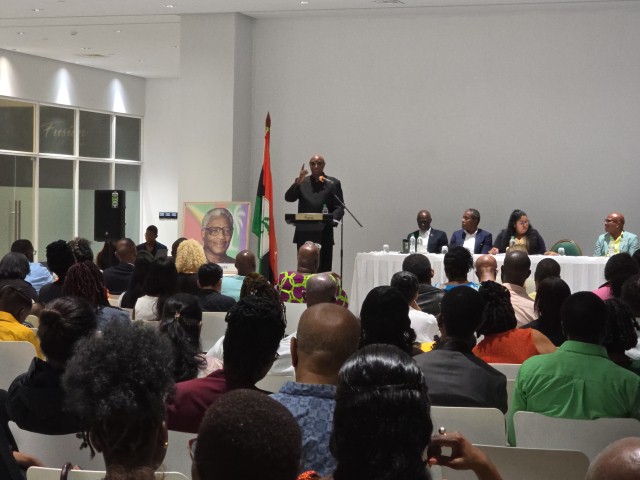
On May 11, 2026, former senior People’s National Congress Reform (PNCR) figure Dr. Aubrey Armstrong delivered the annual Hugh Desmond Hoyte commemorative lecture in Guyana, issuing a stark warning to his former party and laying out enduring leadership lessons drawn from the life and tenure of the nation’s second executive president. The event, held to honor the legacy of the PNCR icon who led the party from 1985 until his death in 2002, came amid a years-long trend of high-profile PNCR members crossing the aisle to join the governing People’s Progressive Party Civic (PPPC).
Opening his address, which carried the theme “Strategic transformation from charismatic/hero-centered leadership: Some lessons from the leadership journey of Hugh Desmond Hoyte,” Dr. Armstrong centered his first critical warning on the need to prioritize the well-being of the party’s grassroots supporters. He emphasized that failing to deliver tangible support to loyal voters creates an open invitation for rival parties to poach disillusioned members. “You have to take care of your people. You have to find ways of feeding them and so on. If not, you open the door for somebody else to poach them,” he told the assembled audience.
Dr. Armstrong rooted this advice in Hoyte’s own actions immediately after the PNCR’s historic 1992 electoral defeat, the first loss of national power for the party after decades in office. He recalled that within days of the result, Hoyte directed internal party policy experts to draft four landmark policy frameworks, one of which focused on expanding equitable access to credit and mainstream financial services for low-income Guyanese. At the time, Dr. Armstrong explained, Hoyte argued that formal banks and insurance institutions had long systematically excluded working-class Black and Indo-Guyanese citizens, and expanding financial access was core to both supporting the party’s base and advancing national equity. This initiative, Dr. Armstrong noted, grew directly from Hoyte’s core principle that parties must actively care for their supporters immediately after losing power, not only when holding office.
Turning to his core analysis of Hoyte’s leadership style and the lessons it offers modern political actors, Dr. Armstrong argued that effective leadership relies on far more than raw intellectual intelligence. He stressed that emotional intelligence is equally critical: leaders must be able to self-reflect, publicly acknowledge mistakes, and deliberately recruit people with diverse skills — even those who do not personally align with the leader, or hold views that differ from their own. Other core pillars of strong leadership, he added, include creating space for constructive criticism from within, actively listening to grassroots feedback, systematically assessing and managing risk, solving problems pragmatically, and building teams that complement the leader’s gaps in skills and perspective.
Dr. Armstrong specifically highlighted Hoyte’s personal commitment to this model of leadership, noting that the former president never felt threatened by colleagues with stronger expertise in specific areas. Confident in his own decision-making, Hoyte actively broke down long-standing barriers to bring more women and young people into senior party roles, making tough, unpopular choices to prioritize skills and representation over loyalty to existing party elites. Dr. Armstrong also celebrated Hoyte’s “iron will” to stand by difficult decisions, pointing to his landmark work on party reform that opened space for new generations of leaders to rise through the ranks. Above all, he emphasized Hoyte’s uncompromising “radical integrity,” noting that the former leader had zero tolerance for corruption and refused to tolerate any illicit financial connections to criminal activity in party or government affairs.
Drawing another lesson from Hoyte’s observations during a visit to African National Congress (ANC) party branch activities in South Africa, Dr. Armstrong noted that Hoyte came away convinced of the need to strengthen local PNCR party chapters rather than keeping them weak and dependent on national leadership. “He began to understand the need for us to strengthen party groups. And they will talk back to you. When you strengthen them, they will talk back to you,” Dr. Armstrong said, adding that allowing local branches to retain financial and operational independence builds a more resilient party over the long term. Weak grassroots groups, he warned, cannot sustain a party through political struggles.
For context, Hoyte assumed the Guyanese presidency in 1985 following the death of the nation’s first executive president, and won a disputed general election later that year widely condemned by international observers as rigged. Hoyte ultimately conceded to mounting local and international pressure for sweeping electoral reform, leading to the PNCR’s 1992 electoral defeat that ended the party’s decades hold on national power. The PNCR returned to government from 2015 to 2020 as the lead partner in the A Partnership for National Unity (APNU) coalition, but lost the 2020 general election and was relegated to the position of second-largest opposition party in parliament following the 2025 national polls.