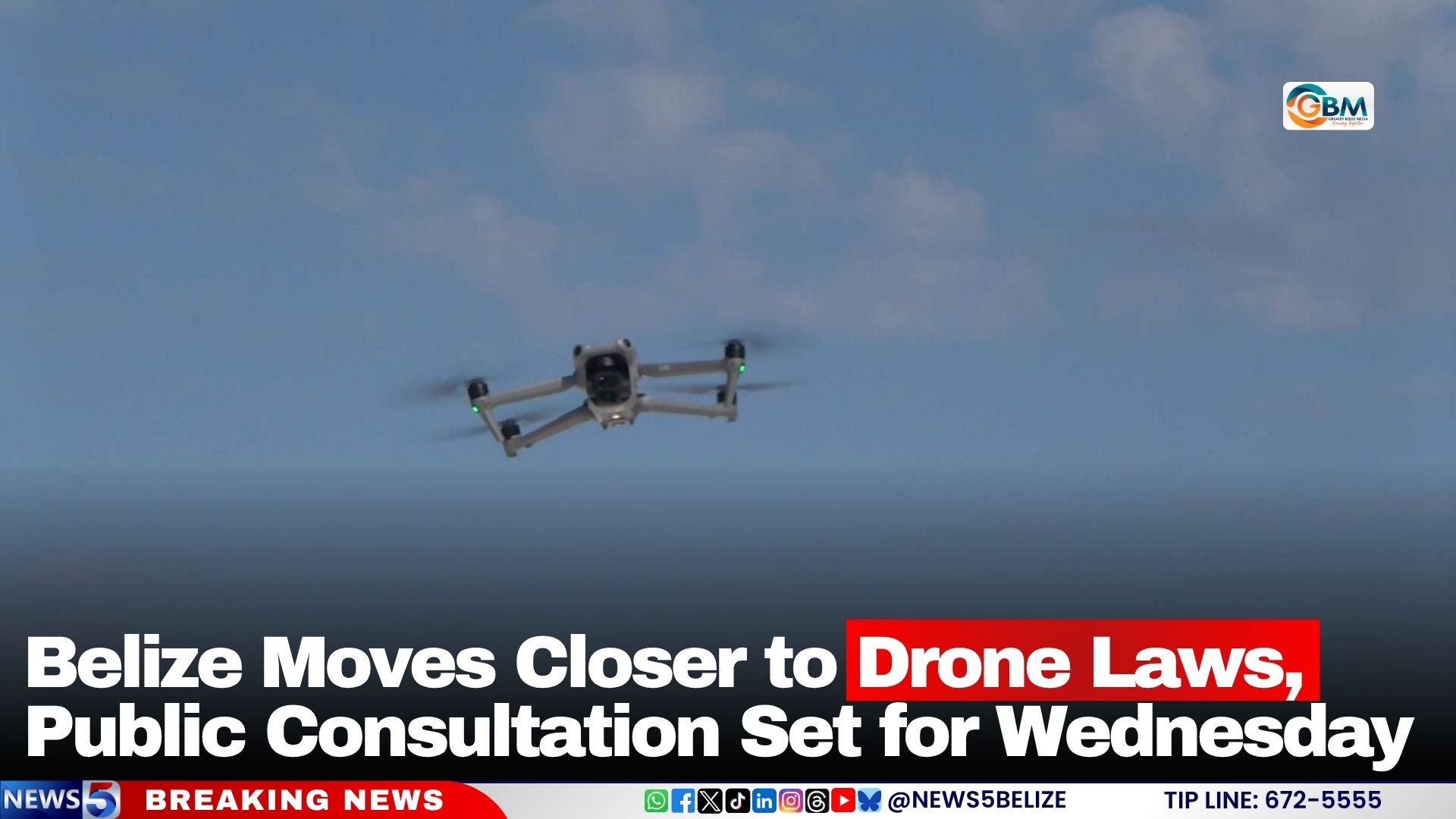
As drone usage surges across multiple sectors of Belize’s economy and public life, the country’s Department of Civil Aviation is advancing toward formal rules for unmanned aerial systems, with a nationwide public consultation scheduled for Wednesday, May 6. The upcoming session, which will be hosted in-person at Belize City’s St. Catherine Academy Mercy Centre from 9 a.m. to 12 p.m. alongside a remote participation option, marks a key milestone in months of policy development aimed at balancing technological innovation with public aviation safety.
The push for formal drone regulations comes after rising concerns over growing airspace congestion over the past year. Back in January 2026, aviation officials issued a formal warning that the rapid expansion of drone activity — spanning commercial uses from real estate mapping and agricultural monitoring to media production, plus recreational hobbyist flights — had significantly increased the risk of mid-air collisions with manned aircraft. Unlike larger nations where commercial and general aviation aircraft typically cruise at higher altitudes, Belize’s air traffic often operates as low as 500 feet above ground level during transit, creating extensive overlap with the operating altitude of most consumer and commercial drones. This overlapping airspace makes unregulated drone flights a critical public safety hazard, according to Department of Civil Aviation Director Nigel Carter.
Following the January warning, the department released an Aeronautical Information Circular to collect initial public input on draft regulatory measures. The current proposal includes standardized operator licensing, geographically and altitude-based operational limits, and formal enforcement mechanisms with legal penalties for operators that fail to comply with the new rules. Ahead of Wednesday’s consultation, the department emphasized that the policy process is designed to be fully transparent and inclusive, inviting input from a broad range of stakeholders: commercial drone service providers, recreational hobbyists, environmental conservation organizations, legal scholars and industry experts. All groups with a vested interest in drone operations are encouraged to participate and share their perspectives to shape a final regulatory framework that meets the needs of all airspace users, the department said.
The policy effort has already sparked mixed reactions from affected groups. While many stakeholders have framed the new regulations as a necessary step to avoid catastrophic safety incidents, some business owners that rely heavily on drone technology have raised concerns that overly restrictive rules could increase operational costs and limit innovation. Director Carter has pushed back on these concerns by acknowledging the economic value of drone technology, while reaffirming that safety must remain the top policy priority. This is particularly critical for Belize, he noted, because the country’s tourism industry and domestic connectivity depend heavily on consistent, safe aviation operations.
Beyond commercial and recreational use, drones have already become an increasingly important tool for Belize’s national security and law enforcement agencies. Local police have integrated aerial surveillance into their regular crime reduction strategies, using drones to monitor high-crime hotspots, track criminal suspects, and coordinate ground patrols more effectively. Just last month in April, law enforcement used drone reconnaissance to locate and destroy dozens of illegal cannabis plants growing in remote, hard-to-access terrain in the Toledo District, demonstrating the public benefit of expanding legal, regulated drone use for government operations.
Wednesday’s consultation is the final major public engagement step before the department finalizes the draft drone regulations and moves to formal adoption. Officials say the ongoing regulatory process reflects Belize’s proactive approach to managing the fast-growing adoption of unmanned aerial systems, aiming to create a clear, sustainable framework that supports innovation while protecting the safety of all airspace users.