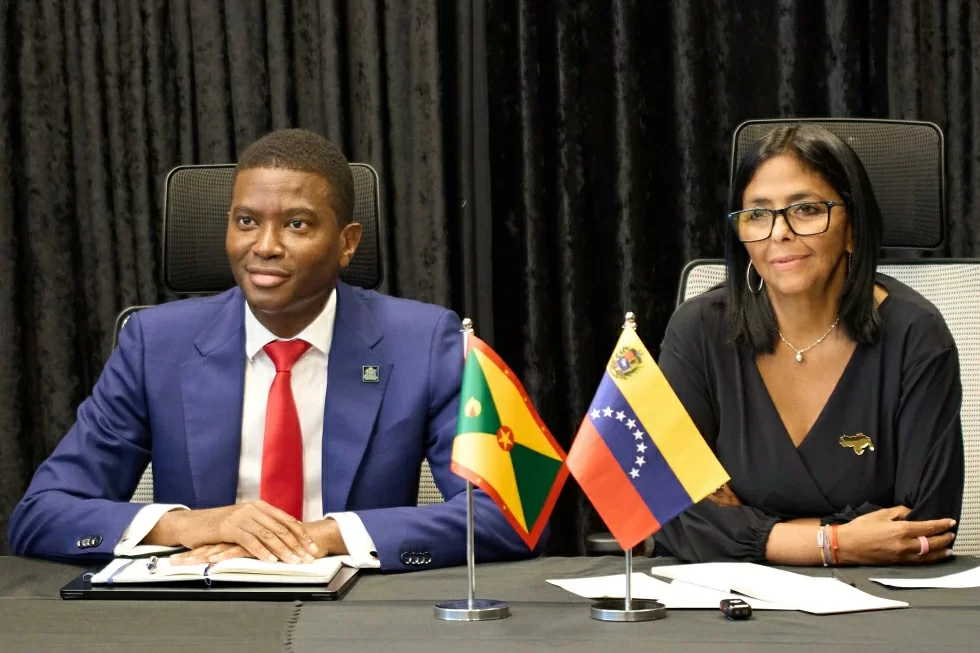
A long-simmering territorial dispute between Guyana and Venezuela has reignited diplomatic tensions this week, after Guyana formally raised grave concerns to the Caribbean Community (CARICOM) over a provocative symbolic gesture from Venezuela’s acting president Delcy Rodríguez. During a series of recent official international visits, Rodríguez wore a custom lapel pin shaped after a map that depicts the resource-rich Essequibo region as part of Venezuelan territory – a claim Venezuela has asserted for more than a century that Guyana rejects as unlawful.
The Essequibo region makes up nearly two-thirds of Guyana’s entire sovereign territory, holding vast untapped reserves of oil, minerals, and other natural resources that have become a core point of friction between the neighboring South American nations. The long-running border dispute has seen a marked escalation in symbolic displays of Venezuelan claims since the high-profile January arrest of Venezuelan leader Nicolás Maduro by United States authorities; the Essequibo-shaped pin is now commonly worn by Venezuelan government officials, state media personalities, ruling party legislators and cabinet members, according to diplomatic accounts.
In a formal letter addressed to Terrance Drew, Prime Minister of St. Kitts and Nevis and current chair of CARICOM, Guyana’s President Irfaan Ali underscored that Rodríguez’s choice to wear the pin during official engagements amounts to an explicit reaffirmation of Venezuela’s illegal claim to Guyanese territory. Ali further warned that allowing such displays during official visits hosted by third countries could be misinterpreted as quiet acceptance or tolerance of Venezuela’s territorial demands by the receiving nations, undermining Guyana’s position in ongoing international legal proceedings.
“CARICOM’s principled support for Guyana must be reflected not just in words, but in the protocols and conduct observed during official meetings,” Ali added in the letter.
The origins of the dispute stretch back to an 1899 border arbitration ruling reached during the British colonial era, which Venezuela has long argued unfairly deprived it of the Essequibo region. Today, the competing territorial claims are being adjudicated by the International Court of Justice (ICJ) based in The Hague, Netherlands, with the case still pending a final ruling.
For her part, Rodríguez defended her decision to wear the disputed pin, claiming the map that includes Essequibo as Venezuelan territory is “the only map of Venezuela I recognize.” She reaffirmed Venezuela’s long-standing claim to the entire region and expressed confidence the ICJ will ultimately uphold the country’s historic territorial position.
Ali used his letter to remind CARICOM of the bloc’s long-standing unwavering commitment to upholding Guyana’s sovereignty and territorial integrity. He argued that Venezuelan officials should not be permitted to display territorial symbols and maps asserting claims to Essequibo in official international forums, noting that such actions could prejudice the ongoing legal process at the ICJ. Ali also separately condemned the inclusion of Essequibo as Venezuelan territory on official Venezuelan state maps, calling it a calculated, deliberate provocation that Guyana will continue to reject in full.
By Tuesday evening, CARICOM issued an official response to Guyana’s complaint, acknowledging receipt of Ali’s letter and affirming that official regional platforms and gatherings should not be used to advance or legitimize territorial claims that are currently the subject of pending international legal proceedings. The bloc reaffirmed its “long-standing and unwavering support for the sovereignty and territorial integrity of Guyana, and for a peaceful negotiated resolution to the dispute through proper international legal channels.”
In recent years, tensions over the region have spilled beyond diplomatic rhetoric. Venezuela has deployed armed patrols to offshore oil blocks licensed by Guyana and currently operated by United States energy firms, repeatedly issuing demands that oil production activities in the area halt. To date, those threats have been ignored by the energy companies operating the offshore platforms, and production has continued uninterrupted.