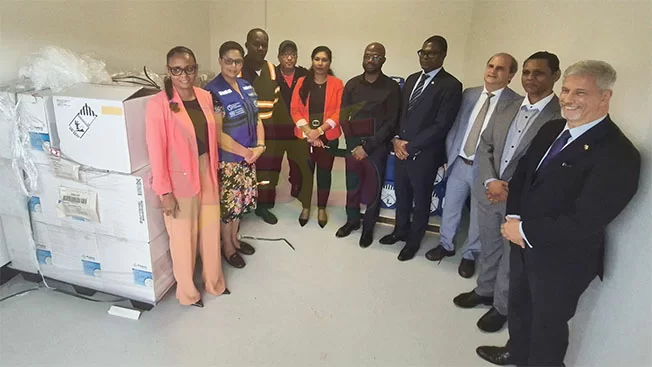
On Wednesday, Suriname’s Public Health Bureau (BOG) took delivery of a shipment of mosquito-control chemicals and spraying equipment donated by Brazil, a critical step forward in curbing a months-long chikungunya outbreak that has stretched local response capacity since the start of 2026. The first round of targeted spraying operations kicked off the same day at Sint Vincentius Hospital, with public health officials confirming the new shipment provides enough supplies to sustain anti-mosquito efforts for between six months and one year, with additional aid already en route to the country. The handover ceremony was hosted at BOG’s new headquarters, coming after widespread public criticism over earlier shortages of control materials that slowed the response to the outbreak that emerged around New Year’s.
Addressing attendees at the ceremony, Health Minister André Misiekaba stressed that supply shortages will not be allowed to hamper future epidemic responses. Moving forward, the ministry will maintain a dedicated emergency stockpile of control materials to respond rapidly to chikungunya and other vector-borne disease outbreaks, he said.
BOG Deputy Director Stephanie Cheuk Alam explained that the response is now leveraging an updated spraying protocol, after local public health staff completed specialized training led by Brazilian instructors on the use of new pumping equipment and donated chemical treatments. Operations launched first at major healthcare facilities, where mobile spraying units are treating high-traffic and high-risk areas including waiting rooms, basements, and hospital corridors.
To scale up the response across populated areas, BOG is deploying specialized mobile spraying units nicknamed ‘dengue trucks’ for targeted neighborhood-level treatments. On the afternoon following the shipment handover, the first of these neighborhood operations was scheduled for the Nickerie district, covering two specific ressort areas: Ressort Nieuw Nickerie (Van Pettenpolder) bounded by Alvertstraat, Industrieweg, Baarstraat, Palingstraat, Aalstraat, Sadin Amatnohweg, Groentenweg, Botstraat, Bronforelstraat, Giebelstraat, Heilbotstraat, Karperstraat, Soekramsinghstraat and all connecting internal streets; and Ressort Westelijke Polder, bounded by Bastiweg, Gemaalweg, Ramadhar Rajaramweg, Haryanaweg, Pt. Bhailal Mahabierweg, Skoerkieweg, Awadhoesseinweg, Asamweg, Rambaran Mishreweg, Abdulghanie Madharweg, Saminweg, Johannes Lurah Bogorweg, all internal roads in that zone, as well as Delhiweg, Hiraweg, Jokhoeweg, Sidoredjoweg, Djakartaweg, Cassaveweg, Arnold Julenweg, Nabidjan Shardaweg, Van Idsingaweg, Margarethenburgstraat, Graderweg and all connecting internal roads.
All scheduled neighborhood spraying operations will run between 5:00 PM and 9:00 PM local time, and will be canceled in the event of heavy rainfall to ensure effectiveness and public safety. BOG has issued a public advisory outlining key precautionary measures for residents in targeted areas to follow during spraying: keep windows and exterior doors open to allow pesticide flow, cover all food and drinking water supplies securely, shelter pet birds in enclosed areas, replace all pet food and drinking water after spraying is complete, keep infants and people with pre-existing respiratory conditions in fully enclosed spaces during treatment, and store all loose clothing indoors before spraying begins.