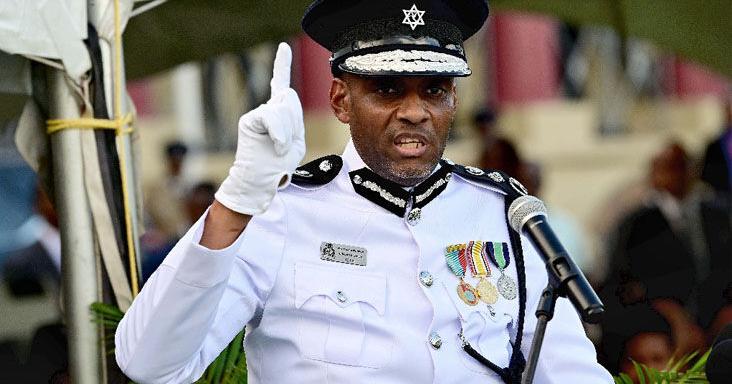
A cloud of uncertainty hangs over the Trinidad and Tobago Police Service (TTPS) following revelations that newly appointed Commissioner of Police Allister Guevarro holds official approval to outfit his privately registered SUV with emergency blue lights and a siren – but key figures at the top of the law enforcement agency cannot confirm who first authorized the rare exemption.
The controversy traces back to February 18, 2025, four months before Guevarro was confirmed as the nation’s top police officer in June 2025. Licensing Division officers pulled over a close relative of Guevarro who was driving the SUV on the southbound lane of Sir Solomon Hochoy Highway near Gasparillo, acting on suspicions the vehicle failed to meet road-worthiness and window tint regulations. During the stop, officers discovered the hidden emergency lights and siren, which were not in use at the time of the stop. When questioned, the driver produced official approval documentation for the equipment issued by a former Transport Commissioner.
Multiple law enforcement sources confirm the initial approval rested on a formal request from a former TTPS Commissioner, but the chain of authorization has become muddled in conflicting and incomplete accounts. When the Sunday Express launched its investigation, Transport Commissioner Clive Clarke – who has held his post since 2020 – clarified that his recent extension of Guevarro’s approval only came after he received an official correspondence from then-Acting TTPS Commissioner Junior Benjamin in early 2025. Clarke emphasized he has never granted any other TTPS officer permission to install emergency equipment on a private vehicle during his tenure, and he has no knowledge of what conditions the prior Transport Commissioner set for the original approval.
Three days after the February traffic stop, Clarke sent a formal letter to Benjamin requesting clarity on three key points: whether Guevarro held the rank of Assistant Superintendent at the time, whether TTPS protocol requires officers of that rank – particularly those assigned to the elite Special Branch intelligence unit – to have emergency equipment on private vehicles, and whether such a requirement applied to Guevarro specifically. In a March 18, 2025 response obtained by the Sunday Express, Benjamin confirmed Guevarro had been promoted to Superintendent and was acting as Senior Superintendent in Special Branch at the time. He noted that TTPS does not mandate emergency equipment for any rank by default, but instead approves such requests on a case-by-case basis at the discretion of the Police Commissioner. Benjamin justified his support for the approval by pointing to the flexible, high-stakes nature of Special Branch intelligence work, arguing Guevarro needed the emergency equipment to respond to rapidly developing situations regardless of whether he was driving his private vehicle or his assigned official police vehicle. He concluded by requesting the approval be maintained to allow Guevarro continued access to the equipment.
On March 24, 2025, Clarke formalized the two-year approval under Regulations 28(m)(iv) and 49 of the Motor Vehicles and Road Traffic Act, Chapter 48:50. The approval sets strict conditions: the equipment must be removed if the vehicle is sold or transferred; the approval documentation must be kept in the vehicle at all times for inspection by police or transport officials; the lights and siren may only be activated during genuine emergencies; the approval does not exempt the vehicle from compliance with other road traffic laws; and all equipment must be removed if Guevarro leaves his current post. The approval is set to expire on March 27, 2027, or when the vehicle is disposed of, whichever comes first.
Despite this paper trail, critical questions remain unanswered. When the Sunday Express contacted Junior Benjamin, who was acting Commissioner when the renewed approval was processed, to ask about the original authorization that preceded his 2025 letter, he replied that he could not honestly remember who first recommended the exemption to the former Transport Commissioner. Repeated attempts to get comment from Guevarro himself also failed to resolve the ambiguity. In a brief WhatsApp response to the outlet’s crime reporter, Guevarro only stated he had no issue with the story and would not attempt to block its publication. No further response was provided to follow-up questions about who authorized the original request or what specific justification was provided for the rare privilege.
Guevarro, a 28-year veteran of the TTPS, has spent the majority of his career in Special Branch, rising steadily through the ranks from junior officer to acting Superintendent of the elite unit before his appointment as Commissioner of Police in June 2025. The lack of transparency around the approval has now sparked ongoing questions about internal protocol and accountability at the highest levels of Trinidad and Tobago’s national police force.