标签: Suriname

苏里南

  • Cubanen schakelen over op overlevingsmodus

    Cubanen schakelen over op overlevingsmodus

    Cubans across all social strata have shifted into survival mode as they confront prolonged power blackouts and skyrocketing prices for essential goods, fuel, and transportation. This escalating crisis unfolds amid heightened pressure from the United States on the communist-led island nation.

    Interviews conducted by Reuters with over thirty residents across Havana neighborhoods reveal a population pushed to its limits. Street vendors, private sector workers, taxi drivers, and government employees alike describe increasingly desperate circumstances as basic commodities become both scarce and prohibitively expensive.

    While rural regions have long endured Cuba’s fragile and aging energy infrastructure, the capital Havana had previously managed relative stability. Now, the city known for its classic 1950s automobiles and colorful colonial architecture faces imminent collapse due to critical fuel shortages. These shortages intensified following Venezuela’s and subsequently Mexico’s cessation of oil deliveries to the island.

    The economic pressure compounds as the Cuban peso has plummeted more than 10% against the dollar within three weeks, dramatically inflating food prices. “This puts me in an impossible situation,” explains Yaite Verdecia, a Havana homemaker. “No salary can keep up with this inflation.”

    Daily life has become consumed with securing basic necessities. Lengthy queues form for gasoline, and since the U.S. blocked Venezuelan oil exports to Cuba in December, nearly all fuel now sells at higher dollar-denominated prices—a currency most Cubans cannot access. Public transportation systems strain under reduced bus services and rising fares, forcing commuters to rely on costlier private taxis.

    Even electric vehicles, once promoted as solutions during fuel shortages, sit idle due to insufficient charging capabilities during frequent power outages. The electrical grid failures have additionally created hazardous urban conditions with malfunctioning traffic lights causing accidents.

    The Cuban government, tracing its roots to the 1959 revolution, has maintained control through strict repression and significant emigration that has diminished organized domestic opposition. While mass protests haven’t materialized, residents acknowledge the unsustainable reality. Mirta Trujillo, a street vendor, emotionally confessed: “I can no longer afford to eat. I’m not against my country, but I don’t want to die of hunger.”

    For older generations like 69-year-old housekeeper Julia Anita Cobas, who makes daily expensive commutes amid transportation cuts, resilience persists but hope dwindles. “We’ve always lived with hardships,” she notes, “but we’re still here.” Yet as 32-year-old Aimee Milanes summarizes: “We’re drowning, but we can’t do anything. It’s about survival. Nothing else.”

  • Betaald en gebouwd, maar geen eigendom; kopers vast door betwiste hypotheek

    Betaald en gebouwd, maar geen eigendom; kopers vast door betwiste hypotheek

    A group of Surinamese citizens who purchased fully paid residential plots in a subdivision project along Frederikshoopweg have been stranded for years without proper ownership titles, prompting presidential intervention. The case, now before President Jennifer Simons, reveals a complex web of financial and legal irregularities involving major national institutions.

    Eleven affected buyers, represented by Vreden & Partners Legal Consultancy, detailed their plight in a formal communication to the presidency. These individuals acted in good faith, completed full payment for their parcels, and in some cases even constructed homes, yet remain unable to obtain legal ownership due to an unresolved mortgage encumbrance on the parent property.

    The core controversy stems from the mortgage’s questionable origination. In August 2010, The Surinamese Trust Company N.V., a subsidiary of De Surinaamsche Bank (DSB), issued a credit commitment on behalf of three parties including Assuria Damage Insurance N.V. However, the subsequent notarial deed registered the mortgage exclusively under Assuria Life Insurance N.V.—an entity conspicuously absent from the original credit agreement.

    Two years later in 2012, the mortgage underwent “rectification” with claims that the original creditor designation was erroneous. The buyers contend this explanation lacks credibility, noting that creditor identification constitutes a fundamental component of mortgage documentation. Their legal representatives suggest potential “deliberate retroactive structural modification” in official correspondence.

    The persistent mortgage blockage continues despite the Ministry of Public Works having approved the land subdivision in May 2011, legally converting the property into sixty individual plots. The involvement of heavily regulated institutions deepens the mystery: DSB operates as a systemically important bank under Central Bank of Suriname supervision, while Assuria represents one of the nation’s largest insurance groups and long served as DSB’s major shareholder. The State of Suriname itself holds shares in DSB.

    Given this institutional landscape, the buyers’ counsel argues that claims of ignorance or simple administrative error remain implausible. The emphasis falls on the stringent care and compliance obligations that life insurers and banks bear precisely for third-party protection.

    The Central Bank of Suriname has declined jurisdiction in the matter, compelling the homeowners to seek presidential assistance in directing relevant authorities to address the situation. Meanwhile, the affected citizens endure profound uncertainty—having invested financially and emotionally in properties that legally remain beyond their grasp.

  • Sapoen: Laat Grondwet keuze open voor hoogste instantie; ook investeringen in basis

    Sapoen: Laat Grondwet keuze open voor hoogste instantie; ook investeringen in basis

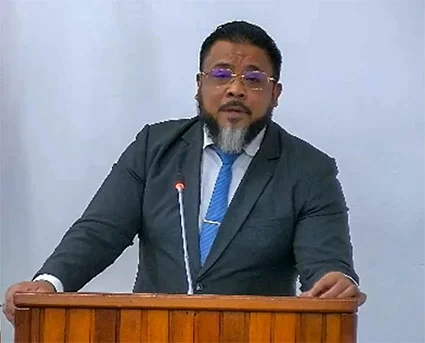
    In a landmark address to De Nationale Assemblee, Assembly Member Raymond Sapoen (NDP) positioned ongoing deliberations on judicial and prosecutorial reforms within the broader framework of constitutional governance. Emphasizing the Constitution’s role as the supreme law safeguarding civil rights and separation of powers, Sapoen characterized the current parliamentary deliberations as ‘historic’ for involving all state powers in modernizing Suriname’s justice system.

    Regarding the proposed cassation (supreme judicial) instance, Sapoen acknowledged widespread legal community support for a third judicial tier beyond appeals. He referenced societal concerns about judicial verdicts’ quality, independence, and reliability as drivers for reform. However, he criticized the explanatory memorandum accompanying the proposals as insufficient, stressing that such transformative changes require detailed justification regarding necessity and integration into Suriname’s legal architecture.

    Notably, Sapoen advocated for constitutional flexibility by defining the supreme judicial body as a ‘highest judicial instance’ for legal violation reviews without pre-committing to a specific model. This approach retains options for regional solutions like the Caribbean Court of Justice (CCJ), potentially with specialized Surinamese civil law chambers, though he emphasized this requires thorough study and political preparation.

    The parliamentarian raised substantive questions about proposed amendments to Article 139 concerning the Court of Justice’s oversight of case processing, demanding clarity on alternative supervisory models. He also highlighted constitutional inconsistencies in appointing prosecutors-general, noting discrepancies between constitutional provisions and 2024 judicial status legislation that must be resolved with constitutional primacy.

    On retirement age, Sapoen supported reinstating the pension age of 65 for standing magistrates (including prosecutors-general) as a systemic correction to reestablish functional distinction between prosecution and judiciary rather than personalizing the debate.

    While expressing theoretical support for a College of Prosecutors-General to mitigate concentration risks in small societies, he criticized the proposal’s lack of justification for member numbers and advocated odd-numbered compositions for decisiveness.

    Sapoen concluded by emphasizing that cassation establishment must not divert resources from strengthening first and second instance courts, maintaining that institutional capacity building remains a perpetual government obligation.

  • VS-Iran spanningen: diplomatiek offensief om oorlog te voorkomen

    VS-Iran spanningen: diplomatiek offensief om oorlog te voorkomen

    As tensions between the United States and Iran approach critical levels, nations across the Middle East and beyond are engaging in urgent diplomatic maneuvers to prevent catastrophic military escalation. The situation has intensified following President Donald Trump’s renewed threats of military intervention unless Iran accepts stringent limitations on its nuclear program and ballistic missile development.

    The current crisis stems from massive protests that erupted across Iran in late 2025, initially sparked by deteriorating economic conditions but gradually evolving into broader challenges to the Islamic Republic’s governing structure. In response to the unrest, Tehran has demonstrated military preparedness, with officials declaring their forces “200 percent ready” to defend the nation despite international mediation attempts.

    Iran’s military capabilities have expanded significantly with the recent announcement of 1,000 new strategic drones, including attack drones and systems designed for reconnaissance and cyber operations targeting land, air, and maritime objectives. This development follows last year’s American strikes on Iranian nuclear facilities, which occurred just before planned peace negotiations with Israel.

    Diplomatic channels have activated across multiple fronts. Iranian officials have engaged in high-level talks with Turkey, including discussions between Foreign Minister Abbas Araghchi and President Recep Tayyip Erdogan. Pakistan, Egypt, Saudi Arabia, and the United Arab Emirates have all participated in telephone diplomacy aimed at preserving regional stability. India dispatched a special delegation to Tehran, while China used United Nations platforms to advocate for national sovereignty and condemn military adventurism.

    Russia has emphasized the critical importance of negotiated solutions, warning that military action would further destabilize the already volatile region. European powers have taken a different approach, focusing primarily on condemning Iran’s harsh treatment of protestors while remaining cautious about addressing war risks. France explicitly rejected military intervention and called for supporting the Iranian people through peaceful means.

    The European Union implemented new sanctions targeting 15 Iranian individuals and six entities for serious human rights violations, following similar designations by the United States, Canada, and Australia that labeled Iran’s Revolutionary Guard Corps as a terrorist organization. Tehran condemned these measures as hypocritical, particularly citing Western inaction regarding Israeli operations in Gaza.

    Despite these extensive diplomatic efforts, regional experts remain skeptical about their effectiveness in reducing US-Iran tensions. Professor Adnan Hayajneh of Qatar University noted that American policymakers predominantly listen to domestic considerations rather than regional voices, increasing the likelihood of military confrontation.

  • Krijgsraad: onvoldoende bewijs dat Veira opdrachtgever was

    Krijgsraad: onvoldoende bewijs dat Veira opdrachtgever was

    In a landmark judicial ruling on Friday, the Court of Martial Justice has fully exonerated Danielle Veira, former head of the Directorate of National Security (DNV), of all criminal charges related to the 2020 kidnapping incident involving Rodney Cairo. The court determined that evidence presented during proceedings failed to establish Veira’s role as either the mastermind or accomplice in the controversial operation.

    The comprehensive acquittal covers multiple serious allegations including kidnapping and attempted kidnapping, unlawful confinement, trespassing, and the unauthorized issuance of firearm permits. The court’s decision represents a significant judicial outcome in a case that has drawn considerable public attention.

    Presiding Judge Cynthia Valstein-Montnor emphasized that the central question throughout deliberations was whether the operation genuinely constituted an official DNV action. “The crucial question was whether this was indeed a DNV operation,” Valstein-Montnor stated during the proceedings. The court noted that only one convicted co-suspect, Imro Miedema, had testified that Veira could be contacted when police requested explanations, while other objective evidence confirming her role as orchestrator remained absent.

    Regarding allegations of improper weapons distribution, the judicial panel acknowledged that providing informants and civilians with weapons and permits had occurred previously within DNV operations. The court further noted that such practices had historically taken place even under presidential instruction, making it unreasonable to hold Veira solely criminally responsible for what appeared to be an established organizational practice.

    Based on these determinations, the court concluded that Veira committed no criminal offenses and discharged her from all further legal prosecution, effectively ending one of the most closely watched security corruption cases in recent years.

  • Bouwprijzen blijven stijgen: bijna 15 procent hoger dan een jaar geleden

    Bouwprijzen blijven stijgen: bijna 15 procent hoger dan een jaar geleden

    Suriname’s construction sector continues to face significant cost pressures as latest data reveals persistent price increases throughout 2025. According to preliminary statistics released by the General Bureau of Statistics (ABS), the Construction Price Index (BPI) climbed by 1.4% in the fourth quarter of 2025 compared to the previous quarter. More strikingly, when measured against the same period in 2024, construction prices have surged by 14.6%.

    The BPI, which tracks average price fluctuations across a fixed basket of 107 construction goods and services categorized into 16 major groups, collects pricing data from approximately fifty monitoring points across Paramaribo and Wanica. The index covers residential buildings, utility structures, and civil engineering works, providing a comprehensive overview of the construction industry’s cost dynamics.

    Quarterly analysis demonstrates a consistent upward trajectory throughout 2025, with the overall index climbing from 1154.2 in Q1 to 1249.0 by year’s end. The third quarter proved particularly volatile, registering a sharp quarterly increase of 5.4% and pushing year-over-year inflation to 15.2%.

    Labor expenses constitute the most substantial cost component within the index, representing 41.73% of total weighting. Unlike other categories, labor costs maintain a constant share without separate price monitoring. Other significant cost drivers include steel and concrete works (13.50%), paving works (13.35%), and masonry and pouring works (12.38%).

    This sustained inflationary trend poses considerable challenges for housing affordability and infrastructure development. Elevated material and operational costs directly impact both private and public sector construction initiatives, potentially delaying new projects and renovations across the nation.

  • Suriname en China zetten stap richting verlichting schuldenlast

    Suriname en China zetten stap richting verlichting schuldenlast

    In a significant diplomatic and financial development, Suriname and China have solidified their economic partnership through the signing of a supplementary framework agreement on concessional loans. The ceremony, held at Suriname’s Ministry of Foreign Affairs, International Business, and International Cooperation (BIS) on Friday, marks a pivotal step in restructuring Suriname’s debt obligations while creating fiscal space for sustainable development initiatives.

    The agreement was formally executed by Suriname’s Foreign Minister Melvin Bouva and Chinese Ambassador Lin Ji, with Finance and Planning Minister Adelien Wijnerman presiding as witness. This strategic financial arrangement emerges as both nations commemorate five decades of diplomatic relations, highlighting their continued commitment to mutual respect, equality, and mutually beneficial cooperation.

    Ambassador Lin Ji emphasized that the framework establishes a robust foundation for addressing debt-related challenges, enabling Suriname to alleviate fiscal pressures, reallocate resources toward development projects, and bolster international confidence in its economic stability. The agreement reflects China’s ongoing support for Suriname’s economic sovereignty and long-term prosperity.

    Minister Wijnerman underscored the framework’s role in providing structural clarity and shared understanding for future financial cooperation phases. The arrangement demonstrates both nations’ dedication to sustainable and responsible financial engagement, with long-term planning aligned with Suriname’s national development objectives.

    According to Minister Bouva, the agreement consolidates three existing concessional loans into a single structured facility with modified terms, representing a comprehensive approach to careful debt management and enhanced debt sustainability. This consolidation will generate additional fiscal space, support macroeconomic stability, and safeguard developmental targets.

    The signing ceremony signifies a new chapter in bilateral cooperation based on mutual trust and strategic partnership. Both nations expressed appreciation for their constructive collaboration, noting that the agreement contributes to sustainable development and mutual economic benefit while strengthening international financial cooperation paradigms.

  • Starmer benadrukt noodzaak open blik op China ondanks waarschuwing van Trump

    Starmer benadrukt noodzaak open blik op China ondanks waarschuwing van Trump

    British Prime Minister Keir Starmer concluded a landmark visit to China on Friday, marking the first official trip by a UK leader to Shanghai and Beijing in eight years. Accompanied by over fifty business executives seeking economic opportunities, Starmer’s mission focused on revitalizing trade relations with the world’s second-largest economy.

    The diplomatic engagement drew immediate criticism from US President Donald Trump, who characterized UK-China trade negotiations as ‘dangerous.’ Starmer countered that Trump’s remarks were primarily directed at Canada, not Britain, and revealed that Washington had been notified in advance about his visit. He further noted the irony of Trump’s criticism given the US president’s own planned spring visit to China.

    During high-level talks in Beijing, Starmer met with President Xi Jinping, with both leaders committing to establish a ‘long-term, stable strategic relationship.’ This development signals a potential thaw in Sino-British relations following years of diplomatic tensions over human rights issues and trade disputes.

    A significant breakthrough emerged regarding travel restrictions on British parliamentarians. China agreed to lift bans imposed after the UK, alongside EU, Canadian, and US allies, sanctioned four Chinese officials over human rights violations against Uyghurs in Xinjiang. Starmer characterized this as addressing ‘a point of concern in Parliament,’ while Chinese officials framed it as part of normalizing parliamentary exchanges.

    However, controversy emerged as affected British lawmakers, including former Conservative leader Iain Duncan Smith, denied any quid pro quo arrangement involving sanction relief. In a joint statement, they emphasized they would ‘rather remain under sanctions than make concessions to those responsible for genocide in Xinjiang.’

    Starmer defended his engagement strategy, telling Sky News: ‘It is not wise for the United Kingdom to bury its head in the sand. China is the world’s second-largest economy and, together with Hong Kong, our third-largest trading partner. This visit opens numerous possibilities for jobs and prosperity.’

  • Veira na vrijspraak: God is groot en zeer te prijzen

    Veira na vrijspraak: God is groot en zeer te prijzen

    In a dramatic courtroom reversal, Lieutenant Colonel Danielle Veira, former head of the Directorate of National Security (DNV), was fully acquitted of all charges by the Military Court on January 30th. The emotional scene unfolded immediately after the verdict was delivered, with Veira visibly overcome with emotion as she addressed journalists outside the courthouse.

    Veira, who had faced a potential nine-year prison sentence with immediate incarceration as requested by the military prosecutor, expressed profound gratitude for the outcome. ‘God is great and worthy of all praise. He has not abandoned me,’ she stated, her voice trembling with emotion. The former security chief described the past five years as an exceptionally challenging period in her life.

    ‘I have journeyed through these five difficult years, and I am grateful that today has demonstrated to those who care about me – and even to those who hoped for a different outcome – that God is the ultimate judge,’ Veira declared. She expressed her belief that justice had been served through the court’s decision.

    Veira specifically thanked the judges for what she characterized as their ‘insight and discernment’ in reaching the verdict. She also acknowledged her family and all those who had supported her throughout the lengthy legal process. The comprehensive acquittal covered all charges that had been brought against her by the military prosecution.

    Concluding her remarks, Veira requested time for reflection and peace, repeating her initial statement: ‘God is great and worthy of all praise.’ The case has drawn significant public attention given Veira’s former high-ranking position in the nation’s security apparatus.

  • Goud, zilver en koper kelderen na winstnemingen en stabilisatie dollar

    Goud, zilver en koper kelderen na winstnemingen en stabilisatie dollar

    Financial markets witnessed a significant reversal in precious metals on Friday as gold, silver, and copper prices retreated sharply from their record-breaking highs earlier in the week. The sell-off was triggered by investors’ growing nervousness over diminishing expectations for aggressive U.S. interest rate cuts and a strengthening dollar.

    The market sentiment shifted dramatically following President Donald Trump’s announcement appointing former Federal Reserve governor Kevin Warsh as the new chairman of the U.S. Central Bank. This development bolstered the dollar index, which measures the currency’s value against other major currencies. Financial analysts perceive Warsh as a more rational policymaker who is less likely to implement substantial rate reductions, prompting investors to unwind their positions in precious metals.

    A stronger dollar typically makes dollar-priced commodities more expensive for holders of other currencies, potentially suppressing demand. This dynamic plays a crucial role in trading decisions for funds that track price movements through sophisticated algorithmic models.

    January had seen remarkable gains for precious metals, with gold advancing 17% and silver surging 39%. Friday’s sharp correction followed several days of relatively low trading volumes during which speculative activity had driven prices to unsustainable levels. Gold declined 4.7% to $5,143.40 per ounce after reaching a record high of $5,594.80 on Thursday. Silver experienced an even more dramatic drop of 11% to $103.40, down from its peak of $121.60.

    Independent analyst Ross Norman observed, ‘Precious metals have rediscovered gravity. Speculators are being reminded that these are markets where prices can move in both directions.’

    Copper also joined the downward trend, losing 1.1% to trade around $13,465 per ton after achieving its own record high of $14,527.50 on Thursday. Following gains of 11% in December and 6% in January, Macquarie analysts noted that the copper market remains volatile and heavily traded.

    With Chinese New Year approaching on February 16th, when China—the world’s largest consumer of industrial metals—will close trading for a week, market participants anticipate further price declines. Chinese investors are particularly keen to reduce their positions to avoid potential volatility during the holiday period.

    Tom Price, analyst at Panmure Liberum, commented: ‘Chinese investors don’t want to risk exposure in these swinging markets. Just look at what happened in merely twelve hours.’