标签: Suriname

苏里南

  • Bee wil ambtenarenapparaat opschonen: Wie niet werkt, wordt geschrapt

    Bee wil ambtenarenapparaat opschonen: Wie niet werkt, wordt geschrapt

    In a major push to overhaul Suriname’s public sector bureaucracy, Interior Minister Marinus Bee has outlined a comprehensive reform agenda for the country’s civil service, centered on strict performance accountability, updated work model trials, and targeted restructuring to eliminate underperforming roles. The minister made the announcement during an official oath-taking ceremony held at Ballroom Prince on April 11, where more than 750 newly appointed civil servants affirmed their commitment to public service in front of top government officials.

    Bee emphasized that the transformation of the civil service corps remains the government’s top priority, with core goals centered on boosting operational efficiency, embedding innovation across public agencies, and raising overall service delivery standards. While the administration is still exploring the adoption of new flexible work arrangements—including adjusted working hours and rotational shift systems—immediate action is already underway to clean up outdated civil service rosters by removing non-functioning employees.

    “Civil service transformation will proceed without delay,” Bee stated firmly during the event. “Every person on the public payroll must contribute to their role. Those who fail to perform will be removed from service.” The minister explained that this streamlining step is critical to free up budget space that can be redirected to higher compensation for civil servants who consistently deliver strong results, rewarding performance and motivating the broader workforce.

    Among the flexible work proposals currently under consideration are adjustments to the standard 7 a.m. to 3 p.m. work schedule, shifting it to an 8 a.m. to 4 p.m. timetable, as well as a rotational shift system that would spread work across teams from Monday through Saturday. Bee clarified that these plans are still in the early conceptual phase, but they signal the clear direction the Surinamese government is moving to modernize the public sector work environment.

    During the ceremony, the minister also stressed that the civil servant oath of office is far more than a symbolic procedural formality. He framed it as a binding legal commitment that must carry tangible meaning in daily public service work. “You only truly become a civil servant once you have made this promise,” Bee said. “Starting today, all work will be held accountable to that promise.”

    Top government leadership used the gathering to reaffirm the administration’s unwavering commitment to seeing the entire reform process through to completion. The clear message from the Ministry of Interior is that the government expects active engagement, full transparency, and measurable results from all public servants, as the civil service overhauls continue moving forward on schedule.

  • Korpschef Melvin Pinas: focus op vertrouwen en modernisering

    Korpschef Melvin Pinas: focus op vertrouwen en modernisering

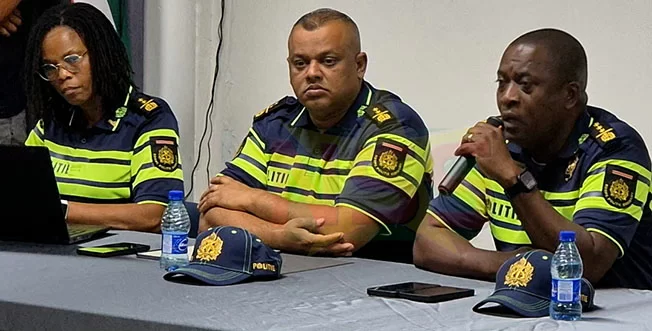
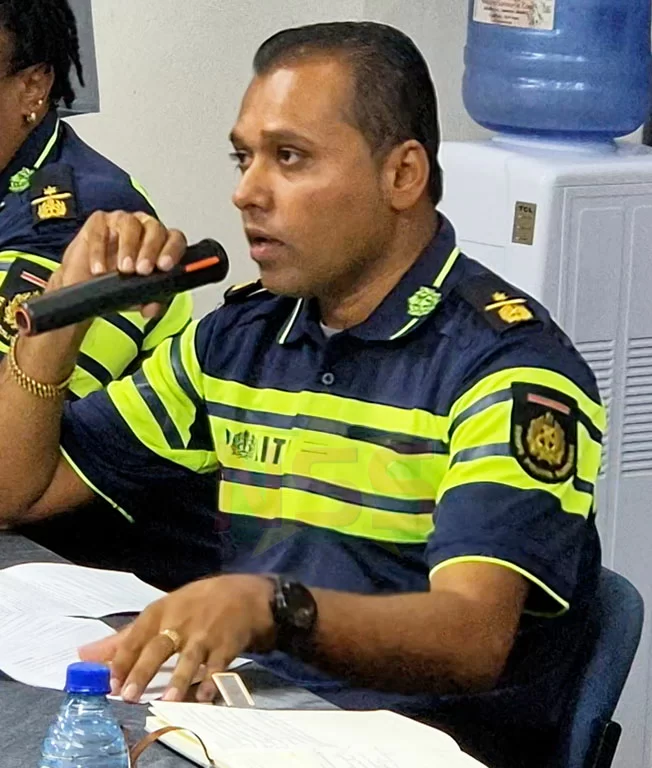
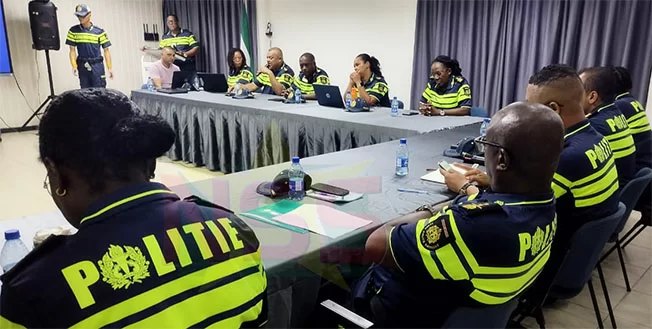
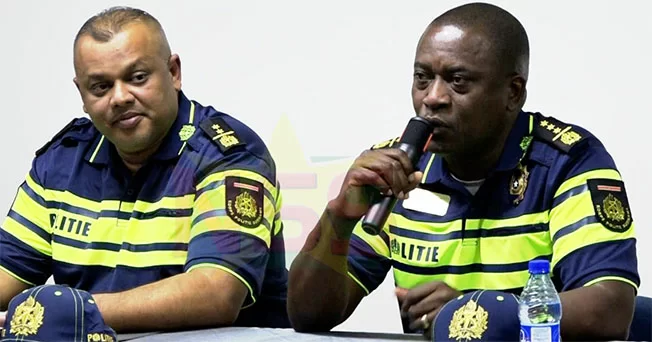
    On a formal ceremony held Friday at the Police Academy in Zorg en Hoop, Suriname, Melvin Pinas has been officially inaugurated as the new Korpschef, or chief, of the Korps Politie Suriname (Suriname Police Corps), marking the start of a new leadership era for the country’s primary law enforcement agency.

    Pinas, who has served as interim chief for eight months following the departure of former chief Bryan Isaacs, was promoted to the rank of Police Commissioner during the event. The official transfer of authority was completed when President Jennifer Simons oversaw the passing of the corps’ ceremonial flag from Isaacs to Pinas, formalizing the handover of command. Now the 51st person to hold the position of national police chief, Pinas faces high expectations from across government, law enforcement leadership and the Surinamese public.

    In his maiden address as chief, Pinas struck a measured, pragmatic tone, rejecting promises of quick fixes to the country’s public safety challenges. “I will not promise miracles, because building public safety is not a sprint – it is a process built on consistent, thoughtful, professional effort that brings together innovation, good governance and integrity,” he told attendees. “What I do promise is a clear direction, accountability, and a forward-looking approach to policing.”

    Pinas framed his appointment not just as a personal career milestone, but as a public calling. “This moment is not only a personal high point for me, but above all a vocation: a vocation to serve and lead an organization that stands guard every day over safety, order, peace and legal protection for all Surinamese,” he said.

    The core expectation shared by all senior stakeholders – including police union chair Revelino Eijk, Minister of Justice and Police Harish Monorath, and President Simons – is for Pinas to transform the Suriname Police Corps into an efficient, modern, and ethical security institution that rebuilds public trust through transparent, timely communication. All speakers emphasized that rebuilding trust, both within the police force and with the broader Surinamese community, remains one of the most pressing challenges facing the new leadership.

    Responding to these expectations, Pinas laid out a clear policy roadmap for his tenure. His priority areas include restoring institutional integrity and public trust, tackling widespread criminal activity, strengthening organizational and workforce capacity, advancing ongoing professionalization of the force, improving crisis response capabilities, expanding data-driven policing, cracking down on cybercrime and upgrading digital security, and deepening collaborative partnerships with other government agencies.

    The Suriname Police Union did note one reservation: it was not included in the consultation process for Pinas’ appointment. Despite this procedural concern, both the union and the national government have publicly pledged their full support to the new chief. All parties have underscored that cross-stakeholder collaboration is non-negotiable to achieve the ambitious policing and public safety goals laid out Friday.

  • Concept-staatsbesluiten tegen kinderarbeid stap dichter bij invoering

    Concept-staatsbesluiten tegen kinderarbeid stap dichter bij invoering

    On April 7, a key milestone in strengthening national child labor protection frameworks was reached during a stakeholder validation session hosted by the Directorate of Welfare and Labor of Suriname. Participants gathered to review two draft state decrees that will formalize rules surrounding permissible light work and restricted hazardous work for children and young people across the country: the Decree on Light Work and an updated version of the Decree on Hazardous Work.

    Broad consensus emerged among attending stakeholders around the urgent need to formalize these new regulations. To ensure inclusive and well-informed policymaking, stakeholders have been granted a two-week window to submit additional comments and adjustments to the draft texts. Once this public consultation period closes, the revised proposals will be forwarded to the relevant labor minister for review before ultimately being sent to the country’s president for final official approval.

    The new decrees are rooted in the 2018 Law on Employment of Children and Young Persons, a foundational piece of legislation that already sets out core age-based protections. Under existing law, children between the ages of 13 and 15 are only permitted to take on light work when strict regulatory conditions are met, while young workers aged 16 and 17 are barred from accepting any form of hazardous employment. The upcoming decrees will clarify and operationalize these existing principles, filling gaps in implementation guidance.

    Addressing attendees during the validation session, Deputy Minister Raj Jadnanansing emphasized that combating exploitative child labor is a shared responsibility that requires buy-in from all sectors of society. He noted that clear, enforceable regulations are non-negotiable to safeguard the health, education, and development of underage people, while policymakers must also balance these protections with the unique socioeconomic realities facing communities across the nation.

  • Onderwijscongres met 25 internationale experts moet leiden tot tienjarige visie

    Onderwijscongres met 25 internationale experts moet leiden tot tienjarige visie

    Suriname has kicked off an ambitious nationwide effort to overhaul its education system and develop its human capital, starting with a high-profile two-day education congress held earlier this month. The 2026 Education Congress, which brought together more than 25 leading international experts alongside hundreds of local policymakers, educators, and civil society stakeholders, concluded on April 9 at Paramaribo’s Hotel Torarica. The gathering is designed to lay the groundwork for two landmark policy documents: a 10-year national vision for education and human capital development, complemented by a sweeping 50-year long-term action plan to guide systemic change.

    The core discussion topic uniting attendees was how Suriname can unlock the full potential of its human capital, a strategic priority as the country prepares for scaled future revenue from its emerging oil and gas sector. Insights gathered from the opening congress will form the foundation of a second, intensive working phase scheduled to run from May 25 to 29 this year. During that follow-up process, national education specialists and international advisors will collaborate to draft concrete, actionable reforms aimed at one overarching goal: guaranteeing every child in Suriname access to high-quality education and equal opportunity to thrive.

    In closing remarks at the inaugural congress, Dirk Currie, Minister of Education, Science and Culture of Suriname, emphasized that broad cross-sector collaboration is non-negotiable for delivering meaningful, lasting change. Currie stressed that the reformed education system must be redesigned to rekindle children’s natural joy of learning, while equipping them with the skills and knowledge they need to succeed in a fast-changing future. He specifically highlighted the critical importance of closing opportunity gaps, noting that this work will lay the foundation for equitable, shared growth as Suriname brings new oil industry revenue online.

    Enrique Ralim, Director of Sports Affairs at the Ministry of Youth Development and Sports, echoed this sentiment, reinforcing that accessible, high-quality education serves as the fundamental bedrock for both broad national development and individual personal growth. Ralim called for a fully inclusive approach to reform, one that ensures no child is left behind regardless of their socio-economic background, physical ability, or any other limiting circumstance.

    Hosted in partnership with the Inter-American Development Bank (IDB), the 2026 Education Congress is widely framed as the official starting point for a years-long national process that will deliver the first major structural overhaul of Suriname’s education system in modern history.

  • Adhin bij rouwzitting Santokhi: Politiek moet buigen voor het mens-zijn

    Adhin bij rouwzitting Santokhi: Politiek moet buigen voor het mens-zijn

    On Friday, the National Assembly of Suriname (DNA) convened a special memorial sitting to honor the life and legacy of Chan Santokhi, a sitting member of the assembly who passed away suddenly on March 30.

    Leading the tribute, DNA Speaker Ashwin Adhin delivered an address reflecting on Santokhi’s life, his public service contributions, and the lasting mark he left on Suriname’s political landscape. Adhin opened his remarks by noting that even in a chamber where political disagreements are a daily part of operations, the entire body had come together in collective reflection and mourning. “There are moments when politics must step aside, to let our shared humanity take center stage,” Adhin told the assembled lawmakers.

    The speaker emphasized that when a public figure passes, their legacy is not measured by the office they held or the power they wielded, but by the positive impact they had on fellow citizens and the broader development of the nation. He spoke on behalf of the entire National Assembly, pointing out that while differing political views are common within the body, these divisions are actually a core strength of Suriname’s democratic system.

    “Above all our differences, one unifying truth remains: we share the same nation, the same future, and the same responsibility to build it for the next generations,” Adhin said. He framed Santokhi’s life and career as an important chapter in Suriname’s modern national history, noting that every contribution to public life — whether made through periods of political struggle or national development — forms a key part of the country’s collective national narrative.

    Adhin closed his address by calling on all present lawmakers to carry on Santokhi’s legacy by continuing the work of governing with responsibility, mutual respect, and unwavering dedication to public service. “The story of Suriname does not stop. It demands that we keep building and keep serving for the good of the entire nation,” he stated. Finally, he extended the entire assembly’s deepest condolences to Santokhi’s widow Mellisa, daughter Shanylla, and the rest of his family, wishing them strength in the face of their loss.

  • Miljoenen stemmen in India bij aanvang serie deelstaatverkiezingen

    Miljoenen stemmen in India bij aanvang serie deelstaatverkiezingen

    Millions of Indian voters turned out across polling stations on Thursday to cast their ballots in the first phase of four critical state-level elections this month, kicking off a political contest widely viewed as a critical gauge of public support for Prime Minister Narendra Modi’s ruling Bharatiya Janata Party (BJP)-led national coalition.

    The first round of voting opened on Thursday in two states, Assam and Kerala, as well as the federal union territory of Puducherry. Two more major states, West Bengal and Tamil Nadu, will hold their polls later this April, with all final results scheduled to be announced on May 2. While state-level elections do not directly shake the stability of India’s federal government, political analysts and party leaders across the spectrum are watching the outcomes closely to detect shifting voter sentiment ahead of future national elections, as the BJP works to consolidate its national hold on power amid mounting economic and geopolitical headwinds.

    Pre-election polling from leading opinion platform Vote Vibe projects a comfortable victory for the BJP-led alliance in Assam, where the ruling coalition has already held power for two consecutive terms. Kerala, by contrast, is widely expected to remain under opposition control. In West Bengal, the race is projected to be a tight neck-and-neck contest: the incumbent regional party currently holds a slight lead in polling, while the BJP — which has never governed the state — has centered its campaign on a promise to curb what it frames as illegal immigration from neighboring Bangladesh, a Muslim-majority nation. In Tamil Nadu, Vote Vibe data also predicts a close battle between the BJP-backed opposition coalition and the sitting regional ruling party.

    This year’s election cycle unfolds against the backdrop of ongoing conflict in the Middle East that has sent global energy prices soaring and created scattered fuel shortages across parts of the world. But Prime Minister Modi’s federal government has moved aggressively to keep domestic fuel costs stable for Indian consumers, a policy that has resonated with voters even as India relies on the Middle East for more than 40% of its crude oil imports and over 90% of its domestic cooking gas supplies. To absorb global price shocks, New Delhi has frozen retail prices for standard gasoline and diesel, and redirected a portion of industrial cooking gas allocations to meet household demand.

    Amitabh Tiwari, founder of Vote Vibe, noted that the full impact of global energy market disruptions on voter behavior remains unclear ahead of the final vote counts. Still, early polling data shows that a majority of voters have praised the Modi administration for its handling of energy security since the escalation of geopolitical tensions in the Middle East earlier this year. As the election process unfolds over the coming weeks, the final results will offer clear insight into how Indian voters judge the Modi government’s policy record, from domestic economic management to its approach to both regional and international geopolitical tensions, and will shape national political dynamics in the months leading up to the next general election.

  • AKMOS slaat alarm over trage bouwvergunningen en vraagt ingrijpen overheid

    AKMOS slaat alarm over trage bouwvergunningen en vraagt ingrijpen overheid

    On April 10, the Association of Small and Medium-sized Enterprises in Suriname (AKMOS) issued an urgent call for the Surinamese government to step in and address persistent long delays in the processing of construction permits, warning that the backlog has become a major drag on the country’s economic expansion. In a formal letter addressed to Stephen Tsang, Minister of Public Works and Spatial Planning (OWRO), AKMOS outlined growing complaints from small and medium-sized business owners who face extended waiting periods and repeated bureaucratic hurdles when applying for necessary construction approvals, with tangible negative consequences for ongoing building projects and planned investments across the sector.

    The construction industry stands as one of the core driving forces of Suriname’s economy, AKMOS emphasized. Beyond generating large-scale direct employment for local workers, the sector also ripples out to boost activity across connected industries, including wholesale and retail trade, transportation, and a wide range of business and consumer services. For Suriname’s large community of small and medium-sized enterprises (SMEs), which form the backbone of domestic private-sector activity, a healthy, growing construction sector is non-negotiable for sustained livelihoods and business development.

    AKMOS detailed the multiple cascading problems caused by permit processing delays. First, extended waiting periods push up costs for building materials and labor, squeezing already thin profit margins for smaller construction firms. Second, the systemic delays have put growing pressure on Suriname’s overall investment climate, making both local entrepreneurs and foreign investors increasingly cautious about committing capital to new projects in the country. Third, project delays caused by permit backlogs have put thousands of potential and existing construction jobs at risk, undermining domestic employment gains.

    Beyond just delays, AKMOS also identified deep-rooted structural issues within the current permit system: inefficient outdated processes, unclear guidance for applicants throughout the approval trajectory, and redundant repeated administrative steps that waste business owners’ time and fuel widespread frustration. These systemic inefficiencies do not just harm individual firms — they cause Suriname to lose out on high-impact economic opportunities that could drive broader national growth, the association noted.

    AKMOS is calling on Minister Tsang to launch a formal review of the current bottlenecks and implement targeted policy measures to streamline and speed up the entire permit approval workflow. Key proposals put forward by the association include shifting the entire process to digital systems, establishing transparent public tools that let applicants track their permit requests in real time, and expanding staffing and skills training for government agencies involved in the approval process. The association also called for a dedicated, well-staffed help desk that can provide clear, accurate guidance to business owners at every stage of the application process.

    AKMOS emphasized that it is ready to collaborate with government stakeholders to co-design and implement practical solutions, and expressed confidence that a more efficient construction permit system would lay the groundwork for a more competitive business climate and inclusive long-term economic growth across Suriname.

  • Ex-international Aloema eist ingrijpen bij nationaliteitscrisis Natio-spelers

    Ex-international Aloema eist ingrijpen bij nationaliteitscrisis Natio-spelers

    A former Surinamese international football star has issued an urgent call for the Suriname Football Association (SVB) and the national government to step in immediately to resolve a growing nationality crisis that currently impacts multiple players on the country’s senior men’s national team, known affectionately as ‘Natio – The Green Guardian’.

    Ex-national team goalkeeper Ronny Aloema has publicly voiced deep concern over recent reports that several Suriname-based internationals risk losing their Dutch citizenship, creating crippling legal uncertainty for the athletes involved. In his appeal, Aloema stresses that this issue extends far beyond the boundaries of professional sports, touching directly on players’ fundamental legal security, the credibility of Suriname’s public and sporting institutions, and the country’s standing on the global stage.

    Aloema emphasizes that players who made a conscious choice to represent Suriname out of loyalty and conviction should not be left to suffer the consequences of administrative confusion, miscommunication between legal bodies, or institutional inaction on the matter. To address the crisis comprehensively, he has put forward five concrete, actionable proposals to resolve the issue and protect the affected players and the future of Surinamese football.

    First, Aloema is calling for immediate specialized legal support for the impacted athletes. He argues that the SVB and national government must immediately assemble a dedicated legal team with deep expertise in nationality law, international sports law, and diplomatic law to provide robust representation for the players. Aloema notes that it is unacceptable for individual players to bear the full burden of outcomes from processes that were originally developed and overseen by Surinamese institutions.

    Second, he demands targeted diplomatic and administrative action. Aloema proposes that Suriname should quickly draft and deliver an official diplomatic note to competent Dutch authorities, coordinated through relevant government ministries, to formalize the country’s position and secure the players’ legal standing, preventing further harm to their careers and personal lives.

    Third, he is calling for full transparency and public accountability around the issue. Aloema is pushing for complete public disclosure of all agreements and procedures that have governed the naturalization and registration of diaspora players for the national team since 2019. He stresses that the affected players, their families, and the broader Surinamese public have a right to full clarity on the legal basis of these processes and the responsibilities of the institutions involved.

    Fourth, Aloema is urging the immediate establishment of a national crisis task force to address the issue long-term. He proposes a collaborative, cross-sector body that includes representatives from the SVB, the national government, independent legal experts, and current and former Surinamese internationals, tasked with developing a permanent structural solution to Suriname’s recurring dual nationality challenges in football.

    Finally, Aloema highlights the urgent need to protect the long-term future of the Natio national team. He explains that the ongoing crisis has far-reaching consequences for Surinamese football, eroding trust among diaspora players and damaging the credibility of the country’s existing sports and naturalization policies.

    Reiterating his core position, Aloema notes that players who made a deliberate choice to represent Suriname are entitled to institutional protection, clear legal guidance, and formal government and football association support. “They must never be made to feel that they are alone in this issue, which developed under the shared responsibility of the relevant institutions,” he says.

    Aloema concludes by expressing his hope that a fair, long-lasting solution can be reached quickly, allowing both current and future Surinamese internationals to continue representing the country with confidence. “Only through decisive, urgent action can we prevent talented players from stepping away from representing Suriname in the future,” Aloema argues. “Action is required right now.”

  • Khamenei: ‘Teheran heeft de wereld verbaasd’

    Khamenei: ‘Teheran heeft de wereld verbaasd’

    On the 40th day of mourning for his predecessor and father, Ayatollah Ali Khamenei – who was killed in a joint US-Israeli strike on the opening day of the ongoing conflict – Iran’s new Supreme Leader Mojtaba Khamenei issued a landmark public address Thursday, marking his first public statement since the outbreak of hostilities. The 58-year-old leader, who had stayed out of the public eye since fighting began, used the televised address to declare that Iran has secured a “final victory” in its war against Israel and the United States.

    Khamenei emphasized that Iran has never sought unnecessary conflict, but remains committed to defending its inalienable legitimate rights. He stressed that the criminal aggressors who launched unprovoked attacks on Iranian soil will not escape unpunished, adding that Tehran will demand full compensation for all infrastructure damage, and for the blood of all martyrs and injured citizens lost in the conflict.

    When addressing the status of the Strait of Hormuz, a critical global chokepoint that Iran has effectively blocked since the war erupted on February 28 and a core point of contention in ongoing US-Iran peace talks, Khamenei only noted that the country would enter a “new phase” without offering additional details. The strait accounts for nearly a fifth of global oil trade, making its status a critical issue for the global economy.

    The announcement comes one day after the United States and Iran reached a two-week ceasefire agreement brokered by Pakistan to allow for formal peace negotiations. The truce was reached after escalating attacks on Gulf states and the near-complete closure of the Strait of Hormuz triggered widespread international fears of a prolonged regional conflict with far-reaching global economic and security consequences. As part of the ceasefire deal, Iran agreed to allow commercial shipping to resume passage through the strategic waterway, with unconfirmed reports indicating Tehran plans to charge transit tolls for vessels using the strait to fund post-conflict reconstruction.

    Despite the diplomatic breakthrough, Khamenei issued a clear warning that Iran stands fully prepared to respond immediately if enemy forces violate the terms of the truce. “Our fingers remain on the trigger,” he stated.

    The fragile ceasefire already faces a major test just hours after it took effect. On Wednesday, Israel carried out a devastating airstrike in Lebanon that killed more than 300 people, putting the US-Iran agreement at severe risk. Dispute already exists over whether Lebanon is covered under the ceasefire terms: Iran and Pakistan maintain the truce applies to all allied fronts of the conflict, while the US and Israel reject this interpretation. Global leaders have already called for Lebanon to be included in the ceasefire framework and urged an immediate end to hostilities across the entire region.

    Khamenei reaffirmed that Iran did not initiate the war, but will never surrender its legitimate rights under any circumstances. He explicitly referenced the “entire resistance front”, a statement widely interpreted as including Lebanese armed groups aligned with Tehran. Formal peace talks between US and Iranian delegations are scheduled to kick off this weekend in Pakistan, where negotiators will work toward a permanent end to the conflict.

  • Column: De oorlog die wij zien en de strijd die wij niet begrijpen

    Column: De oorlog die wij zien en de strijd die wij niet begrijpen

    Mainstream coverage of the ongoing crisis in the Middle East often simplifies the chaos into a familiar, neat narrative: Israel, backed by the United States, is locked in a single open war against regional adversaries led by Iran and its allied armed factions. This framing creates a false sense of clarity, but the reality is far more complex than the superficial story many outlets present. What is often described as one unified conflict is actually a tangled convergence of multiple separate disputes, each with its own distinct objectives, overlapping interests, long-held historical grudges, and competing strategic agendas that interact and intensify one another.

    On the surface, the most visible fronts are clear: Israel fights Hamas in Gaza and exchanges fire with Hezbollah along its northern border with Lebanon. Daily headlines bring images of airstrikes, rocket barrages, widespread destruction, and Israeli officials framing the campaign as a necessary fight for national survival. But beneath this visible frontline fighting lies a deeper layer of geopolitical ambition and risk calculation that rarely makes front-page news.

    For Israel, the conflict extends far beyond neutralizing immediate threats from Hamas and Hezbollah. The core strategic priority driving many of its military actions, particularly sustained airstrikes targeting Hezbollah assets in Lebanon, is curbing the expanding regional influence of Iran. From Israel’s strategic perspective, Iran’s growing power is not an abstract geopolitical concern—it is viewed as an existential threat to the Jewish state, established as a sovereign nation only in 1948. In Israeli policy circles, this is not framed as an offensive war of expansion, but a defensive struggle necessary to guarantee the country’s long-term survival.

    Tensions along the Israel-Lebanon border have escalated dramatically since the outbreak of the Gaza war following Hamas’ October 7, 2023 attack on Israeli territory. Hezbollah, Iran’s most powerful regional proxy, has launched near-daily rocket and drone strikes on northern Israel, and Israel has responded with waves of airstrikes targeting Hezbollah military infrastructure across southern Lebanon. For Israel, Hezbollah represents one of the most pressing security threats in the region: the group maintains an enormous arsenal of projectiles and receives extensive funding, training, and political backing from Iran, Israel’s long-standing core adversary. By targeting Hezbollah weapons depots, launch sites, and command centers, Israeli military leaders aim to erode the group’s offensive capacity and deter future large-scale attacks.

    The United States publicly presents itself as a fully committed ally standing shoulder-to-shoulder with Israel, but Washington’s strategic goals in the crisis diverge significantly from Jerusalem’s. Where Israel frames the conflict as an existential fight for its immediate security, the U.S. is primarily maneuvering to protect and extend its own regional influence and control. For American policymakers, this is not an existential war, but a carefully calibrated geopolitical file. Washington’s core priorities are maintaining a facade of regional stability, protecting its network of allied partners, and preserving decades of American geopolitical dominance in the Middle East. While the U.S. shares Israel’s goal of limiting Iran’s regional expansion, it has no interest in triggering a full-scale regional war that could draw American troops into direct combat. As a result, U.S. engagement is calculated, often restrained, and consistently focused on managing escalation rather than pursuing all-out conflict. The U.S.-Israel alliance does not equate to identical, aligned interests in every part of the crisis.

    Iran, meanwhile, is not a direct belligerent in open fighting, but it is far from a passive bystander. Tehran avoids open, conventional war that would leave it vulnerable to direct American and Israeli retaliation, instead exercises influence through a web of regional proxies and allied armed groups, maintaining constant pressure on Israel and the U.S. without fully committing its own military forces to open conflict. Iran’s strategy of indirect confrontation is deliberately designed to operate outside the boundaries of traditional warfare, making it extremely difficult for its adversaries to counter fully. Flexible, persistent, and focused on long-term gains rather than quick battlefield victories, Iran is playing a long game that pays dividends even as its proxies bear the brunt of fighting.

    A common and misleading misconception about the conflict frames the Israeli-Palestinian confrontation as an ancient, inevitable clash rooted in centuries of religious and ethnic tension. This narrative is convenient but deeply misleading. It frames the current violence as an unavoidable outcome of ancient hatreds, erasing the reality that today’s crisis is the direct product of modern political decisions and territorial disputes. While historical context plays a major role in shaping current tensions, it cannot fully explain or justify the current state of open conflict. What is clear is that every actor involved frames its own actions as a fight for survival, shaped by decades of accumulated grievance and fear.

    The explosions, rubble, and civilian casualties that fill daily news coverage are only the visible symptom of this far larger, more complex struggle. They are the consequences of overlapping disputes, not the core drivers of the conflict itself. This is a multifaceted battle for influence, security, and regional power, where even formal allies hold competing objectives and adversaries often operate in the shadows rather than openly. The central question that matters most is not who is fighting, but what they are fighting for. Until that question is openly and honestly addressed, global audiences will continue to accept a simplified, misleading narrative that ignores the underlying dynamics shaping the crisis—dynamics that play out almost entirely out of public view. Perhaps the biggest problem is not that too little of the conflict is visible to the public, but that most audiences are content to accept the superficial story that is presented to them.