标签: Suriname

苏里南

  • Directoraat Cultuur en AJLA Frans-Guyana tekenen intentieverklaring

    Directoraat Cultuur en AJLA Frans-Guyana tekenen intentieverklaring

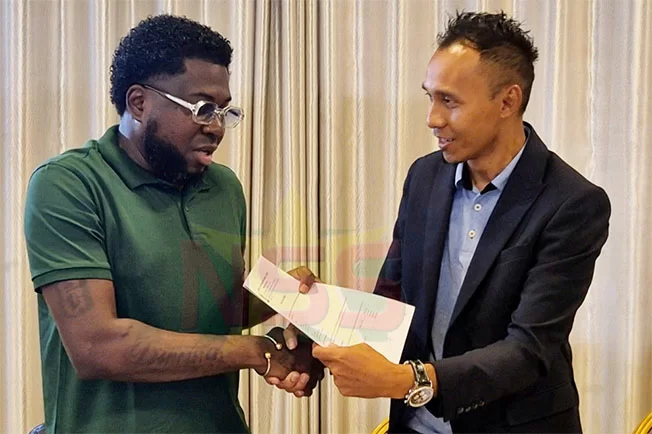
    In a landmark move to foster cultural and community development, Roseline Daan, Cultural Director, and Patrick Burnet, President of the NGO Young Leaders in Action (AJLA), have announced a collaborative initiative in Cayenne, the capital of French Guyana. The partnership, formalized through a Memorandum of Understanding (MoU), aims to unite government ministries, non-governmental organizations, and the private sector in a series of impactful activities. These include promoting traditional culinary practices, organizing art and educational programs, mobilizing families and schools for community engagement, and sharing resources for project execution. Additionally, the collaboration will focus on cross-border environmental efforts, such as cleaning the Marowijne River and establishing a training center in Albina and Saint-Laurent for knowledge exchange. Burnet emphasized, ‘The Marowijne River is not a border; it is a bridge. By uniting the strengths of both sides, we are sowing the seeds for a future-oriented human, cultural, and economic partnership.’ The MoU is initially valid for two years, with the possibility of extension. Daan highlighted that while the agreement provides a framework for cooperation, it does not impose legally binding obligations. ‘We are neighbors, and it is crucial to strengthen bilateral relations at all levels,’ she stated.

  • Burgers leven in angst na nieuwe luchtaanvallen in Afghanistan

    Burgers leven in angst na nieuwe luchtaanvallen in Afghanistan

    Recent drone and aerial bombardments in Afghanistan have plunged the nation into heightened tension, with residential neighborhoods and bustling markets becoming primary targets. Reports from Kabul and southern provinces such as Kandahar and Paktika detail significant civilian casualties and extensive property damage. Families have fled en masse, while others remain confined indoors, paralyzed by fear. The Afghan government has accused neighboring Pakistan of orchestrating these attacks, a claim Pakistan vehemently denies, though it acknowledges “military threats along the border.” The ambiguity surrounding the perpetrators has only deepened public anxiety. Witnesses recount that the explosions occurred unexpectedly in densely populated areas, leaving children too terrified to venture outside. Schools have shuttered, and markets operate at reduced capacity. In border villages, residents seek refuge in mosques and basements, bracing for further violence. International mediators have brokered a temporary ceasefire between Afghanistan and Pakistan, but observers caution that the situation remains precarious. Aid organizations struggle to access affected regions, warning of a rapidly worsening humanitarian crisis if the violence persists. For the Afghan populace, feelings of insecurity and helplessness dominate, with the fear of renewed violence permeating daily life. Calls for international protection and political stabilization grow louder as the crisis deepens.

  • Column: Het verlangen naar vreugde die nooit kwam…

    Column: Het verlangen naar vreugde die nooit kwam…

    In recent weeks, intense clashes have erupted along the border between Pakistan and Afghanistan, leaving devastation in their wake. Danish, a 26-year-old Pakistani man, shared his harrowing experiences with his colleague Indra Toelsie. Born in 1999, Danish has never known a day of peace. His hometown, once filled with towering buildings, now lies in ruins, bombed beyond recognition. He showed Indra a video of a rocket strike in a residential area near his home, a stark reminder of the fragility of life in his war-torn region. For Danish and millions like him, uncertainty is the norm, a daily reality they’ve come to accept.

    Now, in Beijing, Danish is experiencing peace for the first time. Here, he can walk freely without fear of bombs or the need to seek shelter. When Indra encouraged him to enjoy this newfound tranquility, Danish’s response was poignant: ‘I just hear enjoying, enjoying, but what is enjoy and enjoyment? I literally don’t know.’ His words reveal a deep hunger to understand what it means to truly live without fear. Danish’s journey to China, made possible by a program, has opened his eyes to a world where peace is not a luxury but a possibility.

    For Indra, a native of Suriname where life is celebrated and cherished, Danish’s story is a stark reminder of the privileges often taken for granted. While many complain about minor inconveniences, Danish dreams of a life free from violence. His aspirations are not for wealth but for peace—a basic human right that remains elusive for millions. Danish’s story serves as a call to action: to appreciate the peace we have and to strive for a world where it is accessible to all. As Indra reflects, perhaps it’s time to shift from complaints to gratitude, recognizing the value of the peace we often overlook.

    On Divali, Indra urges everyone to light an extra lamp—not just for Danish but for all those who live without the gift of peace.

  • President Simons: Het kleinste licht verdrijft de duisternis

    President Simons: Het kleinste licht verdrijft de duisternis

    In a vibrant celebration of cultural unity, President Jennifer Simons of Suriname marked the 18th annual Divali Festival by adding ghee to the ceremonial Suriname dia on Saturday evening at Independence Square. The event, organized by the Cultural Union Suriname, drew a large crowd eager to witness the symbolic arrival of Ram, Sita, and Hanuman, key figures in the Ramlila tradition.

    In her address, President Simons emphasized the unifying power of light in a diverse society. ‘No matter how small the light may be, where there is light, darkness cannot exist. Even the tiniest light can dispel the deepest shadows,’ she remarked. She highlighted Suriname’s rich cultural tapestry and its numerous festivals of light, all of which share a profound message of hope and unity.

    President Simons urged the community to look beyond religious differences, stating, ‘There are not thousands of lights, but one divine light that we symbolize in every dia. We must also be that light for one another.’ She expressed her hope that the festival would not only illuminate homes but also hearts, fostering a spirit of togetherness and happiness.

    The festivities, which continue today, serve as a reminder of the importance of unity and the shared values that bind the Surinamese people. The event underscores the nation’s commitment to celebrating its diverse heritage while promoting a collective vision of a brighter future.

  • Diaspora Homecoming Summit gestart met boomplanting en investeringen in jeugd

    Diaspora Homecoming Summit gestart met boomplanting en investeringen in jeugd

    The Diaspora Homecoming Summit Suriname commenced on Saturday in Paranam, marking a significant step towards fostering growth, hope, and sustainable collaboration between the diaspora and local communities. Held at the G.A. Kortschool in La Vigilantia, the event was inaugurated with the symbolic planting of a tree by the Diaspora Institute Netherlands (DIN) and the Diaspora Institute Suriname (DIS), alongside local partners. This gesture underscores the project’s commitment to youth empowerment and community development in Paranam. The initiative’s first phase includes the renovation of a classroom equipped with modern educational tools such as computers, school supplies, and a smartboard. Additionally, two students have been awarded full scholarships for four years, while an exchange program with a school in the Netherlands aims to provide international learning experiences. A second pillar of the project focuses on nutrition and agriculture. Through microcredits, local farmers are supported in cultivating papaya, cassava, and soeptayer, with the harvest used to provide students with nutritious soup and fresh fruit weekly, and eventually daily. The initiative also aims to establish a sustainable processing chain, including a pulp machine and freezing facilities, to ensure year-round access to healthy food. Organizers envision the Paranam model as a blueprint for other communities across the country, emphasizing that what begins with one tree, one classroom, and two students can grow into a movement that benefits generations to come.

  • Nieuw kunstgrasveld in Albina moet jongeren perspectief en structuur bieden

    Nieuw kunstgrasveld in Albina moet jongeren perspectief en structuur bieden

    A state-of-the-art multifunctional artificial turf field has been officially inaugurated in Albina, Marowijne, marking a significant step forward in providing local youth with opportunities for sports development, talent discovery, and social cohesion. The facility, designed to accommodate football and various other sports and youth activities, will also serve schools lacking their own sports infrastructure. The opening ceremony was led by Miquella Huur, Minister of Regional Development, alongside Lalinie Gopal, Minister of Youth Development and Sport, who represented President Jennifer Simons. Minister Gopal highlighted the field’s role in creating safe and positive spaces for young people, stating, ‘This field is more than just a sports facility. It’s a foundation for building character, opportunities, and community strength.’ Minister Huur emphasized the facility’s importance in addressing the need for structured activities for youth in the district, noting, ‘Here, children can gather after school, engage in sports, collaborate, and grow—away from negative influences.’ Originally initiated by the former Ministry of Regional Development and Sport, the project has now been completed under the current Ministry of Regional Development. A local maintenance committee will ensure the sustainable use of the facility. Minister Gopal urged the Albina community to care for the field, calling it ‘an investment made with heart and a vision for the future. Cherish it so that future generations can also benefit.’ A similar multifunctional artificial turf field is set to open soon in Galibi.

  • Divali – Van duisternis naar licht

    Divali – Van duisternis naar licht

    Diwali, often referred to as the ‘Festival of Lights,’ is one of India’s most cherished celebrations, observed globally with immense enthusiasm. This year, the festival falls on Monday, October 20, aligning with the lunar calendar. Often compared to Christmas and New Year combined, Diwali carries a profound message of brotherly love, peace, mutual respect, and unity. Both festivals emphasize renewal, the strengthening of family bonds, and the exchange of gifts, blessings, and good wishes. The vibrant atmosphere is further enhanced by new clothes, sweets, and colorful decorations.

  • DNA-leden getraind in genderanalyse van Staatsbegroting 2026

    DNA-leden getraind in genderanalyse van Staatsbegroting 2026

    In a significant step toward fostering inclusive governance, 23 members of various factions in De Nationale Assemblée participated in an interactive training session on analyzing the National Budget through a gender lens. The session, titled ‘A Fair Budget: The National Budget Through a Gender Lens,’ was organized by Stichting Projekta in collaboration with the Ministry of Home Affairs. Held on Friday, the training underscored the importance of recognizing that budgetary policies are not neutral and can disproportionately impact different societal groups. Sharda Ganga, Director of Projekta, led the session, which was funded by the Equality Fund. Participants were equipped with practical tools to assess the 2026 budget’s effects on women, men, boys, and girls, with applications extending to indigenous communities, people with disabilities, and vulnerable youth. During the opening remarks, Director Nasier Eskak, representing Minister Bee, emphasized the necessity of collaboration in crafting policies that reflect societal diversity. The training highlighted the potential of budgetary measures to either reinforce inequality or promote equal opportunities and social justice. One experienced parliamentarian noted, ‘The gender lens reveals who benefits and who is left out, making it clear that the National Budget is not neutral.’ Practical examples and a checklist provided insights into unintended consequences of policies. Participants stressed that the gender lens encompasses all societal groups, not just women. Shiefania Jahangier, Head of the Bureau for Gender Affairs, urged attendees to integrate gender equality into economic, political, and institutional policies. This training is part of a broader initiative by Projekta to strengthen gender-responsive policymaking within the government and De Nationale Assemblée, aligning with its mission to build a human rights-based, inclusive society.

  • Parmessar gekozen tot vicepresident van Grulac tijdens IPU-top in Genève

    Parmessar gekozen tot vicepresident van Grulac tijdens IPU-top in Genève

    In a significant development for Suriname’s political representation on the global stage, Assembly Member Rabin Parmessar, leader of the National Democratic Party (NDP), has been elected Vice President of the Group of Latin America and the Caribbean (Grulac). The election took place on Saturday in Geneva, ahead of the 151st General Assembly of the Inter-Parliamentary Union (IPU). Parmessar’s election underscores Suriname’s growing influence within the regional bloc, which coordinates parliamentary strategies and represents Latin American and Caribbean nations in international forums.

  • Pers blijft rapporteren, maar buiten de muren van Pentagon

    Pers blijft rapporteren, maar buiten de muren van Pentagon

    A significant portion of the American press corps has withdrawn from the Pentagon after journalists refused to comply with the Department of Defense’s new media regulations. The tightened rules prohibit journalists from publishing any information not officially pre-released by the department—even if it is not classified. Those who declined to sign the agreement lost their access passes as of October 15. Nearly all major U.S. news organizations, including CNN, ABC, The New York Times, Reuters, Associated Press, and even the typically conservative Fox News, have turned their backs on the Pentagon. Only a small minority, including some new right-wing media outlets, have formally agreed to the new terms. The rest have vacated their offices, cleared out TV studios, and surrendered their press passes. Despite the exodus, journalists emphasize that their departure does not mean an end to defense reporting. They will continue their work from editorial offices or external sources outside the Pentagon. Many reporters left the building in a symbolic procession, handing in their press passes and leaving behind empty desks. Media organizations have criticized the new rules as a ‘historically dangerous precedent,’ arguing that they bring the U.S. closer to controlled state communication. Critics warn that this makes the work of investigative journalists—who are tasked with exposing abuse of power and misconduct—nearly impossible. Trust in the transparency of the U.S. government and military accountability is under severe pressure. The Pentagon, however, maintains that the measures are necessary ‘for the safety of the troops and the national interest.’