标签: Saint Vincent and the Grenadines

圣文森特和格林纳丁斯

  • PM Browne sworn into office for 4th consecutive term

    PM Browne sworn into office for 4th consecutive term

    In a historic milestone for Antigua and Barbuda’s political landscape, Prime Minister Gaston Browne was officially sworn in for an unprecedented fourth consecutive term as head of government on Friday, mere hours after his ruling Antigua and Barbuda Labour Party (ABLP) secured a landslide win in the snap May 30 general election.

    Browne and Attorney General Steadroy “Cuttie” Benjamin took their oaths of office before Governor General Sir Rodney Williams, alongside all other newly elected ABLP candidates. The election, called by Browne nearly two years ahead of the constitutionally mandated deadline, delivered a lopsided result that underscored the ABLP’s overwhelming popular support. Official figures released by the Antigua and Barbuda Electoral Commission (ABEC) show the ruling party claimed 15 of the 17 available parliamentary seats. The remaining two seats were split between the main opposition United Progressive Party (UPP) and the Barbuda People’s Movement (BPM), with just over 62.5 percent of registered voters turning out to cast their ballots.

    Addressing attendees shortly after his inauguration, Browne framed the outcome as a clear, resounding mandate from the electorate. “That was a resounding victory. People spoke, and they spoke with clarity. They spoke resoundingly, and we’re very happy with the mandate that was given to us,” Browne said, noting that the strong victory comes with amplified responsibility he and his party are fully prepared to uphold.

    The Prime Minister described his fourth consecutive term as a humbling honor that has only deepened his commitment to advancing the interests of Antigua and Barbuda’s people. He pledged accelerated national development across key sectors, promising to speed up ongoing infrastructure projects targeting two longstanding public concerns: road access and water access. “We’ll make sure that we continue to deliver for the people of Antigua and Barbuda. In fact, in terms of my own commitment, the fact that I was given a fourth term as prime minister, that in itself is a humbling experience, and that has served now to even strengthen my commitment to fight even harder for the people of Antigua and Barbuda and to deliver more for them,” Browne said. “So the people of Antigua and Barbuda will be seeing accelerated growth and development, accelerated infrastructural development, so the roadworks, the waterworks that we have started will be accelerated until we substantially resolve the water and road problems.”

    He thanked voters for their patience during ongoing project implementation, noting that the election result confirmed residents trust the ABLP to solve critical national issues and recognize his personal dedication to driving sustained development that lifts living standards for all.

    Looking ahead to cabinet formation, Browne announced that the full ministerial team will be named on Tuesday, with most senior roles retained by incumbent officials to ensure policy continuity amid major ongoing projects. “There will be familiar faces because a number of them are handling significant projects, and we want to ensure there’s continuity,” he explained. Highlighting key appointments, he confirmed that Daryll S. Matthew will remain in the education portfolio to continue ongoing sector expansion, while Chet Green will retain his position as Minister of Foreign Affairs. Browne noted that replacing Green ahead of the upcoming November Commonwealth Heads of Government Conference, which requires extensive advance planning, would be unwise. He also confirmed that his wife, Maria Browne, will continue to serve as Minister of Public Works, crediting her with proven ability to manage multiple cross-constituency projects effectively.

    Newly elected ABLP representatives will first serve as junior ministers for a training period, Browne confirmed, a structure designed to avoid an overly large, bloated government while preparing emerging leaders for future senior roles. “Again, we don’t want to have a bloated government by having all senior ministers. We will have some junior ministers, again, as a form of training and development so that they, too, can blossom into senior ministers eventually and to better serve the people of Antigua and Barbuda,” he said.

    Prior to the inauguration, Browne — who has already received congratulatory messages from regional leaders across the Caribbean Community (CARICOM) and other international partners — thanked God for the victory and expressed gratitude to voters for their overwhelming support. “To God be the glory. Great things he has done,” he said. “You have spoken with clarity, you have spoken resoundingly, and you would have certainly spoken with truth, and in essence would have put to shame all of the lies that have been peddled, all of the disinformation, all of the misinformation, all of the vitriolic rhetoric.”

    The Prime Minister used his inaugural address to call for a new era of more civil, responsible politics across Antigua and Barbuda, warning that toxic misinformation erodes social fabric and damages the country’s international reputation. As a small island nation in an interconnected global world, falsehoods spread locally travel far beyond the country’s borders, shaping unfair negative perceptions among international observers who lack on-the-ground context, he explained. “I’m hoping that with such a resounding victory that there will be a new dispensation going forward. I’m hoping that our politics will become more civil. I’m hoping that politicians on both sides of the aisle will stand on the truth, because at the end of the day, the misinformation, disinformation, the falsities, they are literally eroding the fabric of our society, and they are destroying our country,” Browne said. “So, I’m hoping going forward that we will see greater loyalty to our state and its people, and that politicians should understand that misinformation, disinformation, and falsities, they only thrive for a short period of time. Ultimately, the truth will prevail.”

    Browne argued that his opposition’s poor electoral performance stemmed directly from its embrace of harmful, misleading campaigning during the electoral cycle. He called on the UPP to learn from the defeat and pursue internal reform, noting that a strong, accountable opposition is healthy for Antigua and Barbuda’s democracy. “I would say that, having served in opposition, that I practise responsible politics, and I believe as a consequence that my own credibility within the domestic society would have grown. And I think that UPP should take note and to use this opportunity to reform, because at the end of the day, we want to have a strong opposition. We do not necessarily want to have a weak opposition. We want individuals who have the competence to continue to hold us accountable,” he said.

    Repeating that his fourth consecutive term is a humbling honor, Browne reaffirmed his commitment to centering public welfare in all governance, stating that the landslide mandate presents a critical opportunity to unify the nation and advance inclusive development. “It’s about your empowerment, and I give you a commitment that I will work harder, that I will do all in my power to continue to work unrelentingly to advance the living standards of the people of Antigua and Barbuda,” he said. “the results provide a great opportunity for us to unite our nation, and to work towards improving all aspects of our development going into the future.”

    Browne closed by taking personal responsibility for ensuring all cabinet members honor the public trust, warning that betrayal of that trust will not be tolerated. He reminded incoming ministers that their roles exist exclusively to serve all Antigua and Barbuda residents, require responsible stewardship of public funds, and demand zero discrimination, division, or corruption. “I can assure you that if it is betrayed, certainly will not be tolerated… it is important for those who will be appointed within the cabinet to understand that they will be appointed exclusively to serve the people of Antigua and Barbuda. Not to discriminate against anyone, not to undermine anyone, not to divide a country, not to steal public resources, but to be good stewards of public resources and to make sure that every cent of public resources is utilised for the development of the people of Antigua and Barbuda.”

  • Gaston Browne secures historic 4th term

    Gaston Browne secures historic 4th term

    In a high-stakes political move that has reshaped the landscape of Antigua and Barbuda, Prime Minister Gaston Browne’s decision to call a snap general election nearly two years before its constitutionally mandated deadline has delivered a historic, resounding victory for his ruling Antigua and Barbuda Labour Party (ABLP).

    Preliminary results released by the Antigua and Barbuda Electoral Commission (ABEC) confirm the ABLP secured 15 out of the 17 contested parliamentary seats, a dramatic reversal of the party’s narrow 9-7 majority win in the January 2023 poll. The landslide win also marks a historic milestone for Browne, who easily retained his long-held St. John’s City West seat – a constituency he has represented since 1999 – making him the first prime minister in the nation’s history to win four consecutive general elections.

    Addressing jubilant supporters following the result, Browne expressed deep gratitude for the overwhelming public confidence placed in both his leadership and the ABLP’s agenda for continued national progress. “We are humbled and honoured by your support and confidence. Now is the time to move forward together, build on our gains and continue our work toward the betterment of our society and the upliftment of our people,” Browne wrote in a post on the ruling party’s official Facebook page.

    Outlining his policy priorities for the new term, Browne emphasized that inclusive growth and expanded opportunity would remain at the core of his administration’s agenda. “Education, jobs, business opportunities will be open to all who are prepared to seize them. No one will be left behind who is willing to move forward,” he said, rejecting any suggestion of triumphalism after the landslide. “This is not a moment for gloating. The contest is over, and the 15-seat mandate is a resounding vote of confidence for which we are eternally grateful.”

    Browne also stressed that the new term would see his administration accelerate ongoing national projects, advance new initiatives to strengthen the national economy, transform local communities, and improve living standards for all citizens. He called for collective productivity and national unity, noting that the government’s goal is to position Antigua and Barbuda as one of the most productive small island states in the world, while upholding national dignity in all regional and international forums. Notably, Browne’s wife Maria – the public works minister in the previous administration – also secured a comfortable win in the St. John’s Rural East constituency, defeating UPP candidate Ashworth Azille.

    For the main opposition United Progressive Party (UPP), the election result was a devastating blow: only party leader Jamale Pringle managed to hold onto his seat, defeating ABLP candidate Anthony Smith. On the sister isle of Barbuda, incumbent Trevor Walker of the Barbuda People’s Movement (BPM) retained his seat, winning 609 votes against ABLP challenger Kendra Beazer’s 398. All three independent candidates contesting the election failed to gain traction, losing their deposits.

    Pringle extended congratulations to the ABLP on their victory, telling supporters that the UPP would remain active in opposition. “There’s no second place in politics, but just as we did in 2018, we’ll still be standing. The UPP is not going anywhere,” he said.

    Regional political analysts have weighed in on the historic result, pointing to deep internal divisions within the UPP as a key driver of the party’s collapse. Barbados-based pollster Peter Wickham, who conducted pre-election opinion polling, noted that the UPP’s strong 2023 performance, which saw the party win seven seats, had “completely evaporated” in this poll, with an overall five percent swing toward the ABLP across the mainland.

    Local political analyst Professor Justin Robinson, Pro Vice-Chancellor and Principal of the University of the West Indies Five Islands Campus, observed that the result highlighted key weaknesses in the UPP’s leadership, noting that the electorate delivered a clear verdict on Browne’s leadership and the ABLP’s agenda. Robinson pointed out that Pringle, the only remaining UPP MP, is now the “only man standing” for the opposition, a dynamic that mirrors past election results in other Caribbean nations including St. Vincent and the Grenadines. Still, Wickham argued that Pringle’s retention of his seat is largely a product of long-standing constituency strength rather than public confidence in his national leadership, and called on him to step down as UPP leader to allow the party to rebuild with extra-parliamentary leadership.

  • Layou woman with vast experience in business, law heads Invest SVG

    Layou woman with vast experience in business, law heads Invest SVG

    St. Vincent and the Grenadines’ national investment promotion body Invest SVG has announced a landmark leadership transition, naming homegrown global finance expert Anna C. Young as its eighth executive director. Young’s appointment marks the start of a transformative new chapter for the agency, expanding its core mission far beyond traditional foreign direct investment outreach to incorporate three key new priorities: boosting local export and trade growth, unlocking capital from the country’s global diaspora, and strengthening the nation’s profile as a top-tier destination for international financial services investment.

    A native of Layou, St. Vincent and the Grenadines, Young’s professional roots stretch back to local media and public service early in her career. She got her start in the workforce as a news reporter at NBC Radio, collaborating with some of the nation’s most prominent media figures, including industry veterans Chester Connell, Nichole Hadaway, and the late Glen Jackson and Nina Maloney. From 1992 to 1995, she also served as an information cadet at the Government Information Service, the public communications body now reorganized as the Agency for Public Information.

    To build specialized expertise for her career, Young migrated to the United States to pursue advanced higher education, going on to accumulate an impressive academic and professional profile across multiple continents. She holds a Bachelor of Science in finance from Alabama A&M University in the U.S., and a Master of Science in project analysis, finance and investments from the University of York in the United Kingdom. She later completed legal studies at UWE Bristol Law School, and was admitted to the Bar of England and Wales by one of the UK’s most prestigious professional Inns of Court, Gray’s Inn. Young also holds accreditation as a civil and commercial mediator from the leading global alternative dispute resolution body ADR Group.

    Over more than 20 years working internationally, Young has built a distinguished track record in finance and corporate strategy across top global financial institutions. She held a key leadership role as Assistant Vice President of Finance at Bank of America Merrill Lynch, where she worked with a specialized team focused on addressing and reducing regulatory risks stemming from federal policy mandates. Prior to that, she held multiple progressive roles at American Express, including Senior Investment Manager, Pricing and Marketing Capabilities Manager, and Senior Financial Analyst, leading cross-functional revenue growth projects and supporting C-suite strategic decision-making. Early in her global career, she worked as an investment analyst at Lehman Brothers, supporting senior banking teams with core financial analysis and due diligence.

    A graduate of St. Vincent Girls’ High School, Young says her connection to her home country has remained central to her professional and personal identity throughout her years abroad. “I am proud to be a Vincentian,” she shared in comments following her appointment. “My passion for excellence blossomed at an early age, being a product of the St. Vincent Girls’ High School before pursuing other endeavours in my education and career.”

    Reflecting on her return to take up the new role, she added: “after living abroad for so many years and gaining most of my professional experience overseas, nothing brings me greater joy than returning home to share my knowledge with my Vincentian people. There is so much potential for growth, and with the amazing team at Invest SVG, we are uniquely poised for greatness. I am humbled to serve my country.”

    Young succeeds Glen Beache, a former tourism minister whose tenure with the agency concluded in December 2024.

  • Gonsalves attempts to use IMF report to rally ULP supporters

    Gonsalves attempts to use IMF report to rally ULP supporters

    Five months after the Unity Labour Party (ULP) ended its 24-year consecutive rule over St. Vincent and the Grenadines (SVG), veteran opposition leader and former prime minister Ralph Gonsalves is leveraging a newly released International Monetary Fund economic assessment to mobilize his base and push for an early reversal of the electorate’s decision. The 80-year-old leader, who remains head of the ULP despite the party’s historic electoral defeat, laid out his political campaign in an hours-long broadcast on the ULP-owned Star Radio’s popular “Morning Comrade” show Wednesday.

    In the December 2024 general election, the New Democratic Party (NDP) secured the most lopsided electoral victory in SVG since 1989, beating the ULP by more than 10,000 popular votes. The election saw a dramatic shakeup within the ULP: while Gonsalves retained his own parliamentary seat, both his son Camillo Gonsalves, the former finance minister, and Saboto Caesar, former agriculture minister and a leading contender to succeed the elder Gonsalves, lost their seats. With former deputy leader Montgomery Daniel, 70, retiring from politics last year, the ULP has not yet filled the deputy leadership position after delaying a vote at its 2022 convention.

    On Tuesday, one day before Gonsalves’ broadcast, sitting Prime Minister Godwin Friday upheld his pledge to government transparency by hosting a joint press conference with the Washington-based IMF team to announce the preliminary findings of the fund’s annual Article IV Consultation, a routine assessment SVG completed during every ULP administration. Friday confirmed that while the IMF identified a need for targeted economic reform, his NDP government will develop a locally led economic stabilization program that centers national ownership of the recovery process. He also emphasized that policy adjustments will prioritize protecting the country’s most vulnerable vulnerable populations from hardship. The full IMF staff report and executive board concluding statement are expected to be published at a later date, with additional detail on the fund’s full assessment and policy recommendations.

    Gonsalves seized on the consultation results to frame the new government’s economic approach as illegitimate, arguing that voters made a mistake when they ousted the ULP after more than two decades in power, and now have a political duty to correct that error as quickly as possible. He positioned the conflict as a clear clash of competing economic visions: rejecting what he called the IMF and NDP’s “austerity message,” he argued that the ULP’s platform prioritizes prudence, enterprise, and inclusive growth that benefits all segments of SVG society. Gonsalves called on all ULP party bodies, from constituency councils to national leadership, to activate immediately, announcing that a national council meeting is scheduled for next month to lay the groundwork for the ULP’s return to power.

    This is not the first time in less than a month that Gonsalves has leveraged a current policy debate to rally ULP supporters. Earlier in February, he mobilized opposition to a proposed constitutional amendment put forward by the NDP, framing the change as a self-serving “insurance policy” the governing party introduced to counter the ULP’s ongoing election petitions, which challenge the eligibility of Friday and Foreign Affairs Minister Dwight Fitzgerald Bramble over their dual Canadian citizenship. Friday responded that the amendment will be referred to a parliamentary select committee, and no floor vote or debate will be held until broad public consultation is completed.

  • Gonsalves rejects IMF proposals, embraces statements favourable to ULP

    Gonsalves rejects IMF proposals, embraces statements favourable to ULP

    A sharp political debate has erupted in St. Vincent and the Grenadines after the International Monetary Fund presented its annual economic assessment to the island nation’s new five-month-old administration, drawing fierce criticism from the former ruling party leader who claims the proposed austerity measures will disproportionately harm low-income workers and the growing middle class.

    Ralph Gonsalves, head of the Unity Labour Party (ULP), stepped into the fray shortly after the IMF concluded its 2026 Article IV consultation — the Fund’s mandatory annual economic health check for member states — with a public press conference hosted in Kingstown on Tuesday. The ULP, which held power for 25 consecutive years, was ousted in the November 2025 general election, winning just one of 15 parliamentary seats against Prime Minister Godwin Friday’s New Democratic Party (NDP).

    Gonsalves argues that the IMF’s proposed austerity framework directly contradicts the fiscally prudent, growth-focused economic philosophy his administration advanced during its time in office. “The main issue is they want to impose an austerity programme, which is a wrong and dangerous idea,” Gonsalves stated in his response to the Fund’s recommendations. He warned that the policies, which the IMF is pushing the young NDP government to adopt, would deepen poverty for the nation’s most vulnerable residents and reverse economic gains that lifted many working-class people into the middle class. “Those who are poor it gonna make you poorer… Those who came out of poverty and into the middle class it will drag you down, back into poverty,” he added.

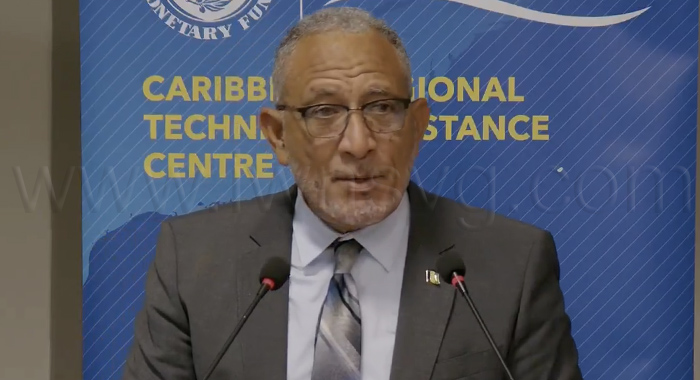
    The Tuesday press conference marked a break from long-standing practice in SVG: for the first time, the IMF’s mission chief for the country presented the Fund’s conclusions directly to the public, rather than having findings filtered through the sitting administration’s partisan framing — a norm that prevailed during Gonsalves’ two-and-a-half decades in office. Prime Minister Friday, who also serves as the nation’s finance minister, spoke before IMF Mission Chief Sergei Antoshin at the event, framing the public presentation as a core commitment of his new government to open governance.

    Friday emphasized that the Article IV consultation is a necessary, routine process that his administration takes extremely seriously. “We have to deal with situations as they are, not as we would like them to be,” he noted, adding that his government is prepared to address the nation’s economic challenges with honesty and pragmatism, prioritizing the best interests of all Vincentians. Having held office for just five months, Friday reiterated that his administration campaigned on a pledge of transparency, saying the public press conference is part of a broader commitment to keep citizens informed of every major policy challenge and decision the government faces. “Today’s session is a part of that process of engaging with the people of this country on important matters that confront them,” he said.

    But Gonsalves took issue not only with the substance of the IMF’s recommendations, but also with Friday’s decision to share the stage with Antoshin. The former prime minister claimed he never invited an IMF mission chief to appear alongside him at a public press conference during his tenure, arguing that Friday’s move amounts to the NDP leader hiding behind the Fund to push unpopular “bitter medicine” on the Vincentian public. Gonsalves accused the NDP government of a “mentality of submission” to the IMF, rather than pursuing genuine dialogue and pushing back against harmful policy prescriptions when necessary.

    The debate has also centered on SVG’s long-running high debt burden, which the IMF has repeatedly flagged as a critical risk to economic stability. As of December 31, 2025, the nation’s total national debt stood at 3.5 billion Eastern Caribbean dollars, equal to an estimated 113% to 120% of gross domestic product, per World Bank calculations. Antoshin noted during Tuesday’s press conference that SVG has been classified at high risk of debt distress since 2016.

    Gonsalves, who served as finance minister for 17 of his 25 years as prime minister, defended his administration’s debt record, pushing back against framing that links the rising debt to reckless public spending. He cited Antoshin’s own comments that growing fiscal deficits were driven by post-disaster relief and reconstruction efforts, large public infrastructure projects, and rising current expenditures. Gonsalves clarified that the major construction projects completed under his administration included critical public assets: primary and secondary schools, coastal and riverine flood defenses, community clinics, a new national hospital, an upgraded port, an international airport, and a national sports stadium.

    He also disputed characterizations of the debt portfolio as overly expensive, noting that total debt sits at 3.3 billion Eastern Caribbean dollars, 2.1 to 2.3 billion of which is low-interest external debt, with less than 1 billion in domestic debt held primarily in government bonds. “When they’re talking about the debt … the bulk of the debt is cheap, overwhelmingly,” Gonsalves said. He added that his administration had already agreed on a framework with the IMF to gradually reduce the debt-to-GDP ratio to 60% to 65% by 2035, putting the nation’s debt on a sustainable long-term trajectory.

    Full details of the IMF’s assessment and policy recommendations are expected to be released publicly in the coming weeks when the Fund publishes its full Article IV staff report and Executive Board concluding statement.

  • Gov’t will enforce taxes, not raise them — PM

    Gov’t will enforce taxes, not raise them — PM

    Eight years after St. Vincent and the Grenadines (SVG) first slid into a state of high risk of debt distress, the island nation’s newly elected government has laid out a balanced fiscal strategy that prioritizes strengthened tax enforcement over new tax hikes, paired with private sector-led growth and targeted debt restructuring to reverse the country’s strained fiscal position.

    Prime Minister and Finance Minister Godwin Friday outlined the administration’s approach during a joint press briefing with the International Monetary Fund (IMF) in Kingstown on Tuesday, held alongside the release of the IMF’s latest economic outlook for SVG. Friday, whose New Democratic Party (NDP) secured a landslide 14-1 victory over the long-ruling Unity Labour Party in the November 2025 general election, ended 25 years of opposition rule and inherited a daunting fiscal landscape: as of December 31, 2025, the country carries a total national debt of 3.5 billion Eastern Caribbean dollars, with a debt-to-GDP ratio hovering between 113% and 120% per World Bank data.

    Framing the government’s core revenue strategy, Friday emphasized systemic tax reform and modernization, with a near-term focus on closing compliance gaps rather than raising existing tax rates. “We’ve identified property tax enforcement as one of our key priority areas,” he explained, noting that current compliance rates for property taxes sit at just 20% — a figure he called shockingly low. “Simply making the existing system work, without changing rates or adding new financial burdens for taxpayers, will deliver significant revenue gains. That’s the approach we are adopting to strengthen our revenue position,” the prime minister said, adding that broader tax system modernization efforts are underway but declined to share further details.

    On the expenditure side, the administration plans to pursue targeted rationalization of large recurring spending items, including public sector wage bills, pension obligations, and government subsidies, while directing limited public resources toward high-impact productive investments to drive economic expansion. Friday highlighted agriculture, tourism, and the blue economy as key growth sectors, noting that tourism has already posted solid gains over the past two to three years, while the blue economy holds untapped transformative potential for the island nation.

    Against a backdrop of limited fiscal space that rules out large-scale public-led investment, Friday made clear that the government’s growth strategy centers on private sector leadership, attracting both domestic private capital and foreign direct investment to drive expansion. “The scope for government to lead the large-scale investments we’ve seen in the past is very limited right now, because we simply don’t have the fiscal room for that,” he noted.

    To address the country’s heavy debt burden directly, Friday laid out a three-pronged strategy combining active debt management operations, fiscal adjustment, and a new citizenship by investment (CBI) programme — a key campaign promise from the NDP that the party has said will not add to existing national debt. The plan includes debt swapping and refinancing to replace higher-interest debt obligations with lower-cost alternatives, and Friday stressed that while the government is negotiating with bilateral and multilateral partners to ease its debt load, it remains fully committed to meeting all its existing financial obligations. The end goal, he said, is to free up critical fiscal space to maintain core government functions and fund new strategic investments.

    Under the proposed CBI programme, which would grant citizenship in exchange for qualified investments, Friday confirmed that all generated revenue will be prioritized for debt reduction and capital projects, rather than covering routine day-to-day government spending, a model aligned with how other Caribbean nations have structured similar programmes. IMF Mission Chief for SVG Sergei Antoshin noted during the briefing that a well-designed CBI programme could deliver a modest boost to fiscal revenue, but also carries inherent risks that require careful structural planning to maximize benefits. Friday responded that he broadly accepts the IMF’s guidance, noting that the government’s revenue allocation strategy aligns with that risk-mitigation approach.

    Currently, SVG’s baseline annual growth projection sits at around 2.7% — a rate Friday says is too slow to address the full scale of the country’s fiscal and social challenges. “We need faster growth than that, and we have a clear roadmap to deliver it. We are working to put all these measures in place as quickly as possible,” he said. The prime minister framed growth, debt sustainability, and social protection as mutually dependent objectives, noting that long-term stability depends on getting the balance right: “Sustainability only comes when we can meet our debt obligations, invest in our productive sectors, and build the infrastructure that generates further growth. These are significant challenges, and we are fully aware of the work ahead of us.”

  • API apologises for ‘genuine error with malicious intent’

    API apologises for ‘genuine error with malicious intent’

    A state-run public information agency in the Caribbean has found itself embroiled in minor political controversy after a costly administrative error triggered multiple conflicting apologies this week. On Tuesday, the Agency for Public Information (API) mistakenly distributed a media advisory announcing that former Prime Minister Dr. Hon. Ralph Gonsalves would host a press conference on April 28, 2026, a date more than two years in the future at the time of the error.

    The blunder comes five months to the exact day after opposition leader Godwin Friday was sworn in as the new prime minister, ending Gonsalves’ historic 25-year consecutive tenure in the nation’s top office.

    Within minutes of the first incorrect advisory going out, API dispatched a follow-up email to correct the mistake. That initial correction, signed by acting API director Nadia Slater, included a contradictory phrasing that only amplified confusion: it claimed the agency “sincerely apologises for the typing error in the previous email and wishes to indicate that it was a genuine error with malicious intent.” The contradictory wording immediately sparked speculation about whether the gaffe was a deliberate political slight rather than an innocent mistake.

    To address the growing confusion, API issued a third formal, press release-style apology hours later, walking back the contradictory language from the first correction. In this statement, the agency emphasized that the misidentification of the prime minister was purely accidental, stemming from a routine administrative oversight during draft preparation.

    “There was NO disrespect, political motive, or malicious intent whatsoever,” the statement read, reaffirming the agency’s commitment to upholding strict standards of professionalism, accuracy, and accountability across all official communications.

    The agency acknowledged that it failed to meet its own quality benchmarks with the erroneous correspondence, attributing the mistake to unintended human error. “We regret any misunderstanding or concern caused by this error and thank the public and members of the media for your understanding,” the statement continued. API officials noted that internal procedural changes are already underway to strengthen pre-release review processes, with the goal of preventing similar embarrassing missteps in the future. Unlike the first correction, this final formal apology was only signed “Director (Ag.)” with no specific named signature.

  • Bagga man, 70, nabbed at AIA trying to take ganja to Holland

    Bagga man, 70, nabbed at AIA trying to take ganja to Holland

    A 70-year-old Vincentian musician who has resided in the Netherlands for a number of years has been handed total fines of EC$770 after being caught with nearly 2 kilograms of cannabis at St. Vincent’s Argyle International Airport, as he waited to board an international flight bound for the United Kingdom.

    The man, Kelroy Edwards, a native of the coastal town of Barrouallie in St. Vincent, pleaded guilty this week at the territory’s Serious Offences Court to three related charges. The charges stem from an April 26 incident where airport law enforcement found the 1,986 grams (4.4 pounds) of cannabis in his checked luggage ahead of his Virgin Atlantic flight to the UK. Edwards admitted that a friend gave him the cannabis, and claimed he mistakenly believed transporting the drug was legal, as he was set to deliver it to contacts waiting for him in Amsterdam.

    Prosecutor Renrick Cato, an Inspector with the local police, laid out the full facts of the case for the court: the cannabis was discovered in six individually plastic-wrapped and taped packages hidden inside a black duffel bag that Edwards had checked in for his outbound flight. When questioned by on-duty police officer PC1021 Thomas after the seizure, Edwards repeated his claim that he did not know crossing international borders with the drug was against St. Vincent’s law. Edwards told investigators he believed carrying cannabis was permitted because the substance is allowed for personal and medicinal use in Amsterdam, where he currently lives.

    In mitigation arguments to the court, Edwards’ defense attorney Grant Connell noted that his client had expressed clear remorse for his mistake, fully cooperated with police investigators throughout the process, and had no prior criminal convictions on his record.

    Chief Magistrate Colin John handed down the sentence on Monday: Edwards received an EC$270 fine for the attempted exportation charge, and an additional EC$500 fine for possession of cannabis with intent to traffic. The magistrate ordered that both fines be paid immediately, with a default three-month prison sentence for non-payment. The charge of possession with intent to supply the drug was dismissed, with Edwards reprimanded and discharged on that count. The court also ordered the entire seized cannabis shipment to be destroyed.

  • IMF says CBI can help SVG but warns against development bank

    IMF says CBI can help SVG but warns against development bank

    Less than one month after the New Democratic Party (NDP) took power following a landslide election victory that ended a quarter-century of Unity Labour Party (ULP) rule in St. Vincent and the Grenadines (SVG), the International Monetary Fund (IMF) has weighed in on two of the new administration’s flagship policy proposals, delivering a mix of conditional approval and sharp pushback. In a joint press conference held Tuesday in the capital Kingstown with SVG Prime Minister and Finance Minister Godwin Friday, IMF mission chief Sergei Antoshin shared the global financial body’s assessment of the NDP’s planned citizenship by investment (CBI) programme, a key campaign promise from the party’s successful November 2025 election run. Antoshin noted that, if structured correctly, the new CBI programme could deliver a modest but meaningful boost to SVG’s public fiscal revenue, the explicit core goal of the initiative. But he stressed that poor design carries significant unaddressed risks, and outlined clear parameters for what the IMF considers an effective, low-risk framework. According to Antoshin, the optimal structure for the programme centers on a single direct donation or contribution to public funds, while pathways that grant citizenship in exchange for private sector investments or real estate purchases are strongly discouraged. He also added a critical requirement: all revenue generated through the CBI programme must be allocated exclusively to reducing the country’s outstanding public debt. The NDP administration has remained firm in its commitment to launching the programme, despite ongoing public opposition from the defeated ULP, which has pushed back against the policy since it was first introduced on the campaign trail. Beyond the CBI proposal, Antoshin made clear that the IMF does not back the NDP’s plan to establish a new national development bank, a proposal already being debated in the country’s parliament. The IMF’s rejection draws on past high-risk experiences with similar institutions across the Caribbean region, and aligns with the ULP opposition’s stance against the initiative. Antoshin explained that launching the new bank would require significant upfront public capitalization, paired with ongoing recurring fiscal costs that would undermine SVG’s critical ongoing fiscal consolidation efforts. He also warned that the institution would create substantial additional contingent liabilities that would strain the country’s public finances long-term. Instead of creating a new standalone institution, Antoshin argued that policymakers should prioritize strengthening the country’s existing credit intermediation systems to support economic development. The IMF’s public comments come one week after SVG’s parliament opened debate on a private member’s motion put forward by government senator Chelsea Alexander, which formally calls for the establishment of the new development bank. ULP Opposition Leader Ralph Gonsalves, who served as prime minister for the party’s 25 years in office, has already spoken against the motion, drawing on historical experience with similar development-focused institutions in SVG to back his opposition. Prime Minister Friday has rejected Gonsalves’ criticism as lacking forward-thinking imagination, arguing that consolidating development financing functions into a single entity is far more efficient than the fragmented model of eight separate institutions that operated under the previous ULP administration. The parliamentary debate on the motion is currently adjourned, with a resumption date yet to be announced by legislative leaders.

  • PM says economic reform to be homegrown, people-focused

    PM says economic reform to be homegrown, people-focused

    Five months after taking office as St. Vincent and the Grenadines’ (SVG) fifth prime minister, Godwin Friday — who also serves as minister of finance — has announced a deliberate, rules-based strategy to address the Caribbean nation’s worsening debt crisis and fragile fiscal position. The plan was unveiled Tuesday during a joint press conference in Kingstown held at the conclusion of an Article IV consultation with the International Monetary Fund (IMF), the Washington-based global financial institution.

    Friday emphasized that SVG cannot rely on passive waiting for economic challenges to resolve on their own, a sharp break from the fiscal trajectory of the previous Unity Labour Party administration, which held power from 2001 until November 2024. Current projections paint a stark picture of the nation’s finances: SVG’s debt-to-GDP ratio already sits at 113% for 2025, and if no policy changes are made, that figure is expected to climb to 145% by 2031. The country has been classified at high risk of debt distress since 2016, and ongoing external shocks including soaring global oil prices and persistent inflation, paired with lingering recovery costs from recent natural disasters, have pushed the already precarious fiscal situation to a breaking point.

    While Friday confirmed the IMF is providing critical technical support to the reform effort, he stressed that the stabilisation programme will be fully homegrown, with national ownership at its core. “We will implement, we will develop, devise, of course with your technical assistance, our homegrown economic stabilisation programme that will ensure that we have national ownership of the recovery journey on which we are embarking,” the prime minister said. “We are on that journey.”

    A core principle guiding the government’s approach is social fairness, Friday added, noting that any fiscal adjustment must prioritize protecting SVG’s most vulnerable communities, who bear the brunt of rising prices and economic instability first. “It is not just a balance sheet matter… it involves people’s lives,” Friday said of the government’s framework. “The costs of these higher oil prices and higher costs of inflation and so forth… will not be borne disproportionately by those persons who are most vulnerable, because they’re the ones who feel it first. Protection of the most vulnerable are central to any reform efforts.”

    To deliver accountability and transparency, the government will establish a legally backed rules-based fiscal framework with clear, measurable targets. Key milestones include reaching a 3% primary surplus as a share of GDP by 2029, and aligning the nation’s fiscal practices with the Eastern Caribbean Currency Union (ECCU)’s 60% debt-to-GDP benchmark. Friday acknowledged the 3% surplus target is ambitious, requiring an 11 percentage point turnaround in the coming years, but noted similar shifts have been achieved in other nations, and the ambitious timeline is necessary to put SVG on a sustainable path.

    The prime minister welcomed the IMF’s balanced, collaborative approach to the partnership, saying it aligned with the government’s focus on balancing fiscal responsibility with inclusive economic growth. “We’re prepared to do what is necessary here in a way that is going to set our country on a path towards fiscal responsibility, but also one that generates growth… and that we do so in a way that is both responsible and sustainable,” Friday said.