标签: Saint Vincent and the Grenadines

圣文森特和格林纳丁斯

  • GHS and the creation of ‘high-maintenance women’

    GHS and the creation of ‘high-maintenance women’

    A recent controversial comment from St. Vincent and the Grenadines’ former prime minister and current opposition leader, who blamed rising national crime rates on so-called “high maintenance women”, has drawn widespread and well-deserved condemnation across the country. This misleading, dismissive statement does nothing to address the root of the nation’s most pressing social challenges – many of which trace directly back to deep, long-standing flaws in the country’s public education system, a crisis that has already been formally flagged by global development experts.

    A 202? World Bank assessment has repeatedly warned that the Caribbean region faces a systemic education crisis, with entrenched structural issues that carry devastating long-term consequences for social stability and economic growth. In St. Vincent and the Grenadines, these gaps are visible even at the nation’s most prestigious educational institutions, underscoring the scale of the problem. This year marks the 115th anniversary of Girls’ High School, the country’s long-revered premier all-girls secondary school. But behind its decades-long reputation for excellence lies a troubling pattern of missing oversight from the national Ministry of Education that has gone unaddressed for years.

    Parents of enrolled students have repeatedly raised alarms about unregulated autonomy at the school, claiming school leadership operates outside formal accountability frameworks. While educational leaders are rightfully granted a degree of institutional autonomy to manage campus operations, this authority must always be bounded by clear national regulations, consistent monitoring, and public transparency. The same standards that govern small rural schools across the nation must apply equally to so-called “elite” institutions – from the curriculum offered to student access to learning equipment, and even to the fees charged for graduation and school events.

    It is true that some schools enjoy advantages from more connected, wealthy alumni networks and parent communities, but public education in St. Vincent and the Grenadines is supposed to be founded on the core principle of equal opportunity for all students, regardless of background. Today, however, relentless fundraising demands have shifted priorities dramatically: many students report that revenue generation has overtaken actual learning as the school’s top focus. Frequent allegations of financial impropriety surrounding combined government funding and independent school fundraising efforts have yet to be addressed by a formal public audit from the Ministry of Education, leaving concerns uninvestigated.

    One alumna of Girls’ High School commented that the school “exposes us to the finer things in life so that we know what we should want later”. But this framing exposes a dangerous double standard: does this mean that young Vincentian women who could not attend the elite school are inherently less capable of aspiring to a high quality of life? For low-income students like Mary Jones, who struggles to cover daily transportation costs for school, let alone the endless fees for mandatory school events, the pressure of keeping up appearances and covering unplanned costs completely overshadows the goal of learning.

    This system risks institutionalizing systemic classism across generations, teaching students that social status and image matter more than knowledge, and that fundraising events matter more than student wellbeing. Instead of scapegoating women for national crime, as the opposition leader did, the country must turn its attention to fixing these deep structural flaws in education – the foundation of any strong, equitable nation.

    If St. Vincent and the Grenadines is serious about building a prosperous, united future, leaders must commit to meaningful reform across the entire education sector. Administrative appointments must be made based on merit and public accountability, not patronage, and consistent oversight must be enforced for every school, regardless of its reputation or student demographic. The education system must be restructured to prepare young people to navigate 21st-century challenges, staffed by well-supported educators focused on the core mission of nation-building, one student at a time.

    Instead of perpetuating learned helplessness, class division, and harmful hierarchies under the guise of education – the very dynamics that produce the inequity the opposition leader wrongly blames on women – the nation must build a new system rooted in equal access, consistent accountability, and opportunity for every young Vincentian, regardless of gender, class, or which school they attend.

  • Volcano-affected fishers get equipment ULP stored since 2022

    Volcano-affected fishers get equipment ULP stored since 2022

    Three and a half years after the devastating 2021 volcanic eruption in Saint Vincent and the Grenadines, fishers across Central Leeward and South Windward have finally received critical fishing supplies that had sat locked in government storage since 2022. The long-overdue equipment, which includes essential gear such as rope, flotation devices, and fish pot wire, has been distributed to fishing communities across Buccament, Layou, Shipping Bay, and Barrouallie as part of this week’s handover events. The unclaimed supplies were originally earmarked for a post-eruption recovery initiative launched by the former Unity Labour Party (ULP) government, which was voted out of national office in last November’s general election. According to reporting from iWitness News, the gear was never distributed to the intended fisher recipients due to public infighting between at least two ULP cabinet ministers during the previous administration’s term. Conroy Huggins, who serves as both Member of Parliament for Central Leeward and the head of the new Ministry of Fisheries under the newly elected New Democratic Party (NDP) administration, made the remarks during an official handover ceremony held in Bottle and Glass, Barrouallie. Huggins explained that the now-defunct recovery program was designed from its inception to help fishing communities rebuild their livelihoods after the 2021 volcanic eruption, which caused widespread disruption to the local fishing industry. “Sadly, they were not distributed to the fishers within the time span,” Huggins told attendees at the ceremony. After winning office and learning of the years-long delay in delivering the critical supplies, Huggins said he immediately directed ministry staff to cut through bureaucratic hold-ups and get the gear to the fishers who needed it. “It’s long overdue. It is something that they should have had at least three, four years ago… So today, we have been doing these distributions,” he added. The fisheries chief also noted that fish pot fishing is a common traditional practice in Barrouallie, making the fish pot wire included in the shipment particularly useful for local fishers. The distribution is being held as a key event during the country’s annual Fisheries Month celebrations, which lead up to the 49th National Fisherman’s Day on May 25. Huggins framed the handover of backlogged recovery supplies as a perfect opportunity to highlight a stark difference in governing philosophy between the new NDP administration and the former ULP government. “And this is essentially the difference between the previous administration and this present administration,” he said. “We are operating on efficiency and delivery. We are about people. So whatever forms of benefits that the fishers are entitled to, we will ensure that they are able to receive this in a timely manner, so that they can be able to recover, operate and move forward with their business.” While he used the delay under the previous government to draw political contrasts, Huggins also acknowledged that the new administration faces a massive backlog of work to repair and upgrade fisheries infrastructure across all of Saint Vincent and the Grenadines, from central ministry headquarters to small local fishery centers in remote coastal communities. “We have quite a lot of work to do in the fishery sector,” he said. Huggins added that the ongoing shifts in the national fisheries sector have drawn significant attention from local, regional, and international stakeholders, framing the current policy adjustments as a once-in-a-generation shift for the industry. “We are confident that we can maximise our ocean [and] improve the livelihoods of our fishers,” Huggins said. “So from a fisheries standpoint, we are here to facilitate and ensure that the capacity building takes place and the necessary equipment, tools that they need. We are here to give that support.”

  • Former national footballer gunned down in Calliaqua

    Former national footballer gunned down in Calliaqua

    A devastating act of violence has shaken the small coastal community of Cailliaqua in St. Vincent and the Grenadines, where former senior men’s national footballer Keith James was shot to death late Friday, just nine days shy of his 38th birthday.

    Local law enforcement agencies remain on site in the hours following the incident, working to gather forensic evidence and interview witnesses near the Anglican Church at the heart of the south coast town where the shooting unfolded.

    Preliminary accounts from early investigators indicate James had just completed his journey back to his local residence. The fatal attack occurred moments after he stepped out of his vehicle, leaving residents and officials in shock.

    Local community members have put forward preliminary speculation about the premeditated nature of the killing: a dark-colored unregistered vehicle was spotted speeding away from the area immediately after the gunshots rang out, leading locals to believe the gunman lay in wait for James before striking.

    The tragedy marks a grim milestone for the Caribbean nation this year. James’ murder pushes the total number of homicides recorded in St. Vincent and the Grenadines in 2024 to 14, and he is the fourth person to be killed by gun violence in the country in less than a four-week period.

    Beyond his time representing St. Vincent and the Grenadines on the international football stage, James also built a well-known legacy as a player for the local club side Avenues United, earning respect from teammates and fans across the country’s domestic football circuit.

  • Farmer, 61, fined for marijuana

    Farmer, 61, fined for marijuana

    A 61-year-old small-scale farmer from Barrouallie has avoided jail time after pleading guilty to a marijuana possession charge in a St. Vincent court, receiving a steep fine instead of a custodial sentence. Andy Reece admitted to the charge of possession with intent to supply a controlled substance before Chief Magistrate Colin John at the Serious Offences Court this Thursday. The case traces back to April 21, when police at the Barrouallie Station received an anonymous tip about Reece’s illicit activity, prompting officers to secure a formal search warrant for his residence.

    When law enforcement officers arrived at the property, they were greeted by Doritha Solomon, who informed the team that Reece was not present at the time. After officers disclosed that they were conducting a search for illegal firearms, ammunition, and controlled drugs, Solomon granted the team permission to proceed with the search, noting that only she and her granddaughter were staying in the home at that point.

    During a search of Reece’s personal bedroom, conducted with Solomon present as a witness, officers first discovered a plastic bag holding suspected cannabis hidden inside a storage container. A further search of the space turned up additional amounts of the drug, stashed inside a tub and bucket tucked under the bed. When confronted with the illicit find, Solomon immediately denied any ownership of the drugs, leading officers to take her into custody on suspicion of drug possession and transport both her and the seized evidence to the Barrouallie Police Station. The total weight of the confiscated marijuana was recorded at 8,034 grammes, equal to roughly 17.7 pounds.

    Roughly an hour and 20 minutes after the search concluded, Reece voluntarily presented himself at the police station and claimed full responsibility for the seized cannabis. Police followed formal procedure, cautioning Reece before conducting an interview in the presence of Justice of the Peace Nash. In his official caution statement, Reece claimed the drugs were for his own personal use rather than for distribution to other buyers, saying: “The drug belongs to me. Me just get it to smoke, not to sell.”

    Grant Connell, Reece’s legal representative, presented several mitigating arguments to the court ahead of sentencing. Connell highlighted that this marked Reece’s first criminal conviction, emphasized that his client voluntarily came forward to take responsibility for the drugs, and entered a guilty plea at the earliest possible opportunity. The attorney also told the court that Reece had relied on illegal marijuana cultivation to support his family financially for the past 40 years, and formally requested that the court issue a non-custodial sentence rather than prison time.

    After weighing both the mitigating circumstances presented by the defense and the aggravating factors of the case, the court initially calculated a total fine of EC$3,320. When Connell informed the judge that Reece only had EC$3,000 available to pay immediately, Chief Magistrate John adjusted the fine to EC$3,000, ordering that the sum be paid right away. The sentence also includes a backup penalty of one year in prison if the fine is not paid. Beyond the fine, the magistrate ordered that the storage containers seized in the search be returned, and that the entire cache of marijuana be destroyed.

  • Everyday citizens help document SVG’s unique biodiversity

    Everyday citizens help document SVG’s unique biodiversity

    To mark Earth Day 2026, hundreds of volunteer citizen scientists across St. Vincent ventured into the Montreal Watershed to map and document the small island nation’s extraordinary native biodiversity, kicking off the inaugural BioSleuths Challenge – a nationwide conservation initiative organized by the Sustainable Development Unit (SDU) under St. Vincent and the Grenadines’ Ministry of Tourism, Civil Aviation and Sustainable Development, in collaboration with the United Nations Development Programme (UNDP).

    The diverse group of participants ranged from local school students and classroom teachers to seasoned technical specialists and members of the general public, all armed with user-friendly smartphone observation tools to identify, photograph, and log a wide spectrum of native species. The survey covered all major taxonomic groups, from native plants and wild birds to terrestrial insects, reptiles, amphibians, and the aquatic life that sustains the Montreal Watershed ecosystem.

    Every observation collected during the field activity will be added to St. Vincent and the Grenadines’ official national environmental database, creating a more robust, comprehensive evidence base to guide evidence-based conservation planning and long-term environmental monitoring across the country.

    For small island developing states like St. Vincent and the Grenadines, where limited scientific funding and personnel often leave critical gaps in biodiversity data, citizen science programmes such as the BioSleuths Challenge fill a uniquely important role. By mobilizing everyday community members as trained environmental observers, the initiative not only generates large-scale, geographically broad ecological data that would be impossible for a small team of professional scientists to collect, but also boosts public environmental literacy and cultivates a widespread culture of environmental stewardship across the nation. This model turns passive public appreciation for nature into active, hands-on participation in conservation action.

    The SDU, which functions as the country’s national focal point for work on climate change, biodiversity protection, chemical and waste management, ocean conservation, and ozone layer protection, coordinated cross-sector collaboration between government agencies and civil society organizations to deliver the event. A team of highly experienced environmental professionals led on-the-ground field guidance and training for all participants: the group included fisheries biologist John Renton, veteran forestry specialist L. Fitzgerald Providence with more than 38 years of on-the-ground conservation experience, plant health expert Sylvester Lynch, and independent environmental consultant Amos Glasgow.

    According to an official press release from the organizing team, the expert squad delivered hands-on practical training covering core skills including species identification, standardized ecological observation techniques, and proper data documentation protocols to ensure all collected information meets national and international research standards. Participants also received guided training on how to use leading mobile species identification applications, including Seek by iNaturalist and Merlin Bird ID, to accurately log and verify their observations in the field.

    As a signatory party to the United Nations Convention on Biological Diversity, St. Vincent and the Grenadines has binding international obligations to systematically document its native biodiversity, monitor ongoing ecosystem health, and submit regular public reports on national conservation progress. The BioSleuths Challenge directly advances these commitments by expanding the country’s formal biodiversity observation network to include a growing cohort of trained citizen scientists, dramatically extending the reach of national monitoring efforts.

    The data collected through this initiative will directly inform updates to the country’s National Biodiversity Strategy and Action Plan, and will also contribute to regional biodiversity assessment efforts across the Caribbean, helping to guide cross-national conservation action in the region.

    This BioSleuths Challenge forms one component of the SDU’s expanding portfolio of national environmental programming. Upcoming initiatives include the Environmental Champions Programme, a national community stewardship scheme set to launch on World Environment Day, June 5, 2026, alongside ongoing work on climate transparency, chemical and waste management, and nationwide conservation education.

    A second BioSleuths Challenge field expedition is already scheduled for May 22 at the Vermont Nature Trail, to continue expanding the scope of the biodiversity survey. All data collected during the April Earth Day field activity will be fully analyzed and shared with participating citizen scientists at a dedicated follow-up event later this year. Moving forward, the SDU has announced plans to continue expanding citizen science and biodiversity initiatives across St. Vincent and the Grenadines, with the goal of strengthening the national environmental knowledge base and embedding communities as active, equal partners in ongoing conservation work.

  • Bequia Basketball host youth clinic to boost interest

    Bequia Basketball host youth clinic to boost interest

    After years without organized youth development programming, the Bequia Basketball Association (BBA) has kicked off its first youth basketball clinic in decades, marking the start of a targeted effort to rebuild local grassroots basketball on the island of Bequia. Held in late April at Port Elizabeth’s iconic Clive Tannis Hard Court, the two-day inaugural event brought together more than 55 young athletes aged 7 to 15, eager to learn the fundamentals of one of the island’s most beloved community sports. Over the course of the weekend, participants received hands-on training in core basketball skills, from controlled dribbling and accurate passing to consistent shooting technique. The clinic balanced structured skill-building with collaborative games and interactive exercises crafted to foster personal confidence, communication, and teamwork among the young attendees, turning skill practice into an engaging, community-focused experience. This revitalization effort would not have been possible without widespread buy-in from Bequia’s entire basketball community. Coaches and volunteers from across the island stepped forward to donate their time, expertise, and energy to mentor the next generation. The coaching roster brought together a who’s who of Bequia basketball, including former Bequia All-Star standouts Kelan Edwards, Keithroy Lavia, and Denroy Hutchins; current BBA Executive Committee members Sabrina Mitchell and Colson Peters; SVG Basketball Federation (SVGBF) 3X3 Coordinator Wayne Williams; former SVG national team player Steveon Taylor; and current national players Lennox Ince and Jermaine John, alongside dozens of other community volunteers. The push to relaunch youth clinics comes in direct response to a worrying trend spotted by the BBA during the 23rd Annual Tournament held in August 2025. In a sharp departure from previous years, when more than eight youth division teams regularly registered for the annual competition, only two youth squads signed up to compete in 2025. The dramatic drop in participation served as a wake-up call for the association, highlighting a critical gap in youth engagement that threatened the long-term future of the sport on the island. “This highlighted the urgent need to rebuild youth interest and participation in the sport on the island, ensuring a feeder system and sustainability of the game,” the BBA explained in an official press release outlining the initiative. The association’s overarching mission extends far beyond a single weekend clinic: organizers aim to give Bequia’s next generation the opportunity to learn the game from experienced local coaches, while nurturing a lasting passion, disciplined work ethic, and raw talent that can carry the sport forward for decades. Looking ahead, the BBA has laid out clear plans to lock in this momentum. Following the successful debut clinic, the association will host regular youth training sessions every Sunday from 9 a.m. to noon, leading up to the 24th Annual Tournament scheduled for August 2026. Longer-term strategy calls for sustained investment and gradual expansion of youth basketball development programming across the island. To connect the grassroots training to competitive play, youth teams will be formed entirely from program participants to compete in the upcoming 2026 summer tournament, creating a clear pathway for young athletes to grow from new learners to competitive players.

  • 15-y-o Vincy sails solo 70 miles from St. Vincent to Grenada

    15-y-o Vincy sails solo 70 miles from St. Vincent to Grenada

    Against the rolling open waters of the Caribbean, 15-year-old sailing prodigy Kai Marks Dasent from St. Vincent and the Grenadines has etched his name into regional youth sports history by pulling off an extraordinary solo voyage: a 70-mile crossing from his home country to Grenada, sailed entirely in a 14-foot ILCA dinghy.

    Marks Dasent launched his ambitious journey from Blue Lagoon, St. Vincent, at 5:41 a.m., cutting through the open ocean for more than 10 hours before touching down at Grenada’s northern tip at 4:06 p.m. that same day, logging a total crossing time of 10 hours and 25 minutes. To ensure his safety throughout the expedition, Horizon Yacht Charters provided a dedicated support boat that shadowed his route the entire way.

    The young sailor did not face the challenge without hurdles. Along the route, persistent seaweed became his most persistent foe, clogging his dinghy’s rudder and centreboard repeatedly and forcing him to stop multiple times to clear the debris. To occupy his mind and distract himself from the daunting distance still ahead, he turned to his music playlist — a plan that hit a snag when his device ran out of battery after eight hours at sea. With just a couple of hours left to go, Marks Dasent said the sight of Grenada’s coastline growing on the horizon gave him the motivation to push through the final stretch. He carried water to stay hydrated and packed energy-boosting food and granola bars to sustain his strength through the long voyage.

    This landmark achievement is the product of three years of deliberate, incremental preparation that saw Marks Dasent steadily build his skill and endurance with progressively longer offshore journeys. At 13, he completed a 10-mile crossing from St. Vincent to Bequia; at 14, he took on an 18-mile trip to Mustique, followed soon after by a 42-mile voyage from St. Vincent to Union Island. Each step of the way, these smaller adventures gave him the seamanship and confidence to take on his largest challenge to date.

    Beyond being a personal athletic milestone, the sponsored voyage carries a deeply community-focused mission: raising funds for Marks Dasent’s home club, Vincy Sailing, to expand competitive opportunities and lower barriers to entry for young people interested in the sport. The funds will go toward launching a new “Learn to Sail” programme, whose first cohort will serve children from the Lowmans Leeward fishing village, giving many of them their first chance to step onto a sailboat and build new transferable skills both on and off the water.

    Jennifer Deane, a representative of Vincy Sailing, emphasized that Marks Dasent’s feat is far more than a one-off personal victory: it is a transformative source of inspiration for young sailors across St. Vincent and the Grenadines. “This initiative is not just about one sail, it’s about creating opportunities for more young people, especially from coastal communities, to get involved in sailing and develop lifelong skills,” Deane explained.

    The Grenada crossing caps an already exceptional year of competition for the young sailor on the regional racing circuit. He took home first place in the ILCA 6 division at the Antigua ILCA Nationals, claimed second in the same class at Barbados Sailing Week, and earned the chance to represent St. Vincent and the Grenadines at Midwinters East in Miami. Beyond his dinghy racing success, Marks Dasent has also built valuable deep-water experience through offshore yacht racing: he crewed aboard *The Blue Peter* during St. Vincent Sailing Week, and spent eight days and nights as part of the crew of *Galiana* at the Antigua Classic Regatta.

    Looking forward, the teenage sailor is already deep in preparation for his next big challenge: representing St. Vincent and the Grenadines at the ILCA 6 Youth World Championships in Denmark this coming summer, as he continues to climb the ranks of competitive sailing.

    Marks Dasent’s breakthrough achievement also aligns with the larger strategic vision of the SVG Sailing Association, which has centered its youth development work on three core pillars: fun, competitive racing, and vocational opportunity. The association works to introduce young people to sailing in a supportive, accessible environment, provide pathways to competitive competition, and show youth that sailing can open doors to long-term careers and life-changing opportunities. For the SVG sailing community, Kai Marks Dasent’s determined journey perfectly embodies this mission, proving what young people can achieve with consistent commitment — and inspiring the next generation of Caribbean sailors to chase their own goals.

  • Man charged over attack on API head remanded

    Man charged over attack on API head remanded

    A 45-year-old delivery clerk from Clare Valley has been remanded in custody following a violent multi-charge attack that left one victim fighting for life in intensive care, court documents confirm.

    Keswert Slater, who is a cousin of the acting director of the Agency for Public Information Nadia Slater, appeared before Chief Magistrate Colin John at the Serious Offences Court on Thursday to answer to four separate criminal charges connected to the May 5 incident in his hometown.

    The charges against Slater include attempted murder of Jean Slater, a fellow Clare Valley resident, inflicting grievous bodily harm on Nadia Slater, and trespassing on Nadia Slater’s residential property with the explicit intent to cause serious physical harm. All charges are indictable, so no plea was requested from the defendant during this initial court appearance.

    Prosecuting the case is Inspector of Police Renrick Cato, who formally objected to granting Slater bail ahead of trial. Cato informed the court that one of the victims remains hospitalized in the Intensive Care Unit of Milton Cato Memorial Hospital, underscoring the severity of the incident. When Chief Magistrate John asked Slater whether he understood the implications of the prosecution’s bail objection, Slater confirmed he understood and stated that he did not object to being held in prison ahead of his trial.

    Slater, who is currently unrepresented by legal counsel, was ultimately denied bail by the magistrate. The case has been adjourned until Monday, when a formal bail review hearing will be held. This is not the first time Slater has attracted public attention: in 2000, he made local headlines after being linked to the theft of 63,000 Eastern Caribbean dollars from C.K. Greaves & Co Ltd, a local business.

  • PM moving ahead with dev’t bank despite IMF objection

    PM moving ahead with dev’t bank despite IMF objection

    Prime Minister Godwin Friday of St. Vincent and the Grenadines (SVG) is holding firm to his administration’s flagship plan to launch a national development bank (NDB), pushing forward despite explicit warnings and opposition from the Washington-based International Monetary Fund (IMF). The proposal, a core campaign promise of Friday’s New Democratic Party (NDP) that won a landslide 14 out of 15 parliamentary seats in the November 2025 general election, is framed by the prime minister as a critical intervention to reverse years of economic stagnation and address the country’s soaring public debt crisis.

    Speaking on NBC Radio this Thursday, Friday — who also holds portfolios for finance, legal affairs and justice, economic planning, and private sector development — explained that the NDB is designed to solve long-standing structural barriers that block small and non-traditional businesses from accessing affordable credit. SVG currently carries a public debt load equivalent to 113% of its gross domestic product, and Friday warned that without bold policy changes, that figure could climb to 145% or higher within five years, a trajectory he calls completely unacceptable.

    While the prime minister acknowledges that the country’s debt profile is severe and requires careful management, he argues that accelerating inclusive economic growth is the fastest route out of the current crisis. He noted that even in discussions with IMF officials, the fund has agreed that growth is the most effective way to reduce debt burdens over time. The IMF has projected that SVG’s economic growth will moderate to 3.7% in 2025 as post-pandemic tourism and construction rebounds fade, and decelerate further to a medium-term average of 2.7% between 2026 and 2027 amid high global oil prices and a weaker global economic outlook. For Friday, this slow growth forecast makes the NDB a more urgent priority, not a less necessary one.

    “This is the way we get out of the difficult situation that we are in, and we have to transform our economy,” Friday said. “We have to unleash the creative and business potential in our economy and make it available to ordinary people to start doing things to grow our economy.”

    The IMF’s opposition, outlined by mission chief for SVG Sergei Antoshin in an April 28 statement, centers on three key concerns: risks to debt sustainability from adding a new quasi-fiscal institution to an already heavily indebted economy, the potential for contingent liabilities that could force the government to inject emergency public funds down the line, and the risk of political interference in lending decisions that has plagued regional development banks in the past, leading to high rates of non-performing loans. Antoshin also referenced a history of underperformance among similar institutions across the Caribbean.

    Critics have also framed the new NDB as a revival of a failed 1970s-era development bank launched by a previous administration, which was eventually absorbed into the National Commercial Bank after being deemed a stillborn, unsuccessful experiment. Friday rejected these claims, emphasizing that the project is not rooted in ideology or a bid to redeem old failed political initiatives. Instead, he argued that continuing with the status quo of fragmented lending support has not worked, and the NDB is a pragmatic solution to the proven problem of limited credit access.

    “Everybody identifies the problem, and we come back to the same thing — is to try to deal with what we have as if that is the perfection that we’re seeking. It doesn’t work. That’s what we have seen,” Friday said. “What we’re saying is what is the best way in which to achieve this, and that is why we are pursuing this objective, because we believe that, properly managed, properly established, that it can meet that need.”

    Friday confirmed that his administration will take the IMF’s concerns into account during the institutional design phase to avoid the pitfalls that derailed past projects. He noted that well-governed development banks across the Caribbean have delivered tangible economic benefits, proving that successful operations are not an impossibility. When asked about the risk of political lending — where loans are approved based on party affiliation rather than viable business plans — Friday said the bank’s long-term survival depends on strict, consistently applied lending standards.

    “For it to survive, for it to achieve its objective, it has to function on set principles that everybody understands,” he said. “You want to be generous and supportive of small investors and so forth… but the only way you can sustain that is if you’re also rigorous in terms of the standards that are applied to the lending of the money and the ways in which they are monitored and required to pay back. If you’re going to do it on a political basis, then you are not serious about the development of the country.”

    Unlike commercial banks, Friday said the NDB’s success will not be measured by profit maximization, but by the growth and performance of its borrowers. Currently, scattered government lending and support schemes for underserved groups operate across multiple separate entities, including the Farmer Support Company and the National Student Loan Company, which serve borrowers that commercial banks routinely reject. Friday framed the NDB as a way to consolidate these fragmented functions, introduce professional management, cut overhead costs, and improve overall efficiency. Beyond lending, the new bank will also provide ongoing business support services to help borrowers succeed, rather than just disbursing funds and leaving borrowers to sink or swim.

    On the topic of capitalization, Friday said the government has already identified initial seed funding in the national budget and has received positive feedback from external partners approached for support. The administration has reallocated approximately EC$1.5 million in seed funding to the project, and plans to grow the bank’s capital base over time without relying on expensive high-interest borrowing. Proceeds from the government’s upcoming citizenship by investment programme, which is set to launch soon, will also contribute to the bank’s capital, as these funds come with no interest obligations. The government targets raising at least EC$10 million in capital by the end of the year, a goal Friday calls entirely feasible.

    “What we can’t do is borrow money at 5, 6 and 7% and then put in the bank and you have to lend [at] 12%. That is not going to work,” he added.

  • New Invest SVG head urges BVI diaspora to ‘build with us’

    New Invest SVG head urges BVI diaspora to ‘build with us’

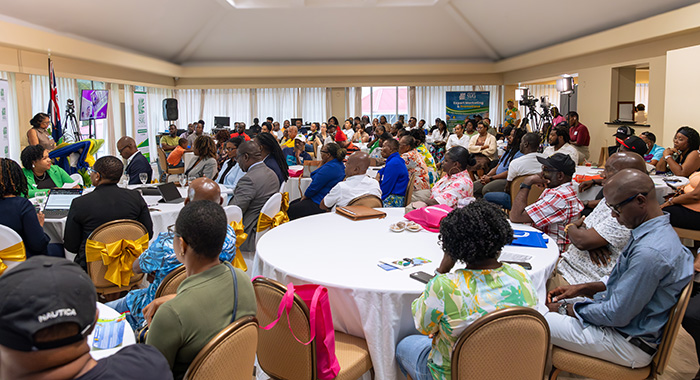
    Fresh off her appointment and 36 years living outside St. Vincent and the Grenadines (SVG), Anna Young, the newly sworn-in Executive Director of Invest SVG, has delivered a landmark call to unity and collective action to the large Vincentian diaspora community in the British Virgin Islands (BVI), urging an end to outdated divisions between domestic and overseas nationals and positioning diaspora contribution as a core strategic pillar of the country’s economic transformation.

    Young, who officially began her role just one day after returning to SVG, used her first major public address as agency head to frame her own homecoming as living proof that diaspora members can successfully reintegrate and contribute meaningfully to national development — a need the country says is increasingly urgent amid shifting global economic conditions. The speech capped off the latest stop of a national investment outreach forum that has already stopped in London, bringing the conversation to the BVI, where an estimated 20% of the population traces its roots to SVG.

    At the core of Young’s message was a rejection of the long-held distinction between Vincentians who reside at home and those who have built lives overseas. “Whether you left our home by choice or by necessity to pursue a better future, you never stopped being Vincentian,” she emphasized, arguing that identity, not current geographic location, defines national belonging. “Vincy by birth, Vincy by descent, Vincy by identity, first generation, second generation, third generation, Vincy by choice. Home is where the heart is, and we are one people,” she told the gathered audience on May 2, 2026.

    Young stressed that this outreach is far more than a sentimental call to return home; it is a deliberate invitation for the global Vincentian community to become structural partners in building the country’s economy. “We are not just asking you to come back — we are asking you to build with us,” she said, noting that contribution extends far beyond high-net-worth investment. “Whatever your profession, from caregivers to nurses, tradespeople to C-suite professionals, your skills, experience and connections matter. Investment is not just about capital. It is human, it is intellectual, it is relational — and we need all of it to move SVG forward.”

    She highlighted early progress from the BVI leg of the forum, noting that local BVI merchants have already expressed interest in stocking products made by Vincentian producers. “That is not just trade. That is increased visibility, growing confidence, and new market opportunities for our entrepreneurs back home. It is a perfect example of what we can achieve when we connect our people across borders,” Young explained.

    Outlining the government’s clear economic roadmap, Young identified four interconnected priority pillars that will drive SVG’s transformation over the coming years: tourism, the green economy, the blue economy, and creative industries. She framed each sector as accessible, growing opportunity areas for diaspora engagement. Tourism, the long-standing cornerstone of the SVG economy, is expanding beyond traditional offerings into high-value niche segments including eco-tourism, boutique experiences, and heritage tourism. The green economy spans renewable energy development, climate-smart agriculture, sustainable construction, and environmental innovation, while the blue economy leverages SVG’s abundant marine assets, covering fisheries, coastal development, marine transport, and emerging ocean-based initiatives. Finally, the creative industries position SVG’s unique cultural identity as an exportable asset, encompassing music, film, digital content, fashion, and visual arts.

    To remove barriers for diaspora investors, Young detailed a comprehensive restructuring of Invest SVG itself, reorienting the agency around four core mandates: export and trade development, foreign direct investment attraction, financial services growth, and intentional diaspora investment mobilization. She positioned the reworked agency as an active, hands-on facilitator rather than a passive bureaucratic body, promising end-to-end support for every investor.

    “We are not asking you to navigate the system alone. We walk with you every step of the way,” Young said, outlining the full scope of support Invest SVG will provide, from initial business registration and project structuring to accessing government incentives, coordinating permits, liaising across ministries, and providing ongoing aftercare once a project launches. Acknowledging that past investment processes have not always been seamless, Young also announced ongoing legislative reforms to the nation’s Investment Act and Tourism Aid Act, designed to turn Invest SVG into a true one-stop shop for investors, with improved transparency, stronger investor protections, and more streamlined coordination across government agencies. The ultimate goal, she said, is to deliver “clarity, predictability and confidence” for all investors.

    SVG already offers a robust package of incentives for qualifying projects, including duty-free concessions on approved imports, corporate tax holidays, targeted sector-based tax deductions and exemptions, facilitated work permits and entry for key personnel, access to land for strategic projects, and ongoing post-launch support. These incentives are structured to make viable local projects more competitive and sustainable, Young noted, adding “You can succeed in St. Vincent.”

    To further support incoming investors, Invest SVG is also building a vetted national ecosystem of pre-qualified service providers, covering construction and project management, sustainable design, architecture, engineering, legal and investment advisory, real estate acquisition, and hospitality operations. “Investment doesn’t succeed in isolation — it succeeds in a strong ecosystem. When you come to SVG, you won’t have to build that ecosystem from scratch; we already have the expert partners you need to hit the ground running,” Young explained.

    Closing her address, Young emphasized that diaspora investment is not a secondary supplementary source of capital for SVG — it is a core strategic priority, particularly amid today’s shifting global economic landscape. “Capital is more selective than ever, competition for investment is fierce, and resilience is the defining requirement for small open economies like ours,” she said. “In this context, diaspora investment is strategic, because you bring more than capital — you bring confidence, credibility, and existing global connections that no outside investor can match.”

    Young rejected the idea that overseas Vincentians must choose between their current adopted homes and their connection to SVG, extending an open invitation for dual belonging: “St. Vincent and the Grenadines is not divided between home and abroad. It is one nation, one people, one identity, working together. Welcome home, come home, invest, build, and let us rise together.”