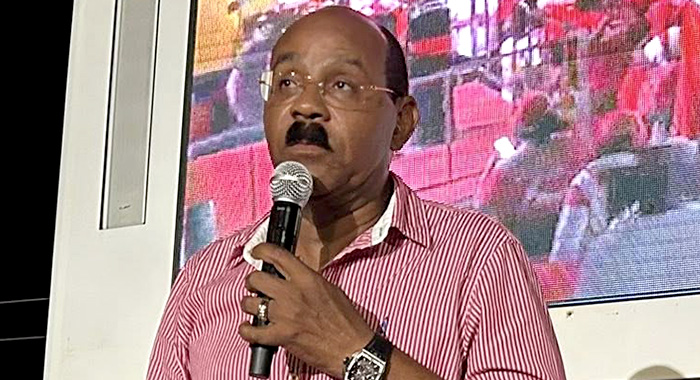
In a high-stakes political move that has reshaped the landscape of Antigua and Barbuda, Prime Minister Gaston Browne’s decision to call a snap general election nearly two years before its constitutionally mandated deadline has delivered a historic, resounding victory for his ruling Antigua and Barbuda Labour Party (ABLP).
Preliminary results released by the Antigua and Barbuda Electoral Commission (ABEC) confirm the ABLP secured 15 out of the 17 contested parliamentary seats, a dramatic reversal of the party’s narrow 9-7 majority win in the January 2023 poll. The landslide win also marks a historic milestone for Browne, who easily retained his long-held St. John’s City West seat – a constituency he has represented since 1999 – making him the first prime minister in the nation’s history to win four consecutive general elections.
Addressing jubilant supporters following the result, Browne expressed deep gratitude for the overwhelming public confidence placed in both his leadership and the ABLP’s agenda for continued national progress. “We are humbled and honoured by your support and confidence. Now is the time to move forward together, build on our gains and continue our work toward the betterment of our society and the upliftment of our people,” Browne wrote in a post on the ruling party’s official Facebook page.
Outlining his policy priorities for the new term, Browne emphasized that inclusive growth and expanded opportunity would remain at the core of his administration’s agenda. “Education, jobs, business opportunities will be open to all who are prepared to seize them. No one will be left behind who is willing to move forward,” he said, rejecting any suggestion of triumphalism after the landslide. “This is not a moment for gloating. The contest is over, and the 15-seat mandate is a resounding vote of confidence for which we are eternally grateful.”
Browne also stressed that the new term would see his administration accelerate ongoing national projects, advance new initiatives to strengthen the national economy, transform local communities, and improve living standards for all citizens. He called for collective productivity and national unity, noting that the government’s goal is to position Antigua and Barbuda as one of the most productive small island states in the world, while upholding national dignity in all regional and international forums. Notably, Browne’s wife Maria – the public works minister in the previous administration – also secured a comfortable win in the St. John’s Rural East constituency, defeating UPP candidate Ashworth Azille.
For the main opposition United Progressive Party (UPP), the election result was a devastating blow: only party leader Jamale Pringle managed to hold onto his seat, defeating ABLP candidate Anthony Smith. On the sister isle of Barbuda, incumbent Trevor Walker of the Barbuda People’s Movement (BPM) retained his seat, winning 609 votes against ABLP challenger Kendra Beazer’s 398. All three independent candidates contesting the election failed to gain traction, losing their deposits.
Pringle extended congratulations to the ABLP on their victory, telling supporters that the UPP would remain active in opposition. “There’s no second place in politics, but just as we did in 2018, we’ll still be standing. The UPP is not going anywhere,” he said.
Regional political analysts have weighed in on the historic result, pointing to deep internal divisions within the UPP as a key driver of the party’s collapse. Barbados-based pollster Peter Wickham, who conducted pre-election opinion polling, noted that the UPP’s strong 2023 performance, which saw the party win seven seats, had “completely evaporated” in this poll, with an overall five percent swing toward the ABLP across the mainland.
Local political analyst Professor Justin Robinson, Pro Vice-Chancellor and Principal of the University of the West Indies Five Islands Campus, observed that the result highlighted key weaknesses in the UPP’s leadership, noting that the electorate delivered a clear verdict on Browne’s leadership and the ABLP’s agenda. Robinson pointed out that Pringle, the only remaining UPP MP, is now the “only man standing” for the opposition, a dynamic that mirrors past election results in other Caribbean nations including St. Vincent and the Grenadines. Still, Wickham argued that Pringle’s retention of his seat is largely a product of long-standing constituency strength rather than public confidence in his national leadership, and called on him to step down as UPP leader to allow the party to rebuild with extra-parliamentary leadership.