标签: Saint Vincent and the Grenadines

圣文森特和格林纳丁斯

  • Scores of public servants welcome new PM to Administrative Complex

    Scores of public servants welcome new PM to Administrative Complex

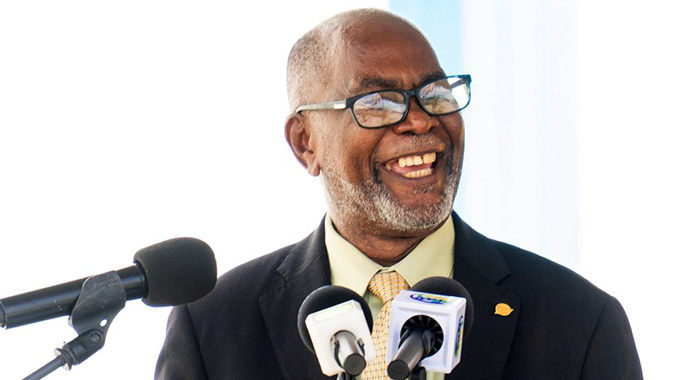
    In a ceremonial transition of power, newly elected Prime Minister Godwin Friday received a warm reception from civil servants upon his arrival at the Administrative Complex in Kingstown on Monday. The historic moment marked his inaugural day at the Office of the Prime Minister following his party’s decisive electoral victory.

    Cabinet Secretary Kattian Barnwell-Scott and Permanent Secretary in the Ministry of Foreign Affairs Sandy Peters-Phillips were among the senior officials present to greet the incoming administration. Friday addressed the assembled crowd—comprising media representatives and supporters of his New Democratic Party (NDP)—with a blend of enthusiasm and measured apprehension regarding the magnitude of his new responsibilities.

    “This building represents my first day on the job!” Friday announced to the gathering. “While I approach this role with some trepidation given its immense scope, I am confident that the dedicated staff will enhance my effectiveness from day one. We stand united in our commitment to serve the people.”

    The Prime Minister, who simultaneously secured his sixth parliamentary term representing Northern Grenadines, emphasized the dawn of a new political era for St. Vincent and the Grenadines. His swearing-in ceremony occurred last Friday, merely one day after the NDP’s landslide 14-1 electoral triumph that left former Prime Minister Ralph Gonsalves as the sole Unity Labour Party (ULP) representative retaining parliamentary presence.

    Friday articulated an ambitious governance agenda during his media engagement, pledging immediate action on campaign commitments. These include reducing Value Added Tax from 16% to 13%, implementing bonus salary payments, elevating Public Assistance to EC$500 monthly, and reinstating public sector workers terminated under previous COVID-19 vaccine mandates—all within a 60-day implementation framework.

    The Prime Minister assured public servants of job security, describing them as “the backbone of any administration” while encouraging autonomous decision-making within their mandates. He revealed that Cabinet ministers would receive their official directives during Tuesday’s swearing-in ceremony, with permanent secretaries providing crucial operational support across ministries.

    Friday concluded with a forward-looking statement: “We require collective effort now more than ever. With the public’s overwhelming mandate, my sole preoccupation remains delivering tangible results for the people of St. Vincent and the Grenadines without unnecessary delay.”

  • PM Pierre relieved at general election victory

    PM Pierre relieved at general election victory

    CASTRIES, St. Lucia – The St. Lucia Labour Party (SLP) has achieved a resounding victory in Monday’s general election, securing a second consecutive five-year term in government. Preliminary results indicate the party has surpassed its previous 13-2 parliamentary majority from the 2021 elections, firmly rejecting the regional trend of victories by parties associated with the color yellow.

    Prime Minister Phillip J. Pierre, addressing jubilant supporters, praised the maturity of St. Lucian democracy following what he characterized as a peaceful and violence-free electoral process. The 71-year-old leader specifically thanked party members, constituency workers, and the electorate for their tireless efforts in achieving this political triumph.

    The main opposition United Workers Party (UWP), led by Allen Chastanet, suffered a devastating defeat with initial results suggesting the former prime minister would be the party’s sole parliamentary representative. Prime Minister Pierre extended congratulations to his political opponent, emphasizing the importance of maintaining democratic traditions through an effective opposition presence.

    The election campaign was notably contentious, with the UWP focusing allegations of corruption and mismanagement against the SLP administration. Particular scrutiny was directed at the government’s handling of the Citizenship by Investment program and allegations against Deputy Prime Minister Ernest Hilaire, though these were dismissed earlier this year by the Caribbean Court of Justice.

    Independent candidates supported by the SLP, including government ministers Stephenson King and Richard Frederick, secured decisive victories in their constituencies. The National Congress Party and other independent contenders failed to gain significant traction, losing their electoral deposits.

    International observation missions from the Organization of American States and CARICOM monitored the electoral process, which was called nearly a year ahead of the constitutional deadline. Prime Minister Pierre indicated he would be formally sworn in later this week, with cabinet announcements expected next week.

  • St. Lucians vote for a new government

    St. Lucians vote for a new government

    CASTRIES, St. Lucia – Citizens of this Eastern Caribbean nation are preparing to cast their votes in a pivotal general election on Monday, marking a democratic contest between incumbent Prime Minister Phillip Pierre’s St. Lucia Labour Party (SLP) and Allen Chastanet’s opposition United Workers Party (UWP).

    The electoral process, monitored by international observers from CARICOM and the Organization of American States, features 52 nominated candidates including eight independents, though political analysts anticipate a direct confrontation between the two dominant parties.

    Prime Minister Pierre, 71, called the election nearly one year ahead of the constitutional deadline, expressing confidence that his party would maintain or exceed its current 13-seat majority achieved in the July 2021 polls. In his final pre-election message on social media, Pierre emphasized divine guidance and collective progress, invoking Psalm 33:12: “Blessed is the nation whose God is the Lord.”

    Opposition leader Chastanet, 65, similarly sought spiritual intervention, praying for “peace, wisdom and protection” during the voting process. Addressing supporters at his final rally in Choiseul, Chastanet referenced recent electoral victories by “yellow” parties across the Caribbean, including in Trinidad and Tobago and St. Vincent and the Grenadines, suggesting a regional political shift.

    Political analyst Rhyesa Joseph identified multiple factors influencing voter behavior, including “national leadership and governance, parliamentary representation, quality of the opposition candidate and trust and confidence in political affiliation.”

    The Electoral Department reports approximately 180,000 registered voters, with Chief Elections Officer Herman St. Helen noting a significant late surge in registrations, particularly among youth. St. Helen emphatically guaranteed a free and fair electoral process despite allegations of corruption.

    Voter turnout remains a concern, with historical data showing a dramatic decline from 80% in 1979 to just over 50% in 2021. Local publication The Voice urged citizens to fulfill their “civic duty” despite this trend.

    Key battlegrounds include constituencies where former UWP members Richard Frederick and Stephenson King, now running as independents after previously aligning with the SLP, face heightened competition. The election’s outcome will determine the direction of national development policies and St. Lucia’s positioning within the Caribbean community.

  • New cabinet could be sworn in on eve of NDP’s 50th anniversary

    New cabinet could be sworn in on eve of NDP’s 50th anniversary

    Newly inaugurated Prime Minister Godwin Friday has confirmed the imminent formation of his administration’s cabinet, with swearing-in ceremonies anticipated for Tuesday. This development follows the New Democratic Party’s (NDP) decisive electoral triumph, securing 14 of 15 parliamentary seats after a quarter-century in opposition.

    The Prime Minister revealed that majority cabinet appointments have been finalized, though specifics remain undisclosed until formal notifications are delivered to designated ministers. Friday emphasized the deliberate selection process, noting the exceptional range of talent available within his parliamentary cohort following Thursday’s electoral sweep.

    In a departure from constitutional conventions, only the Prime Minister took oath during Friday’s ceremony at Government House. Friday attributed this anomaly to unresolved technical considerations requiring additional resolution time, assuring full cabinet inauguration would proceed next week.

    The administration is immediately engaging with critical governance structures, including police leadership and senior civil servants, to ensure seamless transition. Friday acknowledged ongoing celebratory activities among newly elected representatives but emphasized the urgency of convening parliamentary colleagues to establish governance priorities.

    Addressing diplomatic attendance concerns, the Prime Minister characterized the minimal foreign representation at his inauguration as purely logistical, anticipating broader international participation during Tuesday’s comprehensive swearing-in event.

    Geographic representation emerged as a significant theme, with Friday becoming the second Bequia-native to assume Vincentian leadership. While acknowledging regional pride, he stressed national unity across the archipelago, particularly highlighting development initiatives for historically neglected northern regions including North Leeward and North Windward.

    The Prime Minister expressed profound gratitude for the electorate’s emphatic mandate—37,002 votes compared to the incumbent’s 27,148—interpreting the result as both validation of change demands and foundation for stable governance. This victory marks the NDP’s most significant achievement since its founding December 3, 1975, by former Prime Minister Sir James Mitchell.

  • No congratulations to Friday. So what?

    No congratulations to Friday. So what?

    The political landscape of St. Vincent and the Grenadines has been stirred by the conspicuous absence of congratulations from designated Opposition Leader Ralph Gonsalves toward newly elected Prime Minister Godwin Friday. This deliberate omission, rather than undermining the legitimacy of Friday’s administration, has instead become a revealing reflection of Gonsalves’ political posture in the aftermath of a decisive electoral defeat.

    Political analysts observe that Gonsalves’ response mirrors allegorical narratives of power dynamics, reminiscent of Orwellian themes where established orders struggle to acknowledge shifting realities. The electoral outcome demonstrated that Vincentian voters exercised independent judgment rather than flocking behavior, decisively rejecting the previous governance model.

    Gonsalves characterized his party’s performance as merely ‘a setback,’ a description that many commentators consider strikingly disconnected from the comprehensive nature of the electoral results. This minimization stands in stark contrast to the overwhelming public mandate received by the new administration, suggesting a significant divergence between political leadership and popular sentiment.

    The former leader’s recent address contained ominous predictions about the National Democratic Party’s future, delivered with almost prophetic undertones. This is particularly notable given his apparent failure to foresee his own party’s electoral collapse. The irony is compounded by his literary references to Frost, Thomas, and Henley—poetic invocations of resilience that now accompany a diminished political standing.

    Vincentian public discourse suggests that Gonsalves’ request for political ‘lifting’ was fulfilled in the most literal sense: while he maintains his position, nearly all of his party’s candidates were dropped by the electorate. This selective elevation speaks volumes about the nuanced will of the people.

    The absence of traditional political courtesy, while notable, aligns with Gonsalves’ established pattern of operating outside conventional diplomatic norms. Rather than diminishing the new administration, this behavior invites public assessment of statesmanship qualities and appropriate political conduct in democratic transitions.

    Ultimately, the electoral verdict remains unchanged by the lack of ceremonial acknowledgment. The people have spoken through constitutional processes, and the new government proceeds with its mandate undiminished by predecessor’s refusal to recognize its legitimacy.

  • Nolly B freed of murder charge at PI stage

    Nolly B freed of murder charge at PI stage

    In a significant judicial development, former media personality Nolwyn Bennette, widely known as Nolly B, has been formally exonerated from murder charges related to an October 2024 homicide case. The dismissal occurred during a preliminary inquiry held at the Serious Offences Court in Kingstown earlier this month.

    Bennette, a 46-year-old entrepreneur and former announcer for NICE Radio, had been accused of involvement in the fatal stabbing of Elijah Crease, a 34-year-old laborer from Prospect. The incident occurred on September 30, 2024, in Calliaqua, with Crease succumbing to his injuries at Milton Cato Memorial Hospital after being transported for medical treatment.

    The case collapsed when prosecution authorities failed to produce either of their two primary witnesses, whose testimony was considered essential for establishing their legal argument. Notably absent was the mother of another alleged murder victim, whose evidence was anticipated to be particularly significant for the prosecution’s case.

    Legal representation for Bennette was provided by attorney Grant Connell throughout the judicial proceedings. The court’s decision to dismiss charges underscores the critical importance of witness availability and evidentiary presentation within criminal justice systems.

  • Unity as SVG enters new chapter

    Unity as SVG enters new chapter

    St. Vincent and the Grenadines has entered a transformative political era following the conclusion of the 24-year governance by the Unity Labour Party (ULP), with the New Democratic Party (NDP) securing electoral victory. This democratic transition underscores the nation’s robust political institutions while presenting an urgent imperative for transcending partisan divisions to pursue collective national advancement.

    In this critical juncture, all Vincentian professionals—irrespective of political alignment—are summoned to contribute to national development initiatives. The nation’s progress fundamentally depends on unified purpose, collaborative engagement, and shared responsibility rather than political fragmentation.

    This appeal extends globally to the Vincentian diaspora dispersed throughout the Caribbean, North America, Europe, Asia, Africa, and beyond. SVG actively seeks the expertise, innovative capacities, professional networks, and advocacy of its international community. Overseas Vincentians remain integral to the national fabric, with opportunities for contribution spanning mentorship programs, strategic investments, cross-border partnerships, policy advisory roles, skills transfer initiatives, and international representation.

    Nation-building transcends single-party agendas or governmental administrations, constituting instead a collective mission demanding the comprehensive engagement of Vincentians worldwide. As the nation embraces this new beginning, the National Anthem’s invocation—’What e’er the future brings, our faith will see us through’—provides philosophical guidance, emphasizing that national progress hinges on unity rather than division.

    The commentary concludes with a call for respectful, professional, and purposeful collaboration, advocating for the suspension of political differences in favor of shared developmental vision. St. Vincent and the Grenadines’ national identity surpasses any political organization, with its future prosperity contingent upon domestic cohesion and global diaspora solidarity. This historical moment demands unified action toward building a more resilient and prosperous nation.

  • What a whopper!

    What a whopper!

    In a dramatic political upheaval that defied conventional expectations, Vincentian voters have delivered a powerful verdict against entrenched power structures and political entitlement. The election outcome represents far more than a simple transfer of power—it constitutes a fundamental rejection of perceived arrogance and unaccountability that had gradually permeated the ruling party’s culture.

    Political analysts note that the former administration’s decline stemmed from a growing perception that its representatives and their families had developed an aura of invincibility and privilege. The former prime minister’s leadership style increasingly came under scrutiny, particularly his apparent reluctance to hold ministers and even his own sons accountable for controversial actions. His response to the Yugge Farrel matter, advocating for ‘dignified silence’ rather than transparency, particularly resonated as emblematic of this problematic approach.

    The ‘Revelations’ episode, intended to demonstrate strong leadership, instead backfired spectacularly by reinforcing public perceptions of systemic corruption, nepotism, and entitlement. Specific cases such as Carlos James’s alleged misconduct and the disturbing allegations of violence against women further eroded public trust, creating an impression of political figures considering themselves beyond reproach.

    Agricultural communities expressed particular discontent with figures like Saboto Caesar, who appeared to be competing with the very farmers he was meant to serve—echoing the critical fable of ‘All for me, and some for you.’ This sentiment extended to the troubling behavior of political families who seemed to operate with impunity due to their connections.

    The election ultimately transformed from traditional party loyalty to a broader movement rejecting bullying, entitlement, and fear-based politics. Ironically, the former administration inadvertently educated an entire generation about their democratic power, which they decisively exercised at the polls.

    Camillo Gonsalves’s gracious concession speech demonstrated reflective maturity, while Curtis King’s dramatic defeat reflected public dissatisfaction with perceived weaknesses and his wife’s controversial behavior. The message to the victorious NDP remains clear: this represents conditional trust rather than blind loyalty, with voters ready to hold them to the same standards of accountability they demanded from their predecessors.

    This political shift marks both a season of change and a powerful reminder that in democracy, ultimate power resides with the people.

  • ‘Labour is very much alive,’ says former PM Gonsalves

    ‘Labour is very much alive,’ says former PM Gonsalves

    In a dramatic political shift, veteran leader Ralph Gonsalves has announced his transition to Opposition Leader following his Unity Labour Party’s (ULP) seismic electoral defeat after nearly 25 years in government. The New Democratic Party (NDP) secured a commanding victory, capturing 14 of the 15 parliamentary seats in Thursday’s general elections.

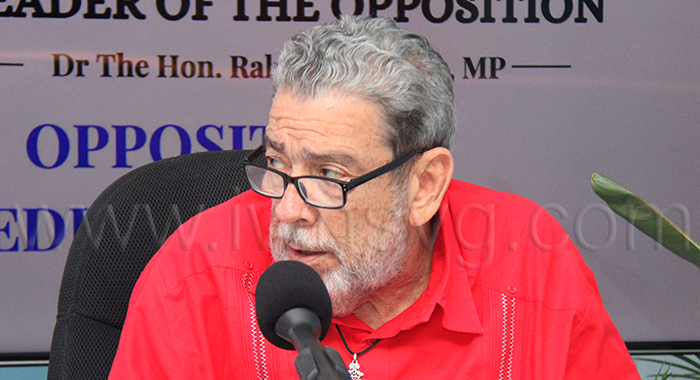
    Addressing supporters through the ULP’s Star Radio platform on Saturday, Gonsalves delivered a concession speech notable for its philosophical reflections and combative undertones. While acknowledging the electoral outcome, the former prime minister pointedly withheld direct congratulations for Prime Minister-elect Godwin Friday or the victorious NDP.

    Gonsalves framed the NDP’s triumph as a temporary phenomenon, declaring with poetic gravity: “At this very height of NDP triumphalism, it is the moment of the start of their descent. And descend they will.” He predicted the new administration would experience “a flood of disarray” as governing realities set in, asserting that “the clock of their demise is already ticking” in today’s rapidly evolving world.

    The seasoned politician, who previously served as opposition leader from 1998 to 2001, emphasized his readiness to embrace this familiar role “with dignity, duty and love.” He portrayed himself as undaunted by the reversal, stating: “The menace of the years finds and shall find me unafraid; it is my lot to accept, indeed prefer a strenuous life to one of ignoble ease.”

    Gonsalves outlined a tripartite strategy for the ULP’s renewal: helping supporters understand the setback as temporary, pursuing comprehensive party rebuilding, and resolutely defending the nation’s interests against any perceived attempts to “sell out St Vincent and the Grenadines or its patrimony”—a clear reference to NDP proposals such as citizenship-by-investment programs.

    Despite the crushing defeat that saw prominent ULP figures including his son, former Finance Minister Camillo Gonsalves, and four-term MP Saboto Caesar lose their seats, Gonsalves secured his North Central Windward constituency for an eighth consecutive term—a seat he has held for 31 years since February 1994.

    In his address, Gonsalves acknowledged the “shock and pain” permeating the Labour movement while urging against despair. He called for unity beyond traditional party lines, extending an olive branch to those who “deserted the family of labour,” emphasizing the urgency to protect the gains achieved during nearly a quarter-century of ULP governance.

    The former prime minister committed to maintaining high standards of parliamentary opposition despite the NDP’s overwhelming majority, noting that Vincentians would judge the opposition based on “the quality of our work.” He concluded with defiant resilience, echoing Victorian poet William Ernest Henley: “My head is bloodied, but unbowed.”

  • New PM promises inclusive, prayerful governance

    New PM promises inclusive, prayerful governance

    KINGSTOWN, St. Vincent – In a historic political transition, Godwin Friday was formally inaugurated as the fifth Prime Minister of St. Vincent and the Grenadines since the nation gained independence in 1979. The swearing-in ceremony, conducted by Governor General Dame Susan Dougan on Friday evening, marked the culmination of a decisive electoral victory that ended the 24-year governance of Ralph Gonsalves’ Unity Labour Party (ULP).

    Friday’s New Democratic Party (NDP) achieved an extraordinary 14-1 mandate in Thursday’s general election, preventing the ULP from securing an unprecedented sixth consecutive term. The 66-year-old leader, also a seasoned attorney, pledged to govern inclusively, emphasizing his commitment to serve “for all the people of this country.”

    In his inaugural address, Prime Minister Friday outlined a vision centered on national unity and transformative development. “It is my duty to uplift living standards, moral values, hopes and expectations of our people,” he declared, emphasizing the need to transcend partisan politics. He stressed the importance of collective effort for national progress, noting that the country’s population of under 110,000 should be viewed as “precious, not small.”

    The new Prime Minister acknowledged the significant challenges ahead, referencing policy plans presented during the campaign while remaining open to alternative solutions. He expressed particular commitment to addressing economic disparities, stating, “It does us no good as a people for some to be thriving while others are struggling.”

    Friday paid tribute to his predecessor, Arnhim Eustace, who led the NDP from 2000 to 2016, recognizing his foundational contributions to the party. Governor General Dougan offered both congratulations and counsel, urging the new administration to foster an inclusive society and progressive agenda while navigating global turbulence.

    The ceremony also honored former Prime Minister Gonsalves for his quarter-century of public service, with the Governor General noting the foundation established during his tenure. Gonsalves remains the sole ULP representative in the new Parliament.

    Prime Minister Friday announced that his cabinet appointments would be revealed next week, with the administration immediately commencing work on implementing its campaign commitments under what he described as “a new dawn” for the nation.