标签: Jamaica

牙买加

  • Woman allegedly shot by police in Granville

    Woman allegedly shot by police in Granville

    In the tight-knit community of Granville, located in St James, Jamaica, a fresh wave of unease and unrest has erupted after emerging reports of a woman being shot by law enforcement officers in an incident that unfolded just hours ago.

    Details reaching local media outlet Observer Online confirm that the shooting occurred after the woman drove her Toyota Voxy directly toward a group of police officers on the scene. The bullet struck her in the torso, and officers immediately transported the injured woman to a nearby medical facility for urgent treatment. As of the latest update, medical officials have not released any information on her current condition, leaving community members in a state of anxious uncertainty.

    The shooting took place mid-protest, as Granville residents had gathered to demand formal justice for the recent killing of 17-year-old Tjey Edwards. Edwards was shot and killed by police during a law enforcement operation held on Mother’s Day, June 10, a death that has already sparked sustained outcry and repeated demonstrations across the community. This latest violent incident has amplified already raw tensions in the area, with residents bracing for further unrest as more details about the shooting continue to emerge. Additional updates on the incident are expected to be released in the coming hours.

  • ‘I thought I was going to die’

    ‘I thought I was going to die’

    Two months after a fatal school violence incident shocked Jamaica, a second brutal attack at another campus in the same parish has reignited urgent conversations about the country’s growing bullying crisis and failures in school safety. On March 4, 2026, 16-year-old Ocho Rios High School student Devonie Shearer was killed when a 17-year-old classmate allegedly struck him in the head with a metal chair. On May 4, that same act of violence nearly played out again: an 11-year-old sixth-grade student at St John’s Preparatory School, located in St Ann parish, was surrounded and beaten by five of his schoolmates, one of whom lifted a chair to strike him. The child, still haunted by news of Shearer’s killing, left the attack convinced he would suffer the same deadly fate.

    The attack unfolded while teachers were distracted assisting graduating students with graduation photographs. School accounts frame the incident as a casual “play fight” that spiraled out of control after a verbal altercation. But the victim and his mother, who have chosen to remain anonymous to protect the child’s privacy, describe it as a coordinated, life-threatening assault. According to the 11-year-old’s account, the confrontation began when a classmate targeted him with unprovoked harassment. After repeated pleas for the harassment to stop were ignored, the aggressor began shoving him around the campus. The victim pushed back in self-defense, which prompted four other students to join the attack. Fleeing for his safety, the child ran into an empty classroom, but his attackers followed, throwing objects at him as the violence escalated.

    In the chilling moments that followed, one of the attackers picked up a metal chair and prepared to swing it at the victim’s head – the same weapon that killed Shearer just two months prior. “I thought I was going to die,” the 11-year-old told Jamaica Observer in an interview. Exhausted and shaken from the sustained attack, he was unable to locate a teacher to report the violence immediately, and returned home injured and terrified. The attack was recorded on a student’s phone and circulated to a campus WhatsApp group, leaving the child subjected to further humiliation. “I had a sharp pain in my chest and my legs, and when I was going home, my legs were trembling. I just wanted to get home and lie down, and pray that the pain would go away,” he recalled. The child added that he was especially distressed by the attackers’ insults targeting his mother, and now refuses to return to campus, saying: “When I come back, I don’t know if the chair is going to hit me this time.”

    Compounding the family’s anger, school administrators only learned of the attack after the victim contacted his mother directly, who then alerted the school. The child’s mother, who was in the middle of sitting final exams to qualify as an attorney, told reporters she first found out about the assault when her son called her via video call after school, showing her the large bump on his head from the attack. “I have since withdrawn my son from the school, and I am considering legal action,” she said. “It is outrageous that I had to hear about this from my child, not from the school administration. This is not an isolated incident – my son has been targeted in at least four separate bullying incidents at this school, and nothing was ever done to stop it.”

    St John’s Preparatory Principal Bertram Watson confirmed that the school launched an internal investigation immediately after being notified by the mother. The students accused of involvement were removed from campus and asked to stay home while the school board reviews the incident and determines further disciplinary action. The parents of the aggressors have already offered to cover the victim’s medical costs and issued a formal apology. Watson pushed back on claims that the school has a persistent bullying problem, noting “There has never been any gang-related violence or organized group fighting of this nature at our school. One of the boys involved had a previous conflict with the victim in grade five, but that incident was resolved through meetings with parents. To call this an ongoing issue is inaccurate.” The principal added that the school maintains a strict zero-tolerance policy for bullying, pointing to regular anti-bullying campaigns, distributed educational flyers via parent WhatsApp groups, webinars organized in partnership with the Ministry of Education, and regular class and school-wide devotional discussions on the harms of bullying.

    While the mother acknowledges the school has taken steps to address the incident following her complaint, she remains resolute in demanding accountability. Multiple parents of the involved students have reached out to her to apologize and urge her not to pursue formal action, but she says she cannot let the incident be swept under the rug. “I am not doing this to be vindictive. I appreciate everything the school has done for my son over the years,” she explained. “But children need to learn that there are real consequences for violent actions. If I stay silent now, my son will grow up knowing five boys attacked him and I did nothing. That is something I cannot allow.” The mother, who has been deeply affected by seeing her son’s trauma – he has become withdrawn and unusually quiet since the attack – shared that she feels every bit of his pain: “There were nights I laid in bed and felt every blow my child took to his head. It is an agony no parent should have to go through.” She is calling on parents across Jamaica to address aggressive behavior in children early, before it escalates into irreversible violence.

    The incident comes as Jamaica observes Child Month 2026 under the official theme “Prioritise Our Children’s Mental Health: Strong Minds, Safer Future.” The 11-year-old victim himself has joined the call for reform, noting that bullying causes irreversible damage to young people’s mental wellbeing. “Bullying affects your mental health and makes you unstable. Sometimes when bullying gets too bad, it can lead to children taking their own life – or the bully ending it for them,” he said. He is calling for closer adult supervision on school campuses to prevent future attacks, stressing that “It is important to keep children safe, because if you don’t keep children safe, they lose their lives.”

    Jamaica is a signatory to the United Nations Convention on the Rights of the Child, which Article 19 guarantees all children the right to be protected from all forms of violence, including bullying, physical harm, and emotional abuse. Bullying violates fundamental child rights to education, health, and human dignity, requiring signatory nations to implement robust legislative and social measures to prevent attacks, support victims, and maintain safe, inclusive learning environments. But official data obtained by the Sunday Observer reveals that reports of bullying across Jamaica have risen steadily for four consecutive years, with the trend accelerating into 2026.

    Between January 1 and March 26 of 2026 alone, 49 bullying incidents were reported to the National Children’s Registry, a division of Jamaica’s Child Protection and Family Services Agency. January led with 22 reported cases, followed by 11 in February and 16 in March. Looking back over the previous four years, the trend is clear: 130 bullying incidents were reported in 2022, climbing to 140 in 2023, 151 in 2024, and 167 in 2025. Between January 2022 and January 2023, 55 critical incident reports related to school violence were submitted to the Ministry of Education and Youth – 15 at the primary school level and 35 at the secondary level. Data from the 2023 Jamaica Violence Against Children and Youth Survey further reveals that among school-attending youth aged 13 to 24, one in four females and one in three males report knowing of active gang presence on their school campuses.

  • Trelawny motorcyclist dies in Manchester crash

    Trelawny motorcyclist dies in Manchester crash

    In a tragic weekend traffic incident in central Jamaica, a young motorcyclist has died after sustaining severe critical injuries in a two-vehicle collision. The crash unfolded shortly before 10 p.m. Saturday along the Sedburgh main road, close to the town of Christiana in the parish of Manchester, local law enforcement confirmed.

    Investigating officers have identified the fatality as Valdie Thomas, a 20-year-old resident of the Lowe River district in Trelawny parish. According to official police accounts, Thomas was operating a 2025 green-model Missile CG250 motorcycle when the collision occurred with a 2003 grey Toyota Probox passenger vehicle.

    The force of the impact threw Thomas from his motorcycle immediately after the crash. First responders rushed the injured motorcyclist to the nearby Percy Junor Hospital located in Spalding, where medical personnel later pronounced him dead from his injuries. No further details on the condition of the Probox driver or any other passengers have been released as of this update. The report was filed by correspondent Kasey Williams.

  • Man who shot at cop fails in bid to overturn conviction

    Man who shot at cop fails in bid to overturn conviction

    Nearly a decade after a Jamaican man opened fire on a police officer conducting a stakeout in Kingston’s Manning’s Hill neighborhood, the Court of Appeal has finalized his sentence, upholding his conviction on weapons and assault charges while trimming two months off his 20-year prison term to account for pre-sentencing custody time.

    The defendant, Rohan Dixon, a St. Catherine resident, was first found guilty in the 2015 incident in 2021 by the Gun Court’s High Court division. For the charge of illegal firearm possession, he received a 15-year prison term, and an additional 20-year sentence for shooting with intent to harm. The court ruled the sentences would run concurrently, meaning Dixon would serve the full 20-year term. Dissatisfied with the ruling, Dixon launched an appeal challenging both his conviction and the original sentencing.

    Dixon’s legal team argued the original trial had critical flaws. They claimed there was no physical evidence to prove a firearm was even present at the scene—neither the weapon itself nor spent bullet casings were ever recovered—and no accurate description of the weapon was provided by witnesses. The defense further pushed the claim that prosecution evidence could not support the conviction, as there was no definitive proof Dixon was the person who fired at the officer.

    The prosecution’s account of the 2015 incident lays out the context for the case. In July 2015, a team of plainclothes police officers executing an operation targeted a specific residential property in Manning’s Hill. When officers arrived, they found the home empty but discovered clear signs that occupants had fled in a urgent hurry. The team set up a hidden surveillance perimeter around the property to wait for the occupants’ return.

    One lead detective, who was a sergeant at the time of the operation, testified that while he was positioned at the rear of the home watching a downhill slope through a window, he spotted two armed men moving up the hill toward the back of the property. The officer moved to hide behind a wall on the home’s left side, where he saw one man approaching his position with a gun pointed directly toward him. When the man got within range, the officer shouted his police identification and ordered the man to stop. The detective confirmed the suspect fired at him, but the shot missed. The officer returned fire, and the suspect fled the yard into nearby dense brush. A subsequent search of the brush turned up multiple blood trails, indicating the suspect had been hit in the exchange.

    A month after the shooting, acting on a tip, a detective corporal apprehended Dixon at a home in Gregory Park, St. Catherine. The officer, who had prior knowledge of Dixon, noticed Dixon had a fresh gunshot wound to his ankle. When cautioned, Dixon initially claimed he had been shot while trespassing on a squatted site near Mexico. Later, while detained at the Portmore lock-up, Dixon allegedly admitted to the corporal he had been at the Manning’s Hill scene, telling the officer he had followed another person uptown when police arrived, shots broke out, and he was shot in the foot. During another police interview, Dixon gave a contradictory statement, saying he had never carried a gun, had just run from the house when shots started, and was shot by police.

    At his original trial, Dixon swore under oath he had no involvement in the shooting at the officer. He admitted he could not even confirm where he was on the day of the incident, and denied ever telling police he had been present at the scene. During the appeal process, the prosecution successfully petitioned to reopen its case to present new rebuttal evidence refuting Dixon’s claim that he was not at the crime scene.

    After reviewing all arguments from both sides and issuing its ruling this month, the Appeal Court confirmed the original convictions were legally sound. Justices on the appeal panel wrote that a thorough review of the case found the lead detective had provided sufficient, detailed description of the firearm used in the attack. The court further noted that the detective’s testimony, which was accepted by the original trial judge, led to one unavoidable conclusion: that Dixon fired at the detective with the clear intent to cause severe bodily harm.

    The court highlighted significant aggravating factors that justified the lengthy sentence, including the original trial judge’s note that Dixon’s social enquiry report painted a picture of a man widely feared in his local community. Justices also pointed out that Dixon had two prior convictions for illegal firearm and ammunition possession, both of which were committed after he was charged for the 2015 shooting. He had just finished serving those prior sentences when he was sentenced for the 2015 crimes, further weighing against a more lenient sentence.

    A key argument from the defense was that the six-year delay between Dixon’s arrest and his trial violated his constitutional right to a timely, fair trial, and the trial judge had failed to account for this delay in sentencing. The Appeal Court ruled that Dixon could not prove his defense had suffered any prejudice from the overall delay, which was split between prosecution/administrative delays (accounting for 60% of the total wait) and defense-caused delays (the remaining 40%). The court found the three years and four months of delay attributable to the state was not excessive, given the well-documented operational constraints of Jamaica’s justice system, and did not violate Dixon’s constitutional rights.

    While the court upheld the convictions, it did find the original trial judge had made a procedural error in carrying out the sentencing. After conducting a full resentencing review, the only adjustment the court made was a two-month reduction to account for pre-sentence custody Dixon served after completing his prior, unrelated sentences. The court rejected the defense’s request for a broader sentence reduction tied to the delay, finding no constitutional violation had occurred that would warrant such a cut.

    After apologizing to both legal teams for the delay in issuing the appeal judgement, the court dismissed Dixon’s challenge to his illegal firearm possession conviction and 15-year sentence, affirming that penalty in full. The court allowed the appeal of the 20-year shooting with intent sentence, setting aside the original term and substituting it with a 19-year and 10-month term. As with the original ruling, the two sentences will run concurrently, backdated to the original April 15, 2021 sentencing date.

  • Woman dies after alleged police shooting at protest in Granville

    Woman dies after alleged police shooting at protest in Granville

    In St James, Jamaica, a woman who sustained a gunshot wound early Sunday in an incident allegedly involving local law enforcement has passed away while receiving medical care at a local hospital, multiple sources including Jamaica Observer Online have confirmed.

    Identified as Latoya Bulgin, who was widely known by her community nickname “Buju”, the deceased was a resident of Granville, the same St James community where the shooting unfolded.

    The Independent Commission of Investigations (INDECOM), Jamaica’s independent oversight body tasked with probing incidents involving law enforcement officers, has confirmed it has opened an active investigation into the fatal shooting.

    According to initial incident reports, Bulgin was among a crowd of demonstrators gathering to protest the recent fatal shooting of 17-year-old Tjey Edwards. At the time of the shooting, she was seated in the driver’s seat of a Toyota Voxy bus parked in the center of Granville’s community square. No further details about the circumstances of the shooting or potential witnesses have been released to the public as of yet, with INDECOM’s ongoing review expected to uncover a full account of what led to Bulgin’s death.

  • Why inflation is falling but Jamaicans still feel squeezed?

    Why inflation is falling but Jamaicans still feel squeezed?

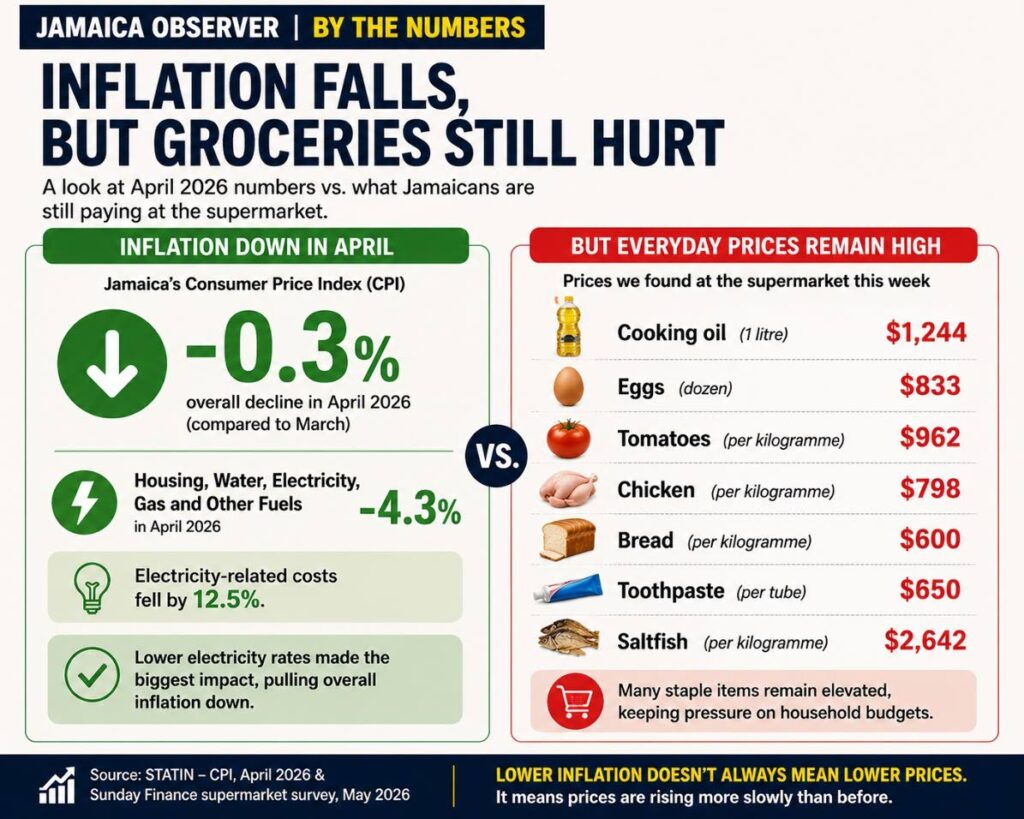
    Jamaica’s national inflation rate recorded another downward shift in April, with official data pointing to sharp drops in electricity costs as the primary driver. The Statistical Institute of Jamaica (Statin) announced that the country’s Consumer Price Index (CPI) fell by 0.3% for the month, a move that looks encouraging on paper but has failed to translate into tangible relief for the majority of Jamaican households.

    The reality on the ground tells a more complicated story: grocery costs remain elevated, petrol prices have climbed once again, rent stays at historically high levels, school fees are increasing, and dining out has grown more expensive. After years of consecutive price hikes triggered by the COVID-19 pandemic, global supply chain disruptions, and repeated hurricane damage to local infrastructure and agriculture, most families are still adjusting to a permanently higher cost of living that shows little sign of reversing.

    This gap between falling official inflation figures and widespread persistent financial pressure has emerged as one of the most widely misunderstood features of Jamaica’s current economy. The confusion stems from a common misinterpretation: lower inflation does not mean prices are decreasing across the board. Instead, it simply means that prices are rising at a slower pace than they were previously. In April’s case, the overall decline was only made possible by a single large category — electricity — dropping enough to cancel out price increases across every other major sector.

    Statin’s breakdown confirms this disparity: food prices rose by 0.6% in April, led by a dramatic 6.2% jump in the cost of fruits and nuts including ripe bananas, oranges, and watermelon. Higher petrol prices also pushed up overall transport costs for consumers and businesses alike. That means while the headline inflation number moved downward, most of the goods and services Jamaicans purchase on a regular basis continued to get more expensive.

    This mismatch explains why so many households still feel financially squeezed even though headline inflation now sits squarely within the Bank of Jamaica (BOJ)’s official target range, a development policymakers frame as a sign of economic stability.

    Clearing Up the Inflation Misconception

    A core source of public confusion is the frequent mixing up of inflation and general price levels. Inflation does not measure how cheap or expensive goods are — it measures the rate at which prices are changing over time. For example, if inflation falls from 8% to 4%, prices are still going up; they are just increasing at half the speed they were previously.

    After several years of sustained high inflation across the global economy, most prices remain far higher than they were in the pre-pandemic period. A family that once spent JMD 15,000 a week on groceries may now pay JMD 23,000 or more for the same basket of goods. Even if inflation slows sharply, prices almost never drop back to their previous levels, leaving families permanently adjusting to higher costs. This is the key reason official inflation statistics and everyday lived experience so often feel out of alignment: official numbers may show stabilizing price growth, but consumers are still dealing with long-term financial fatigue from cumulative increases.

    Electricity Carries the Weight of April’s Decline

    April’s drop in inflation was driven almost entirely by a single factor: falling electricity costs. Statin reports that the “Housing, Water, Electricity, Gas and Other Fuels” category fell by 4.3% in April, after electricity costs themselves dropped by 12.5%. This shift is economically significant, because electricity touches nearly every part of the national economy. Lower electricity costs can reduce pressure on businesses, transport operators, manufacturers, distribution networks, and household budgets all at the same time.

    Over the past year, Jamaica’s inflation trends have increasingly been shaped by movements in global energy prices, paired with weather-related disruptions to local food production. When global oil prices ease and fuel-related utility charges fall, inflation tends to soften quickly. Food prices, by contrast, follow a much more volatile pattern.

    Agricultural prices remain extremely vulnerable to droughts, hurricanes, supply chain breakdowns, and seasonal shortages, and this volatility consistently shows up in monthly inflation data. Over the 12 months leading up to April, prices for fruits and nuts jumped 26.3%, while fish and seafood costs rose 11.4%, both adding steady upward pressure to household grocery budgets. This explains why consumers feel the impact of inflation most acutely at supermarkets and local markets, even when the overall headline inflation rate is moderating.

    What This Means for the Bank of Jamaica’s Policy

    The Bank of Jamaica does not aim to drive prices down across the entire economy — its core mandate is to prevent inflation from becoming unstable and eroding purchasing power too quickly. Sustained high inflation creates widespread economic uncertainty: businesses struggle to set accurate prices for goods and services, borrowing becomes riskier for all parties, savings lose value more quickly, consumers delay major discretionary purchases, and long-term investment decisions become far harder to make.

    To avoid these outcomes, the BOJ targets an inflation range of 4% to 6%. April’s 4.3% year-over-year inflation rate falls comfortably within that target, a reading that is widely expected to reinforce the central bank’s plan to keep interest rates relatively stable when the Monetary Policy Committee meets later this month.

    Stable interest rates have direct benefits for consumers: higher rates push up the cost of mortgages, car loans, credit cards, and business borrowing, so holding rates steady eliminates the risk of even higher debt repayments for households and enterprises. But stable, moderate inflation does not immediately solve widespread affordability problems — it primarily prevents economic conditions from worsening more quickly than they otherwise would.

    The Long-Term Structural Shift in Living Costs

    What Jamaica appears to be entering right now is not a return to the era of cheap living many consumers remember, but rather a period of slower, more stable price growth after years of rapid increases. These are two very different outcomes.

    For decades before the pandemic, the global economy saw unusually low inflation, and consumers grew accustomed to gradual, barely noticeable price increases. The post-pandemic world upended that reality entirely. Global shipping disruptions, geopolitical conflicts, climate-related extreme weather, widespread labor shortages, and energy market volatility pushed costs higher across dozens of sectors at the same time.

    Many economists now believe the global economy is entering a structurally more inflationary era than the period that existed before 2020. If that prediction holds, consumers will need to adjust their expectations of what counts as a “normal” price level. This does not mean inflation will spin out of control, but it does mean households will likely continue facing elevated costs even when headline inflation appears statistically stable.

    Broader Social and Political Implications

    Inflation is never just an economic metric — it is a major driver of public mood and political sentiment. When workers find their salaries do not stretch far enough to cover basic needs, public frustration grows regardless of what official statistics report. This dynamic has left governments around the world struggling politically even as inflation rates have moderated from their post-pandemic peaks.

    Consumers experience prices through deeply personal, repeated encounters: the weekly grocery checkout total, the daily taxi fare, the monthly electricity bill, school lunch costs, and the quarterly rent payment. Food inflation in particular hits harder psychologically, because consumers encounter price increases at the grocery store every week, making the pressure impossible to ignore.

    In Jamaica’s context, this pressure is especially acute because wages in most sectors have not kept pace with cumulative price increases over the past five years. Even with inflation slowing, many households are still working to recover financial ground after years of eroding purchasing power.

    The real question facing Jamaican policymakers and households right now is not whether inflation is falling. Instead, the more critical question is whether incomes will rise fast enough to rebuild consumers’ purchasing power after several years of economic hardship. For most families, the only economic statistic that matters ultimately comes down to one simple, practical question: when will it be affordable to live comfortably again?


  • Late own goal gifts Montego Bay lead over Cavalier after JLP first-leg semis

    Late own goal gifts Montego Bay lead over Cavalier after JLP first-leg semis

    KINGSTON, Jamaica — The opening round of the Jamaica Premier League’s semi-final stage delivered a tense, dramatic encounter at the National Stadium on Sunday, where Montego Bay United secured a fragile one-goal advantage over reigning title holders Cavalier FC ahead of Wednesday’s decisive second leg at the same ground.

    From the opening whistle, Montego Bay, the western Jamaican side, controlled large stretches of the match, pinning Cavalier back in their defensive half and creating a string of dangerous chances. However, the defending champions’ backline held firm for nearly 90 minutes, frustrating Montego Bay’s attacking efforts and keeping the scoreline deadlocked.

    The first big moment of the game came in the opening 45 minutes, when Malachi Sterling thought he had put Montego Bay ahead, only for the assistant referee’s flag to rule out the effort for offside, leaving his side still waiting for a breakthrough. After halftime, Montego Bay came close again: Dwight Merrick fired a powerful shot that beat Cavalier’s goalkeeper, but the effort bounced off the crossbar, sparing the defending champions from falling behind.

    It was not until three minutes into stoppage time at the end of the second half that the deadlock was finally broken — and it came from an uncharacteristic mistake from Cavalier midfielder Adrian Reid Jr. Attacking a corner delivered into the box by Montego Bay, Reid accidentally redirected the ball past his own goalkeeper, handing Montego Bay a last-gasp 1-0 advantage. The late own goal gives Montego Bay a critical slim lead heading into the second leg, setting up a high-stakes decider for a spot in the league final.

  • Daredevil motorcyclists causing concern in St Thomas

    Daredevil motorcyclists causing concern in St Thomas

    Jamaica’s St Thomas parish is boosting uniformed police presence along its new stretch of the Southern Coastal Highway to crack down on dangerous speeding, particularly among reckless motorcycle delivery riders, according to the division’s top law enforcement official.

    Deputy Superintendent Rohan Ritchie, commanding officer of the St Thomas Police Division, announced the new enforcement measure during a regular monthly sitting of the St Thomas Municipal Corporation on Thursday. The move follows urgent public safety warnings raised by Port Morant Division Councillor Dinsdale Smith, a member of the People’s National Party, who highlighted growing community alarm over reckless operation of delivery bikes linked to local fast-food outlets.

    At the center of Smith’s concerns are riders working out of the newly opened Kentucky Fried Chicken (KFC) location in Morant Bay’s Urban Centre. He told assembled municipal officials that local residents have grown increasingly uneasy watching riders weave erratically through congested traffic to meet delivery deadlines, warning that unchecked reckless behavior will almost certainly lead to catastrophic, fatal collisions.

    “We have one of the world’s biggest food franchises newly opened here, and their delivery service is certainly efficient, but the way some of these riders use our public roads is deeply troubling,” Smith told the meeting. “I cannot understand what pushes them to ride the way they do, but I can already see catastrophic accidents on the horizon if nothing changes.”

    Smith called on local police to intervene, suggesting targeted outreach and educational sessions could help riders understand how their reckless maneuvers put other road users at risk and create public nuisance. “We need to make clear that this kind of behavior cannot continue, and that fatalities are not a price we are willing to pay for fast delivery,” he added.

    Ritchie acknowledged the validity of the concerns, but outlined significant operational challenges law enforcement faces when intercepting reckless motorcycle riders. Police are banned from engaging in high-speed chases, he explained, because fleeing riders often lose control and turn their bikes into dangerous weapons that can injure bystanders or other motorists. Compounding enforcement issues, Ritchie added that many of the motorcycles ridden by delivery workers carry registration plates that are not legally tied to the actual rider, making post-incident accountability difficult. Even when officers are able to catch offenders, he noted, vehicles are seized and violators are prosecuted, but the structural challenges persist.

    Going forward, Ritchie said the division will pair increased visible patrols along the highway with expanded public education campaigns targeted at young motorcyclists, who make up the vast majority of delivery riders and speed-related accidents in the parish. “Data shows that most speed-related crash victims and offenders are young people, who push their bikes to the limit because they think they are invincible,” Ritchie told the chamber, drawing light laughter when he noted “At my age, I never go over 30 miles an hour.” He added that the core message of outreach will be simple: the whole point of driving is to arrive at your destination alive.

    The newly completed stretch of highway that cuts through St Thomas has been a major infrastructure win for the parish, cutting travel time from Harbour View to Morant Bay from an average two hours to just 30 to 40 minutes by Ritchie’s account, smoothing out the notoriously congested route that once plagued commercial and personal travel. But better road conditions have come with an unexpected downside: they have emboldened motorists to hit dangerously high speeds, Ritchie said. Since the start of 2024, the parish has recorded four fatal collisions that left five people dead, a statistic Ritchie says demands urgent action to slow traffic down.

    “We cannot overemphasize this enough: we need all motorists to slow down and take extra care on this new thoroughfare,” Ritchie said. “We are committed to doing everything in our power to curb reckless driving and prevent more preventable deaths.”

  • Dr Patricia Smith presents Tourism Minister with copy of her book ‘I Persist’

    Dr Patricia Smith presents Tourism Minister with copy of her book ‘I Persist’

    KINGSTON, Jamaica — At a small ceremonial gathering held at Kingston’s AC Hotel, multi-hyphenate Jamaican leader Dr Patricia Smith — a successful home care entrepreneur, hotel operator, and published author — officially gifted a signed copy of her latest work *I Persist* to Jamaica’s Minister of Tourism Edmund Bartlett. The event unfolded on the margins of a cross-sector convening that brought together top stakeholders from Jamaica’s tourism, education, and business industries, all gathered to exchange ideas around building greater resilience and driving innovation across the country’s key service sectors.

    In her remarks during the presentation, Dr Smith outlined the core mission that drove her to write *I Persist*. The book was crafted as a source of encouragement for Jamaicans across all walks of life, she explained, with a special focus on uplifting women who grew up in state-run care institutions, as well as any person who has navigated the devastating challenges of homelessness and hopelessness. Its core message is simple: to urge readers to stay unshakable in the face of hardship, and to build every part of their lives around clear, intentional purpose.

    Dr Smith went on to frame Minister Bartlett himself as a living example of the persistence her book celebrates. From leading Jamaica’s tourism sector through repeated global crises to advocating tirelessly for the country as a top-tier travel destination on the international stage, Bartlett’s decades-long career embodies the very spirit at the heart of *I Persist*, she said. Dr Smith shared that her hope is the book will strike a chord with every Jamaican who is dedicated to building a more robust, prosperous nation for all.

    Minister Bartlett accepted the gift with gratitude, emphasizing that the values of resilience and endurance that *I Persist* explores lie at the center of Jamaica’s strategy for tourism recovery and long-term growth. He reflected on the repeated shocks the sector has absorbed over recent years: devastating hurricanes, the global COVID-19 pandemic, and ongoing geopolitical instability that has reshaped international travel. Through every challenge, Bartlett noted, Jamaica’s tourism industry has persisted, adapted, and reimagined itself — and that ability to bounce back is the very reason the country remains one of the most sought-after Caribbean destinations for travelers worldwide. He thanked Dr Smith for the thoughtful gesture and for her contribution to the growing national conversation about what it means to lead with endurance.

    Beyond its motivational message, *I Persist* digs into interconnected themes of personal resilience, overcoming systemic barriers that hold marginalized communities back, and the transformative power of leadership rooted in clear purpose.

  • Effect of Aidonia’s electrifying Live Wire performance lingers

    Effect of Aidonia’s electrifying Live Wire performance lingers

    One of dancehall music’s most formidable forces, Aidonia, headlined a spectacular sold-out opening night of the Appleton Estate Live Wire event on April 30, leaving thousands of attendees breathless at Usain Bolt’s famous Tracks & Records venue in St Andrew’s Marketplace. The iconic entertainment hub was filled to capacity long before the headliner took the stage, with a crackling energy that rippled through every corner of the space as fans gathered for a night of authentic Jamaican music, cultural celebration, and world-class live performance.

    Kicking off the evening’s lineup was emerging reggae-dancehall star Amanyea, who set an impossibly high bar with a dynamic opening set that won over the early crowd. The rising talent blended her own original viral tracks, including *Friends + Tax*, *Still Go Dance*, *La La*, and *Bad Gyal Szn*, with inventive covers of global and local hits from legends ranging from Beyoncé and Michael Jackson to Jamaican greats Tanya Stephens and Dexta Daps, keeping the audience engaged and singing along from her first note to her last.

    Just moments before midnight, Aidonia stepped onto the stage to a roar of applause, bringing with him the razor-sharp lyrical skill and magnetic stage presence that have made him a mainstay of the global dancehall scene. Backed by the high-energy Ruff Kutt Krew, the dancehall icon launched into an explosive, hit-packed set that pulled from his decades-long catalog of fan favorites and chart-topping releases. Tracks including *Bad People*, *Empty*, *Trigger Work It*, *Run Road*, *Anyweh at All*, and *Fi Di Jockey* kept the crowd moving nonstop, with every lyric screamed back by the adoring audience.

    Midway through his set, Aidonia upped the ante by stripping off his bright lemon-colored stage jacket to welcome his protégé, popular dancehall artist Govana, for a surprise joint performance of their collaborative hit single *Breeze*. After the duo wrapped up their collaboration, Govana kept the momentum going with a high-octane solo performance of his own track *Mawning Sir* before exiting the stage to thunderous applause.

    Industry leaders have hailed the opening night of the series as a runaway success. “Tracks & Records was absolutely on fire — Aidonia and Amanyea delivered beyond every expectation,” shared Mark Telfer, customer and channel marketing manager for the event. “The combination of world-class entertainment, our premium brand partnership, and the unmatched energy of the Jamaican audience made this first instalment of Appleton Estate Live Wire truly one for the books.”

    Building on the overwhelming success of the St Andrew opening, the Appleton Estate Live Wire series is now set to expand across the island, with its next stop scheduled for August 5 at the popular Plantation Smokehouse venue in St Ann. Event organizers say they plan to bring the same immersive, high-energy cultural experience to music fans across Jamaica in the coming months.

    “We are incredibly pleased with the turnout and the electric energy we saw at Tracks & Records,” said Carlton Davy, lead promoter of Live Wire Events. “We want to thank Aidonia for such an outstanding performance, and every single patron who turned out to support live music. This is exactly the kind of vibrant, authentic experience we set out to create, and we could not be more excited to bring Live Wire to new audiences across the island moving forward.”