标签: Haiti

海地

  • FLASH : 46% increase in the minimum wage for subcontracting in Haiti

    FLASH : 46% increase in the minimum wage for subcontracting in Haiti

    In a major policy announcement aimed at addressing longstanding worker grievances and easing cost-of-living pressures, Haiti’s Ministry of Economy and Finance has unveiled a sweeping set of economic measures, headlined by a near-46% increase to the daily minimum wage for workers in the country’s critical subcontracting sector. The announcement was made public by Minister Serge Gabriel Collin during a May 4, 2026 press conference hosted at the headquarters of Haiti’s Economic and Social Assistance Fund (FAES).

    Prior to this adjustment, the daily minimum wage for Segment F subcontracting workers — a category that includes the country’s large textile manufacturing workforce — has remained frozen at 685 gourdes per day since 2022. Under the new ruling, that baseline will rise to 1,000 gourdes per day, a jump of just under 46%. The adjustment comes after months of advocacy from textile workers, who had originally called for a far steeper increase, pushing for a daily minimum wage set between 2,500 and 3,000 gourdes.

    Minister Collin emphasized that the wage hike for subcontracting workers is only the first step in a broader, phased strategy to update minimum wage standards across all Haitian economic sectors. The government’s approach prioritizes a gradual rollout to avoid destabilizing Haiti’s fragile macroeconomic balance, he explained, balancing the urgent need to improve working people’s quality of life with the need to sustain overall economic stability.

    Beyond minimum wage reform, the administration has moved to address another major pain point for domestic businesses: high energy costs. Recognizing the private sector’s central role in driving job creation and national wealth generation, Haitian officials have opened negotiations to bring down energy prices, with a specific focus on expanding access to affordable renewable energy. As a first concrete step, electricity rates for industrial operators in the Caracol Industrial Park will drop from 30 cents per kilowatt-hour to 21 cents per kilowatt-hour starting in January 2027.

    To further bolster household purchasing power and strengthen the country’s social safety net, Minister Collin also announced direct targeted financial assistance for eligible workers. A total fund of 625 million gourdes will be distributed over the final five months of the 2025-2026 Haitian fiscal year, with resources earmarked for expanded social protection programs and direct support to offset rising consumer costs.

  • Digicel Haiti celebrates 20 years of presence alongside Haitians

    Digicel Haiti celebrates 20 years of presence alongside Haitians

    In 2026, telecommunications provider Digicel Haiti is celebrating two decades of continuous service and partnership with communities across the country, marking a milestone defined by shared resilience, mutual trust, and long-term commitment to national development.

    Jean-Philippe Brun, Chief Executive Officer of Digicel Haiti, outlined the company’s 20-year journey in an official press release, emphasizing that the anniversary is as much a tribute to customers, employees, and local partners as it is a celebration of corporate achievement. “Two decades driven by unwavering commitment, made possible above all by the trust of our customers, partners, and communities, and the steadfast dedication of our employees,” Brun stated.

    Since the company first launched its operations in Haiti in 2006, its core mission has never shifted: to connect Haitian people across regions and expand access to economic and social opportunities that improve quality of life. Brun stressed that this two-decade legacy extends far beyond building telecommunications infrastructure. It is, at its core, a story of deep human connection, collective resilience, and lasting partnerships forged alongside Haitian communities through every high and low.

    Over the past 20 years, Digicel Haiti has stood with the Haitian people through both moments of celebration and periods of profound crisis. The company has been a core supporter of local cultural life, sponsoring beloved national traditions including Carnival, football competitions, and the popular Artisanat en Fête crafts festival that highlights local creators. When crisis has struck, from the devastating 2010 earthquake to destructive hurricanes and repeated periods of national instability, Digicel Haiti’s on-the-ground teams have remained mobilized to support communities and maintain critical connectivity.

    This commitment to public good is institutionalized through the Digicel Foundation, which has delivered large-scale, impact-focused educational programs and community development projects across the country. These initiatives have opened new pathways for Haitian young people and marginalized communities, delivering tangible hope and opportunity where it is most needed.

    Brun acknowledged that the past two decades have brought significant, unforeseen challenges, and company leadership remains fully aware of the ongoing difficulties facing Haitian society. Through every turning point, however, one constant has endured: the trust that Haitian customers, partners and communities have placed in Digicel Haiti. That trust, Brun noted, has been the driving force behind the company’s constant efforts to upgrade services, innovate its offerings, and move forward with purpose even in the most difficult contexts.

    “For 20 years, Digicel has been part of the daily lives of Haitians. This relationship is built on trust; a trust we never take for granted,” Brun said. “It compels us to do better every day, to stay close to our customers, and to continue playing a vital role in the country’s development. These 20 years are yours, and our commitment to the future remains unwavering.”

    As the company kicks off its anniversary celebrations, Brun extended the company’s deepest gratitude to all those who made its 20-year journey possible. “Thank you for being part of this story. Thank you for continuing to inspire us to do even better. Let’s continue to build connections that matter. Together,” he said.

  • US$10 million from Rotary International (District 7020) for DINEPA in Haiti

    US$10 million from Rotary International (District 7020) for DINEPA in Haiti

    At the 2026 annual conference of Rotary International District 7020, hosted in Jamaica between April 28 and May 1, Haiti’s leading water and sanitation public agency secured a landmark multi-year investment to expand critical public services across the country. The National Directorate of Drinking Water and Sanitation (DINEPA), led by Director General Théophil Ostinvil, held a series of targeted high-level strategic talks with top Rotary leaders during the event, including former Rotary International President Barry Rasin, former Zone 33/34 Director Jeremy Hurst, and incumbent District 7020 Governor William Bill Aiken, alongside multiple past district and organizational leaders.

    These in-depth discussions successfully aligned the institutional priorities of both organizations around advancing Haiti’s drinking water and sanitation goals, laying a solid foundation for deeper long-term collaboration. After productive negotiations, the two sides finalized a binding financial commitment of $10 million that will be disbursed over the coming five years. This injection of capital marks a major milestone in resource mobilization for Haiti’s underfunded water and sanitation infrastructure.

    The new funding falls under the ongoing partnership between DINEPA and Rotary International District 7020, managed through the Haiti National Water, Sanitation and Hygiene Initiative (HANWASH) — the official technical implementation body for Rotary’s development work in Haiti. Beyond addressing the urgent need for capital, this commitment carries broader strategic meaning: it signals broad international confidence in DINEPA’s institutional leadership and validates the impact of recent sectoral reforms implemented by the agency. It also opens new doors for expanded technical and financial partnerships with other global development actors, a critical enabler for Haiti’s goal of achieving universal access to safe drinking water and formal sanitation services for all citizens.

  • Argentina is preparing to join the GSF in Haiti

    Argentina is preparing to join the GSF in Haiti

    In a step that expands the multinational response to Haiti’s ongoing security crisis, Argentina is moving forward with plans to deploy military personnel to the Caribbean nation as part of the international Gang Suppression Force (GSF), multiple sources confirm. As of May 1, 2026, the Argentine Armed Forces General Staff was in the final stages of preparations, wrapping up the selection of officers who will fill key roles within the GSF’s multinational command structure, including positions in planning, coordination, liaison, operational support, and overall command coordination.

    Unlike several contributing nations that are sending frontline combat troops to Haiti—most notably Chad, which has already deployed 1,500 soldiers to the region—Argentina has framed its contribution as focused on non-combat, enabling support for the mission. The South American country plans to send a specialized contingent that will be primarily made up of military engineers, with additional medical personnel assigned to support GSF operations.

    A core component of Argentina’s deployment will be a fully operational field hospital, designed to provide medical care to GSF personnel and potentially local populations affected by the ongoing conflict between gangs and security forces. While Buenos Aires has not yet released an official public figure for the total number of military personnel it will send to Haiti, the mission’s core objectives have already been finalized ahead of the first deployment.

    This participation marks a notable shift from Argentina’s traditional foreign military engagements, which have long centered on traditional United Nations peacekeeping operations. The GSF itself is a purpose-built multinational force created to address Haiti’s unique security breakdown, in which heavily armed criminal gangs have seized control of large swathes of national territory, including most of the capital Port-au-Prince, and have carried out widespread violence against civilians and state institutions. The first contingent of 400 Chadian fighters already arrived in Haiti several weeks ago and have begun carrying out discreet initial operations against gang strongholds, according to earlier local reports.

  • Official creation of the Youth Football Department in Haiti

    Official creation of the Youth Football Department in Haiti

    The Haitian Football Federation (FHF) has announced the official launch of a dedicated Youth Football Department, a landmark institutional move crafted to align the country’s grassroots football ecosystem with global development guidelines set by FIFA and the Confederation of North, Central American and Caribbean Association Football (CONCACAF).

    This new governing body is the centerpiece of FHF’s long-term strategic vision to rebuild and strengthen the foundational structure of Haitian football. By delivering structured, inclusive, and sustainable support to emerging young players across the country, the department aims to nurture a new pipeline of competitive talent that can compete at both the regional and global stages, building a more resilient future for Haitian football.

    The Youth Football Department has been assigned five core strategic responsibilities to deliver on its mandate. First, it will roll out a unified national youth football development policy that matches international best practices and regulatory standards. Second, it will build a standardized scouting and training network to identify, register, and track the progress of promising young talent from all regions of Haiti. Third, it will coordinate with local regional and departmental leagues to organize and standardize youth competitions across the country, ensuring all events adhere to official regulatory frameworks. Fourth, the department will oversee the training and deployment of Haiti’s national youth youth teams for all continental and global tournaments hosted by FIFA and CONCACAF. Finally, it will lead the establishment of a new National Youth Football League, identified as a critical pillar for sustained long-term growth of the sport in Haiti.

    Alongside the official creation of the department, FHF has announced the full leadership roster for the new entity. Fleurant Antoine will serve as President of the department, with Saint Surin Richard stepping into the role of Vice-President. Ricardo Pierre-Louis has been appointed Department Coordinator, while Vanessa Gabriel Michel Jean will take on the critical post of Safeguarding Officer, focused on athlete protection. Katia Saint-Gilles rounds out the leadership team as a core department member.

    In announcing the initiative, FHF emphasized that the new department reaffirms the federation’s commitment to embedding international best practices across all levels of Haitian football. The organization highlighted four core priorities that will guide the new department’s work: ongoing skills training for young players, comprehensive protection of youth athletes, upholding integrity in all operations, and pursuing sustained sporting excellence across all national youth programs.

  • 3 structuring projects in at-risk areas of Haiti

    3 structuring projects in at-risk areas of Haiti

    Haiti’s national government and the United Nations Development Programme (UNDP) have advanced a new suite of peacebuilding initiatives aimed at curbing gang violence, strengthening state presence and advancing long-term stability across the country’s most vulnerable regions. During a high-level meeting held on April 30, 2026, Haiti’s Minister of Planning and External Cooperation Sandra Paulemon convened with a UNDP Governance Unit delegation led by unit head Djenanne Félix Désir and Peacebuilding Fund (PBF) project coordinator Juviny Jacques, where the three PBF-funded projects were formally presented for government alignment.

  • FLASH : Resumption of flights between Haiti and the Dom. Republic temporarily suspended

    FLASH : Resumption of flights between Haiti and the Dom. Republic temporarily suspended

    Just weeks after the foreign affairs delegations of Haiti and the Dominican Republic announced a landmark deal to restore cross-border air connectivity between the two Caribbean nations, the planned May 1, 2026 resumption of commercial flights has been put on an indefinite hold. The delay comes as officials from both countries work to wrap up negotiations on a comprehensive new cross-border travel protocol, a framework designed to govern all passenger and cargo movement between Haitian and Dominican airports. The original April 17 agreement between the two ministries of foreign affairs had set May 1 as the official launch date for restored air links, specifically connecting Cap-Haïtien International Airport with multiple airports across the Dominican Republic.

    In an official statement released on May 1, the Dominican Republic’s Civil Aviation Authority (Junta de Aviación Civil) confirmed the postponement, noting that the full reopening of shared airspace will now take place sometime in May 2026, though no revised firm date has been set. The authority clarified that the delay is not rooted in diplomatic friction or disagreement, but rather in the need to finalize all components of the new regulatory protocol, which outlines binding operating standards across three critical areas: public health, immigration screening, and general passenger and cargo security.

    Work on the framework is currently advancing steadily through joint coordination between relevant regulatory agencies from both Haiti and the Dominican Republic. The overarching goal of the collaborative process is to ensure that when flights do resume, operations launch under the safest possible conditions for all travelers, airline staff, and border officials. The Haitian government has reaffirmed its full commitment to the reopening project, emphasizing that it continues to work in close lockstep with Dominican authorities to deliver a resumption of air services that is rapid, gradual, and fully secure, with a core focus on restoring connectivity through Cap-Haïtien International Airport.

    Both national governments have reiterated their shared commitment to reopening the shared airspace, noting that open lines of communication and ongoing bilateral dialogue remain in place, guided by the longstanding principles of mutual respect and good neighborliness between the two neighboring nations. The Haitian Ministry of Foreign Affairs has also committed to providing timely public updates as new developments emerge, ensuring that travelers, airline operators, and local communities stay informed of changes to the timeline for restored air connectivity.

  • The «Madan Sara» women drive 85% of the informal economy in Haiti (Video)

    The «Madan Sara» women drive 85% of the informal economy in Haiti (Video)

    Against the backdrop of persistent instability and systemic marginalization in Haiti, a group of extraordinary female entrepreneurs known as Madan Sara hold a quiet but transformative power: they sustain 85 percent of the Caribbean nation’s entire informal economy, the backbone of daily livelihoods for millions of Haitians. It was this staggering statistic, paired with the ongoing exclusion of these women from key policy and decision-making spaces, that pushed community leader Jocelyne Jean Louis to launch Rasanbleman Madan Sara (RAMSA) in 2018.

    From its founding, Jean Louis has anchored RAMSA in a core, unwavering principle: the Madan Sara do not need to be treated as passive aid beneficiaries. They are core stakeholders in Haiti’s economy, and they deserve a formal seat at every table where rules, regulations, and development plans for the sector are shaped.

    Over the past year, the organization faced its most daunting test to date: widespread insecurity across Haiti directly disrupted the livelihoods of more than 13,000 Madan Sara, many of whom work as street vendors, small-scale traders, and cross-border transporters, jobs that require constant movement and safe public spaces to operate. Rather than retreat or scale back their advocacy in the face of danger, RAMSA doubled down. Leaders organized community mutual aid networks to support impacted members, negotiated with local authorities and non-state actors to secure safe operating corridors for vendors, and delivered on every commitment they made to the women who rely on the organization.

    In a recent candid interview with local Haitian media outlet Wi Ayiti Kapab, Jean Louis spoke with characteristic clarity and urgency about the priorities of her organization and its members. She outlined the unmet obligations the Haitian state owes to the Madan Sara, who keep food affordable, maintain supply chains, and keep household economies afloat despite decades of political and economic crisis, yet rarely receive public support or legal protections for their work. She also laid out clear expectations for the next generation of elected leaders in Haiti, emphasizing that any pathway to national recovery must center the contributions and needs of the women who keep the country’s economy running. The reporting for this story comes from HaitiLibre, a long-running independent news source covering Haitian current affairs.

  • National Agriculture and Labor Day, rain of messages (video)

    National Agriculture and Labor Day, rain of messages (video)

    On May 1, 2026, Haiti observes its annual National Agriculture and Labor Day, with a wave of official messages from government bodies, public institutions, and diplomatic missions honoring the critical contributions of the country’s farmers and working people. The national holiday, which centers the dual importance of agricultural production and labor across all sectors, has become a platform for leaders to highlight workers’ foundational role in Haiti’s food security, economic stability and long-term development.

    In an official address from the Ministry of Agriculture, Director General Pierre-Richard René extended profound respect and gratitude to all individuals whose daily work sustains the nation and drives it forward. “To you, women and men of the fields, who work the land with dignity, often in difficult conditions, the Nation owes you recognition,” René noted, emphasizing that agricultural workers’ commitment is irreplaceable to upholding Haiti’s food security and advancing sustainable development across the country. He also paid tribute to all Haitian workers across urban and rural communities, framing daily labor as the lifeblood of Haitian society. “Work is a right, but also a dignity that deserves protection, recognition, and appreciation,” he added. Closing his address, René called for reflection, unity, solidarity and collective action to build a more just, stronger, and more prosperous Haiti, ending with the rallying cries: “Happy Agriculture and Labor Day to all. Long live work, long live agriculture, long live Haiti!”

    Pedrica Saint Jean, Haiti’s Minister for the Status of Women, used the holiday as an opportunity to shine a light on the underrecognized contributions of women across every sector of national life. Saint Jean paid tribute to all Haitian workers whose courage, perseverance and daily commitment underpin the nation’s survival, resilience and social and economic progress. She specifically highlighted the strategic role women play in the agricultural sector, noting that women are major actors in every stage of agricultural production, from growing crops to processing and selling agricultural goods. “Long live the Day of Agriculture and Labor! Long live Haiti!” she closed.

    This year’s holiday falls under the unifying theme: “National production is the foundation of the fight for security,” which provided a solemn, moving framework for remarks from Prime Minister Alix Didier Fils-Aimé.

    The Ministry of Haitians Living Abroad (MHAVE) also joined the tributes, saluting the courage of all workers and farmers who work tirelessly each day to keep the nation running. “Our work is the cornerstone of the nation’s development,” MHAVE’s statement read, adding that “Together, let’s continue to value work, local products, and build a stronger Haiti. Our work, our strength, our land, our future.”

    The National Education Fund (FNE) extended its tribute to all working Haitians, singling out the courage of workers and determination of farmers as essential pillars of the national economy and guarantors of Haiti’s food sovereignty. On this symbolic holiday, the fund reaffirmed its commitment to investing in education, which it frames as a fundamental lever to elevate the value of work, strengthen workers’ skills, and build a sustainable future for the whole nation.

    For the National Old-Age Insurance Office (ONA), the holiday is an opportunity to extend warm greetings and deep gratitude to all ONA colleagues, insured members and pensioners. “Your daily commitment, professionalism, and resilience are the driving forces behind our collective success,” ONA’s statement noted. The office also emphasized the fundamental connection between the agricultural sector and the land, which it calls the source of life and national renewal. This tribute, the office said, invites all stakeholders to cultivate the values of respect, solidarity, and sustainability within the institution, just as farmers cultivate the land. “Thank you for your essential work. Let us take care of one another and continue to build a strong and humane future together. Happy Labor and Agriculture Day to everyone,” the statement concluded.

    The Office of Occupational Accident, Illness, and Maternity Insurance (OFATMA) used the occasion to reaffirm its commitment to improving working conditions and expanding social protections for all Haitian workers. In its message, OFATMA wished all national workers a happy holiday, expressing hope for a future built on social justice, solidarity and respect for every worker’s rights. The agency’s General Directorate reaffirmed its ongoing efforts to boost workers’ skills and strengthen protection mechanisms for all insured people. OFATMA also extended special respect to the commitment, courage and determination of all Haitian workers, including its own employees. “Work is the foundation of any organized society. It is a source of dignity, stability, and progress,” the statement read. “In a national context marked by numerous challenges, our workers continue, with dedication, to keep our institutions functioning and to carry the hope of a better future.”

    The Embassy of the Republic of Haiti in Benin also joined the celebrations from overseas, extending warm wishes to all workers across Haiti, Benin and the global Haitian diaspora. The embassy saluted workers’ courage, determination and daily commitment, which contribute to the development of both nations and strengthen the bonds between the Haitian and Beninese peoples. “May this day be a source of inspiration to build together a future founded on dignity, solidarity, and progress. Happy Labor Day to all!” the embassy’s message read.

    The Investment Facilitation Center (CFI), which prioritizes agricultural development as a core national priority, commended the courage and resilience of Haitian workers and farmers, who feed the nation and sustain local communities. CFI noted that it actively facilitates investments in the strategic agricultural sector by offering free support to help agricultural entrepreneurs access substantial tax benefits. “Investing in agriculture is investing in Haiti’s future,” the center said, closing with holiday wishes for all Haitian workers and farmers.


  • 500 new appointments : Haitian Gov strengthens the health system in the West

    500 new appointments : Haitian Gov strengthens the health system in the West

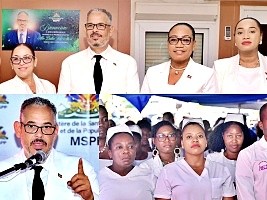
    In a landmark ceremony focused on shoring up Haiti’s strained public health infrastructure, Prime Minister Alix Didier Fils-Aimé presided over an event hosted by the Ministry of Public Health on May 1, 2026, to officially distribute 500 appointment and promotion letters to new healthcare staff serving the country’s West Department.

    Marking the International Workers’ Day observance, Prime Minister Fils-Aimé framed the mass hiring as far more than a routine personnel move, positioning it as a tangible demonstration of the Haitian state’s commitment to rebuilding and expanding accessible health services for communities across the western region. He noted that this year’s May 1 celebration carries unique weight, rooted in this concrete investment in the nation’s most essential public service.

    “Behind every appointment letter lies an individual, a personal journey, a professional aspiration, and a shared promise: to serve communities, deliver compassionate care, and ease the suffering of vulnerable Haitians,” the prime minister added, his remarks highlighting the quiet courage of the new hires. Many healthcare workers have chosen to leave Haiti amid ongoing instability, making the decision of these 500 professionals to stay and answer the call of public service a profound act of national dedication. “That is true courage. That is the love of Haiti,” he emphasized.

    Drawing on the symbolic meaning of May 1 as a day honoring work and national productivity, Fils-Aimé outlined the interconnected nature of three pillars of Haitian progress: public health, national security, and long-term development. “There is no viable hospital without security. There is no prosperous agriculture without stability, and there is no dignified work without the protection of life,” he stated, reinforcing that investments in health cannot deliver lasting impact without parallel progress in stabilizing communities across the country.

    The prime minister reaffirmed a core policy stance that health is a fundamental human right, not a marketable commodity reserved for those who can afford care. He also highlighted ongoing efforts to upgrade and expand health facilities across the country, with a specific focus on under-resourced border regions that serve some of Haiti’s most at-risk populations, ensuring these communities can access the care they need.

    Closing his address to the newly appointed and promoted healthcare workers, Fils-Aimé stressed the weight of their new roles. “An entire Nation is watching you, respecting you, and thanking you,” he said. “You are now at the heart of a vital commitment to the Nation.”

    The mass hiring marks one of the most significant public sector investments in Haiti’s health system in recent years, aimed at addressing longstanding staffing gaps that have left millions of Haitians without consistent access to primary and emergency care.