标签: Haiti

海地

  • Reconstruction : The State comes to the aid of infrastructure in the Southeast

    Reconstruction : The State comes to the aid of infrastructure in the Southeast

    As Haiti prepares for the upcoming 2026 Atlantic hurricane season, the country’s Ministry of Public Works has ramped up on-site infrastructure assessments and reconstruction work across the Southeast department, focusing on critical energy and flood mitigation projects that address long-standing vulnerabilities in the region.

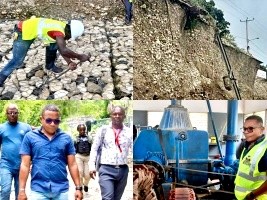
    Following a recent strategic inspection tour of the Palmes region, Minister of Public Works Joseph Almathe Pierre Louis led a ministerial delegation to the Southeast this week, kicking off the visit with a stop at the Gaillard hydroelectric power plant in Cayes-Jacmel. The facility, a key contributor to local energy supply, has been completely shut down for roughly 12 months, creating widespread disruptions to power access for surrounding communities. Minister Pierre Louis emphasized that restoring the plant aligns directly with the Haitian government’s top priority of expanding domestic energy independence, noting that engineering teams will quickly conduct full technical evaluations to launch rehabilitation work and bring the plant back online as soon as possible.

    After wrapping up the inspection at the hydropower plant, the delegation traveled to Bassin Caïman, a geographically critical hydrological hub where three major Haitian waterways — the Rivière Gauche, Rivière Gosseline, and Grande Rivière — converge. The site suffered severe damage during Haiti’s last major cyclone, which washed out a large stretch of the country’s national highway that runs through the area. During the visit, the minister reviewed ongoing gabion construction projects designed to reinforce damaged infrastructure and reduce future flood risk.

    Against a backdrop of increasing climate-related extreme weather events hitting the Caribbean, Haiti’s public works ministry — backed by the Prime Minister’s Office — has rejected short-term, superficial fixes that fail to address the root of the country’s infrastructure vulnerabilities. With the official hurricane season set to begin on June 1, immediate action is the top priority right now: the ministry will launch intensive operations to correct at-risk riverbeds across the Southeast, including embankment reinforcement, dredging of accumulated sediment, and bank protection work designed to lower the risk of catastrophic flooding as storm activity ramps up.

    Over the medium term, the government plans to shift focus to long-term structural improvements for regional watersheds, implementing comprehensive upgrades that will protect both residential communities and critical infrastructure for decades to come. Beyond infrastructure assessments, this cross-country tour of Haiti’s administrative departments has allowed Minister Pierre Louis and his team to gain on-the-ground insight into local infrastructure needs and engage directly with residents to understand their top concerns as the country works toward widespread reconstruction.


  • FLASH : The FAd’H will launch a massive recruitment drive in all 10 departments

    FLASH : The FAd’H will launch a massive recruitment drive in all 10 departments

    Haiti’s Ministry of Defense has formally announced that the Haitian Armed Forces (FAd’H) will soon roll out a large-scale recruitment campaign across all 10 of the country’s administrative departments, in a move aligned with the institution’s 2026-2027 strategic plan to steadily expand and strengthen its military workforce.

    Unveiled via an official press release on Thursday, May 21, 2026, the initiative aims to bring 1,000 new service members into the force, filling ranks across all tiers: enlisted soldiers, non-commissioned officers, and commissioned officers. Unlike targeted recruitment drives limited to specific regions, this campaign will open applications to eligible young men and women across the entire country, expanding access for interested candidates regardless of where they reside.

    In addition to the longstanding mandatory eligibility checks covering physical fitness, cognitive aptitude, and medical clearance, the FAd’H has introduced a new set of alternative social profile criteria to vet candidates. This update is designed to embed core Haitian national values — including civic responsibility, patriotism, and collective mutual support — into the force’s membership.

    Candidates only need to meet one of the 10 listed social criteria to qualify, rather than satisfying all requirements. The eligible criteria include: being an active blood donor registered with the National Transfusion Safety Program; demonstrating consistent eco-citizenship practices; participating in community-led projects that boost local public well-being; contributing to support networks for socially isolated patients; holding membership in a youth educational movement such as Scouting, MEJ, or Junior Achievement; working with mutual aid groups supporting vulnerable adults facing mental, cognitive, or social disabilities, as well as elderly adults; taking part in local or national reforestation initiatives; leading or participating in civic, artistic, or athletic training programs for underserved teens and young adults; serving as a recognized role model for positive masculinity within one’s community; and actively advancing a culture of peace among local residents.

    Official documentation from social or institutional partners confirming a candidate’s participation in one of these activities will be required during the application and vetting process. The expanded criteria mark a notable shift in how the FAd’H evaluates candidates, prioritizing community commitment alongside traditional service qualifications as the force works to build a military that reflects and supports national social priorities.

  • U-17 World Cup Qatar 2026 : Our Grenadiers know their opponents

    U-17 World Cup Qatar 2026 : Our Grenadiers know their opponents

    The stage is now set for the 2026 FIFA U-17 Men’s World Cup in Qatar, after football’s global governing body FIFA completed the final tournament draw in Zurich, Switzerland on Thursday, May 21, 2026. Scheduled to run from November 19 through December 13 this year, the youth football showcase will bring 48 of the world’s top under-17 national teams to compete across world-class venues in Doha’s Aspire Zone complex in Al Rayyan, with 8 match pitches ready for action and the tournament final set to be hosted at the iconic Khalifa International Stadium.

    For Haiti’s young national side, nicknamed the Grenadiers, this tournament marks their fourth appearance at the FIFA U-17 Men’s World Cup, and they have learned they will compete in Group D alongside three formidable opponents: European champions France, Asian side Saudi Arabia, and South American powerhouse Uruguay. The expanded 48-team format sees all participating nations split into 12 groups of four teams for the opening round. After the group stage concludes, the top two finishers from each group will advance to the knockout round of 32, joined by the eight highest-ranked third-place teams from the group stage. From the round of 32 onward, the tournament will follow a single-elimination knockout bracket to decide the world champion.

    Haiti qualified for the 2026 finals after an impressive run through regional qualifying matches, where they picked up decisive wins over Antigua & Barbuda (4-0), Grenada (5-1) and Guatemala (2-1) to secure their spot in the final draw. At the helm of the squad is head coach Kowsky Sainvil, who previously led Haiti’s U-20 national team in 2016 and has served as a coach with Canada’s FC Laval based in Quebec since 2024. Speaking after the draw ceremony, Sainvil shared that he was pleased with the outcome of the group draw, and remains confident in his young side’s prospects. The coach emphasized that with structured, high-intensity preparation in the months leading up to the tournament, his team is capable of pulling off unexpected results, earning a spot in the knockout round, and making a deep run in the competition.

    In the weeks following Haiti’s successful qualification, the country’s prime minister offered official congratulations to the U-17 squad for their achievement, marking another milestone for Haitian youth football as the nation prepares to compete on the global stage this November.

  • Leisure : Did you know ? #26

    Leisure : Did you know ? #26

    In the 26th installment of HaitiLibre’s popular “Did You Know?” trivia series, a revealing fact about Haiti’s two centuries of political history offers new context for the country’s ongoing governance challenges. Data pulled from the outlet’s interactive Haiti History Quiz 2.1 shows that from the reign of founding father Jean-Jacques Dessalines, who led Haiti to independence in 1804, to the current Transitional Presidential Council, the Caribbean nation has been led by more than 90 different heads of state.

    This extraordinary frequency of leadership turnover is rooted in the dramatic shifts in governing systems Haiti has experienced over its modern history, ranging from early imperial and monarchical structures to various republican frameworks and repeated provisional administrations. Across this timeline, long, stable tenures in office have remained rare deviations from the norm rather than the established pattern.

    Of the more than 90 leaders who have held the highest office in Haiti, a vast majority never completed their full constitutional mandates. Their terms ended in one of three common outcomes: forced exile, assassination, or ouster at the hands of popular uprisings or military coups.

    This well-documented historical pattern underscores a critical lesson for national progress: that institutional stability and consistent respect for democratic processes are foundational to long-term development. By tracing this complex history of leadership turnover, observers and citizens alike can gain deeper insight into Haiti’s contemporary political obstacles, as well as the Haitian people’s persistent aspiration for durable, forward-thinking leadership.

    Beyond this historical trivia, the fact was sourced from HaitiLibre’s growing collection of free, public online quizzes, hosted at quiz.haitilibre.com/en. The platform offers hundreds of trivia games covering topics ranging from Haitian history and culture to global affairs, designed to test general knowledge for users of all backgrounds. For more experienced trivia enthusiasts, a dedicated expert menu offers more challenging question sets tailored to advanced learners.

    All quizzes on the platform are free to access, require no user registration, and are available in both French and English, with three adjustable difficulty levels (easy, intermediate, and hard) to accommodate different skill levels. As of the latest monthly update rolled out on May 4, 2026, the platform added 30 new quiz games, bringing its total catalog to 119 interactive knowledge games. New content is added to the site every month, expanding its range of topics for returning users.

  • In Haiti, Collection of local seeds to support national reforestation

    In Haiti, Collection of local seeds to support national reforestation

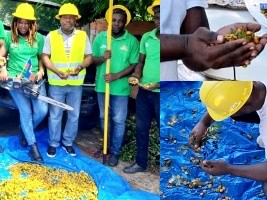
    In a major push to reverse decades of deforestation and rebuild Haiti’s fragile ecosystems, two key environmental agencies have ramped up a national native seed collection campaign focused on safeguarding the country’s unique ecological heritage. The initiative, led by the Directorate of Forests and Renewable Energies (DFER) in partnership with the Northeast Departmental Directorate (DDNE) under Haiti’s Ministry of the Environment (MdE), kicked off earlier this week with targeted field work in the country’s northern coastal region.

    Teams of DDNE-MdE technical staff have been deployed across two key collection sites: Carrefour Chivry and the Morne Casse Border Police (PoliFRONT) post in the Fort-Liberté commune. Their primary target is seed from two ecologically and economically valuable native species: local mahogany (Swietenia mahagoni) and guaiac tree (Guaiacum officinale), both of which are iconic components of Haiti’s native forest ecosystems.

    Agronomist Eder Audate, head of DFER’s Department of Forestry and Rural Development, publicly praised the relentless work of Luckin Charles, DDNE’s departmental director, and the entire field technical team. Audate emphasized that the seed collection operation is a strategically critical step that will underpin all upcoming national forest restoration projects and long-term biodiversity preservation programs across the country.

    To date, the teams have already collected more than 126 kilograms of high-quality seed, sorted and processed following a strict, science-based methodology. Collectors assess each batch based on fruit maturity and quality, the health and morphology of parent trees, the density of surrounding vegetation cover, and site accessibility to ensure only the most robust seed is selected for propagation.

    This campaign is a concrete reflection of Environment Minister Valéry Fils-Aimé’s commitment to advancing Haitian forest regeneration through native, locally sourced seed. Unlike imported tree stock, locally harvested seed is naturally adapted to Haiti’s specific climatic conditions, soil types, and regional environmental stressors, resulting in higher survival rates for transplanted seedlings. After several months of germination and growth in controlled nurseries, the seeds will develop into seedlings that will be planted out in mass reforestation campaigns scheduled across all regions of Haiti in the coming months.

  • Morocco : Chancellor Raina Forbin calls for strengthened international mobilization for Haiti

    Morocco : Chancellor Raina Forbin calls for strengthened international mobilization for Haiti

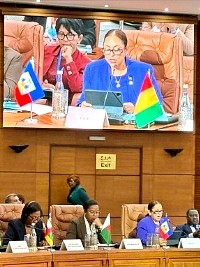
    The second High-Level Ministerial Conference on Peacekeeping in Francophone Environments brought global diplomatic attention to Haiti’s deepening security crisis this week, as Haiti’s top diplomat pressed the international community to speed up support for a critical multinational security deployment. Hosted in the Moroccan capital of Rabat on May 20, 2026, the conference was co-chaired by Nasser Bourita, Morocco’s Minister of Foreign Affairs, African Cooperation, and Moroccans Living Abroad, and Jean-Noël Barrot, France’s Minister for Europe and Foreign Affairs, drawing ministerial representatives from across the French-speaking world to address shared peace and security challenges.

    Speaking during the main ministerial debate, Haitian Foreign Minister Raina Forbin outlined the progress that the administration of Prime Minister Fils-Aimé has already made to rebuild state control across Haiti, shore up public safety, and lay the groundwork for a return to full democratic and constitutional governance. Her core message centered on accelerating the deployment of the long-planned Gang Suppression Force (GSF), a mission that Haiti has pushed for to combat widespread gang violence that has paralyzed much of the country. Forbin stressed that continued delays to the deployment would carry devastating human consequences for ordinary Haitian civilians, and called for far stronger, faster, and more closely coordinated international action to address the scale of Haiti’s ongoing security emergency.

    Beyond the urgent call for security support, Forbin used the conference as a platform to reaffirm Haiti’s longstanding commitment to the values of international solidarity, durable peace, and multilateral collaboration within the global Francophone community, framing the gathering as a key opportunity to deepen ties between Haiti and other French-speaking nations. At the conclusion of the ministerial portion of the conference, all participating delegates formally adopted the Rabat Declaration, a joint document outlining shared commitments to advancing peacekeeping efforts in Francophone regions facing instability.

    In a separate bilateral meeting with Moroccan Foreign Minister Nasser Bourita held after the conference, Forbin once again made clear Haiti’s official position on regional sovereignty issues: Haiti reaffirms its full support for Morocco’s territorial integrity and full sovereignty over all of its territory, including the Sahara region, and backs the Moroccan-proposed Autonomy Plan for the region. The meeting and conference participation also marked a step forward in strengthening bilateral diplomatic ties between Port-au-Prince and Rabat, while keeping global focus on Haiti’s urgent need for international intervention to address its ongoing crisis.

  • The Haitian Gov is toughening its response against gangs.

    The Haitian Gov is toughening its response against gangs.

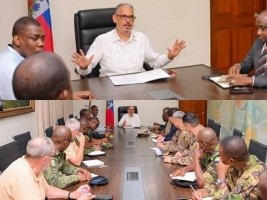
    In a decisive step to address the country’s long-running gang violence crisis, Haitian Prime Minister Alix Didier Fils-Aimé gathered top security leadership on May 20, 2026, to ramp up the government’s crackdown on armed groups that have seized swathes of national territory.

    The closed-door meeting at the Prime Minister’s Office brought together the highest-ranking command of the Haitian National Police (PNH), the High Command of the Armed Forces of Haiti (FAd’H), Defense Minister Mario Andresol, and leadership of the specialized Gang Suppression Force (GSF), alongside all frontline operational commanders deployed across conflict zones. What started as a one-off security briefing has now become a recurring weekly check-in, with the government formalizing a permanent mechanism held every Wednesday to assess evolving security conditions, coordinate cross-force operations, and refine tactical plans for joint intervention.

    At the core of the gathering was a review of Haiti’s deteriorating national security landscape, and a finalization of aggressive new offensive measures designed to accelerate the recapture of all areas held by armed criminal groups. Following the meeting, the Prime Minister’s office announced that the Haitian government would enact a sustained nationwide security deployment across every region of the country.

    Under the new plan, counter-gang operations led by the PNH, with critical backing from the FAd’H and GSF, will be immediately expanded in scale and intensity. These operations will continue around the clock without interruption until full state authority is reestablished in every territory currently controlled by armed gangs.

    The government also formalized a strict zero-tolerance policy that applies not only to armed gang members and the groups classified as terrorist entities, but also to their supporting networks, logistical suppliers, financial backers, and any individual who directly or indirectly enables the ongoing climate of insecurity.

    In an official statement released after the meeting, the Prime Minister’s office laid out three non-negotiable commitments from the government: no territory held by gangs will be written off as lost, no acts of complicity with criminal groups will be overlooked within state ranks, and no illicit financing for gangs will escape legal punishment.

    “The State is standing firm, the response is underway, the Republic will triumph, and order will be restored,” the statement read, marking a clear show of resolve from the Haitian administration as it launches one of its most ambitious counter-gang campaigns in recent history.

  • Leisure : Did you know ? #25

    Leisure : Did you know ? #25

    In the 25th installment of HaitiLibre’s popular ‘Did You Know?’ leisure series, published May 20, 2026, readers are invited to explore the little-known history and unique culinary character of sumac, a versatile ancient spice with deep roots in Mediterranean and Middle Eastern food traditions.

    Sumac is harvested from the berries of wild shrubs that thrive in the rugged rocky terrain spanning the Mediterranean basin and the Middle East. What sets this spice apart from common acidic seasonings is its bright, lemony-forward profile paired with a subtle astringent bite, which adds fresh, tangy depth to dishes without requiring liquid additives like vinegar or freshly squeezed lemon juice. It has long been a staple in the national cuisines of Lebanon, Syria, and Turkey, and serves as a core component of the iconic Za’atar spice blend—an aromatic mix that also includes dried thyme, toasted sesame seeds, and salt.

    The historical reach of sumac stretches back far earlier than many modern home cooks realize. Long before lemons were introduced to European markets, ancient Romans already relied on sumac for both its medicinal benefits and culinary versatility. This long legacy offers a powerful reminder: regional biodiversity shaped unique culinary identities centuries before the globalization of food ingredients homogenized modern diets. In highlighting sumac’s story, the feature also issues a quiet call to action: to honor distinct regional terroirs, and recognize that every corner of the world holds one-of-a-kind natural treasures that deserve protection from conflict and the gradual erasure of ancient cultural traditions.

    This fun, educational fact comes straight from the HaitiLibre Quiz platform, an interactive general knowledge hub designed to challenge and engage learners across a wide range of topics. The platform caters to casual knowledge seekers and trivia enthusiasts alike, covering everything from Haitian current affairs and culture to global general knowledge. For users ready to test their expertise, the platform’s expert menu, hosted at https://quiz.haitilibre.com/en, offers a diverse array of specialized, challenging themes.

    Currently, the platform hosts 119 unique interactive quiz games, with new content added on a monthly basis. As part of the May 2026 monthly update, 30 brand-new quizzes were added to the library on May 4, expanding the platform’s offerings for all audiences. All HaitiLibre Quiz games are exclusive, completely free to access, and require no account registration to play. They are designed to be accessible to all age groups and knowledge levels, with three difficulty tiers—easy, intermediate, and hard—available for every quiz, and full support for both French and English languages.

    Readers are invited to visit the quiz hub at https://quiz.haitilibre.com/en to explore the full collection of content, test their own general knowledge, share the platform with family and friends, and send feedback to the HaitiLibre team to help improve future updates. This ‘Did You Know?’ entry is pulled from the platform’s International Cuisine 2.1 themed quiz, and previous installments of the series dating back to the 21st entry are also archived on the HaitiLibre website for interested readers to explore.

  • Internships : Launch of the Youth Employment Initiation Program in the Private Sector

    Internships : Launch of the Youth Employment Initiation Program in the Private Sector

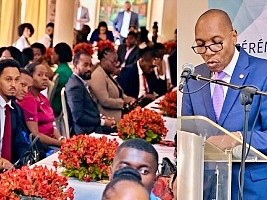
    In a formal ceremony held at Port-au-Prince’s Ritz Kinam Hotel on May 15, 2026, Haitian academic leaders and stakeholders marked the official launch of the long-awaited Youth Employment Initiation Program, known locally by its Haitian Creole acronym PIJE, an initiative designed to bridge the gap between academic training and professional employment for the country’s young graduates.

    Dr. Jean Denis Saint-Felix S.J., dean of the Faculty of Economic, Social, and Political Sciences at Notre Dame University of Haiti (FSESP-UNDH), delivered opening remarks at the event, expressing heartfelt appreciation for the collaborative effort behind the program’s rollout. He emphasized that youth unemployment remains one of Haiti’s most pressing social and economic challenges, and called on the Haitian government to prioritize long-term, sustainable funding and implementation of PIJE to ensure that thousands of job-seeking young people across the country can access its benefits in coming years.

    Unlike generic unpaid internship programs that leave young graduates covering their own living costs during training, PIJE is structured to remove common barriers to entry for early-career workers. The initiative targets recent graduates from all accredited public and private universities and vocational training institutions across Haiti, placing selected participants into three-month paid internships at both public sector agencies and approved private companies. All participant stipends are fully covered by Haiti’s Public Treasury, eliminating the financial barrier that often prevents low-income young people from accessing skill-building work experience.

    The core mission of PIJE is to equip new graduates with hands-on, practical professional skills that cannot be taught in a classroom setting. By offering structured on-the-job training, the program prepares participants to enter the open job market with verifiable work experience, expanding their employment prospects while encouraging them to contribute actively to Haiti’s ongoing economic and social recovery.

    The program’s selection process is managed through coordinated outreach between the Ministry of Economy and Finance and Haiti’s post-secondary institutions. Each cohort of participants is selected through a progressive process: ministry officials contact participating universities and vocational schools in phases, requesting institutions to nominate candidates based on a combination of strong academic performance and demonstrated professional aptitude. To date, more than 60 post-secondary institutions across Haiti have already participated in earlier iterations of the program, including 16 vocational training centers, 14 public universities, and 33 private higher education institutions.

    As Haiti continues to work toward stabilizing its economy and expanding opportunities for its growing youth population, PIJE represents a targeted policy intervention that addresses a critical gap in the country’s workforce development ecosystem.

  • Colombia : Haiti participates in an important Conference of Ministers of Labor from Latin America and the Caribbean

    Colombia : Haiti participates in an important Conference of Ministers of Labor from Latin America and the Caribbean

    In a step that underscores Haiti’s growing engagement with regional policy cooperation on labor issues, Haiti’s Minister of Social Affairs and Labor Marc-Elie Nelson departed the country on May 20, 2026, for Bogotá, Colombia, to take part in the upcoming 2026 Conference of Ministers of Labor from Latin America and the Caribbean. The two-day event, scheduled to kick off on May 21, brings together a diverse cross-section of stakeholders to address the pressing, complex challenge of labor migration across the region. Attendees include heads of state, senior labor officials from across the Americas and the Caribbean, multilateral organization representatives, private sector leaders, and leading international experts focused on labor rights and migration policy.

    Over the course of the conference, participants will dive into a broad range of interconnected topics central to creating fair, sustainable migration frameworks. Key discussion themes cover the professional integration of migrant workers and robust protection of their fundamental rights, mechanisms for the mutual recognition of professional skills and qualifications across national borders, the development of regulated, secure pathways for professional mobility, and targeted strategies to advance socio-economic inclusion in communities and regions that face high rates of migration inflow. Additional agenda items include exploring opportunities to support migrant entrepreneurship and address challenges tied to the informal economy, fostering social innovation to strengthen community cohesion, and expanding targeted technical cooperation to improve vocational training systems across the region.

    On the second day of the gathering, Nelson is set to deliver an official address focused on the specific theme of “Migration and Professional Integration,” sharing Haiti’s perspectives and experiences on this critical policy area. When the conference draws to a close, participating ministers will gather to sign two landmark documents: the Bogotá Declaration and the Multilateral Memorandum of Understanding on Dignified Labor Migration and Rights-Based Mobility in Latin America and the Caribbean. These agreements will formalize a new regional cooperation framework centered on advancing decent work for migrant workers, standardizing qualification recognition, and upholding migrants’ rights, all with the goal of supporting seamless socio-economic integration for people moving across regional borders.

    his official participation in the high-profile regional conference makes clear the commitment of Haiti’s Prime Minister Fils-Aimé administration to strengthening inclusive social policies. These policies prioritize both the socio-economic integration of Haitian migrants across the region and the protection of their core fundamental rights, aligning Haiti with broader regional efforts to create more equitable, rights-centered migration systems.