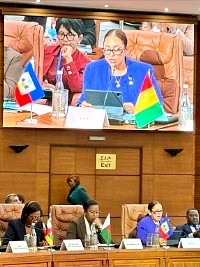
The second High-Level Ministerial Conference on Peacekeeping in Francophone Environments brought global diplomatic attention to Haiti’s deepening security crisis this week, as Haiti’s top diplomat pressed the international community to speed up support for a critical multinational security deployment. Hosted in the Moroccan capital of Rabat on May 20, 2026, the conference was co-chaired by Nasser Bourita, Morocco’s Minister of Foreign Affairs, African Cooperation, and Moroccans Living Abroad, and Jean-Noël Barrot, France’s Minister for Europe and Foreign Affairs, drawing ministerial representatives from across the French-speaking world to address shared peace and security challenges.
Speaking during the main ministerial debate, Haitian Foreign Minister Raina Forbin outlined the progress that the administration of Prime Minister Fils-Aimé has already made to rebuild state control across Haiti, shore up public safety, and lay the groundwork for a return to full democratic and constitutional governance. Her core message centered on accelerating the deployment of the long-planned Gang Suppression Force (GSF), a mission that Haiti has pushed for to combat widespread gang violence that has paralyzed much of the country. Forbin stressed that continued delays to the deployment would carry devastating human consequences for ordinary Haitian civilians, and called for far stronger, faster, and more closely coordinated international action to address the scale of Haiti’s ongoing security emergency.
Beyond the urgent call for security support, Forbin used the conference as a platform to reaffirm Haiti’s longstanding commitment to the values of international solidarity, durable peace, and multilateral collaboration within the global Francophone community, framing the gathering as a key opportunity to deepen ties between Haiti and other French-speaking nations. At the conclusion of the ministerial portion of the conference, all participating delegates formally adopted the Rabat Declaration, a joint document outlining shared commitments to advancing peacekeeping efforts in Francophone regions facing instability.
In a separate bilateral meeting with Moroccan Foreign Minister Nasser Bourita held after the conference, Forbin once again made clear Haiti’s official position on regional sovereignty issues: Haiti reaffirms its full support for Morocco’s territorial integrity and full sovereignty over all of its territory, including the Sahara region, and backs the Moroccan-proposed Autonomy Plan for the region. The meeting and conference participation also marked a step forward in strengthening bilateral diplomatic ties between Port-au-Prince and Rabat, while keeping global focus on Haiti’s urgent need for international intervention to address its ongoing crisis.