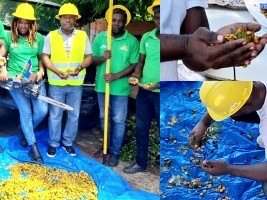
In a major push to reverse decades of deforestation and rebuild Haiti’s fragile ecosystems, two key environmental agencies have ramped up a national native seed collection campaign focused on safeguarding the country’s unique ecological heritage. The initiative, led by the Directorate of Forests and Renewable Energies (DFER) in partnership with the Northeast Departmental Directorate (DDNE) under Haiti’s Ministry of the Environment (MdE), kicked off earlier this week with targeted field work in the country’s northern coastal region.
Teams of DDNE-MdE technical staff have been deployed across two key collection sites: Carrefour Chivry and the Morne Casse Border Police (PoliFRONT) post in the Fort-Liberté commune. Their primary target is seed from two ecologically and economically valuable native species: local mahogany (Swietenia mahagoni) and guaiac tree (Guaiacum officinale), both of which are iconic components of Haiti’s native forest ecosystems.
Agronomist Eder Audate, head of DFER’s Department of Forestry and Rural Development, publicly praised the relentless work of Luckin Charles, DDNE’s departmental director, and the entire field technical team. Audate emphasized that the seed collection operation is a strategically critical step that will underpin all upcoming national forest restoration projects and long-term biodiversity preservation programs across the country.
To date, the teams have already collected more than 126 kilograms of high-quality seed, sorted and processed following a strict, science-based methodology. Collectors assess each batch based on fruit maturity and quality, the health and morphology of parent trees, the density of surrounding vegetation cover, and site accessibility to ensure only the most robust seed is selected for propagation.
This campaign is a concrete reflection of Environment Minister Valéry Fils-Aimé’s commitment to advancing Haitian forest regeneration through native, locally sourced seed. Unlike imported tree stock, locally harvested seed is naturally adapted to Haiti’s specific climatic conditions, soil types, and regional environmental stressors, resulting in higher survival rates for transplanted seedlings. After several months of germination and growth in controlled nurseries, the seeds will develop into seedlings that will be planted out in mass reforestation campaigns scheduled across all regions of Haiti in the coming months.