标签: Guyana

圭亚那

  • Guyana-Venezuela boundary awarded unanimously

    Guyana-Venezuela boundary awarded unanimously

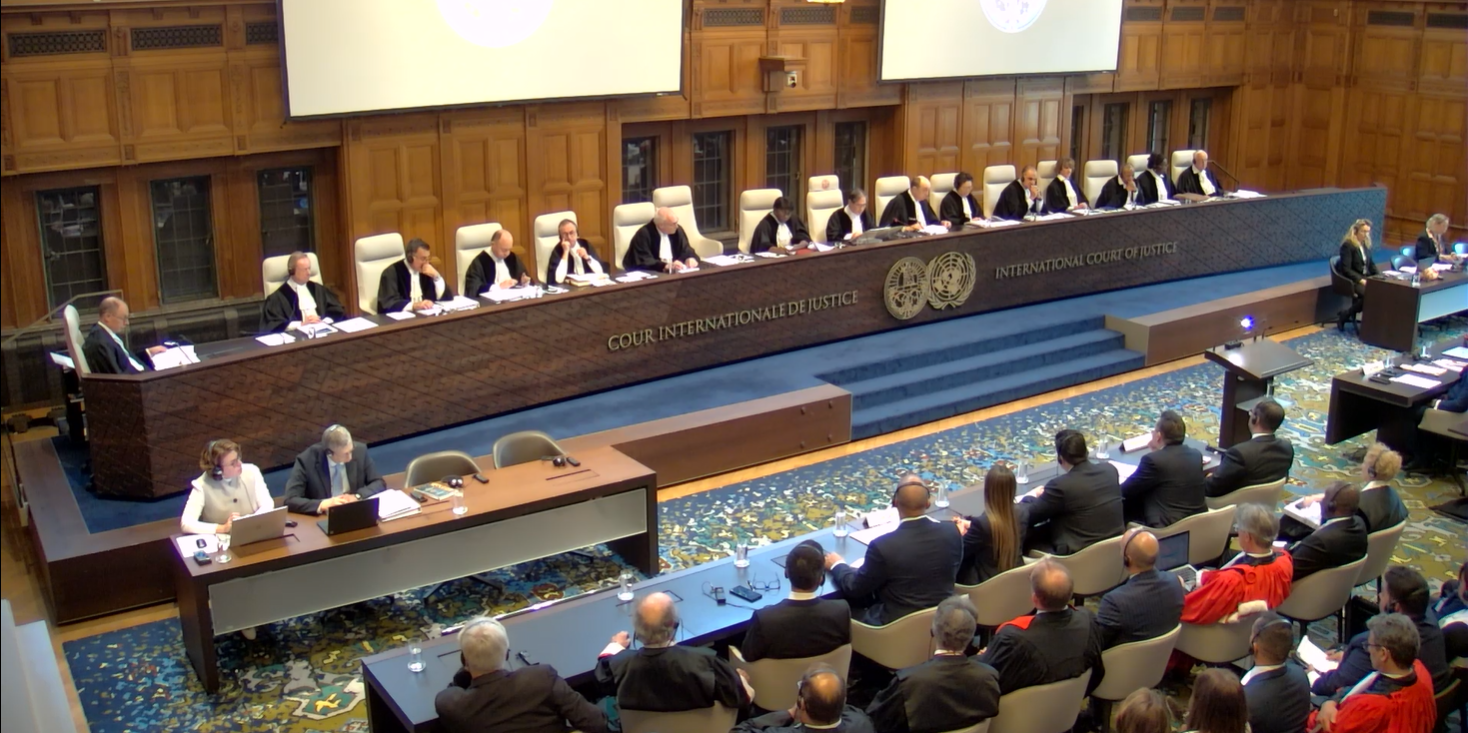
    On Friday, May 8, 2026, legal representatives for Guyana presented the country’s formal defense of the 1899 Arbitral Tribunal border award before the International Court of Justice (ICJ), the United Nations’ highest judicial body based in The Hague, pushing back against Venezuela’s claims that the historic ruling was illegitimate.

    The decades-long territorial dispute between Guyana and Venezuela centers on the 1899 award, which established the land boundary between the two nations and granted what is now Guyana control over the disputed Essequibo region. Venezuela has long challenged the ruling, arguing that tribunal president Friedrich Martens colluded with British representatives to secure an outcome that favored the United Kingdom, then the colonial ruler of British Guiana. In the current round of proceedings, Caracas has released new documentary excerpts that it claims back up these allegations of foul play.

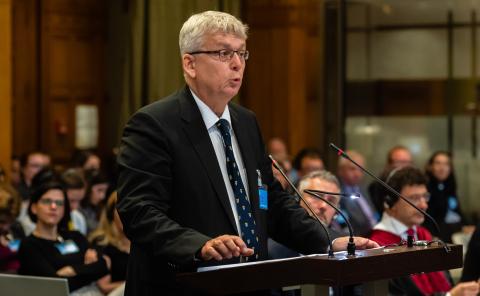
    Presenting Guyana’s second round of oral arguments, international law scholar Alain Pelet addressed Venezuela’s core criticism that the 1899 tribunal failed to include formal reasoning for its final decision. Pelet explained that while including explanatory reasoning for arbitral rulings is standard today, such a requirement was not mandatory in 1899. He confirmed that, with only one minor exception, all arbitrators unanimously signed the final award text after Martens led closed-door negotiations to build consensus. Pelet also referenced the tribunal’s original mandate, which tasked the panel with determining which territories lawfully belonged to the Netherlands and Spain respectively at the time Great Britain acquired the colony of British Guiana.

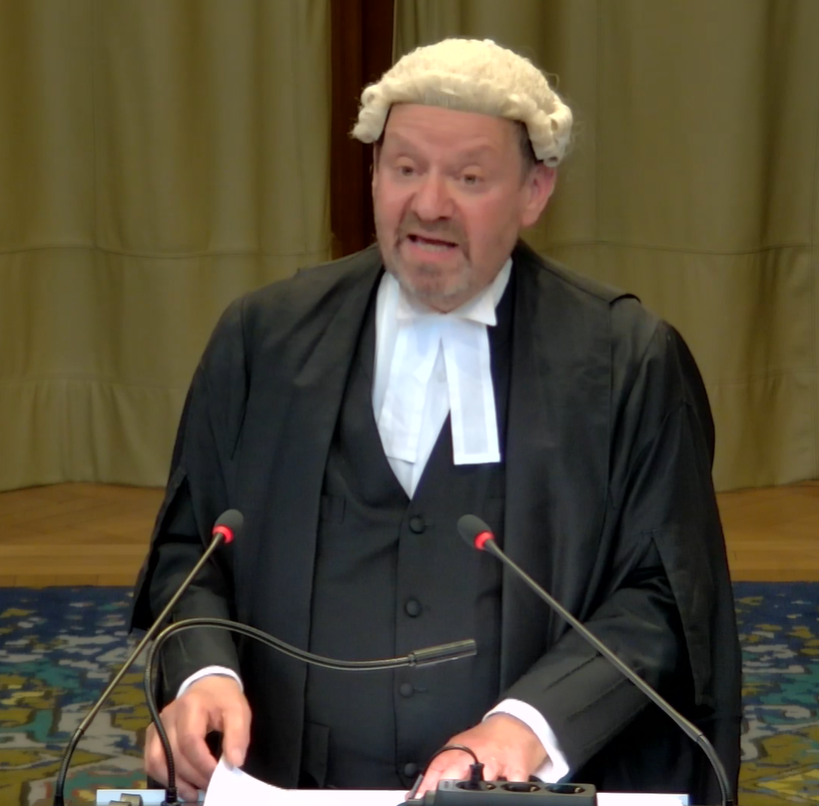
    Fellow legal representative Philippe Sands further refuted Venezuela’s claims of coercion and improper influence by Martens. Sands emphasized that there is no credible evidence to back up assertions that Martens used threats or overstepped his authority to force an outcome favorable to Britain. Even when taking at face value the controversial Mallet Prevost memorandum – the primary document Venezuela relies on to back its collusion claims – Sands noted the text only describes Martens’ efforts to encourage arbitrators to reach a unified ruling, warning that a split majority decision might be less favorable to all parties. He added that Venezuela publicly accepted the 1899 award for more than 60 years, and that Martens’ push for consensus was an act of pragmatic wisdom: had arbitrators failed to reach a unified agreement, Sands argued, Great Britain would have likely laid claim to even more territory, an outcome Martens sought to avoid.

    Sands accused Venezuela of leveraging the decades-old memorandum to stoke anti-colonial sentiment for modern political gain. He issued a stark warning about the global ramifications if the ICJ rules in Venezuela’s favor and invalidates the 1899 award and the 1905 follow-up treaty. Such a ruling, he argued, would not only put Guyana at risk of domination by its far larger neighbor, but would also set a dangerous precedent that could open the door to challenges for every colonial-era border settlement and arbitral award around the world. This outcome, Sands warned, would rekindle widespread territorial instability and erase the long-standing international norm that decades-old boundary settlements are final and binding.

    Completing Guyana’s arguments, professor Nilüfer Oral added that historical evidence confirms Great Britain strictly abided by the 1899 boundary for the entire colonial period, never attempting to cross the line or seize additional territory. In fact, Oral noted, the award achieved one of Venezuela’s core original goals: it permanently halted the westward expansion of British settlement into territory claimed by Caracas.

    The case was originally brought to the ICJ by Guyana eight years ago. Guyana’s Ministry of Foreign Affairs confirmed last Thursday that the court is expected to issue its final ruling by the end of 2026, though anonymous diplomatic sources suggest the decision could be delayed until early 2027.
  • WORLD COURT: Guyana says Venezuela failed to prove historical occupation of Essequibo

    WORLD COURT: Guyana says Venezuela failed to prove historical occupation of Essequibo

    On Friday, 8 May 2026, Guyana delivered new documentary evidence to the United Nations’ highest judicial body, the International Court of Justice (ICJ), to strengthen its position in the long-running border dispute over the Essequibo Region with Venezuela. The submission centers on historical cartographic and archival records that Guyana argues disprove Venezuela’s core territorial claims.

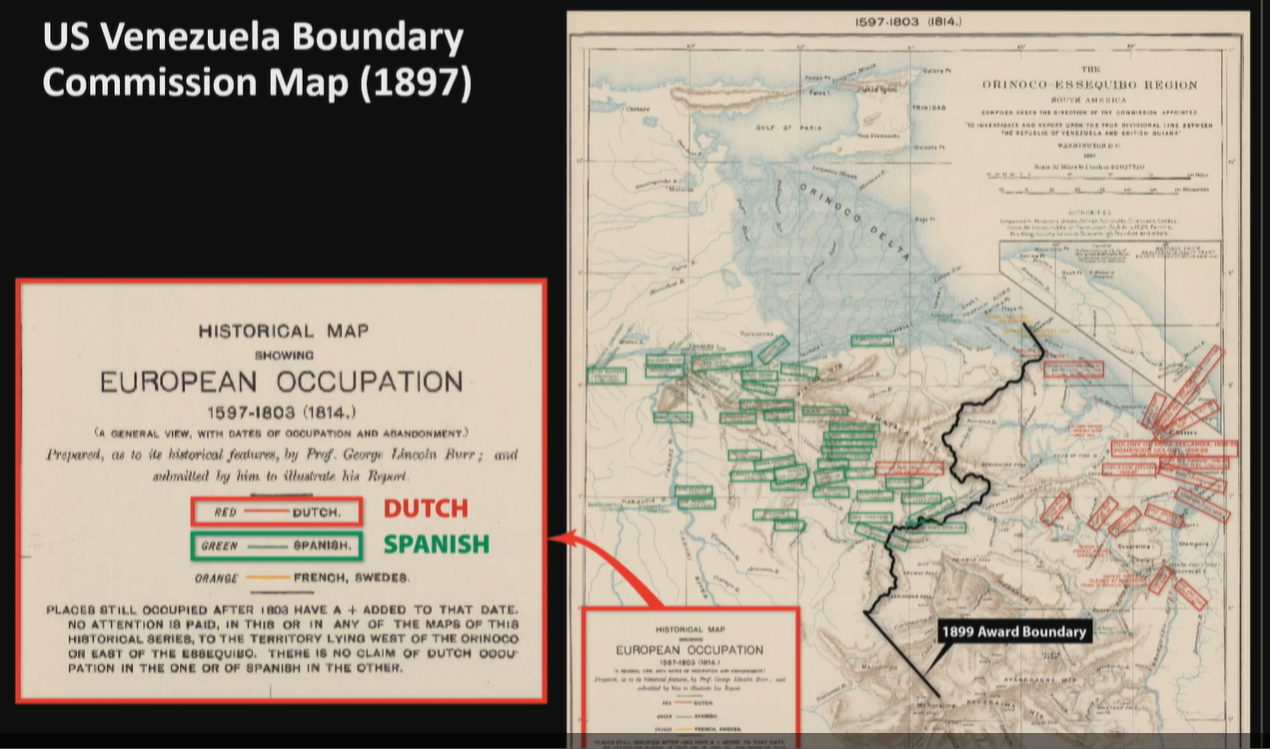
    Paul Reichler, lead legal counsel for Guyana, presented a collection of historical maps to the court, including one that clearly marks the boundary demarcated by the 1899 Arbitral Tribunal Award — the original ruling that established the territorial division at the center of the modern dispute. One key document, a map published by the joint United States-Venezuela Boundary Commission in February 1897, the exact same month that the 1897 bilateral treaty to resolve the dispute was signed, confirms that Spanish forces never established occupation in the territory east of the agreed preliminary boundary line, Reichler explained.

    Reichler emphasized that this finding aligns with Guyana’s long-held position that the Essequibo Region was historically occupied by Dutch colonizers, not Spanish, a fact echoed by the more than 30 Dutch place names still in use across the area today. He added that neither the 1899 arbitration proceedings nor the current ICJ case have ever produced credible evidence from Venezuela proving that it or Spain ever held actual occupation of any portion of the territory ultimately awarded to Great Britain. He urged ICJ justices to review the full official transcripts of both the US-Venezuela Boundary Commission and the 1899 Arbitral Tribunal to verify this finding.

    Clarifying the core question before the court, Reichler noted that the current proceedings are focused on the legal validity of the 1899 Arbitral Award, not on whether the tribunal drew the geographically correct boundary. Per the ICJ’s 2020 preliminary ruling, the court will only assess the accuracy of the boundary line if it first determines the 1899 award is legally invalid.

    Venezuela has previously argued before the court that 19th-century Britain repeatedly engaged in territorial aggression against Spanish holdings in the region, and claims that the 1966 Geneva Agreement replaced the 1899 award as the valid framework for settling the controversy. But Reichler pushed back against this interpretation, reading key excerpts of the 1966 agreement into the court record that contradict Venezuela’s position.

    The text of the Geneva Agreement explicitly states that no provision of the document can be read as a renunciation or reduction of any territorial sovereignty claim by either party, and that no activities taking place during the agreement’s term create new legal basis for any territorial claim outside of a mutually agreed settlement by the mixed commission established by the pact. Reichler stressed that Venezuela’s argument that the 1966 agreement completely set aside and replaced the 1899 award cannot be reconciled with the actual written text of the agreement, calling Venezuela’s reading a novel reinterpretation that does not align with the agreement’s original wording.

    Professor Pierre d’Argent, another member of Guyana’s legal team, added that the Geneva Agreement explicitly grants the United Nations Secretary General the authority to refer the unresolved dispute to the ICJ for a final settlement after decades of failed negotiations. After more than 60 years of discussions without a resolution, the referral to the ICJ was fully consistent with the terms of the 1966 agreement, he confirmed.

  • Sergeant arrested for assaulting policewoman

    Sergeant arrested for assaulting policewoman

    A senior non-commissioned officer with the Guyana Police Force has been taken into custody following allegations of a violent assault against a female officer at the Anna Regina Police Station, law enforcement authorities confirmed. The reported incident unfolded in the early hours of Friday, May 8, 2026, at approximately 1:00 a.m. local time.

    In an official public statement released following the arrest, the Guyana Police Force outlined that preliminary investigations have confirmed the female officer was the target of the alleged assault inside the station compound. Alongside the assault, a second female member of the force was reportedly subjected to threats by the suspect, the statement added. As of Friday afternoon, authorities have not released any details regarding the underlying trigger for the alleged violence and intimidation.

    Once regional senior police command was notified of the incident, immediate action was taken to arrest the suspect sergeant, who remains in police custody as investigators continue to build their case. The alleged assault victim was promptly transported to a local medical facility for a full clinical evaluation by a licensed physician, and law enforcement officials confirmed that medical care has been provided as needed. Investigators have already begun collecting formal witness statements as part of the ongoing inquiry, with no further updates expected until initial probes are completed.

  • Court of Appeal overturns High Court’s ruling on ExxonMobil, EPA’s financial guarantees

    Court of Appeal overturns High Court’s ruling on ExxonMobil, EPA’s financial guarantees

    On Thursday, 7 May 2026, Guyana’s Court of Appeal delivered a unanimous landmark ruling reversing a 2023 High Court judgment that found ExxonMobil Guyana Limited and the country’s Environmental Protection Agency (EPA) in breach of statutory and environmental permit obligations. The decision, handed down by Court President Dawn Gregory Barnes alongside Justices of Appeal Nareshwar Harnanan and Priya Sewnarine-Beharry, marks a major resolution to a high-stakes legal dispute over environmental liability rules for the country’s offshore petroleum operations.

    The case originated in 2023, when activists Frederick Collins and Godfrey Whyte brought a legal challenge against Exxon and the EPA. Then-High Court Justice Sandil Kissoon ruled in the claimants’ favor, accepting the argument that Exxon’s liability for environmental damage from its offshore work must be unlimited, and thus the financial guarantee required under the company’s environmental permit also needed to be uncapped. Justice Kissoon found that Exxon had knowingly violated its obligations by only submitting a US$2 billion capped guarantee, and the EPA had breached its own statutory duties by approving this limited financial assurance. He ordered the EPA to issue an enforcement notice forcing Exxon to secure an unlimited guarantee within 30 days, and threatened to suspend the company’s operating permit if it failed to comply.

    Both Exxon and the EPA appealed the ruling to the Court of Appeal, which immediately granted a stay on Justice Kissoon’s orders pending the appeal outcome. The appellate court heard full legal arguments from all involved parties in February 2026. Andrew Pollard, lead defense counsel for Exxon, outlined the court’s core findings after the ruling was released.

    Pollard explained that the appellate court drew a critical legal distinction between unlimited liability for environmental damage and the separate requirement of financial assurance. The court found that Justice Kissoon had made a legal error by conflating these two distinct concepts. Under the correct interpretation of the permit’s financial provisions, Exxon was only required to submit a guarantee for a fixed, defined amount. The court further held that the EPA retains discretionary authority under Guyana’s Environmental Protection Act and the terms of the permit to approve a capped guarantee, and Justice Kissoon had overstepped his jurisdiction by substituting his own judgment for the agency’s statutorily granted discretion.

    The ruling also confirmed that the EPA and Exxon acted appropriately in negotiating the US$2 billion guarantee, noting that Parliament had designated the EPA as the sole authorized body to make such regulatory determinations. Additionally, the court threw out Justice Kissoon’s finding that the insurance policy submitted by Exxon and approved by the EPA did not meet international petroleum industry standards, as there was no admissible evidence presented to support that conclusion. All orders issued by the High Court in 2023 were formally set aside.

    The path to the appellate ruling included a prior detour at the regional Caribbean Court of Justice (CCJ). The Guyana Court of Appeal initially blocked the country’s Attorney General from joining the case as a party, but the CCJ overturned that decision, emphasizing that the Attorney General is tasked with representing public interest, and this dispute carried significant public interest implications. That ruling cleared the way for the Attorney General to participate in the appellate proceedings and submit legal arguments.

    Multiple legal teams represented the diverse parties in the case: Exxon was represented by Andrew Pollard SC, Edward Luckhoo SC, and Eleanor Luckhoo; the EPA was represented by Sanjeev Datadin and Mohanie Anganoo; claimants Collins and Whyte were represented by Seenath Jairam SC, Saevion David-Longe, Melinda Janki, and Abiola Wong-Inniss; and the state was represented by Attorney General Anil Nandlall, Arud Gossai, and Shoshanna Lall.

  • Demerara Bank loses bid for High Court to throw out WIN members’ account closure cases

    Demerara Bank loses bid for High Court to throw out WIN members’ account closure cases

    On Thursday, 7 May 2026, Guyana’s Full Court delivered a landmark ruling against Demerara Bank, dismissing the financial institution’s appeal that sought to block six senior members of the country’s main opposition party We Invest in Nationhood (WIN) from legally challenging the bank’s unexplained closure of their personal accounts.

    The three-judge panel — led by Chief Justice Navindra Singh, alongside Justices Deborah Kumar-Chetty and Nigel Niles — upheld the lower court’s original decision, ordering Demerara Bank to submit a formal defensive affidavit to the court by 21 May 2026. The ruling also mandated that the bank pay 100,000 Guyanese dollars in legal costs to each of the six claimants by 1 June 2026. The six affected WIN members are Gobin Harbajhan, Denodra Park, Dexter George, Joel Ramesh, Lester Benjamin, and Denitta Parkes, who are represented by private attorney Darren Wade. Demerara Bank’s legal team was led by Devindra Kissoon, Natasha Vieria, and A. Dev.

    In its written judgment, the Full Court panel clarified that Demerara Bank’s procedural choice to pursue a strike-out application against the claimants’ Fixed Date Application (FDA), rather than filing a substantive defense directly, caused unnecessary delays in the legal process. “The appellant’s decision to challenge the FDA by way of a strike-out application has protracted the resolution of this matter,” the judgment read. “When weighing the core arguments presented to the lower court, we find that a defensive affidavit should have been filed from the outset, allowing the trial judge to assess the substantive claim on its legal merits.”

    The court further noted that Demerara Bank failed to provide sufficient evidence to support its claim that the opposition members’ FDA was scandalous, frivolous, vexatious, or an improper abuse of court process. The panel confirmed that the claimants had raised an arguable legal case with reasonable grounds to bring their challenge, rejecting the bank’s assertion that the suit had no legitimate path to success.

    Demerara Bank’s appeal originated from a dispute over the unexplained account closures. Instead of responding to the claimants’ FDA with a formal substantive defense, the bank opted to file a motion to have the entire claim struck from the court docket. The bank’s core arguments included that the FDA did not disclose a valid legal cause of action, that the claim was legally misconceived, and that the requested relief could not be granted under Guyanese law. Demerara Bank also argued that there was no connection between the account closures and Guyana’s Anti-Money Laundering and Countering of Financing Terrorism (AML/CFT) Act, that no private legal claim could arise from alleged breaches of that legislation, that the claimants lacked legal standing to bring the suit because the bank is not subject to public law remedies, that no implicit duty of good faith exists in customer banking contracts, and that the bank owes no fiduciary duty of trust or confidence when making the decision to close a customer’s account.

    Counsel for the six opposition members pushed back against all of the bank’s claims, arguing that a clear legal cause of action does exist. The claimants contend that an implicit duty of good faith is a standard component of all banking contractual relationships in Guyana, and that Demerara Bank breached that fundamental overriding duty when it shut down their accounts without any warning or explanation.

  • Venezuela alleges to ICJ that 1899 boundary was awarded based on “threats”

    Venezuela alleges to ICJ that 1899 boundary was awarded based on “threats”

    A decades-long territorial dispute over the resource-rich Essequibo Region returned to the International Court of Justice (ICJ) this week, as Venezuela’s legal team laid out substantial new evidence arguing the 1899 boundary award that granted control of the territory to Britain (the predecessor of modern Guyana) was obtained through improper coercion and political collusion, not legal reasoning.

    The controversy stretches back more than 125 years, rooted in an 1897 treaty between Venezuela and Britain that established an arbitral tribunal to settle their long-running border conflict. The 1899 final award from that tribunal awarded 90 percent of the disputed Essequibo territory to Britain, a ruling Venezuela has contested for decades. The debate gained new momentum after a posthumous 1944 memorandum by Mallet Prevost, an American lawyer who served as counsel for Venezuela at the 1899 tribunal, alleged that the tribunal’s outcome was shaped by outside pressure.

    On Wednesday, Venezuela’s legal team told the ICJ that far more evidence beyond Prevost’s posthumous document corroborates claims the arbitrators were coerced into a ruling that stripped Venezuela of Essequibo. The lawyers also emphasized that the 1899 tribunal never provided any formal legal reasoning to justify its final boundary decision, a failure that alone undermines the award’s legal validity.

    Venezuela’s arguments directly contradict the position Guyana laid out before the court just days earlier. Guyana’s legal team contended that Spain, Venezuela’s colonial predecessor, never held sovereign control over Essequibo, that Venezuela formally ratified the 1897 treaty creating the tribunal, and that Venezuela publicly recognized the 1899 award for more than 60 years through official maps, government statements, and participation in boundary demarcation. Guyana also dismissed Prevost’s memorandum as a collection of unreliable, unsubstantiated claims made decades after the ruling.

    But Professor Christian Tams, lead counsel for Venezuela, told the court that contemporary accounts from multiple key 1899 tribunal participants—including arbitrators and legal counsel, documented in their personal diaries and private correspondence—all align to confirm that the final boundary line was proposed by tribunal president Friedrich Martens, a Russian jurist, with no legal basis whatsoever. Tams explained that Martens leveraged coercive threats to force the British and American arbitrators to accept his compromise line during closed, off-the-record meetings separate from the tribunal’s formal deliberations. Tams noted that Martens explicitly threatened to side fully with the opposing camp in any split vote unless arbitrators accepted his proposed line.

    Tams added that this new body of documentary evidence directly undermines Guyana’s attempt to dismiss Venezuela’s claims as the invention of an older man writing decades after the event. “These are authoritative, contemporary accounts that converge on the same core conclusion,” Tams told the court. He further confirmed that the core claims in Prevost’s posthumous memorandum match a private letter Prevost wrote just three weeks after the 1899 award was issued, a letter uncovered by Venezuelan researchers after the memorandum was published. In that 1899 letter, Prevost explicitly stated the final decision was forced on the American arbitrators.

    Tams shared details of firsthand accounts from U.S. arbitrator David Brewer, who recorded that Martens manipulated divisions between British and American arbitrators to force through his preferred outcome. If the American arbitrators refused Martens’ compromise line, Martens threatened to side with Britain’s claim to the full Schomburgk Line, resulting in a 3-2 split that would give Britain complete control of the entire disputed territory. If the American arbitrators accepted the compromise, Martens guaranteed he would secure British consent, resulting in a unanimous ruling that granted 90 percent of the territory to Britain, with only a small sliver left to Venezuela. “Legal considerations played no role in this deal,” Tams said. “There is no trace of any legal reasoning that could explain why Martens drew his compromise line where he did. Arbitrators did not yield to a stronger legal argument—they yielded to clear, specific threats.”

    Venezuela’s legal team also expanded on the context of coercion surrounding the tribunal’s creation, arguing that Britain—then the world’s dominant superpower—used military pressure to force Venezuela into agreeing to the 1897 treaty. Professor Danae Azaria told the court that Britain issued multiple explicit threats of military aggression between August and December 1899 to compel Venezuela to negotiate. Just one month before talks on the Washington Treaty (the formal name for the 1897 agreement) began, the *New York Herald* reported that Britain had deployed advanced Maxim machine guns to the Venezuela border, a clear show of force. Azaria explained that Venezuela, facing British expansionism, relied entirely on U.S. support to avoid further territorial loss, and had no viable alternative to accepting the treaty terms.

    Azaria added that even after the 1899 award was issued, Britain continued to act unilaterally, beginning its own boundary demarcation in 1900. At the time, Venezuela was in the middle of a civil war and too vulnerable to resist, so it had no choice but to send a demarcation commission to avoid losing even more territory. She also noted that Venezuela only obtained solid evidence proving the award was procured through coercion in the second half of the 20th century, explaining why formal challenges to the ruling took so long to emerge.

    Professor Paolo Palchetti, another member of Venezuela’s legal team, further pushed back against Guyana’s dismissal of Prevost’s memorandum, noting that multiple independent contemporary documents corroborate Prevost’s claim that the award resulted from collusion between Britain and Russia, with improper pressure from Martens.

    Tams also added that the 1899 tribunal failed to complete its core legal mandate: it never conducted a formal investigation to confirm which territories were originally held by the Netherlands (Guyana’s colonial predecessor) and which by Spain, a foundational step for any legitimate boundary ruling. Addressing the tribunal’s complete failure to publish any legal reasoning for its decision, Tams noted that the absence of any documented legal rationale is itself a ground for invalidating the award, and further confirms the outcome was not rooted in law.

    The framework for the modern dispute is shaped by the 1966 Geneva Agreement, which established bilateral negotiations as the official mechanism to resolve the dispute after new evidence of coercion emerged. While Venezuela is participating in the current ICJ proceedings, the country has repeatedly stated it does not recognize the court’s jurisdiction over this long-standing territorial dispute.

  • World Court hears PNC, PPP govts had floated returning parts of Essequibo to Venezuela

    World Court hears PNC, PPP govts had floated returning parts of Essequibo to Venezuela

    On Monday, May 2026, Venezuela presented new archival evidence to the United Nations’ highest judicial body, the International Court of Justice (ICJ), as part of its ongoing argument that the 1966 Geneva Agreement remains the sole valid framework for bilateral negotiation of its long-running border dispute with Guyana over the resource-rich Essequibo region.

    Leading Venezuela’s presentation of this evidence, international law professor Andreas Zimmermann told the court that Guyana itself had twice, across different ruling administrations, floated proposals to cede partial control of disputed Essequibo territory to Venezuela during past bilateral talks.

    The first documented proposal emerged in 1977, when Guyana was governed by the People’s National Congress (PNC) under Prime Minister Forbes Burnham. During closed-door bilateral negotiations held under the Port of Spain Protocol, a subsidiary agreement to the 1966 Geneva framework, Guyana’s foreign minister tabled a formal proposal to adjust the existing border at Punta Playa, Zimmermann told the court. The proposed change would shift the current border’s orientation from the northwest to the northeast, effectively transferring the affected territory to Venezuelan control.

    “This development confirms that, during bilateral talks conducted under both the Port of Spain Protocol and the Geneva Agreement, Guyana was willing to pursue creative, mutually acceptable solutions and relinquish de facto control over territory that the 1899 Arbitral Award had supposedly assigned to British Guiana,” Zimmermann told the ICJ.

    Decades later, during the 1990s when Guyana was led by the People’s Progressive Party Civic (PPPC) administration, further talks explored even more flexible frameworks for resolving the dispute, the professor added. In 1995, joint discussions between the two countries included serious consideration of returning partial control of the disputed territory to Venezuela, as well as an innovative proposal for a reverse lease arrangement that would have Venezuela hold sovereignty over some areas while Guyana retained day-to-day operational control.

    Zimmermann also cited a 1998 letter written by then-Guyanese President Janet Jagan that reaffirmed the core purpose of the UN Secretary-General’s Good Officer mediation process – a process established under the Geneva Agreement – which Jagan explicitly noted was to “explore all avenues that would lead to the settlement of the border controversy” rather than simply debating the legal validity of the 1899 award.

    The professor added that high-level talks exploring practical solutions date back even further: between 1970 and 1975, Venezuelan President Carlos Andrés Pérez and Prime Minister Burnham held extensive, detailed discussions on the border dispute and mapped out multiple potential pathways to a compromise. Those talks culminated in a 1976 proposal from Burnham himself to resolve the long-running disagreement through expanded cross-border economic cooperation, with Burnham quoted as saying: “I would propose that there should be signed an accord which would lay at rest the border question.”

    Based on this long paper trail of past negotiations and proposals, Zimmermann argued, Guyana has long implicitly recognized that the Geneva Agreement is the proper instrument to resolve the substantive border dispute between the two nations, rather than treating the 1899 Arbitral Award as a final, unchallengeable settlement. The core mandate of Article 4 of the Geneva Agreement, he reminded the court, requires parties to pursue a practical, mutually acceptable solution to the full dispute, which aligns directly with the past actions of successive Guyanese governments.

    The ICJ is currently holding hearings this week and next to consider the merits of the case, which centers on the legal validity of the 1899 Arbitral Award. Guyana has long maintained that the 1899 award represents a full, final and binding settlement of the border with Venezuela, and is expected to deliver its rebuttal to Venezuela’s latest arguments in the coming days.

  • A World Court ruling in favour of Guyana will “freeze” controversy- Venezuela

    A World Court ruling in favour of Guyana will “freeze” controversy- Venezuela

    On Wednesday, May 6, 2026, Venezuela’s legal delegation presented stark warnings to the International Court of Justice (ICJ) in The Hague, arguing that upholding the validity of the controversial 1899 Arbitral Tribunal Award over the Essequibo Region will leave the decades-long territorial dispute between Venezuela and neighboring Guyana permanently unresolved.

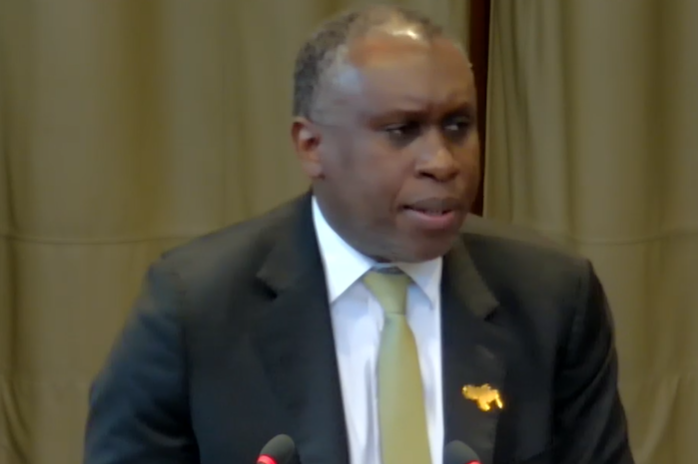
    Speaking on behalf of Venezuela, Senegalese-born international law professor Makane Moïse Mbengue, who wore a lapel pin printed with Venezuela’s claimed territorial map that includes the 160,000-square-kilometer Essequibo Region, told the ICJ panel that validating the 1899 award would achieve the exact opposite of a lasting resolution. Instead, it would lock the two South American nations into a permanent deadlock – an outcome the 1966 Geneva Agreement was explicitly crafted to overcome. Two other members of Venezuela’s legal team, professors Andreas Zimmermann and Antonio Remiro Brotóns, did not wear the symbolic pin during their presentations.

    Professor Brotóns echoed Mbengue’s position, stressing that if the ICJ dismisses Venezuela’s challenge by confirming the 1899 award’s legal standing, the 1966 Geneva Agreement would be reduced to an empty, meaningless document. He characterized such a ruling as the final step in what he called the “judicial whitewashing” of a territorial seizure imposed on Venezuela by the British Empire 127 years ago. Brotóns further warned that a ruling upholding the 1899 award would inflame tensions between the two neighboring states, rather than resolving the dispute. “This will not put an end to the controversy. On the contrary, it may exacerbate it by driving the parties further apart. It will merely be another step in a never ending saga that the parties alone can end through a common agreement. No one should have any interest in fueling the conflict,” he told the court.

    Brotóns also criticized Guyana’s approach to the dispute over the past decade, arguing that the country has abandoned its commitments under the Geneva Agreement through what he described as a combination of deliberate disregard and territorial ambition. He claimed Guyana has effectively taken the place of the United Kingdom as an “usurper” of the contested territory, and has even portrayed itself as a victim of Venezuelan aggression despite this history. “Decolonization cannot be exploited to reinforce or perpetuate colonial injustices. The colonial appropriation of the United Kingdom cannot, within the normative framework of decolonization, result in a legal title for Guyana against Venezuela. Venezuela supported Guyana’s independence,” he added.

    Mbengue centered his core argument on the legal principle of novation, asserting that the 1966 Geneva Agreement legally invalidated the 1899 award and replaced it with a new framework centered on bilateral negotiation, mutual agreement, and equal sovereign standing for both parties. He emphasized that Guyana explicitly agreed to this structure when it signed onto the accord, committing to find a new resolution to the dispute over the resource-rich Essequibo Region.

    Under the terms of the Geneva Agreement, both parties are required to pursue a mutually acceptable solution through direct bilateral talks, Mbengue explained. If the court upholds the 1899 award and rejects the mandate for negotiated settlement, the dispute will again be trapped in stalemate. Even if the court overturns the 1899 award and Guyana still refuses to return to negotiations, the controversy will be left to fester, falling short of the requirements set out in the 1966 accord, he added.

    Mbengue also highlighted key provisions of the agreement that bar either side from claiming sovereign rights or legal prescription through unilateral activities undertaken during the negotiation process. The accord, he said, clearly establishes that both parties agreed to operate within a new legal framework where all territorial claims remain open pending a mutually negotiated outcome. Notably, Venezuela’s legal team did not reference the clause in the Geneva Agreement that allows the United Nations Secretary-General to refer the dispute to the ICJ for a binding ruling if bilateral and good offices mediation processes fail to produce a resolution.

    Addressing the transition to Guyanese independence, Mbengue told judges that the United Kingdom did not dismiss Venezuela’s long-standing allegations of fraud in the 1899 proceedings, and that the original 1899 framework was not simply inherited by newly independent Guyana. Instead, he noted, Article 8 of the Geneva Agreement explicitly stipulates that Guyana becomes a party to the new negotiated framework upon gaining independence.

    Guyana’s legal team had already presented its case earlier this week, submitting documentary evidence that showed Venezuela accepted the 1899 award for more than 60 years through actions including participating in border demarcation, publishing maps that recognized the award, and making official statements affirming its validity. Guyana’s side noted that Venezuela only challenged the award after a 1960s letter from a former secretary to the 1899 arbitral tribunal, Mallet Prevost, claimed the proceedings included irregularities that favored Britain, which was Guyana’s colonial ruler at the time.

    Mbengue countered Guyana’s position by pointing to 50 years of practice consistent with the novation framework established by the Geneva Agreement. For half a century, he noted, Guyana never invoked the 1899 award in any international forum, and instead participated in negotiations through the Good Officer process and other mechanisms created by the 1966 accord. “That sustained practice from Guyana reflects precisely the understanding that the award had been superseded. The intention to novate emerges finally from the practice of the United Kingdom, which consistently maintained in its diplomatic practice that former colonies could not simply inherit all obligations of colonial era treaties by automatic succession,” Mbengue added.

    Venezuela has maintained its position that the ICJ’s 2020 ruling asserting jurisdiction over Guyana’s case was incorrect, and Mbengue confirmed that “Venezuela reserves its position on the matter.” Even setting the jurisdiction question aside, Mbengue argued that the legal novation completed by the Geneva Agreement bars the ICJ from adjudicating the territorial dispute. He claimed that Guyana’s case amounts to an attempt to revive the 1899 award through the backdoor of ICJ jurisdiction, after having abandoned it through the front door of the 1966 agreement’s substantive terms. “International law does not permit that,” he said.

    Professor Andreas Zimmermann, another member of Venezuela’s legal team, criticized Guyana’s inconsistent handling of the Geneva Agreement, noting that Guyana relied on the accord to bring the case to the ICJ, but has since refused to engage with the binding legal obligations the agreement imposes on it. “What is more, Guyana, by not engaging in the substantive interpretation of the Geneva agreement, implicitly acknowledged that it has nothing, nothing to say on the manifold arguments related to the impact of the Geneva agreement on how to solve the boundary dispute, arguments that Venezuela had already brought forward in its written pleadings,” Zimmermann said.

    Zimmermann stressed that the explicit purpose of the jointly negotiated Geneva Agreement is to resolve “any outstanding controversy” related to the border. If the parties had only intended to address the narrow question of the 1899 award’s validity, that limited scope would have been clearly stated in the agreement’s preamble, he argued. To support his position, Zimmermann presented excerpts from official diplomatic documents from both Guyana and Venezuela that he says prove the Geneva Agreement was intended to serve as the foundation for a mutually negotiated settlement between the two sovereign states.

  • Venezuela maintains ICJ does not recognise court in border controversy; says Spain was responsible for Essequibo

    Venezuela maintains ICJ does not recognise court in border controversy; says Spain was responsible for Essequibo

    On Wednesday, May 6, 2026, during ongoing oral proceedings at the United Nations’ highest judicial body, the International Court of Justice (ICJ), Venezuela doubled down on its longstanding refusal to recognize the court’s authority to adjudicate a decades-long territorial border dispute with neighboring Guyana centered on the contested Essequibo Region.

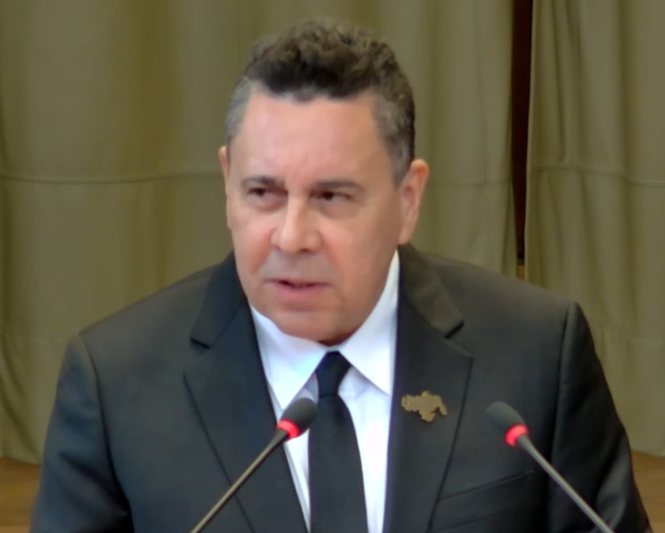
    Samuel Moncada, Venezuela’s designated agent to the ICJ, opened his remarks to the court wearing a lapel pin displaying a map of Venezuela that explicitly incorporates the 159,000-square-kilometer Essequibo Region – a move that has already drawn formal concern from Guyana through the Caribbean Community (CARICOM), the regional bloc of which Guyana is a member. The appearance comes just two days after Guyana presented its case to the ICJ, calling on the court to issue binding orders requiring Venezuela to remove all official maps labeling Essequibo as Venezuelan territory, and to rescind all domestic laws and constitutional amendments passed following a 2023 Venezuelan national referendum that formalized the country’s claim to the region.

    Addressing the court directly, Moncada emphasized that the 2023 popular referendum “unequivocally reaffirmed” Venezuelan voters’ unanimous rejection of the ICJ’s jurisdiction over the long-running disagreement. “That position has not changed. Venezuela has never consented to submitting this dispute to the jurisdiction of any court or arbitral tribunal,” he told the panel of ICJ judges.

    Moncada argued that any ruling by the court that interferes with the 1966 Geneva Agreement – the bilateral pact brokered by the United Nations that frames the dispute – would block any path to a resolution that satisfies both nations. “The only option is to allow the agreement to fulfill its purpose and objective without impediments,” he added. He accused Guyana of deliberately disregarding the terms of the 1966 accord, which was designed to address the colonial-era “fraudulent” 1899 Arbitral Award that first granted Essequibo to British Guiana, the predecessor to modern Guyana. Unlike judicial adjudication that produces a winner and a loser, Moncada noted, the Geneva Agreement mandates a mutually acceptable bilateral solution to overcome the harmful legacy of colonial border drawing.

    Staking Venezuela’s historical claim to the region, Moncada contended that Essequibo was always part of Spanish colonial territory that later became independent Venezuela. He argued that the Netherlands gained control of territory only east of the Essequibo River under the 1648 Treaty of Munster, in which Spain formally recognized Dutch independence and its territorial claims. This position directly contradicts Guyana’s formal submissions to the court, which have included cartographic and historical evidence showing Spanish colonial forces never established a presence in Essequibo, and that most place names across the region trace back to Dutch colonial settlement.

    Carl Greenidge, Guyana’s agent to the ICJ, laid out his country’s historical case during Monday’s proceedings, presenting maps showing the westernmost Spanish colonial outposts sat more than 650 kilometers east of the Venezuelan border, outside the boundaries of Essequibo. Greenidge also submitted a list of 35 existing place names across the region that retain their original Dutch monikers, tracing Guyana’s colonial history back to the first permanent Dutch settlement in 1598. By 1616, the Dutch had formally established the Colony of Essequibo, built Fort Kykoveral along the Mazaruni River as their administrative seat, and began governing territory stretching west to the Orinoco River, Greenidge explained. The Dutch West India Company took over administration of the colony in 1621, before moving the colonial seat to Fort Zealandia in 1744, he added.

    Moncada closed his remarks by reaffirming Venezuela’s commitment to a peaceful resolution of the dispute, while rejecting reliance on great power influence or outcomes from what he called “rigged international arbitrations.” “This is what led to our tradition of not recognizing the jurisdiction of arbitral tribunals or courts of any kind when it comes to matters relating to our territorial integrity,” he said. “This is why Venezuela does not accept the jurisdiction of the International Court of Justice, which was erroneously imposed in the 2020 judgment, it respectfully rejects its jurisdiction to hear and decide on this dispute.”

  • Mohameds ordered to surrender personal guns because of US sanctions

    Mohameds ordered to surrender personal guns because of US sanctions

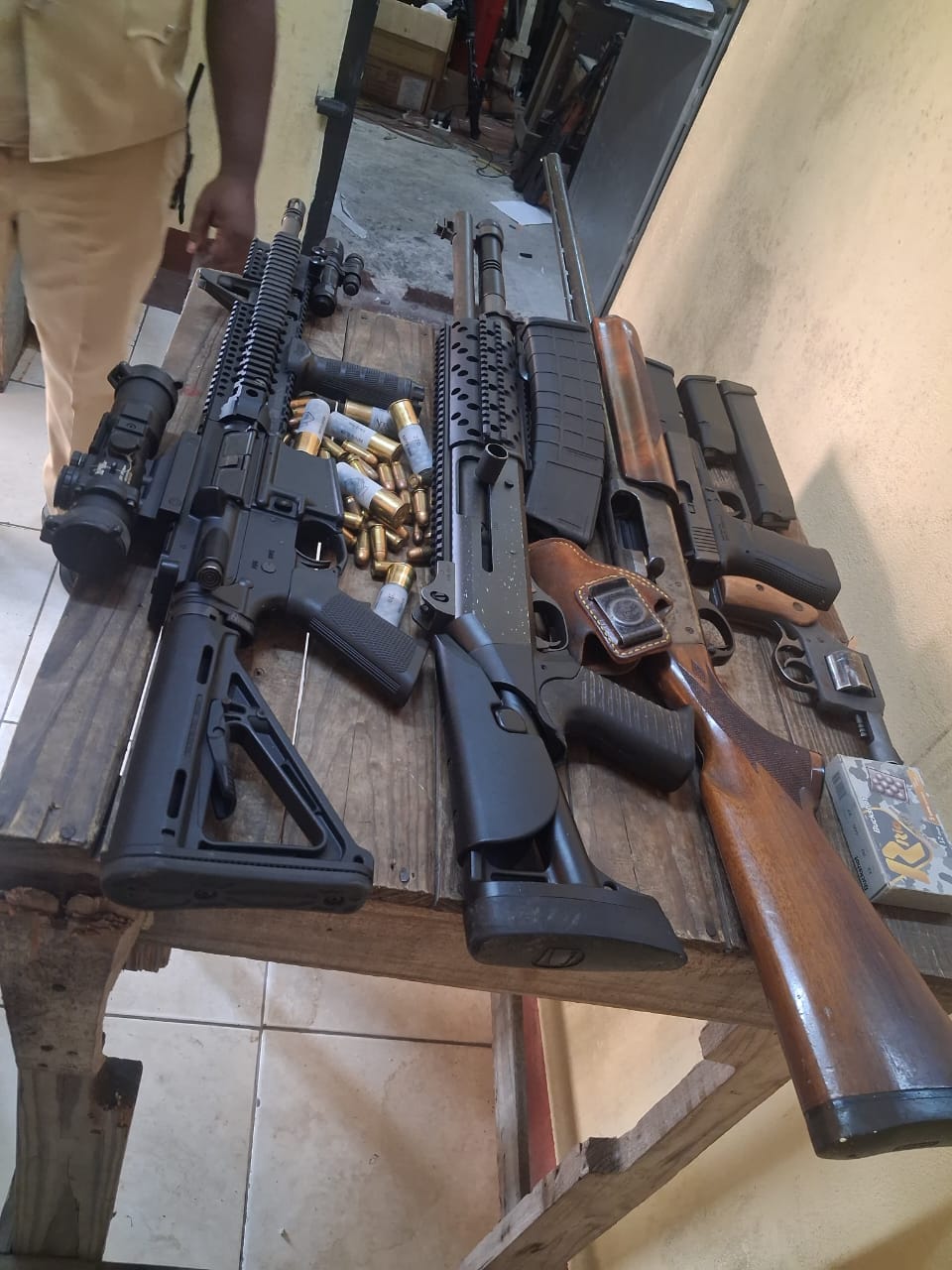
    On Tuesday, May 5, 2026, the Guyana Police Force carried out a high-stakes seizure of personal firearms and ammunition from Nazar “Shell” Mohamed, a prominent Guyanese billionaire businessman, and his son Azruddin Mohamed — the country’s sitting Opposition Leader — nearly two full years after the pair were hit with United States sanctions over allegations of mass tax evasion linked to gold exports.

    The seizure was ordered in official correspondence from Deputy Police Commissioner Simon McBean, Divisional Commander of Region 4 “A”, addressed directly to the Mohameds. In the document, McBean cites the 2025 indictment handed down against the pair in the Southern District of Florida, which charges them with conspiracy to commit mail and wire fraud, substantive wire and mail fraud, and conspiracy to commit money laundering. Under the terms of the order, the Mohameds were required to immediately surrender all weapons, ammunition, and their corresponding firearm licenses to serving officers, and have been ordered to show cause in writing as to why their licenses should not be permanently revoked per Guyana’s Firearms Act.

    Currently, the Mohameds are actively fighting an extradition request that would force them to travel to the U.S. to face trial on the Florida indictment, which was issued in October 2025. Speaking to reporters following the seizure, Azruddin Mohamed confirmed that he and his father had complied with the order, stating he had turned over one 12-gauge shotgun, one 5.56 mm (.223) rifle, and one .45 caliber pistol, while his father surrendered a .32 caliber handgun and a second 12-gauge shotgun. He added that police did not conduct a search of the family’s properties as part of this latest action.

    In a striking detail, Azruddin noted that the order to surrender the weapons came just one week after the pair had successfully renewed their firearm licenses on April 27, 2026, and he had been preparing to complete additional routine renewal paperwork this same week.

    McBean’s correspondence clarified that the current action stems from the 2024 OFAC sanctions, which were the result of a cross-border investigation into the Mohamed family’s global and local business networks, conducted jointly by the U.S. Treasury Department’s Office of Foreign Assets Control and Guyanese law enforcement authorities. The 2024 sanctions were originally imposed over allegations that the pair evaded more than $50 million in tax payments owed to the Guyanese government connected to the export of over 10,000 kilograms of unreported gold.

    This is not the first time the family has lost firearms to police action. Azruddin confirmed that shortly after the 2024 OFAC sanctions were announced, police seized roughly 70 security firearms that were deployed to protect the family’s residential properties, commercial holdings, and mining operations.

    The Opposition Leader, who has long been a vocal critic of the ruling People’s Progressive Party (PPP) government, has repeatedly rejected a government offer of official police security provided through Parliament, stating he cannot trust the personnel that would be assigned to his detail. Even after the seizure of his personal weapons, Azruddin reiterated that he will not reverse that decision. He also emphasized that neither he nor his father have ever been questioned by authorities in connection with any gun-related crime or incident.

    Azruddin directly framed the latest police action as a politically motivated attack orchestrated by the ruling PPP. “The PPP they are terrified right now; they don’t know what to do. They tried everything against me,” he told reporters. He claimed the government has been behind a sustained campaign targeting himself and his father, including the previous closure of the family’s bank accounts, repeated attempts to falsely pin charges of murder, rape, and drug trafficking on the pair, and covert influence behind the U.S. indictment, sanctions, and current law enforcement actions. “They are not succeeding with anything so they are desperate right now. They’re like a headless chicken just running all over,” he added. The Mohameds have already engaged their legal team to review the seizure and advise on their next legal steps to challenge the order.