标签: Grenada

格林纳达

  • Grenada champions small island priorities at 8th GEF Assembly

    Grenada champions small island priorities at 8th GEF Assembly

    From May 30 to June 6, 2026, the historic city of Samarkand, Uzbekistan played host to the 8th Assembly and Associated Meetings of the Global Environment Facility (GEF), drawing official delegations from all 186 of the institution’s member nations. Among the participating countries was the Caribbean small island nation of Grenada, which used the high-profile global gathering to center the unique needs and priorities of Small Island Developing States (SIDS) as the GEF opens its ninth four-year funding cycle.

    As the GEF’s top decision-making and governing body, the Assembly only convenes once every four years. This year’s meeting marked the official launch of the GEF-9 funding cycle, which will run from 2026 through 2030, and established the framework for the body’s new integrated Nature–Climate–Pollution agenda that will shape all global environmental financing activities for the next four years.

    Grenada’s three-person delegation to the Assembly included High Commissioner to the United Kingdom Rachér Croney, GEF Operational Focal Point Nicole Clarke-Gurley, and alternate Operational Focal Point Isabel Morris. Over the course of the week-long meetings, the delegation carried out a broad range of diplomatic and policy engagement: it delivered Grenada’s official national statement to the plenary, took part in high-level panel discussions including a focused session on the function of National Steering Committees, and joined delegations from Nigeria and Trinidad and Tobago for the official side event titled “Leaving No Country Behind”. On the sidelines of the main Assembly sessions, the delegation also held working meetings with representatives from the GEF Independent Evaluation Office and the body’s partner implementing agencies.

    A core focus of Grenada’s engagement throughout the Assembly was elevating the longstanding priority issues of SIDS, which are disproportionately vulnerable to climate change and environmental degradation despite contributing minimally to global emissions. The delegation pushed for major reforms to make global environmental finance more accessible, calling for simpler application processes and faster disbursement of funds to meet SIDS’ urgent needs. It also advocated for stronger global recognition of SIDS as equal co-designers of environmental projects, rather than passive recipients of funding, and called for consistent, long-term investment in building local institutional and operational capacity to sustain environmental outcomes.

    The Grenadian delegation welcomed the GEF-9 cycle’s commitment to a Whole-of-Society Approach, which includes expanding direct access to financing for Indigenous Peoples, local community groups, women-led organizations, and youth initiatives. It also reaffirmed Grenada’s full commitment to meeting the 30 x 30 biodiversity target laid out in the Kunming-Montreal Global Biodiversity Framework, which commits signatory nations to protecting 30 percent of global land and water areas by 2030.

    “Grenada came to Samarkand to ensure our voice is heard at the table upstream, where global priorities are set and funding decisions are shaped,” Clarke-Gurley said in remarks following the delegation’s participation. “Our focus for GEF-9 is delivering innovation and high, practical impact that the ordinary Grenadian can actually feel in their daily lives, backed by robust local capacity to sustain results long after a project wraps up.”

    Back home, Grenada has already taken concrete steps to translate the outcomes of the Samarkand Assembly into national action. The government has established a dedicated National Steering Committee to oversee GEF-9 project identification and build a more balanced national environmental project portfolio. By early July, the committee will issue a public call for project proposals to relevant government ministries, covering priority areas including climate change adaptation and mitigation, ocean conservation and the blue economy, water resource management, and waste reduction. All submitted proposals will be required to align with Grenada’s National Sustainable Development Plan 2035 and the country’s medium-term national action plan.

    Once the country’s STAR allocation — the GEF’s system for allocating funding to member states — is formally confirmed in July, Grenada will deepen its collaboration with implementing agencies, prioritizing projects that incorporate innovation, digitalization, on-the-ground capacity building, and stronger national oversight of project delivery. These coordinated planning steps reflect Grenada’s clear commitment to turning the global commitments agreed in Samarkand into tangible, long-lasting benefits for all Grenadian citizens, according to the Office of the Prime Minister.


  • GIZ, Camper & Nicholsons and TAMCC collaborate

    GIZ, Camper & Nicholsons and TAMCC collaborate

    On May 29, 2026, hundreds of learners across Grenada’s education spectrum – from primary and secondary school pupils to T.A. Marryshow Community College (TAMCC) students – gathered at Camper & Nicholsons Port Louis Marina for the inaugural *Explore the Blue – Marine Pathways Event*, an innovative outreach effort designed to open young people’s eyes to the potential of the island nation’s fast-expanding blue economy. The collaborative event was coordinated by Camper & Nicholsons Port Louis Marina, the Grenada Tourism Authority and the Grenada Yacht Club, with core funding and support from the Green & Blue Skills Project, an initiative run by Germany’s Deutsche Gesellschaft für Internationale Zusammenarbeit (GIZ) GmbH, commissioned by the German Federal Ministry for Economic Cooperation and Development, and delivered in partnership with the Caribbean Community (Caricom).

    One of the event’s most anticipated highlights was a series of guided glass-bottom boat tours that gave students a rare firsthand look at the vibrant underwater ecosystems that underpin Grenada’s marine industries. Accompanied by professional marine biologists, groups traveled to Pandy Beach to learn about the ecological roles of seagrass beds and coral reefs, as well as the urgent need for marine conservation. After the ocean excursion, participants moved to the Grenada Yacht Club, where they interacted directly with marine sector business representatives to explore the wide range of professional roles available in the local blue economy.

    Zara Tremlett, General Manager of Camper & Nicholsons Port Louis Marina, praised the overwhelming energy and curiosity students brought to the day. “We ran two rotating glass-bottom boat tours made possible through GIZ’s Green & Blue Skills support,” Tremlett explained. “This wasn’t just a field trip – it was a chance for young people to connect what they learn in the classroom to the living, working ocean that drives so much of Grenada’s economy.”

    The Green & Blue Skills Project, which operates across four Caribbean small island developing states, works to reform national and regional Technical and Vocational Education and Training (TVET) systems to better equip young people – especially women and marginalized vulnerable groups – to access jobs and launch enterprises in green and blue economy sectors. In Grenada, the initiative prioritizes the entire maritime industry, covering everything from luxury yachting and marine tourism to traditional boatbuilding, fisheries, ferry transport, and vessel repair and maintenance.

    Sabine Klaus, head of the Green & Blue Skills Project, emphasized that bridging the gap between education institutions and industry is critical to meeting current and future workforce demands in Grenada. “Grenada’s blue economy holds enormous potential for inclusive, sustainable economic growth, but right now, there are far too few structured training programs and clear career pathways for young people interested in marine careers,” Klaus noted. “As a result, many local marine businesses are forced to bring in specialized experts from overseas to fill critical roles, from equipment repair to operations management, which holds back the sector’s growth.”

    Klaus added that the project will continue its work with TAMCC and local industry partners such as Port Louis Marina to expand accessible marine training programs, update curricula and qualification standards, and develop structured apprenticeship and direct employment pathways aligned with the evolving needs of Grenada’s growing blue economy.

    Akimo Murray, TAMCC’s Acting Corporate Communications Officer, framed the event as a transformative step for marine education in Grenada. “For students, getting to see and experience first-hand the concepts their lecturers discuss in the classroom is invaluable,” Murray said. “This kind of real-world engagement benefits learners, our institution, and Grenada as a whole by building a pipeline of local talent for the marine sector.”

    The Grenada National Training Agency (GNTA), which also partnered on the event, leveraged the accompanying Open House and Exhibition to connect directly with learners across all education levels, from primary school through tertiary education. GNTA Marketing and Communications Officer Kay Julien-Gutu called the event a resounding success, noting that it created a critical public space for career exploration and educational outreach. “Our team got to interact directly with the next generation of marine professionals, showcase what TVET has to offer, and share targeted guidance on careers in marine industries and yachting,” Julien-Gutu explained. “Initiatives like this help us deliver on our core mission: building strong links between education providers and industry, so Grenada’s young people are prepared to pursue sustainable, rewarding careers that benefit both themselves and their country.”

    Buoyed by overwhelmingly positive feedback from participating students, educators, and industry partners, stakeholders are now discussing the possibility of making the Explore the Blue event a regular fixture, held either annually or biannually to reach new groups of young Grenadians each year.

    As a long-standing global leader in international development cooperation with more than 50 years of experience, GIZ works with partners in roughly 120 countries worldwide to deliver practical, locally led solutions that improve livelihoods, expand economic opportunity, and advance environmental sustainability. Beyond Grenada, the Green & Blue Skills Project also operates in Dominica, St Lucia, and St Vincent and the Grenadines, addressing skills gaps across green sectors including renewable energy and climate-resilient agriculture, as well as blue economy sectors such as sustainable tourism and marine conservation. In Grenada, widespread industry reports confirm persistent shortages of qualified workers across key maritime roles, including marine technicians, marina operations staff, marine hospitality personnel, and certified seafarers – a gap the project and its local partners are working steadily to close.

  • Pope Leo XIV has officially accepted the resignation of Bishop Clyde Martin Harvey

    Pope Leo XIV has officially accepted the resignation of Bishop Clyde Martin Harvey

    In a formal church development that closes a years-long transition process, Pope Leo XIV has formally accepted the resignation of Bishop Clyde Martin Harvey, the long-serving leader of the Diocese of St George’s-in-Grenada, the diocese confirmed in a public statement released this week. The resignation process first began back in November 2023, when Bishop Harvey submitted his formal notice of stepping down in compliance with the Roman Catholic Church’s canon law requirements for clergy retirement. At that time, then-Pope Francis declined to accept the immediate resignation, requesting that Harvey remain in his post to oversee diocesan operations through January 31, 2026, to ensure a stable, orderly transition of responsibilities.

    Following the passing of Pope Francis, Pope Leo XIV took office as the head of the Roman Catholic Church in May 2025, inheriting the pending transition process for the Grenada diocese. On Tuesday, June 9, 2026, the new pontiff officially formalized the acceptance of Harvey’s resignation, bringing the transition period to a close. To lead the diocese through the interim period before a permanent new bishop is selected, the Vatican has appointed Archbishop Gabriel Malzaire, who currently serves the Archdiocese of Castries in neighboring St Lucia, as the Apostolic Administrator of the Diocese of St George’s-in-Grenada.

    Archbishop Malzaire is already scheduled to make his first public appearance in his new interim role next Sunday, June 14, 2026. He will lead the monthly devotion service at the Marian Shrine located on Battle Hill, kicking off at 3:00 p.m. local time. For his part, Bishop Harvey is expected to wrap up his remaining administrative duties and depart the diocese next week, marking the end of his tenure leading the Grenada-based diocese.

    A disclaimer accompanying the diocesan announcement notes that NOW Grenada, the outlet that first distributed the statement, does not take responsibility for the personal opinions, public statements or third-party contributed media content included in the announcement. Members of the public are invited to report any potential abusive content via a designated channel provided by the outlet.

  • GUT accuses education ministry of downplaying teachers’ pay delays

    GUT accuses education ministry of downplaying teachers’ pay delays

    As the Grenada Union of Teachers (GUT) marks 113 years of advocating for the island nation’s educators, a bitter dispute over persistent, months-long salary delays has brought long-simmering tensions between the union and the Ministry of Education to a head.

    According to GUT President Jude Bartholomew, dozens of teachers across Grenada have waited as long as eight months to receive pay they have already earned, with complaints about late and incomplete salaries first emerging as far back as September 2025. The union has repeatedly escalated the issue to top government bodies, including the Public Service Commission, the Department of Public Administration, the Education Minister and the Permanent Secretary, but Bartholomew says officials have failed to act with urgency.

    The conflict intensified last Friday, after the Ministry of Education released an official statement responding to the union’s public allegations of “extremely late payments.” In the statement, ministry officials claimed they had only received a formal list of 17 affected teachers with partial payment issues between September 2025 and April 2026. They asserted that all 17 teachers are now receiving their regular base salaries, that most outstanding back payments have already been processed, and that remaining claims would be resolved during the June 2026 payroll cycle.

    But Bartholomew has pushed back sharply against the ministry’s account, accusing officials of downplaying the scale of the crisis and misleading the public. “We receive complaints every day which are sent to the ministry,” he told reporters at a press briefing last Friday. “So, it’s much more than 17. And whether it is 17 teachers, 100, 500 teachers or one teacher, that is not the essence of the matter. You should move speedily to pay the teachers.”

    The GUT president also noted that while the ministry has temporarily suspended some in-office services starting June 3 due to facility challenges, this logistical issue cannot explain payment delays that have stretched on for months. He criticized the government’s statement for omitting critical context about how long educators have struggled with the issue, arguing that officials have deliberately framed the dispute to minimize the union’s concerns.

    For the GUT, which has represented Grenada’s teaching workforce for more than a century, the fight is about more than just correcting payroll errors. Months of delayed pay have placed severe financial strain on working educators who continue showing up to teach while waiting for owed compensation, and have severely damaged staff morale across the country’s education system. Bartholomew emphasized that educators deserve timely payment for their work, and called on officials to resolve all outstanding claims immediately rather than deflecting or downplaying the ongoing crisis.

  • SPECTO: Early closure of turtle watching tours for 2026 Season

    SPECTO: Early closure of turtle watching tours for 2026 Season

    The St Patrick Environmental and Community Tourism Organisation (SPECTO), a Grenada-based group focused on leatherback turtle conservation and responsible ecotourism, has announced an immediate, early end to all remaining turtle watching tours for the 2026 leatherback nesting season, marking the second straight year the organization has been forced to take this step.

    The difficult decision comes after weeks of sharply declining observations of nesting female leatherbacks on Grenada’s Levera Beach, one of the Caribbean’s key nesting sites for the vulnerable marine species. While SPECTO has always noted that wild turtle encounters cannot be guaranteed in its nature-focused tours, the ongoing sharp drop in nesting activity left the organization unable to deliver the consistent, high-quality visitor experience that tourists have come to expect from its programming.

    SPECTO leadership confirmed that the repeated early closure has raised serious alarm, as the organization’s core mission centers on protecting leatherback turtle populations and advancing community-centered sustainable tourism. Preliminary observations from regional partners have added further context to the concerning trend: similar dramatic declines in nesting activity have already been recorded in Trinidad, which hosts one of the largest and most significant leatherback nesting colonies in the entire Caribbean region. This cross-border pattern suggests that the drop in nesting numbers is not an isolated issue limited to Grenada, but may stem from broader regional or global ecological and environmental shifts impacting the entire species.

    Moving forward, SPECTO has announced it will collaborate closely with local government agencies, independent marine researchers, international conservation groups, and regional ecological partners to collect comprehensive data on the decline and identify its root causes. The organization aims to contribute to a robust, evidence-based understanding of the threats facing leatherback turtle populations, and to help develop targeted conservation actions that can support the species’ long-term survival.

    In a public notice, SPECTO also reiterated longstanding protections for Levera Beach during the annual nesting season, which runs from April through August. Under Grenada’s 2010 Statutory Rules and Orders No. 15 and the national Fisheries Act, the beach remains a restricted protected area throughout the nesting period. Unauthorized entry is strictly prohibited, as limiting human disturbance is critical to protecting nesting females, newly hatched turtle hatchlings, and the fragile coastal dune habitat that leatherbacks depend on for successful reproduction.

    The organization closed its announcement by extending sincere gratitude to all tourists, volunteer stewards, local community members, and institutional partners that supported the 2026 tour season. SPECTO noted that participation in its regulated ecotours delivers multiple benefits beyond direct conservation action, supporting local livelihoods and expanding public awareness of marine environmental issues across Grenada.

  • Echoes of Waltham wins Best Video Production at CTO Media Awards

    Echoes of Waltham wins Best Video Production at CTO Media Awards

    A landmark community-led heritage documentary centered on the Grenadian village of Waltham has earned the region’s top tourism industry recognition, taking home the Best Video Production prize at the Caribbean Tourism Organisation (CTO) Media Awards.

    *Echoes of Waltham*, which captures the personal memories, intergenerational stories and distinct cultural landscape of Waltham in Grenada’s St Mark parish, emerged from the Island Echoes cross-cultural co-production initiative. The project is led by the Caribbean Institute for EcoLiberation (CIEL) in strategic partnership with Paxton House’s Caribbean Connections programme, an effort designed to unpack the little-known historical ties between the 18th-century Scottish Borders stately home and Caribbean communities shaped by the plantation economy.

    The transatlantic collaboration traces its origins to journalist Zoe Smith, who uncovered the hidden history of Waltham Estate while investigating the region’s plantation-era past. After discovering the estate was once owned by Ninian Home, a former colonial governor of Grenada who also owned Paxton House, Smith reached out to Home’s descendants to launch a community-focused heritage project that would center local voices rather than elite historical narratives. Over the course of the project, the partnership brought together a diverse coalition of Waltham residents, community organizers, academic researchers, creative artists, young participants and heritage institutions across Grenada, Scotland and England.

    For Smith, the project’s lead, the award is far more than an industry honor—it is a validation of the community trust that made the work possible. “This award is a beautiful recognition of Waltham’s story, but more than that, it is a recognition of the elders, residents and neighbours who trusted us with their memories,” Smith explained. “*Echoes of Waltham* was never simply about making a film. It was about honouring a village, preserving living memory, and creating a bridge between Grenada’s past, present and future. I’m especially proud that this work has connected Grenada, Paxton House and the wider Caribbean diaspora.”

    Unlike traditional historical documentaries that rely heavily on archival text and external expert narration, *Echoes of Waltham* centers the unrecorded voices of Waltham’s long-term residents and elders, preserving their oral histories that might otherwise have been lost to time. Through these personal stories, the film opens critical, accessible conversations about plantation history, the value of intergenerational storytelling, and the urgent need to safeguard Grenada’s vulnerable intangible cultural heritage. The production was shaped by collective input: historian and archivist Dr. Angus Martin provided deep contextual historical expertise, Scottish Paxton House curator Dr. Fiona Salvesen Murrell contributed guidance on transatlantic archival records, and Waltham residents Laslynn Andall and Anthony Patrick brought on-the-ground community perspective that anchored the entire project.

    Dr. Salvesen Murrell emphasized that the documentary aligns with the core mission of Caribbean Connections, which seeks to re-examine Paxton House’s colonial ties through a community-centered lens rather than a traditional institutional framework. “We are delighted that *Echoes of Waltham* has received this recognition from the Caribbean Tourism Organisation,” she said. “This highly meaningful film forms part of Paxton House’s wider Caribbean Connections work, which seeks to explore our historic links with the Caribbean in a thoughtful, creative and resident-centred way. We are deeply grateful to the people of Waltham and to all the partners who helped bring this story to life.”

    The award-winning documentary is just one component of the broader Caribbean Connections programme, which also includes *Palimpsest*, a major exhibition by Grenadian-born artist Billy Gérard Frank. Frank’s work served as a central creative anchor for the partnership, illuminating the layered cultural, historical and emotional connections that bind Grenada, the wider Caribbean, and the Scottish Borders to this day. For Frank, the documentary’s award win highlights the transformative power of centering marginalized voices in shared heritage work. “This film demonstrates the power of storytelling to connect generations, preserve local histories, and deepen our understanding of the enduring ties between Grenada, Scotland, and England,” Frank said. “At its heart, *Echoes of Waltham* is a celebration of memory, place, and the voices that shape our shared heritage.”

    Beyond the recognition from the CTO, the project has already sparked new academic and community engagement. It has catalyzed expanded research into the historical links between St Mark parish and Scotland, with a team of researchers from the University of Edinburgh already conducting an on-site visit to Waltham to advance their work. The film has also been screened locally for staff, students and residents at St Mark’s Bonaire Government School, bringing the story of Waltham back to the community that inspired it.

    Looking ahead, the Island Echoes initiative is set to expand its work in Waltham, with new funding secured from the Grenada Office of Creative Affairs. The next phase of the project will deepen the team’s oral history documentation work with Waltham residents, capturing more untold personal stories, and launch an interactive digital mapping project that preserves the village’s stories, historic sites and cultural landmarks for future generations. The project’s model of cross-border, community-led heritage work has already emerged as a groundbreaking example of how to confront shared colonial history while centering the voices of those most affected by that past.

  • RGPF warns against illegal activities associated with masquerading

    RGPF warns against illegal activities associated with masquerading

    Grenada’s top law enforcement body, the Royal Grenada Police Force (RGPF), has issued a formal warning over a wave of unapproved masquerading events that have spawned a string of illegal and disruptive behaviors across the island nation.

    In an official statement released from the Office of the Commissioner of Police, the RGPF outlined the multiple harms stemming from these unregulated gatherings: public roadways have been blocked, cutting off access for emergency and civilian vehicles; both public infrastructure and private property have been vandalized; residents and local business owners have faced repeated intimidation; and persistent excessive noise has upended daily life for communities across the country. All of these actions amount to widespread public nuisance that disrupts social order, the force confirmed.

    Beyond immediate public inconvenience, the RGPF emphasized that these rogue activities undermine the rich cultural heritage and positive communal values that define legal, properly organized masquerading and community cultural celebrations. What is intended to be a unifying, tradition-affirming cultural practice has been distorted by unregulated participants to become a source of harm and friction for local populations.

    The force stressed that it remains fully committed to upholding and protecting Grenada’s long-standing cultural traditions. However, this support comes with a clear requirement: all cultural activities must be carried out in full compliance with national and local laws, and organizers and participants must uphold the rights, personal safety and property interests of all Grenadian residents.

    Any behavior that disrupts community life, causes damage to property, or creates unnecessary public safety risks will not be tolerated, the statement warned. The RGPF has called on the general public to collaborate with law enforcement by promptly reporting any unlawful activity linked to unregulated masquerading, and to adhere to existing regulations that govern public gatherings and sanctioned cultural events.

    The force also appealed directly to key stakeholders, including community leaders, organized cultural groups, and other relevant parties, to take proactive steps to promote responsible participation in masquerading traditions. By guiding participants toward lawful, respectful behavior, these groups can help protect the positive reputation and cultural integrity of these beloved local practices.

    Moving forward, the RGPF confirmed that it will maintain active, continuous monitoring of masquerading activities across Grenada, and will not hesitate to implement appropriate enforcement measures in any location where unlawful behavior occurs. The force reaffirmed its core mandate: to preserve public safety, protect public and private property, and uphold stable public order across the entirety of the island for all residents and visitors.

    This statement is issued by the Office of the Commissioner of Police. NOW Grenada notes that it does not take responsibility for opinions or content shared by external contributors, and invites users to report any content that violates platform policies through official reporting channels.

  • BEMA condemns slaughter of Leatherback turtle

    BEMA condemns slaughter of Leatherback turtle

    Grenada’s Ministry of Blue Economy and Marine Affairs (BEMA) is investigating a recent illegal killing of a critically endangered leatherback sea turtle, an incident that took place on May 13 at a beach adjacent to the Solamente Guesthouse in Lance Aux Épines, St George. The ministry has issued a firm condemnation of the act, emphasizing that the harvesting of leatherback turtles has long been outlawed under Grenadian fisheries regulation.

    The targeted species, the leatherback sea turtle, is classified as vulnerable globally, with distinct protections in place through Grenadian law. BEMA has reiterated the terms of long-standing regulatory framework: SRO 9 of 1987, as amended by SRO 24 of 1996 and SRO 2 of 2001, Regulation 17. These rules institute a total ban on all interactions with leatherback turtles of any size at any time, including fishing, capturing, trading, holding possession of the animals or disturbing their nesting sites. The regulations also prohibit any tampering, capture, trade or possession of turtle eggs, as well as the harvesting of undersized turtles of any species and all turtle fishing outside of open seasons, and interference with any turtle nests during closed periods.

    Beyond the permanent ban on leatherback turtle hunting, BEMA has reminded the public of other active seasonal protections for marine species across Grenada. From April 1 to August 31 annually, all harvest of turtles and sea urchins is prohibited. A similar closed season for lobster harvesting runs from May 1 to August 31, while Levera Beach in St Patrick parish is entirely closed to all leisure activities and fishing from April through August to protect critical nesting habitats.

    In the wake of this latest illegal killing, BEMA is calling on the public to assist with the ongoing investigation. Any individual with information related to the incident, including details about the perpetrators or anyone in possession of the turtle’s shell or meat, is urged to contact the ministry directly at (473) 440-3814 or (473) 438-5050, or reach out to their local police station.

    To strengthen protections for vulnerable marine species during the annual nesting season, BEMA announced that it will expand routine beach patrols in partnership with the Royal Grenada Police Force (RGPF). However, ministry officials stressed that collaborative action is required to protect Grenada’s unique marine ecosystems. Conservation of these resources is critical not only for preserving biodiversity, but also for safeguarding local livelihoods, upholding environmental responsibility, and ensuring these natural assets are preserved for future generations, the ministry added.

  • ECCB Career Opportunity: Facilities Maintenance Technician

    ECCB Career Opportunity: Facilities Maintenance Technician

    The Eastern Caribbean Central Bank (ECCB), the primary monetary authority for the Eastern Caribbean Currency Union (ECCU) with its headquarters in Basseterre, Saint Christopher and Nevis, has announced an open call for qualified applicants from across ECCU member states to fill a vacant position of Facilities Maintenance Technician specializing in Electricals within the organization. The role is housed in the Facilities Maintenance Unit of the bank’s Support Services Management Department (SSMD).

    The selected candidate will be permanently based at the ECCB’s headquarters in St. Kitts, with an initial two-year fixed-term contract. Following the completion of the initial contract term, the appointment may be renewed, or the technician may be transitioned to a permanent role within the bank, contingent on satisfactory work performance.

    To be considered for the position, applicants must meet a set of clear academic and professional requirements. A minimum qualification of a technical certification from an accredited apprenticeship program, a diploma, or an associate degree in Electrical Engineering Technology is required, with a full bachelor’s degree in an engineering discipline listed as a preferred qualification. Candidates must also have 3 to 5 years of hands-on professional experience troubleshooting critical industrial machinery and building infrastructure, with prior experience working in a commercial office setting considered a strong advantage.

    Beyond academic and experience credentials, the ECCB is seeking candidates with a robust skill set aligned to the role’s demands. Required soft and technical skills include advanced engineering and technical troubleshooting abilities, working knowledge of modern energy management protocols and regional building codes, strong written and verbal communication capabilities, advanced analytical and critical thinking skills, a proactive professional attitude and demonstrated strong work ethic, flexible scheduling, excellent time management and proven multitasking skills, and the ability to collaborate effectively on cross-functional teams while also completing independent work with minimal supervision.

    The successful hire will report directly to both the Director of SSMD and the Facilities Engineer of the Facilities Maintenance Unit. Core job responsibilities include conducting specialized maintenance for campus solar energy systems and passenger elevators, servicing and inspecting core campus electrical infrastructure and specialized life safety systems, performing scheduled and reactive maintenance for the campus’s backup generator fleet, ensuring all work adheres to regional and organizational health and safety compliance standards, and completing any other job-related tasks assigned by the ECCB’s executive leadership and department management.

    Interested candidates can access full vacancy details and official application forms via the ECCB’s official careers page at https://www.eccb-centralbank.org/careers. All applications must be submitted no later than Friday, June 19, 2026.

    In addition to the completed application form, applicants are required to submit a full updated curriculum vitae, two original professional reference letters, certified copies of all academic and professional credentials, official academic transcripts, and a recent original or certified copy of a criminal record check or police character certificate. All supporting documentation can be uploaded directly to the corresponding fields in the online application form, or alternatively submitted via email to the ECCB’s Human Resource Department at [email protected].

    This vacancy announcement was published via NOW Grenada, which notes that it is not responsible for the content, opinions or statements shared in contributor-provided announcements, and provides a channel for users to report any abusive content.

  • GCF Private Sector Readiness REOI

    GCF Private Sector Readiness REOI

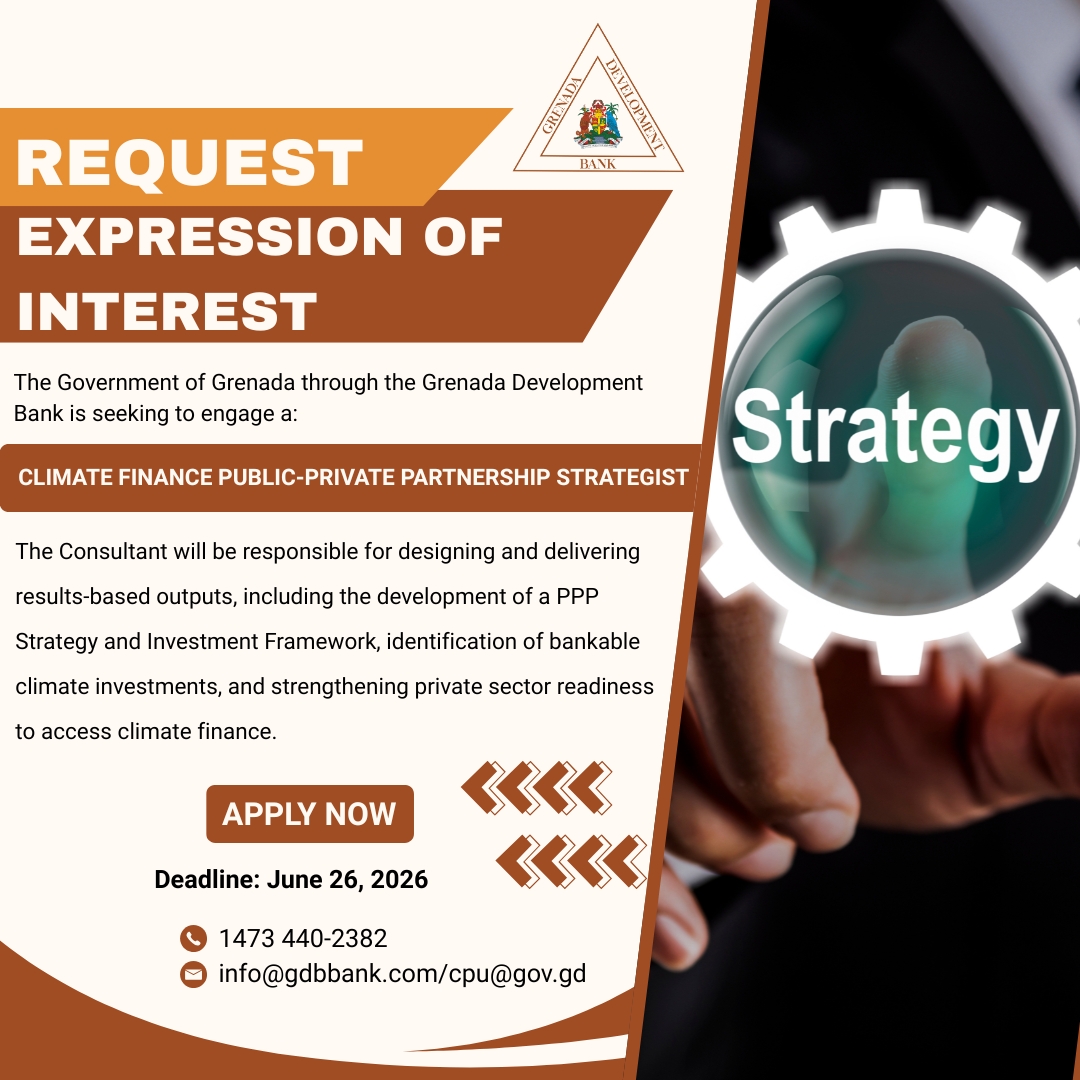
    The Caribbean island nation of Grenada, whose core economic pillars of tourism, agriculture, and construction are disproportionately vulnerable to climate shocks ranging from extreme hurricanes to accelerating sea-level rise, is taking a key step to unlock critical climate investment by launching a search for a specialized Climate Finance Public-Private Partnership (PPP) Strategist.

    As the country charts a path toward the low-carbon, climate-resilient economic transition laid out in its official Nationally Determined Contributions (NDC) and National Adaptation Plan (NAP), official estimates indicate more than $500 million in targeted investment will be required over the next decade to meet these climate goals. However, persistent gaps in access to international climate finance and limited familiarity with innovative green financing mechanisms have created a critical barrier to progress, making expanded private sector participation an urgent priority.

    To address this gap, the Government of Grenada is leading the “Getting Grenada Private Sector Ready for Grenada’s Climate Finance (GPS-4-GCF)” initiative, implemented by the Grenada Development Bank (GDB) with funding from the Green Climate Fund (GCF) through its Readiness and Preparatory Support Programme. The overarching goal of the project is to build local institutional and industry capacity to leverage climate finance, including targeted training and framework development for private sector stakeholders on core skills such as green finance management, climate risk screening, and climate-aligned investment planning. By cultivating a supportive ecosystem for private sector climate action, the project aims to unlock local contributions to both national climate adaptation and emissions reduction efforts.

    A broad cross-section of local stakeholders stand to benefit from the initiative, including commercial and development banks, credit unions, financial regulatory bodies, insurance providers, private sector businesses ranging from micro-enterprises to large hotel operators, commodity boards and state-owned enterprises, private education and medical providers, construction firms, architects, and engineering professionals.

    The selected consultant will be tasked with delivering clear, results-driven outputs aligned with the project’s objectives. Three core deliverables have been outlined: first, supporting private sector stakeholders to identify existing barriers to investment in climate resilience and emissions reduction, and co-developing actionable recommendations to remove these barriers while helping local actors leverage available public climate finance; second, designing a formal PPP Strategy and Investment Framework for climate mitigation and adaptation infrastructure projects, including the identification of high-priority, investment-ready climate-resilient PPP opportunities; and third, leading outreach and sensitization campaigns to educate private sector actors on the unique investment and development opportunities PPP structures can unlock for climate action in Grenada.

    This is a fixed-price consultancy assignment scheduled to run over a four-month period. The GDB has outlined strict qualifications for interested candidates, requiring a master’s degree or equivalent in finance, climate finance, economics, public policy, development studies, or a related field, with a Certified PPP Professional (CP3P) certification considered a major advantage.

    Candidates must demonstrate a minimum of seven years of hands-on experience developing and implementing PPP investment strategies, with preference given to candidates with existing work experience in the Caribbean or other small island developing states that share similar geographic, financial, and cultural contexts. Additional requirements include at least five years of experience working with the Green Climate Fund, multilateral development banks, or private investors in structuring capital investment arrangements, proven experience delivering climate adaptation and mitigation projects, deep expertise in climate finance, institutional capacity building, and climate risk management, and a track record of collaborating with Caribbean governments and regulatory bodies to design PPP frameworks and policies. Candidates must also have direct experience structuring PPP transactions, blended finance deals, and building pipelines of investment-ready projects, with technical expertise in blending commercial and concessional financing for both sovereign and non-sovereign projects, identifying and mitigating financial, operational, and political climate investment risks, conducting qualitative research and data analysis to develop evidence-based strategies, and building cross-sector partnerships with a diverse range of stakeholders from private investors to micro, small, and medium enterprises (MSMEs).

    The GDB is currently accepting expressions of interest from individual candidates, though firms may nominate one qualified individual candidate per firm for the role; selection will be based solely on the individual candidate’s qualifications and experience, not the nominating firm’s credentials.

    The selection process adheres to the procedures for Individual Consultant Selection laid out in Grenada’s Public Procurement Act 39 and Public Procurement Regulations SRO 32. Candidates will be evaluated on two core criteria: relevant qualifications account for 35% of the total score, while relevant professional experience accounts for the remaining 65%. Only candidates shortlisted through the expression of interest stage will be invited to submit full technical and financial proposals for the assignment.

    Interested candidates must submit their expressions of interest no later than 3 pm Eastern Standard Time on June 26, 2026, with the subject line “GCF Readiness and Preparatory Support Programme – Climate Finance Public-Private Partnership Strategist”. Submissions must include a Statement of Capability confirming the candidate’s availability for the four-month assignment, and a detailed curriculum vitae highlighting relevant completed projects. All expressions of interest must be sent via email to [email protected], with a copy to [email protected], addressed to the General Manager of the Grenada Development Bank in St George’s, Grenada. Full detailed Terms of Reference for the role are available for download on the Grenada Public Procurement website (www.procurement.gd) and the Grenada Development Bank website (www.grenadadevelopmentbank.com), or can be requested via email.