标签: Dominican Republic

多米尼加共和国

  • Illegal greenhouse Neither coffee nor bananas: what they were growing in these mountains was marijuana

    Illegal greenhouse Neither coffee nor bananas: what they were growing in these mountains was marijuana

    In a significant counter-narcotics operation, Dominican authorities have uncovered and dismantled a major marijuana cultivation site in the mountainous terrain of Baní, Peravia province. The joint operation involved prosecutors from the Public Ministry and agents from the National Drug Control Directorate (DNCD), supported by state intelligence services and aerial surveillance from Dominican Republic Air Force helicopters.

    Intelligence gathering revealed multiple individuals were engaged in systematic cultivation and distribution operations, prompting an extensive air and ground assault in the Montería sector. During the raid, law enforcement officials discovered 1,835 marijuana plants standing approximately two meters tall, indicating an advanced stage of cultivation.

    The seizure included substantial evidence: two buckets filled with processed plant material, five industrial exhaust fans, four extension cords, an irrigation pump, agricultural tools, water storage tanks, multiple fuel containers, and hundreds of bags containing soil and seeds prepared for future planting. Authorities also confiscated living quarter items including foam mattresses found within a makeshift shelter at the site.

    Investigators are currently pursuing three suspects, including two Haitian nationals and a Dominican landowner identified through intelligence reports as the property owner. The Public Prosecutor’s Office has issued calls for the identified individuals to surrender voluntarily to face justice under Law 50-88 on Drugs and Controlled Substances.

    All confiscated plants and materials have been transferred to the National Institute of Forensic Sciences (INACIF) for analysis and legal processing. This operation represents one of the largest recent marijuana plantation dismantlements in the region, demonstrating enhanced inter-agency cooperation in combating drug trafficking operations.

  • After the passage of the cold front Will it rain today? Here’s the forecast for several provinces

    After the passage of the cold front Will it rain today? Here’s the forecast for several provinces

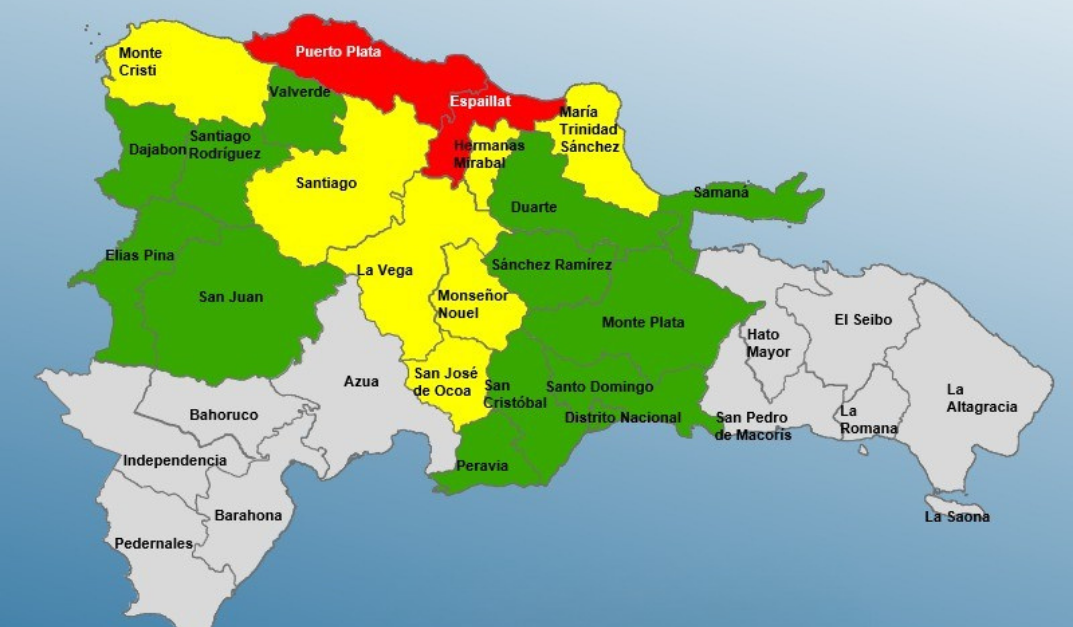
    The Dominican Republic is experiencing a significant shift in meteorological conditions this Sunday as the frontal system previously affecting the nation weakens substantially. According to the Dominican Institute of Meteorology (Indomet), this transition brings markedly reduced precipitation and the cancellation of all weather alerts that had been in effect during recent days.

    Meteorological analysis indicates that a drier, more stable air mass linked to an approaching high-pressure system is now dominating the region’s weather patterns. This atmospheric change will substantially limit rainfall across most territories, though isolated morning showers of light to moderate intensity are anticipated in several northern provinces including Duarte, Hermanas Mirabal, María Trinidad Sánchez, Espaillat, Puerto Plata, Monte Cristi, and La Altagracia’s coastal zone.

    During afternoon hours, meteorological models suggest precipitation may extend to Monseñor Nouel, La Vega, and Santiago regions, plus southwestern mountain ranges, driven by localized effects and cool northeasterly wind patterns. Evening conditions will see easterly and northeasterly winds transporting cloud cover that may generate isolated showers in El Seibo, Hato Mayor, Monte Plata, Santo Domingo, and other northeastern locations.

    The forecast indicates increasing atmospheric instability by Monday, with scattered showers expected from early morning across eastern, northeastern and central provinces including La Romana, San Pedro de Macorís, Sánchez Ramírez, Samaná, and San José de Ocoa. Meteorological analysis suggests precipitation could intensify during afternoon hours, particularly throughout the Cibao region where localized downpours may occur, potentially accompanied by electrical storms and gusty winds.

    Temperature projections indicate a continuing decline over the next 24-48 hours, consistent with seasonal patterns and the recent frontal system’s passage. The resulting thermal conditions will create noticeably pleasant cooling sensations, especially in mountainous areas during nighttime and early morning hours.

  • PRM marks 11th anniversary today: a massive show of force in Santiago amid internal friction

    PRM marks 11th anniversary today: a massive show of force in Santiago amid internal friction

    SANTIAGO, DOMINICAN REPUBLIC – The Modern Revolutionary Party (PRM), the nation’s governing political force, marked its 11th anniversary with a massive demonstration of political strength at the Gran Arena del Cibao on Sunday. President Luis Abinader headlined the capacity event, which served as both a celebration of the party’s decade-long ascent to power and a strategic display of organizational might in the electorally crucial Cibao region.

    The arena reached full capacity as delegations from all 14 provinces of the northern region gathered to hear party leaders including José Ignacio Paliza and Carolina Mejía. The event projected an image of political dominance and continuity while simultaneously functioning as an unofficial launch for the 2028 electoral cycle.

    Strategic Significance and Electoral Positioning

    Today’s gathering represents a critical juncture for the PRM, which has transformed from a 2014 splinter movement into the country’s predominant political institution. The selection of Santiago as the celebration’s epicenter reinforces the party’s stronghold in the North, considered the decisive electoral battleground in Dominican politics.

    With President Abinader constitutionally barred from seeking reelection, political observers closely monitored the rally’s dynamics for clues about potential successors. Party leadership also used the platform to promote what they characterize as a purified, digitized voter registry system, claiming it eliminates historical duplication issues that have compromised electoral integrity.

    Internal Challenges Beneath Unified Surface

    Despite the jubilant atmosphere and sea of party colors, the PRM confronts significant internal tensions as it enters its second decade. While official rhetoric emphasized unity and cohesion, a substantive divide exists between the party’s grassroots foundation and its technocratic administration.

    A central point of contention involves the integration of longtime militants into government positions. Many activists instrumental to the party’s 2020 and 2024 electoral victories express mounting frustration over perceived exclusion from political appointments, creating friction between the party base and bureaucratic leadership that threatens organizational cohesion.

    As the celebration continued, the PRM faced the dual challenge of commemorating its unprecedented political ascent while addressing internal demands for greater inclusion. Simultaneously, opposition forces conducted activities elsewhere in the country, signaling that the next electoral contest has effectively commenced.

  • Caribbean crossroads: 4th Dominican Writing Festival maps a region in motion

    Caribbean crossroads: 4th Dominican Writing Festival maps a region in motion

    Santo Domingo prepares to host a groundbreaking cultural convergence as the fourth Dominican Writing Festival (FESD) unfolds at Galería 360 on April 25-26, 2026. Under the thematic banner “We tell our great stories,” this multidisciplinary event transcends conventional literary gatherings to examine the evolving Caribbean identity through the prism of displacement and homecoming.

    Organized by the visionary multicultural platform CuentaRD—founded by writers Roxanna Marte and Rafael J. Rodríguez Pérez—in collaboration with Luna Insomne Editores, the festival strategically connects the island nation with its extensive global diaspora. The 2026 edition positions itself as a dynamic forum exploring transnationalism, the psychological landscape inhabited by authors who create from the peripheries of their homeland.

    The festival’s centerpiece dialogue, “Archipelago on Fire: For whom do we Caribbean writers write?”, addresses the complex relationship between Caribbean authors and their geographically dispersed audiences. This thematic focus gains depth through the participation of acclaimed Cuban-American author Achy Obejas, whose work exemplifies the concept of “extra-territorial” belonging that resonates with many Dominican writers.

    Regional integration forms a critical component of this year’s programming. The festival deliberately intertwines Dominican narratives with broader Caribbean experiences through several curated discussions. “Haiti in words: identity, resistance, and hope” brings together Edwin Paraison, Jhak Valcourt, and Jacques Alix Louis to examine literature as an instrument of resilience during crisis. Similarly, “Reading Cuba: between the island and the diaspora” features Alberto Garrido, Bismar Galán, and Celestino Esquerré dissecting the political and intimate dimensions of writing from within and beyond national borders.

    The Venezuelan migratory experience receives dedicated attention through the colloquium “Reading a new country” with Siddharta Mata and Aída Magallanes, acknowledging the shared displacement narratives that increasingly unite Caribbean nations.

    Beyond traditional literary formats, FESD embraces the multidisciplinary nature of contemporary Caribbean storytelling. Filmmakers Natalia Cabral and Tito Rodríguez join author Miguel Yarull in analyzing the transition from “paper to screen” in a session moderated by Juan José Namnún. Theatrical adaptations take center stage as Manuel Chapuseaux, Ingrid Luciano, and Richarson Díaz explore the translation of Dominican literature to performance mediums.

    The festival incorporates vibrant performative elements, including a presentation inspired by Julia de Burgos’ work and a tribute to Cuban poet Dulce María Loynaz. The event culminates with “The voice on fire,” a Spoken Word performance celebrating the visceral power of oral storytelling.

    Academic discourse finds its place through Sarah Aponte, Chief Librarian of the Dominican Studies Institute at CUNY, who presents a conference on digital preservation in specialized libraries. This addresses the paradoxical reality that significant portions of Dominican intellectual heritage are currently maintained and digitized abroad.

    Maintaining its commitment to accessibility, the festival offers free admission to all events, supported by sponsors including Kelsy Wilmot, Navegante Urbano, and Editora Pulpo. Complementary programming includes workshops for parents led by Mariela García and sessions examining the global emergence of Dominican comic books, ensuring the festival cultivates a sustainable reading culture amidst digital age challenges.

  • DEA office supervisor arrested in Dominican Republic

    DEA office supervisor arrested in Dominican Republic

    In a significant development in U.S. anti-narcotics operations, federal authorities have arrested a DEA supervisor stationed in the Dominican Republic as part of an investigation into alleged misuse of confidential informant visa programs. The arrest coincides with the abrupt closure of the U.S. anti-narcotics office in Santo Domingo, a move described by the Trump administration as addressing a “disgusting and dishonorable breach of public trust.”

    Melitón Cordero, a supervisory agent at the Drug Enforcement Administration’s Caribbean office, was taken into custody Thursday following an investigation led by the U.S. Department of Homeland Security. The arrest was confirmed by multiple sources speaking anonymously to The Associated Press due to the ongoing nature of the investigation.

    The closure of the DEA office and subsequent arrest stem from concerns about potential corruption within the program. U.S. Ambassador to the Dominican Republic Leah Campos emphasized that the temporary shutdown would facilitate an internal embassy investigation, stating unequivocally that she “will not tolerate corruption” among officials who might exploit their positions for personal gain.

    Despite the office closure, U.S. officials maintain that bilateral cooperation against drug trafficking remains unaffected. The embassy issued a statement affirming that the Dominican Republic continues to be a “key partner” in regional counter-narcotics efforts, with operations continuing “at the same robust pace” during the investigation.

    Dominican officials have sought to distance themselves from the controversy. Foreign Minister Roberto Álvarez confirmed after speaking with Ambassador Campos that the investigation was strictly an internal U.S. matter with “no relation whatsoever to the Dominican government or official.”

    The case has been referred to the United States Attorney’s Office for the District of Columbia in Washington, which now holds primary jurisdiction over the investigation. Public Diplomacy Counselor Chelsia Hetrick of the U.S. Embassy indicated that no further details would be released beyond the ambassador’s initial statements, directing all inquiries to the Washington-based prosecutors.

    As of Thursday evening, neither DHS nor DEA officials had responded to formal requests for comment, and attempts to reach Cordero on his personal cell phone were unsuccessful. The development represents one of the most significant integrity challenges to U.S. narcotics enforcement operations in the Caribbean region in recent years.

  • January ended with a 47% increase in cases of severe acute respiratory infections

    January ended with a 47% increase in cases of severe acute respiratory infections

    The Dominican Republic’s Ministry of Public Health has documented a significant escalation in severe acute respiratory infections (SARI) during January 2026, reporting a 47% increase compared to the same period in 2025. Epidemiological data reveals 69 suspected cases this year versus 47 previously, with children under four years old and adults over sixty constituting the most vulnerable demographics.

    Geographical analysis identifies Azua and Santo Domingo provinces as the primary hotspots, recording 31 and 13 cases respectively. The National District and San Cristóbal followed with 5 cases each. Health officials attribute this distribution pattern to regions with higher population density, increased mobility, and greater hospital service demand.

    Notably, the epidemiological report confirms zero fatalities from SARI in January 2026, maintaining a 0% lethality rate—a substantial improvement from the 6.4% mortality rate (3 deaths) documented during the same period in 2025. This positive development suggests enhanced early detection capabilities, improved patient referral systems, and more effective clinical management of severe cases.

    Virological surveillance indicates persistent circulation of respiratory syncytial virus and influenza, though authorities report a progressive decrease in viral activity early in 2026. Crucially, no instances of influenza A (H3N2) subclade K have been detected, though health officials emphasize continued vigilance against emerging variants.

    The Ministry has implemented strengthened surveillance measures including expanded sampling protocols, immediate case notification, and daily monitoring of hospital bed occupancy. Additional measures include rapid referral pathways for pediatric cases, guaranteed availability of critical medical supplies, and promoted influenza vaccination among high-risk populations.

    Despite these efforts, structural challenges persist, particularly regarding limited availability of neonatal intensive care units (NICU) and intensive care units (ICU), alongside territorial access disparities. Health authorities acknowledge these limitations necessitate sustained, multi-sectoral strategies to manage morbidity during an increasingly active and prolonged respiratory season.

  • February shakes the country: the cases that have shocked in just 15 days

    February shakes the country: the cases that have shocked in just 15 days

    The Dominican Republic is confronting an unprecedented crisis of violence and social tragedy during the first half of February 2026, with a devastating series of events that have left the nation in a state of collective mourning and profound shock. Over a mere 13-day period, the country has witnessed a harrowing convergence of criminal violence, fatal accidents, and commercial disasters that have fundamentally challenged perceptions of public safety and social order.

    Gender-based violence has emerged as a particularly distressing theme, highlighted by the murder of young Noemí Suárez in the National District. The victim was fatally attacked by her former boyfriend, reigniting national outrage over the persistent issue of femicide in Dominican society. This tragedy was compounded by the shooting death of teenager Yokairy Núñez Bueno in Sánchez, Samaná, allegedly at the hands of a cousin, which has left the local community in stunned silence.

    Simultaneously, the Cibao region remains gripped by uncertainty following the disappearance of Brianna Genao González in Puerto Plata. Although the minor vanished in late January, February has brought intensified investigation efforts, including involvement from the FBI, as religious and civil leaders amplify demands for justice and the restoration of safety in Dominican communities.

    The nation’s trauma has been further exacerbated by two additional high-impact incidents: a desperate search operation for a motorcyclist who plunged into the Isabela River following a traffic accident on the Jacinto Peynado bridge in Villa Mella, and a destructive fire that ravaged the L and R electromuebles store in the same municipality. These events, combined with the recent passing of prominent political leader Ramón Alburquerque, have created a multifaceted national crisis that sociologists and authorities describe as a severe breakdown in social cohesion.

  • Cool temperatures: What will the weather be like this weekend in the Dominican Republic?

    Cool temperatures: What will the weather be like this weekend in the Dominican Republic?

    Meteorological systems converging north of the Caribbean are set to deliver a weekend of unusually cool temperatures and significant precipitation across the Dominican Republic. A pronounced trough interacting with an advancing cold front will create widespread atmospheric instability throughout the nation’s territory.

    The most substantial rainfall accumulations are forecast for the Cibao valley region, the Greater Santo Domingo metropolitan area, and the provinces of Monseñor Nouel, La Vega, and San Cristóbal. These zones should prepare for intense downpours potentially accompanied by isolated thunderstorm activity. The national weather service has issued advisories regarding possible flash flooding in topographically vulnerable and low-lying areas, urging residents to monitor official emergency communications channels.

    Temperatures will register notably below seasonal averages, producing distinctly chilly conditions, particularly during nighttime and early morning hours. Precipitation patterns will manifest as intermittent afternoon showers on both Saturday and Sunday, transitioning to more scattered nocturnal rainfall activity. The combined effect of persistent cloud cover and precipitation will maintain the cooler thermal regime throughout the weekend period.

  • Social reality: Woman, mother and “NEET”: the female face of a worrying statistic

    Social reality: Woman, mother and “NEET”: the female face of a worrying statistic

    In the Dominican Republic, a silent crisis disproportionately affects young women, as exemplified by the story of 35-year-old Brianda Araujo Rodríguez. A mother of five, Brianda battles type two diabetes and associated neuropathy that prevents her from maintaining employment. Her last position at a bank ended a year ago, forcing her to rely on siblings for financial support while managing daily insulin injections and Metformin treatments.

    Brianda’s challenges extend beyond health concerns. Her personal history includes a marriage at 15 to a man 14 years her senior—a relationship marked by mistreatment, infidelity, and deception. The early loss of her mother compounded these difficulties, creating a childhood trauma that continues to resonate. Her primary aspiration now centers on ensuring her children avoid repeating her patterns.

    The educational gap affecting her family illustrates broader systemic issues. Two of her five children have been out of school for two years due to inability to secure placements—a situation that reflects national trends. Recent statistics from the National Statistics Office (ONE) reveal that among 628,181 Dominicans aged 18-35 who neither work nor study, 454,779 (72.4%) are women.

    Sociologist Tahira Vargas analyzes this gender disparity through labor market dynamics. “Access to employment is heavily mediated by strategies that are entirely masculine,” Vargas notes, explaining that informal sector jobs—such as motorcycle taxiing, security, and electrical work—predominantly employ men. Women without academic credentials typically find limited opportunities in domestic work or caregiving roles.

    In response to this crisis, the Dominican government launched the “Opportunity 14-24” program in October 2020. Coordinated by the Social Policy Cabinet under Alexander Mordan, this initiative aims to reintegrate vulnerable youth into education systems (ages 14-17) or prepare them for labor market entry (ages 18-24). Despite these efforts, structural barriers continue to perpetuate gender inequalities in economic participation.

  • DEA announces restructuring of personnel in the Dominican Republic

    DEA announces restructuring of personnel in the Dominican Republic

    ARLINGTON, Virginia – The U.S. Drug Enforcement Administration has initiated a significant operational reshuffle of its personnel stationed in the Dominican Republic following allegations of professional misconduct currently under federal investigation. This strategic repositioning emerges from an internal agency review aimed at preserving operational integrity while maintaining bilateral counter-narcotics cooperation.

    In an official communiqué, the DEA characterized the move as a precautionary administrative measure designed to strengthen supervisory protocols and accountability mechanisms. The agency explicitly clarified that this reorganization does not constitute a reduction of its operational footprint in the Caribbean nation, but rather represents a structural realignment under enhanced compliance standards.

    Personnel previously deployed to the Santo Domingo field office are being temporarily reassigned during the ongoing investigation. The DEA emphasized that this transitional phase will not impair collaborative anti-drug initiatives with Dominican authorities, noting that Administrator Anne Milgram has personally coordinated with the U.S. Ambassador to ensure an orderly transition process.

    The agency highlighted the Dominican Republic’s critical geopolitical significance as a Caribbean logistics hub and praised the longstanding partnership with the country’s National Directorate for Drug Control (DNCD). This collaboration has produced substantial results in recent years, including major cocaine seizures and the disruption of transnational criminal syndicates operating in the region.

    The DEA concluded its statement by affirming that the investigated conduct represents isolated incidents rather than institutional practice, reiterating its commitment to professional standards, transparency, and the rule of law in all international operations.