标签: Belize

伯利兹

  • Revamped ITVET Campus Opens Doors in Hope Creek Village

    Revamped ITVET Campus Opens Doors in Hope Creek Village

    For generations of young people and working adults in southern Belize, technical and vocational education has stood as one of the most reliable pathways to stable employment, in-demand skills, and upward economic mobility. Now, that critical pathway has received a transformative upgrade, with the official inauguration of the fully renovated Stann Creek ITVET (Institute for Technical and Vocational Education and Training) campus in Hope Creek Village, following a 12-month, $1.4 million rehabilitation project.

    The campus reopening, originally scheduled for late June 2026, was delayed by an unexpected heavy downpour, but the setback did little to reduce the milestone’s importance for the local community. A formal ribbon-cutting ceremony finally marked the completion of the project, which addresses years of structural decay that had limited the institution’s ability to serve a growing student body. Speaking at the event, Dangriga Area Representative Dr. Louis Zabaneh emphasized that the upgrades will touch lives across the entire Dangriga, Sarawee, and Hope Creek constituency.

    “Walking through the campus, it is clear that every classroom, office, and training lab is now fully functional,” Dr. Zabaneh noted. “One of the most persistent problems we faced, constant roof leaks that disrupted classes and damaged equipment, has finally been solved. These improvements will go a long way in helping us better serve our community, especially the students who come here to build the skills they need for successful careers.”

    Funded by the Caribbean Development Bank through the 10th cycle of the Basic Needs Trust Fund (BNTF), the project was implemented jointly by the Belize Social Investment Fund and the Ministry of Education. Beyond superficial aesthetic changes, the renovation completely overhauls the campus’s core infrastructure to meet modern training standards. Dorett Tennyson, project manager for the BNFT, outlined the full scope of work completed over the past year: “We fixed persistent roof leaks, repainted all campus buildings, upgraded security lighting across the grounds, and replaced every window and door. We fully refurbished all existing restroom facilities, added a new staff restroom on the ground floor of the administration building, installed new tile flooring in the computer lab, and even provided new equipment for the building and trade training programs.”

    Once a small campus serving fewer than 50 students total, Stann Creek ITVET has seen rapid growth in demand over the past decade, with more than 200 students graduating in recent years and applications continuing to climb. Campus manager Gwendolyn Garcia Martinez says the improved facilities have already sparked even more interest from prospective students, with more people eager to enroll and spreading the word about the upgraded institution to their communities.

    The impact of the renovation is already extending beyond traditional student populations, Garcia Martinez explained. Local businesses and tourism operators, the region’s largest employment sector, have reached out to the campus to partner on employee upskilling programs. The institution will also now be able to accommodate vocational training for asylum seekers in the area, expanding its public service mission.

    “The impact of this renovation is going to be far greater than any of us can fully anticipate right now,” Garcia Martinez said. “This upgraded campus gives us the capacity to serve far more people across this region, and to do it better than we ever could before.”

    Looking ahead, the second phase of the improvement project will focus on strengthening the quality of instruction itself. Professional development training sessions for campus instructors are scheduled for early August, designed to give educators the tools and resources they need to deliver more effective, industry-aligned training to the next generation of Belize’s workforce.


  • Belize Heads to Central American and Caribbean Games with Gold in Sight

    Belize Heads to Central American and Caribbean Games with Gold in Sight

    Nearly 30 years have passed since Belize’s iconic “Golden Boys” men’s national basketball squad claimed gold at the 1996 CARICOM Men’s Basketball Championships, a historic victory that has stood as the high water mark for the nation’s hoops legacy ever since. Now, for the first time since that legendary run, a young, hungry junior national team has qualified for the Central American and Caribbean Games, and the entire Belize basketball community is rallying around the squad as they eye a historic return to the top of the regional podium.

    Local outlet News Five’s sports correspondent Paul Lopez visited the team’s closed training camp at Belize’s Civic Center this week, catching a first-hand look at the disciplined preparation that has defined the squad’s build-up to the tournament. For the Belize Basketball Federation, the team’s qualification alone marks a milestone decades in the making.

    “It has been almost three decades since our Golden Boys brought home CARICOM gold, and we have not qualified for a major regional multi-sport games basketball tournament since that 1998 run,” explained Jacob Leslie, president of the Belize Basketball Federation, during an on-site interview at the Civic Center. “For Belize to return to this regional basketball stage is a historic moment for our entire program.”

    Leading the new generation is captain Douglas Langford, who serves as the team’s emotional and on-court anchor, both in practice and in competitive play. For Langford and his teammates, the tournament is about more than just a medal: it is an opportunity to put Belize basketball back on the regional map and open doors for the next generation of young Belizean players.

    “We are here to shock a few regional powerhouses and bring gold home to Belize,” Langford said. “We want to put our country on the basketball radar, and create the same kind of opportunities for young kids that dream of playing that we have been given.”

    Helmed by veteran head coach Bernie Tarr, the coaching staff has spent weeks honing customized offensive and defensive game plans tailored to Belize’s group-stage opponents. Tarr emphasized that while the team is embracing the underdog role, their sights are set firmly on a podium finish.

    “Of course every team comes into a tournament wanting to win, and our clear goal is to reach the podium,” Tarr said. “We are in uncharted territory — no Belize basketball team has been in this position since 1998, and we are ready to see how our squad rises to the challenge.”

    Running the point for the team is starting point guard Devin Moody, who will carry the responsibility of setting the team’s offensive tempo and orchestrating plays against tough regional competition. Moody made the team’s goal clear: nothing short of a gold medal will satisfy this hungry squad.

    “The president gave us a clear reality check on what is expected of us, and our whole mindset is focused on winning,” Moody said. When asked what the team’s target was for the tournament, he added: “Gold is the only mindset we have coming into this tournament. We are taking it one game at a time, and we are ready to deliver on that goal.”

    The 2026 Central American and Caribbean Games men’s basketball tournament features eight competing nations, split into two preliminary groups. Belize was drawn into Group A, where they will face off against Nicaragua, Guatemala, and the Dominican Republic in the opening round. The team’s first matchup is scheduled for this coming Sunday, tipping off what the entire Belize basketball community hopes will be a historic run for the nation.

  • Andy Burnham Becomes UK Prime Minister, Promises Political Reset and Stability

    Andy Burnham Becomes UK Prime Minister, Promises Political Reset and Stability

    On a formal Monday ceremony at Buckingham Palace, Andy Burnham officially accepted the role of United Kingdom Prime Minister, stepping into the office as the nation’s seventh prime minister in just 10 years. The appointment follows the resignation of former Labour Prime Minister Keir Starmer, whose tenure stands as one of the shortest in modern British Labour Party history.

    After his audience with King Charles III, Burnham delivered his maiden public address from the iconic steps of 10 Downing Street, where he laid out an ambitious agenda centered on national renewal and political repair. He emphasized that the UK’s top priority under his leadership will be rebuilding public faith in government institutions, after years of shifting leadership that eroded public trust. “Britain needs to show the world that we can regain our stability once again,” he told assembled reporters and crowds.

    The new prime minister has staked his early premiership on delivering transformative change, framing his proposed reforms as the most significant shakeup to British politics in four decades. Among his flagship policy pledges is a commitment to completely end rough sleeping across the UK, alongside the launch of the largest social housing development programme the country has seen since the immediate post-World War II era. He also outlined plans for major overhauls of the country’s education system and social care infrastructure, promising to refocus government on serving working-class and marginalized communities.

    Burnham’s ascension comes on the heels of internal upheaval for the Labour Party, with multiple senior cabinet members from Starmer’s administration announcing their resignations in advance of the incoming government’s planned ministerial reshuffle. Internationally, the new prime minister faces immediate diplomatic and policy challenges, chief among them navigating the UK’s relationship with U.S. President Donald Trump. Trump publicly congratulated Burnham following his appointment, after months of sharp criticism aimed at Starmer and public praise for Burnham’s stance on expanding oil and gas extraction in the North Sea. Burnham also used his first address to reaffirm the UK’s unwavering commitment to its longstanding international defense partnerships, as the new government works to reset both domestic and foreign policy.

  • WestJet Launching Winnipeg-Belize Nonstop Flight

    WestJet Launching Winnipeg-Belize Nonstop Flight

    As the winter travel planning season gets underway, Canadian airline WestJet has announced a major expansion of its sun destination network, with a new nonstop route linking Winnipeg, Manitoba, to Belize City set to launch this December.

    The new service, scheduled to begin operations on December 14, will run once weekly between Winnipeg Richardson International Airport and Belize’s Philip Goldson International Airport. The route has been introduced to meet rapidly growing demand from Canadian travelers seeking direct access to warm getaways to escape harsh prairie winters, and it marks a significant upgrade to regional air connectivity between Canada and Central America.

    Prior to this launch, Belize only offered direct flights to two other Canadian cities, meaning passengers traveling from Manitoba were forced to make time-consuming connections in Calgary, Toronto, or even transit through hubs in the United States. This new nonstop option eliminates those inconvenient layovers, opening up easy Caribbean access for thousands of winter travelers in central Canada.

    John Weatherill, WestJet’s executive vice president and chief commercial officer, noted that the route expansion aligns with the airline’s strategic growth goals for the peak winter travel period. “These additions support the growing demand for options in Mexico and the Latin Caribbean while sustainably expanding our schedule and managing our fleet during the peak winter travel season,” Weatherill explained.

    Beyond traveler convenience, the new route delivers broad economic and diplomatic benefits for both nations. Enhanced air access is projected to boost Belize’s tourism sector, which is a core pillar of the country’s economy, while also opening the door for increased bilateral investment between Canada and Belize. For Belize’s tourism leadership, the new route represents a clear vote of confidence in the country’s long-term growth as a travel destination.

    “The launch of WestJet’s new Winnipeg–Belize City service is an important step in strengthening air connectivity between Canada and Belize and a strong sign of confidence in our destination’s continued growth,” said Anthony Mahler, Belize’s minister of tourism, youth, sport and diaspora relations. Travel industry analysts note that the route comes as Canadian demand for sun and beach winter getaways continues to rise, making targeted expansions like this a smart strategic move for WestJet’s competitive positioning in the Canadian leisure travel market.

  • Family Rejects Claims Linking Christopher Witzel to Orange Walk Shooting

    Family Rejects Claims Linking Christopher Witzel to Orange Walk Shooting

    In a developing story out of Belize, the family of 27-year-old Christopher Witzel has vehemently pushed back against unconfirmed reports linking their late relative to a recent shooting in the Orange Walk district, following his death on Monday evening.

    Witzel was transported to Karl Heusner Memorial Hospital earlier this week, where he passed away after reporting intense, debilitating pain. To date, law enforcement officials have not publicly released a formal cause of death, leaving the exact circumstances of his passing open to ongoing active investigation.

    Following Witzel’s death, local law enforcement confirmed that investigators were exploring potential connections between the 27-year-old and the shooting incident that occurred in Orange Walk just one week prior. These preliminary leads have been met with fierce pushback from Witzel’s family, who dispute the claims entirely.

    A close relative of the deceased stated publicly that Witzel’s death was caused by organ failure impacting his kidneys and liver, and stressed that he played no role whatsoever in the Orange Walk shooting. The family also contradicted early reporting that claimed police escorted Witzel to the hospital for treatment.

    While the family rejects the recent connection to the Orange Walk case, court and law enforcement records show Witzel had a long-standing history of interactions with Belizean police dating back years. In 2024, he was taken into custody during a nationwide State of Emergency, facing multiple charges including assault on a police officer, resisting arrest, use of threatening language, and trespassing. On that occasion, he was also held for questioning as a person of interest in an unrelated shooting investigation.

    Even earlier, in 2018, Witzel was hit with a series of serious felony charges stemming from a gang-related shooting on Mopan Street in Belize City. The attack left three people injured, among them a woman and a minor. Charges from that incident included three counts of attempted murder, one count each of wounding and inflicting grievous harm, and two additional counts of assault with a deadly weapon.

  • Tropical Storm Bertha Set to Hit Louisiana Coast Wednesday

    Tropical Storm Bertha Set to Hit Louisiana Coast Wednesday

    As the 2026 Atlantic hurricane season continues its early progression, communities across the U.S. Gulf of Mexico coast are rushing to complete emergency preparations ahead of Tropical Storm Bertha’s expected landfall this Wednesday.

    The storm picked up strength on Tuesday while traversing the northeastern quadrant of the Gulf of Mexico, with the U.S. National Hurricane Center currently recording maximum sustained winds of 60 miles per hour. Forecasters have pinpointed Plaquemines Parish, Louisiana as the most likely area where Bertha will make its first landfall, after which the system is projected to gradually weaken as it moves inland.

    To alert residents and local authorities to incoming hazards, the National Weather Service has issued a Tropical Storm Warning spanning more than 600 miles of coastline: the alert stretches from the Bay/Gulf County border in western Florida all the way to the Terrebonne/Lafourche Parish line in southern Louisiana. Areas further west, including the major city of New Orleans, Lake Pontchartrain, Lake Maurepas, and the coastal stretch extending from the Terrebonne/Lafourche line to the Vermilion/Cameron Parish line, remain under a Tropical Storm Watch, with officials warning conditions could deteriorate rapidly in these zones.

    The National Hurricane Center has outlined the primary threats facing vulnerable low-lying coastal communities: total rainfall accumulations between 2 and 6 inches, which raises a high risk of life-threatening flash flooding, wind gusts exceeding the 39 mile per hour threshold for tropical storm classification, and a storm surge capable of pushing ocean water up to four feet above normal tide levels in exposed coastal areas.

    Bertha marks only the second named storm of the 2026 Atlantic hurricane season, coming less than one month after Tropical Storm Arthur formed over the basin in June, making this an on-track start to the year’s hurricane activity according to seasonal forecasting models.

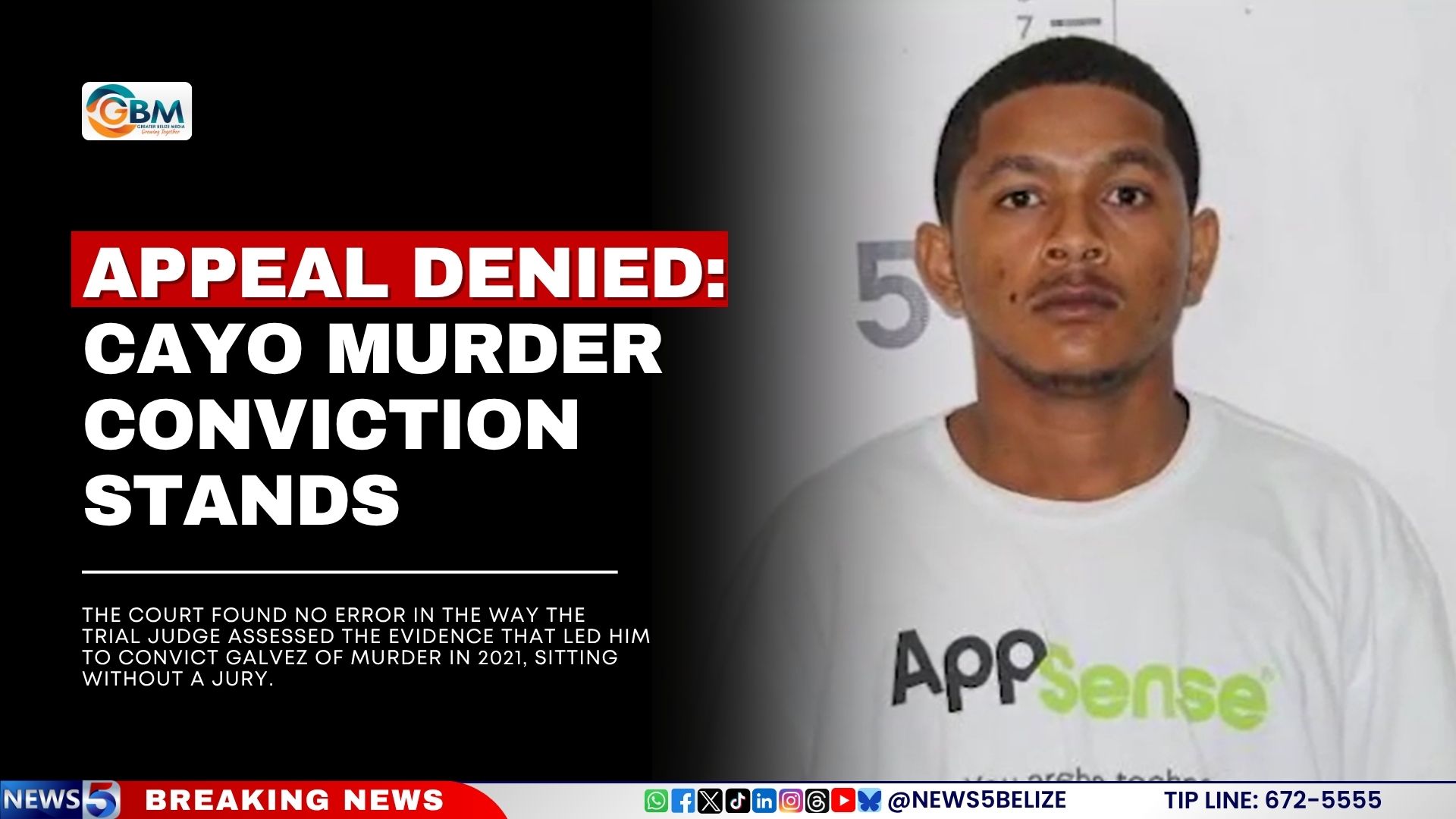
  • Appeal Denied: Cayo Murder Conviction Stands

    Appeal Denied: Cayo Murder Conviction Stands

    On July 21, 2026, Belize’s Court of Appeal delivered a landmark ruling dismissing an appeal against a 2021 murder conviction, leaving Dean Galvez’s life sentence for the 2018 fatal shooting of Ronnie Omar Cassasola Jr. intact.

    The fatal incident traces back to the night of May 5, 2018, at the Pedrigal Bar in San Mateo, Cayo District, where a confrontation erupted between Dean Galvez, his companions, and members of the Cassasola family and their associates. When the groups left the bar, tensions did not de-escalate as the Cassasola group traveled home. According to prosecution allegations, Galvez pulled a firearm and opened fire, withdrew from the scene, then returned to fire a second volley of shots. Cassasola Jr. ultimately died from a gunshot wound sustained in the attack.

    Galvez was convicted of murder in 2021 during a judge-alone bench trial, where no jury was seated. His appeal to the higher court centered on multiple claims of legal error during the original trial, chief among them arguments that the trial judge improperly relied on eyewitness identification evidence to secure a guilty verdict.

    Five witnesses who had personal prior knowledge of Galvez testified that they identified him as the shooter, noting they observed him at a distance of 20 to 30 feet under clear street lighting at the time of the shooting. Galvez repeatedly denied any involvement, telling the court he was not present at the scene when the shooting began, and had fled to take cover elsewhere after hearing gunfire. While an alibi witness for the defense largely backed up Galvez’s account of his whereabouts that night, a key inconsistency over whether Galvez had jumped a fence while fleeing weakened the alibi, a gap the original trial judge cited in discounting the defense’s claim.

    In his appeal arguments, defense counsel Norman Rodriguez laid out multiple grounds to overturn the conviction. He argued the trial judge incorrectly ruled that eyewitness evidence was strong enough to prove guilt beyond a reasonable doubt. He pointed to forensic evidence showing the fatal bullet was fired from behind the victim, and claimed the trial judge failed to draw a critical legal distinction between identifying an unknown suspect and recognizing a person already known to witnesses. Rodriguez also challenged the judge’s finding that lighting conditions were sufficient to support reliable identifications, and noted that no formal identification parade was conducted before trial.

    Director of Public Prosecutions Cheryl-Lynn Vidal, leading the prosecution’s response to the appeal, pushed back against these claims. She emphasized that the original trial judge had fully complied with long-standing legal safeguards for eyewitness identification known as the Turnbull guidelines. Vidal also noted that all five witnesses had known Galvez for a long time before the shooting, and that favorable lighting and unobstructed lines of sight made their recognition of Galvez reliable.

    The appellate court’s ruling delved deeply into the legal framework governing identification evidence, walking through the core requirements of the Turnbull principles. These guidelines mandate that trial judges explicitly warn of the risk of misidentification even when witnesses appear honest and convincing, and require close scrutiny of key factors including observation distance, lighting conditions, how long the witness had to observe the suspect, and prior familiarity with the person in question.

    The appellate panel also addressed a key procedural question: how these identification safeguards apply differently in a judge-alone bench trial versus a conventional jury trial. The court clarified that a judge sitting without a jury does not need to recite every legal principle in formal, explicit terms, as long as the overall reasoning of the ruling demonstrates that all core legal issues were properly considered and addressed.

    After a full review of the original trial judge’s written ruling, the appellate judges found that the lower court had properly followed all required safeguards. The trial judge had explicitly noted the risk of mistaken identification for the record, individually examined lighting conditions, observation distance, and the duration of each witness’s view of the shooter, conducted an in-person visit to the crime scene to assess visibility and sightlines, and explicitly weighed all inconsistencies in the evidence—including one witness’s failure to initially mention seeing Galvez draw the weapon—before concluding the identification evidence remained reliable.

    On the contested issue of the missing formal identification parade, the court ruled that the absence of this procedure does not automatically render a conviction unsafe. In this specific case, all eyewitnesses already knew Galvez personally, and the case relied on recognition of a known individual rather than identification of an unknown stranger, making a formal parade of limited procedural value. The court also confirmed that the trial judge did not treat the in-court “dock identification” of Galvez as independent proof of guilt, only as consistent confirmation of the witnesses’ earlier out-of-court recognition of the defendant.

    With all appeal arguments rejected, Galvez’s 2021 murder conviction and life sentence will stand, closing a years-long legal process stemming from the 2018 Cayo District shooting.

  • Belize Offers Help to “Brothers and Sisters in Guyana”

    Belize Offers Help to “Brothers and Sisters in Guyana”

    In the wake of one of Guyana’s deadliest maritime disasters in modern history, the Central American nation of Belize has extended a hand of support to the South American country, offering material aid and standing in solidarity with affected communities following the capsizing of the MV Barima ferry.

    Belize’s Minister of Foreign Affairs Francis Fonseca publicly confirmed the country’s outreach in an interview on the local current affairs program *Open Your Eyes* on Monday, noting that Belize has already made contact with Guyanese leadership to offer assistance. “We’ve reached out… and expressed our solidarity and asked them how we can provide any meaningful material support in any way,” Fonseca told the program. “President Ali is a good friend of Belize, so we’re praying for our brothers and sisters in Guyana.”

    The deadly incident unfolded last Saturday, when the passenger ferry capsized mid-voyage while traveling between Georgetown, Guyana’s capital, and the far-flung community of Port Kaituma. Initial accounting of those on board proved inaccurate after 32 rescued survivors were found not to be listed on the vessel’s official passenger manifest, pushing the updated total of people on the ferry to 179—far higher than first reported.

    As of Monday’s update from Guyanese authorities, recovery teams have recovered 27 bodies and pulled 69 survivors from the water, while 83 people remain unaccounted for as search operations continue. Guyana’s Minister of Public Works Juan Edghill has labeled the incident the country’s worst marine disaster in decades.

    In a development that has raised serious questions about the incident, Guyanese law enforcement has taken the ferry’s captain and at least one additional crew member into custody. Both tested positive for marijuana, and authorities have launched a formal investigation into potential crew negligence, specifically looking into the circumstances that allowed the vessel to leave port drastically overcrowded.

    Guyanese President Irfaan Ali has personally visited survivors and grieving family members receiving care at local hospitals, calling the encounter a “deeply emotional experience.”

    Belize’s gesture of support is not the first regional humanitarian action the country has joined in recent weeks. Just a month prior, Belize stood alongside other member states of the Caribbean Community (CARICOM) to deliver emergency aid to Venezuela in the aftermath of twin destructive earthquakes that struck the country.

  • Empowering Young Women to Dream Big, Lead Boldly & Break Barriers

    Empowering Young Women to Dream Big, Lead Boldly & Break Barriers

    In a landmark step toward closing the gender gap in male-dominated innovation fields, Belize’s Ministry of Education, Culture, Science and Technology wrapped up its first-ever nationwide Girls in STEAM Festival over the weekend in San Ignacio. Backed by the Inter-American Development Bank (IDB) through its global Skills for the Future initiative, the event brought hundreds of young female students from across the country into hands-on learning experiences designed to reshape their understanding of what they can achieve in science, technology, engineering, arts and mathematics.

    The festival was structured in two sequential phases, starting with a week-long residential camp for upper-level primary school students. A total of 17 institutions from every region of Belize participated, with more than 300 girls enrolled from Standards 4 through 6. Dr. Consuelo Godfrey, the program’s lead consultant for Girls in STEAM, explained that the introductory camp was built around one core mission: to demystify STEAM fields for young learners before they internalize harmful gender stereotypes about technical work. “The goal was for those girls to be exposed to all aspects of STEAM: Science, Technology, Engineering, Arts and Mathematics,” Godfrey noted, emphasizing that early exposure is critical to encouraging long-term interest in these career paths.

    Following the primary school camp, a two-week secondary-level camp launched with a deeper focus on integrating practical technology across every STEAM discipline. To help students see STEAM work as tangible, accessible part of everyday life in Belize, organizers arranged immersive site visits to local industry and innovation hubs. Participants toured key locations including the Esquivel Apiary in Corozal, Hydro Belize’s Chalillo Dam in Cayo, the women-led clean energy network Solar Sisters in San Pedro Columbia, and the T.R.E.E.S. environmental research organization along the Hummingbird Highway. Keila Mai, a female STEAM professional who spoke to the secondary camp participants, shared actionable advice for young women entering male-dominated fields: “Every time I felt like an outsider or felt that heavy weight of a male-dominated field, I leaned into my curiosity. Curiosity leaves no room for fear.”

    The festival closed with a public showcase of the original projects developed by the participating students, followed by an award ceremony to honor the most innovative and impactful work. Yolanda Gongora, Belize’s Chief Education Officer, reflected on the transformational vision behind the event, noting that its purpose extends far beyond teaching technical skills like coding, robotics, or artificial intelligence. “When we first envisioned this programme at the Ministry of Education, Culture, Science and Technology, our ambition extended far beyond teaching coding, robotics or artificial intelligence. We set out to create something transformational: an extracurricular programme that would inspire girls to see themselves not simply as users of technology, but as innovators, creators, scientists, engineers, entrepreneurs and leaders,” Gongora said.

    Karla Gonzalez, the IDB’s resident representative in Belize, echoed that optimism, noting that closing the gender gap in STEAM will benefit not just individual women, but Belize’s entire economy and research ecosystem. “Belize, like the rest of the world, needs more women studying maths and science and leading research, and who knows, in the future maybe we will get a Nobel Prize,” Gonzalez said. Organizers have announced plans to make the Girls in STEAM Festival an annual event, expanding participation to more schools across the country in coming years.

  • Nicaraguan President: ‘No More Elections’

    Nicaraguan President: ‘No More Elections’

    On July 21, 2026, at an official ceremony marking the 47th anniversary of the Sandinista Revolution, 80-year-old Nicaraguan President Daniel Ortega made a landmark announcement that has sent shockwaves across global political circles: there will be no more democratic elections in the Central American nation moving forward. This appearance marked Ortega’s first public address in two months, and the announcement solidifies a years-long power grab that has steadily eroded democratic norms in Nicaragua.

    Ortega, who has held uninterrupted control of the Nicaraguan government since 2007, framed the end of elections as a necessary defensive measure to protect national sovereignty from what he frames as internal enemies. He labeled opposition figures “coup plotters” and “traitors who sell out their country,” arguing that halting electoral processes would prevent these groups from attempting to seize state power. The next presidential vote had been formally scheduled for 2027, but Ortega’s statement has effectively erased that planned democratic process entirely.

    The move is far from an unforeseen shift, but rather the culmination of years of systematic consolidation of authoritarian control by Ortega and his wife, Rosario Murillo, whom he appointed as co-president in 2025. Following that appointment, Ortega delegated authority over most of the government apparatus to Murillo, including command of the armed forces and oversight of the national judiciary. He has also overseen a series of constitutional reforms that extended his presidential term and transformed Nicaragua into a de facto one-party state, where any political dissent carries severe consequences: opponents have been routinely jailed, killed, or forced into exile.

    The 2021 election, the last national vote held in Nicaragua, offered a clear preview of Ortega’s current actions. Ahead of that vote, he ordered the imprisonment of all major opposition candidates and formally outlawed key opposition parties, clearing the way for his easy re-election. Felix Maradiaga, a former opposition presidential candidate who was jailed before ultimately being exiled to the United States, told reporters that Ortega’s latest announcement merely brings his long-held intentions into public view. “Ortega publicly acknowledged what has always been his true intention: to prevent his tyrannical project from being subjected to any form of democratic competition,” Maradiaga said.

    Ortega’s administration has faced widespread international condemnation for years over its brutal crackdown on dissent. The United Nations Human Rights Council has formally accused the government of systematic, widespread human rights abuses, a charge backed by extensive evidence of systemic violence and extrajudicial killing used to suppress anti-government protests and any perceived challenges to Ortega’s rule.

    To date, Ortega has not released specific details on how the government will formally codify the end of elections, but political analysts agree that the announcement is a definitive step toward entrenching full authoritarian rule. Many international analysts interpret the move as a response to growing underlying insecurity among Ortega and Murillo, rather than a show of strength. Tiziano Breda, senior analyst at the Armed Conflict Location & Event Data Project, noted that the decision reveals a deep fear of even limited political opening. “Ortega and Murillo are evidently afraid of the idea that the slightest political opening could create the conditions for dissent to manifest and threaten their grip on power,” Breda explained. For observers, the announcement confirms what many have argued for years: that Ortega rules Nicaragua as an unaccountable dictator, with no intention of ever allowing democratic competition to challenge his hold on power.