
标签: Belize

伯利兹

  • Why Santa Claus Wears Red

    Why Santa Claus Wears Red

    The vibrant red suit synonymous with Santa Claus carries a historical legacy far deeper than modern commercial origins, tracing back to ancient ecclesiastical traditions. Contrary to popular belief, Coca-Cola did not originate Santa’s crimson attire but rather amplified an already established visual identity through twentieth-century marketing campaigns.

    The sartorial tradition finds its earliest roots in fourth-century Greek bishop Saint Nicholas of Myra, renowned for his secret gift-giving to children. Historical accounts and artistic depictions consistently portrayed the saint wearing red and white vestments, colors symbolizing his ecclesiastical authority and benevolent nature.

    During the nineteenth century, Dutch immigrants introduced the Sinterklaas tradition to American shores, where the figure underwent cultural transformation. New York writers and artists, particularly Clement Clarke Moore through his 1823 poem ‘A Visit from St. Nicholas,’ progressively shaped the jolly, chimney-descending persona now recognized globally.

    Commercial adoption began as early as the 1840s when retailers leveraged Santa’s cheerful image in Christmas promotions, frequently depicting him in red garments. Illustrator Thomas Nast fundamentally established the modern visual interpretation during the 1870s through Harper’s Weekly publications, crafting the definitive rotund, bearded figure with red suit and white fur trim.

    Coca-Cola’s seminal contribution emerged in 1931 when illustrator Haddon Sundblom developed the brand’s iconic Christmas campaign. His warmly humanized, rosy-cheeked Santa version achieved unprecedented global penetration, cementing the red-suited image in popular consciousness without inventing its chromatic scheme.

  • PM Briceño Sends Festive Message to Belizeans: “Feliz Navidad”

    PM Briceño Sends Festive Message to Belizeans: “Feliz Navidad”

    In his annual Christmas message to the nation, Belizean Prime Minister John Briceño delivered a powerful reflection on the deeper significance of the holiday season, emphasizing themes of community solidarity and familial bonds. Speaking on December 24, 2025, the leader articulated that Christmas transcends mere calendar observance, serving instead as a vital reminder of collective strength achieved through mutual support and cherished relationships.

    Briceño painted a vivid picture of Belize’s festive transformation, noting how communities nationwide have come alive with brilliant lighting displays and decorative arrangements. He highlighted that these visual celebrations represent a concerted effort by all 31 elected representatives to enhance the seasonal experience for citizens.

    ‘The most valuable treasures of this season are found in simple, shared moments—gathering around tables, participating in communal prayers, exchanging laughter, and envisioning futures together,’ Briceño stated. He particularly noted the exceptional brightness of the ‘Belizean spirit’ throughout the past year, describing it as more radiant than ever before.

    Concluding his address with traditional holiday wishes, the Prime Minister extended blessings for health and happiness to all families. His message culminated with the heartfelt Spanish greeting ‘Feliz Navidad Belize,’ accompanied by a prayer for divine blessing upon the nation and its people.

  • CARICOM Private Sector Reaffirms Support for Single Market

    CARICOM Private Sector Reaffirms Support for Single Market

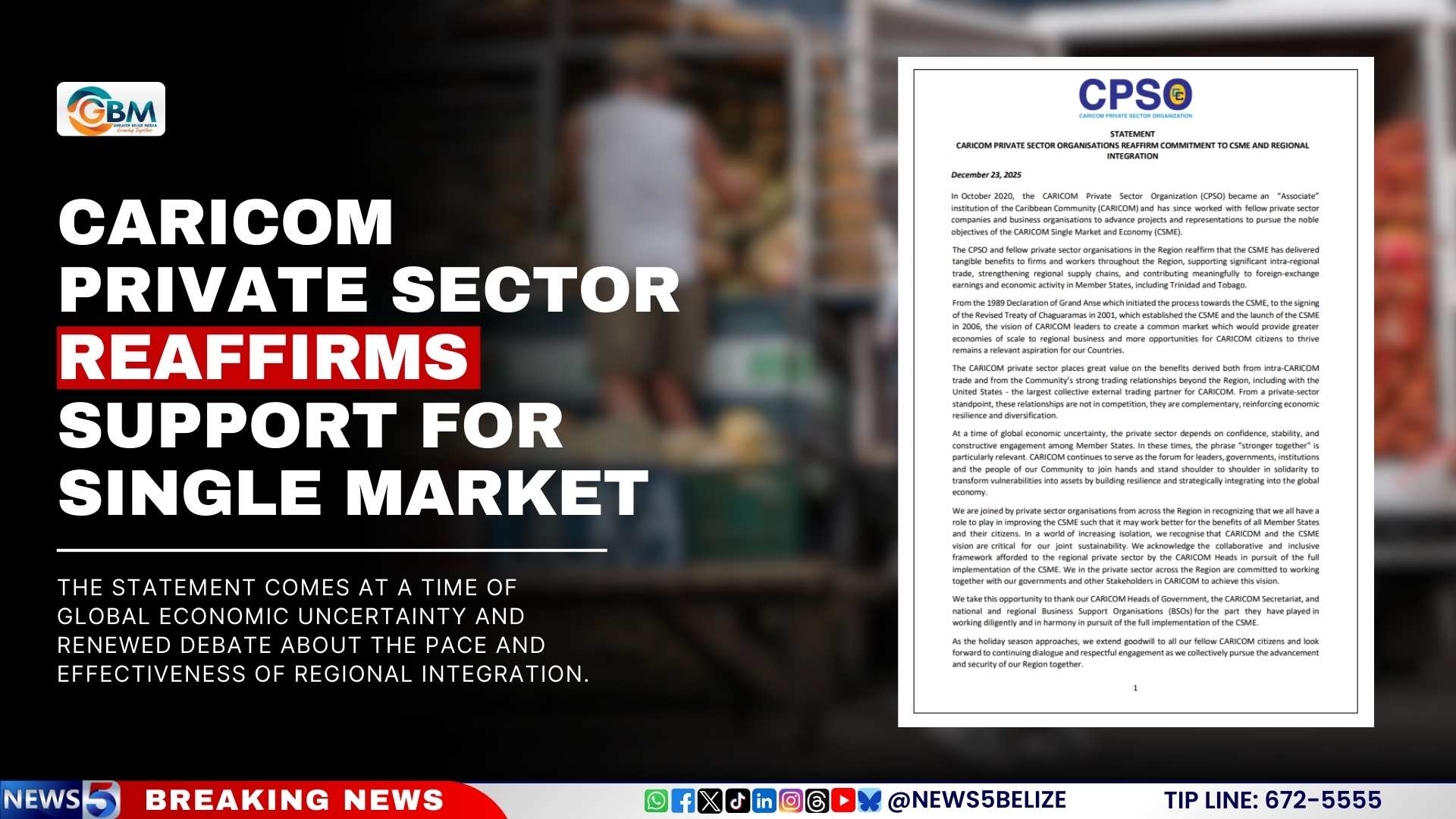
    In a significant show of regional solidarity, private sector organizations across the Caribbean have collectively reaffirmed their commitment to the CARICOM Single Market and Economy (CSME). The CARICOM Private Sector Organization (CPSO) emphasized the critical importance of regional economic integration during a period of heightened global economic instability.

    In an official statement released Tuesday, the CPSO highlighted that the CSME framework has generated substantial advantages for both corporations and workers throughout the Caribbean community. These benefits include notable expansion in intra-regional commerce, reinforced supply chain networks, and enhanced foreign exchange revenues for participating nations.

    The declaration received endorsement from prominent business organizations across multiple CARICOM member states, including Belize, Jamaica, Trinidad and Tobago, Guyana, Barbados, Suriname, and the Organization of Eastern Caribbean States Business Council.

    The CPSO simultaneously addressed the region’s international economic relationships, noting that the United States continues to serve as CARICOM’s principal collective trading partner externally. From a commercial perspective, the organization characterized these international partnerships as complementary rather than competitive with regional integration efforts.

    This reaffirmation of support emerges against a backdrop of renewed discussions regarding the velocity and efficacy of regional consolidation. The timing is particularly notable following recent diplomatic tensions, including Trinidad and Tobago’s Prime Minister Kamla Persad-Bissessar publicly distancing her government from a CARICOM statement concerning U.S. visa restrictions imposed on Dominica and Antigua & Barbuda.

    The CPSO statement concluded with a powerful call for strengthened collaboration among member nations, asserting that the maxim ‘stronger together’ holds exceptional relevance in the current global climate. The organization further emphasized that the CARICOM and CSME frameworks remain indispensable for collective sustainability in an increasingly fragmented world economy.

  • Prefab House Builders Thank Ministry for “Constructive Discussions”

    Prefab House Builders Thank Ministry for “Constructive Discussions”

    BELIZE CITY – A significant breakthrough has been achieved between Belize’s prefabricated housing sector and government transportation authorities following productive negotiations aimed at resolving a regulatory impasse that had paralyzed deliveries of completed homes.

    The Pre-Fabricated House Builders and Movers of Belize characterized their December 23rd meeting with Police Commissioner and Chief Executive Officer Chester Williams as “amicable and constructive,” marking a positive development after weeks of mounting concerns over updated transport regulations.

    Industry representatives had raised alarms about recently implemented measures that restricted the transportation of completed prefabricated dwellings, leaving numerous finished homes stranded in construction yards nationwide. Builders warned these constraints threatened to escalate costs and potentially undermine Belize’s affordable housing initiatives.

    Commissioner Williams clarified the government’s position following Tuesday’s deliberations, emphasizing that while authorities remain receptive to industry input, no fundamental policy reversals are imminent. “We are not walking back on nothing. We are putting in place a system temporarily until we can discuss,” Williams stated, noting that any permanent modifications would require formal Cabinet endorsement.

    The police commissioner additionally addressed safety considerations, asserting that recent incidents involving prefab structures were unrelated to substandard safety protocols. Current guidelines permit the transport of homes measuring up to twenty feet in width intact, while mandating that larger units be moved in segmented sections.

    In an official communication, the builders’ collective expressed satisfaction with the outcomes, noting they “aligned closely with the collaborative proposed solutions.” The group further emphasized their “shared goal of protecting road users without unnecessarily hindering affordable housing deliveries” and pledged ongoing cooperation with transportation authorities to maintain rigorous road safety standards throughout Belize.

  • For Cordelah Duran, Christmas Means Hope, Not Presents

    For Cordelah Duran, Christmas Means Hope, Not Presents

    While most children anticipate Christmas with dreams of presents and festivities, fourteen-year-old Cordelah Duran measures the holiday season through hospital visits and medical struggles. The Belizean teenager, battling pediatric cancer for over seven years, has redefined the meaning of Christmas hope through a heartfelt handwritten letter to her mother that transcends material desires.

    Cordelah’s journey represents both medical triumph and ongoing challenge. Currently in remission from cancer, she continues to endure complications affecting her heart and intestines, requiring regular treatment at O’Horan Hospital in Mérida. Her poignant letter, initially intended as private communication, reveals the exhausting reality of her condition while expressing a profound wish for simple normalcy: a Christmas tree with lights, family meals, and precious moments of happiness for her mother.

    The financial burden of Cordelah’s medical care has pushed her family to extreme limits, forcing her mother Delilah Arana to abandon her teaching career. Yet their story transcends individual struggle, highlighting a remarkable cross-border medical partnership. Since 2008, O’Horan Hospital has provided specialized care to Belizean children with cancer, with Dr. Pablo Gonzalez Montalvo leading efforts that have dramatically improved survival rates from 38% to 67% over the past decade.

    Dr. Montalvo emphasizes the transformative impact of pediatric oncology treatment: “If we do nothing, everybody will die. If you do something, most of them will conquer cancer and live full healthy lives. We give families forty, fifty, sixty years of life—that’s the huge impact of childhood cancer treatment.”

    Cordelah’s perspective embodies extraordinary resilience. “I try to ignore that I’m sick,” she explains. “If I think about it, I get down. So I just try to be a normal child like everyone else.” Her Christmas expectations have evolved into simple aspirations: quality time with family, shared meals, and creating memories rather than accumulating gifts.

    This narrative transcends seasonal sentimentality, serving as both a testament to medical progress and a reminder of childhood cancer’s ongoing challenges. Cordelah’s story illustrates how hope persists through medical adversity, redefining holiday spirit through resilience, familial love, and the courageous pursuit of normalcy amid extraordinary circumstances.

  • Remembering Jerry Lopez: The Heart of Albert Street

    Remembering Jerry Lopez: The Heart of Albert Street

    The bustling heart of downtown Belize City has fallen silent with the sudden passing of Jerry Lopez, the cherished fruit vendor whose presence graced Albert Street for nearly three decades. Lopez, 52, collapsed and died of natural causes on Monday evening mere steps from the iconic fruit stand that served as both his livelihood and the community’s social nucleus.

    For thirty years, Lopez transformed his modest produce stall into an urban institution—a welcoming oasis where strangers became friends over shared smiles and seasonal fruits. His father had established the family tradition in the 1970s, selling fruits before the historic Palace Theater, with Jerry eventually assuming the role and becoming what many describe as ‘the face of downtown.’

    Beyond his commercial offerings of plums, custard apples, sour sap, and craboo, Lopez distributed generosity freely—gifting produce to schoolchildren, offering shoulders to lean on, and weaving together the social fabric of the community. His encouragement inspired fellow vendor Cindy Joseph to establish her own powder bun business adjacent to his stand, exemplifying his role as both mentor and catalyst for local enterprise.

    The impact of his loss resonates through multiple layers of Belize City society. Prime Minister John Briceño offered official condolences via social media, while Deputy Mayor Eluide Miller characterized Lopez as ‘synonymous with downtown’ and integral to the city’s social fabric. Cassius Lopez, Jerry’s older brother, now contemplates continuing the family legacy while mourning the man who embodied their father’s physical presence and entrepreneurial spirit.

    Lopez’s passing has sparked grassroots movements advocating for permanent memorials, including proposals to rename King Street in his honor—a testament to his profound community influence. He is survived by a son, whose recent high school graduation Lopez celebrated with immense pride, marking one of his final familial milestones.

    As makeshift memorials bloom at his former stall, the city collectively remembers not merely a vendor, but the enduring heart of Albert Street—a man whose legacy transcends commerce and embodies the very essence of community connection.

  • Safety or Setback? Prefab Transport Rules Are Questioned

    Safety or Setback? Prefab Transport Rules Are Questioned

    The prefabricated housing sector confronts a severe operational crisis following the implementation of revised transportation regulations that restrict the movement of fully assembled modular homes on national highways. This regulatory shift has left numerous construction companies grappling with logistical gridlock, with multiple completed dwellings stranded and unable to reach their intended destinations.

    Transport Ministry CEO Chester Williams convened emergency discussions with industry representatives to address the mounting predicament. During these critical talks, Williams acknowledged the compliance of transport operators with previous permit requirements, citing documented evidence that properly lit convoys with adequate warning systems and escort vehicles accompanied recent shipments.

    Current regulations mandate that structures exceeding twenty feet in width must be disassembled before highway transport—a requirement that renders numerous already-constructed homes effectively immobile. Williams emphasized the impracticality of demanding deconstruction, noting this would essentially force builders to demolish finished properties and reconstruct them onsite, potentially doubling costs for consumers.

    Proposed interim solutions include implementing police-escorted nighttime transport operations for existing inventory. However, Williams clarified that any permanent regulatory modifications would require Cabinet-level authorization. Simultaneously, homebuilders have committed to developing public awareness campaigns through informational commercials and notices regarding safe transport practices for oversized loads.

    The regulatory review was prompted by recent highway incidents involving prefab home transports, though preliminary investigations suggest proper safety protocols were followed in both cases, indicating factors beyond transport procedures may have contributed to the accidents.

  • Transport Ministry Under Fire for Flip-Flop Policies

    Transport Ministry Under Fire for Flip-Flop Policies

    The Ministry of Transport finds itself at the center of a growing controversy regarding its policymaking approach, following multiple instances of proposed regulations meeting public resistance and subsequent modifications. This pattern has raised questions about whether policies are being developed with adequate stakeholder engagement or implemented hastily without proper consultation.

    The sequence of contentious proposals began with initial plans for a national bus company that encountered significant pushback. This was followed by comprehensive motorcycle regulations criticized for their lack of clarity, and most recently, amendments to house transportation rules that generated strong opposition from affected parties.

    In response to mounting criticism, Transport Ministry CEO Chester Williams defended the department’s approach, characterizing the adjustments as responsive governance rather than policy reversals. “We are not walking back on nothing,” Williams stated during a phone interview. “We are putting in place a system temporarily until we can discuss.”

    Williams emphasized that recent meetings have produced recommendations requiring Cabinet approval before implementation, framing the process as one of listening to affected constituencies and making reasonable recommendations for governmental consideration. Regarding the motorcycle regulations specifically, Williams asserted there has been no retreat from the proposed framework, noting that the Prime Minister and Cabinet are collaboratively exploring how best the government can support this initiative while acknowledging the necessity of training programs.

    The ongoing situation highlights broader questions about governance methodology, particularly whether reactive policymaking is becoming institutionalized within the transport sector administration.

  • Belize’s Hidden Housing Industry Moves While You Sleep

    Belize’s Hidden Housing Industry Moves While You Sleep

    BELIZE CITY – While most citizens sleep, a massive industrial operation moves silently through Belize’s nighttime highways. The country’s prefabricated housing industry has developed a sophisticated nocturnal transport system that remains largely invisible to the public eye, yet represents a significant economic sector.

    Ronny Plett, Manager of Plett Home Builders, reveals that nighttime relocation has become the industry standard for safety and efficiency. “The general public and government officials remain largely unaware of the scale of this industry because transportation occurs exclusively during overnight hours,” Plett explained in an exclusive interview.

    The practice gained formal recognition eleven years ago when government authorities issued a directive encouraging nighttime moves. While initially met with limited compliance, several major companies including Plett Home Builders recognized the substantial advantages and continued the practice independently after the directive was retracted.

    Plett provided compelling statistics demonstrating the scale of this hidden industry: his company alone has transported over 3,000 homes during the past two decades without a single traffic incident. Industry-wide, approximately 200 homes are moved annually under cover of darkness.

    The safety and efficiency benefits are substantial. Daylight transport between Spanish Lookout and Belize City typically involves navigating around hundreds of vehicles, creating dangerous congestion. Nighttime operations reduce vehicle encounters to just three or four throughout the entire journey, significantly lowering accident risks while improving cost efficiency through faster completion times.

    This sophisticated nighttime logistics network represents an innovative solution to industrial transportation challenges in developing nations, demonstrating how private industry can self-regulate for improved safety outcomes without government mandate.

  • Strobe Light Overload: Safety Signal Losing Impact?

    Strobe Light Overload: Safety Signal Losing Impact?

    A growing proliferation of unauthorized strobe light usage on Belizean roads is creating potentially dangerous desensitization among drivers, according to transportation industry expert Ronny Plett. The manager of Plett’s Home Builders raised urgent concerns on Friday about the diminishing effectiveness of safety signals meant to alert motorists to oversized loads.

    Plett identified a troubling pattern where flashing strobes have become commonplace on various vehicles including semi-trucks and buses that aren’t transporting any special loads. This indiscriminate usage, he warns, conditions drivers to ignore the critical warning signals when they actually appear on legitimate wide-load transporters.

    ‘The widespread unnecessary flashing teaches people to become accustomed to them,’ Plett explained, noting this concerning trend has been steadily growing. ‘When moving a wide load now, people are conditioned to disrespect the strobe.’

    The transportation veteran called for stricter enforcement from regulatory departments, emphasizing that strobe lights should be activated exclusively during actual wide-load transportation operations. He stressed that immediate action is necessary to preserve the vital safety function these signals provide for both transportation workers and the general public.