标签: Belize

伯利兹

  • Refunds Promised at Ten, Frustration Arrived First

    Refunds Promised at Ten, Frustration Arrived First

    On April 7, 2026, what was supposed to be a straightforward reimbursement process for ticket holders of a canceled charity raffle in Belize City devolved into hours of confusion, delayed waits, and public tension, leaving dozens of people frustrated with mismanaged expectations from the Sub Umbra Floreo Lions Club.

    The local service organization had planned a 2026 Toyota Hilux raffle as a fundraising event, but the initiative ultimately fell through. Leaders publicly promised to begin issuing full refunds to all ticket purchasers starting at 10 a.m. on Monday at the Belize City Civic Center’s ticket booth, with the announcement shared widely across the club’s official Facebook page. However, when early arrivals showed up at the scheduled time, they found the booth completely empty, with no club representatives on site and no advance explanation for the absence.

    As more ticket holders converged on the location throughout the morning, frustration mounted steadily. Many attendees had traveled across the region to collect their refunds, facing steep travel costs amid ongoing high gas prices. Multiple ticket holders noted that this was not the first delay: the organization had already pushed back the original refund timeline from Christmas to March, blaming slow ticket sales for the first shift. When no update came on Monday morning, attendees said the lack of communication felt disrespectful to people who had placed their trust in the non-profit service group.

    Nearly two hours after the scheduled start time, the club finally posted a brief update to Facebook, attributing the holdup to unspecified banking delays and pushing the start of refunds to later in the day. It was not until approximately 2 p.m. that club members finally arrived at the civic center to begin processing reimbursements. When approached for comment by News Five reporter Paul Lopez, club representatives declined to speak on the record about the delays.

    While most ticket holders ultimately received their full refunds after waiting out the extended hold up, the tense start set a sour tone for the entire day. The process was not entirely conflict-free: local law enforcement was called to the site after a confrontation broke out over what attendees perceived as unfair treatment of two young ticket holders. A video and on-the-record interviews captured heated exchanges, with frustrated attendees demanding the money they had paid months earlier.

    For many ticket holders, even successful reimbursement did little to ease the disappointment over how the situation was handled. Carl Duncan, a ticket holder who traveled from Ladyville to attend the refund event, noted that he had invested significant time and gas money to attend, saying “People have their trust in the organization, so hopefully it pulls through. It is a big let down.” Other attendees echoed that sentiment, saying that a simple heads-up about the delay would have saved hours of unnecessary waiting.

    Elizabeth Ranguy, a former board member of the Sub Umbra Floreo Lions Club who attended to collect refunds on behalf of multiple ticket holders, said the mismanaged fiasco has done lasting damage to the organization’s reputation. “The truth is the Sub Umbra Floreo Club has taken a hit. Will they be able to recover, I don’t know. I hope so. The club is still great, the members in there are still great. This is just one bad situation. I know it has some side effects on Lions International itself,” she said, adding that she is pushing for greater accountability from the club’s current leadership to prevent similar missteps in the future.

    While most attendees left with their money in hand by the end of the day, the failed raffle and chaotic refund process have left lingering questions about transparency and management within the local service club, highlighting how poor communication can erode public trust even in long-standing community organizations. Reporting for News Five, Paul Lopez contributed to this report.

  • Police Expand Search as Deborah Arthurs Remains Missing

    Police Expand Search as Deborah Arthurs Remains Missing

    It has now been 10 full days since 28-year-old Deborah Bree Arthurs was last seen by friends or family, and as authorities expand their search operations across two districts in Belize, public and family anxiety over her safety continues to climb.

    Arthurs’ sudden disappearance has left loved ones stunned, with close relatives confirming that her extended silence is completely uncharacteristic of her. To date, law enforcement has confirmed no trace of contact between Arthurs and any member of her family since she went missing, prompting coordinated search efforts across both the Belize and Cayo districts.

    A key development in the ongoing investigation is the emerging potential connection between Arthurs’ disappearance and the recent shooting of Jevon Clare just outside Belmopan, the capital of Belize. This connection remains an active line of inquiry as detectives work to reconstruct Arthurs’ final known movements and deliver long-awaited answers to her distraught family.

    In an on-the-record briefing with reporters, Assistant Superintendent of Police Stacy Smith, staff officer for the investigation, confirmed that both the disappearance and the Clare shooting are being probed in tandem. “What I will say is that the disappearance is a matter of investigation as well as the shooting of Mr. Clare. We have heard, as the media has, the indication of there being some nexus between the two incidents and they are being explored to the extent they can be explored,” Smith stated.

    When pressed for details on the scope of the search, Smith confirmed that law enforcement has already carried out multiple search missions across both the Belize and Cayo districts, and investigators have successfully located a vehicle of interest linked to the case, later confirmed to be an Equinox.

    “The concern is based on the fact that she has not communicated with any family member to our knowledge and we are hopeful we will bring some resolution to the family to whatever extent that will be,” Smith added.

    As of the latest update, the search for Arthurs remains an active priority for Belizean law enforcement, with multiple operational efforts ongoing, the vehicle of interest secured for forensic examination, and the potential connection to the Belmopan shooting still under active review. For Arthurs’ family, every passing day without answers only deepens their worry as they wait for any update on the 28-year-old’s whereabouts.

    This report is adapted from a transcribed broadcast of an evening local news program in Belize.

  • Police Blanket Major Roads with Easter Checkpoints

    Police Blanket Major Roads with Easter Checkpoints

    Ahead of the anticipated Easter long weekend, national law enforcement agencies launched a large-scale coordinated road safety operation in partnership with the Ministry of Transport, deploying checkpoints across major thoroughfares nationwide to curb risky driving behavior and prevent holiday traffic incidents.

    Scheduled to run through the April 2026 Easter break, the operation saw officers fan out across the country to establish 56 fixed vehicle check points (VCPs) designed to intercept drivers violating road safety regulations, from impaired driving to unregistered vehicles and other infractions. Over the course of the operation, law enforcement officers stopped more than 5,000 private and commercial vehicles, conducted searches of 500 vehicles, and issued 232 citations for various road traffic violations, according to Assistant Superintendent Stacy Smith, Staff Officer with the national police department.

    Eight motorists were taken into custody and formally charged with driving under the influence of alcohol, one of the deadliest and most common causes of holiday road fatalities globally. The high-visibility deployment comes as part of an annual push by transportation and law enforcement authorities to reduce traffic accidents during peak holiday travel periods, when volumes of road traffic surge and instances of impaired driving linked to holiday gatherings typically rise.

    This report is adapted from a televised evening news broadcast transcript published by the outlet’s digital news platform, which noted that translated passages from Creole speech included in the original broadcast were transcribed using a standardized spelling system for accessibility.

  • Another Blaze, Another Loss for Bowen Family

    Another Blaze, Another Loss for Bowen Family

    In a heartbreaking turn of events that has repeated cruel misfortune for one Belize City family, a midday blaze on April 7, 2026, tore through a Quallo’s Alley duplex, destroying all belongings for two households and leaving both families displaced for the second time in recent years.

    For Melonie Bowen, the homeowner of the front unit, the acrid scent of smoke triggered a devastating sense of deja vu. Bowen had stepped out only briefly to purchase a fan from a local shop, leaving her two teenage sons alone in the residence. When she returned, she initially dismissed the haze drifting through the neighborhood as routine residential brush burning — until she spotted thick grey smoke billowing through her front window.

    “In that moment, I just thought, ‘This can’t be happening again,’” Bowen recalled in a phone interview with reporters. This blaze marks the second destructive fire to hit the duplex in less than a decade. After the first blaze, which originated from an electrical fault in the back unit’s upper floor, the entire structure was fully renovated, and Bowen and her family moved back in to rebuild their lives.

    On the day of the new fire, Bowen’s two sons were inside the front unit when the flames broke out. Fortunately, all residents — including Bowen’s sons — escaped the structure without injury. By the time fire department crews arrived 20 to 25 minutes after the emergency call was placed, the fire had already spread through both halves of the connected building. Every item in both units was either burned beyond recognition, destroyed by smoke, or ruined by water used to douse the flames.

    The back unit of the duplex, owned by Anthony Scott, a worker who was away on a job in San Pedro when the fire broke out, was completely gutted. Scott’s father and brother had been attending church services at the time of the blaze, so no one was in the unit when the fire started. But that small stroke of luck offers little comfort: Scott lost every possession he owned in the fire, save for the small bag of clothing he brought with him for his work trip.

    “Everything got burned up. We only have the clothes that were on our backs when we got the news,” Scott explained. “The loss is critical. Any little assistance from the community would mean the world right now.”

    Scott’s father is currently staying with a daughter in the city, while Scott has booked a low-cost hotel room, and Bowen and her sons are being housed temporarily at a local guesthouse. Both families are now starting over from scratch, navigating the overwhelming process of rebuilding their lives for a second time after destructive fire. Local reporters note that the original report is a transcript of an evening television newscast, with Kriol language dialogue transcribed using a standardized spelling system for publication.

  • Indian Creek Council Distances Itself from Land Scheme

    Indian Creek Council Distances Itself from Land Scheme

    In an official statement released on Tuesday, April 7, 2026, the Indian Creek Village Council has publicly cut ties with an unauthorized, corrupt land distribution scheme that has roiled the small community, placing full blame for the irregular activity directly on the village Alcalde and his affiliated supporters.

    The council made clear in its strongly worded release that it had no involvement whatsoever in the controversial actions at the center of the dispute: the unauthorized marking of new survey lines and the distribution of unofficial land certificates that are now circulating among community members. Labeling the Alcalde-led actions as lawless and entirely invalid, the council added that the episode represents a significant embarrassment to all local governing institutions.

    Beyond the basic illegality of the scheme, the council highlighted a series of particularly alarming violations of local land regulations. According to the council’s findings, the unauthorized land distribution has allocated plots to a range of ineligible recipients, including non-residents of Indian Creek, individuals who already hold legal title to land within the village, and even minor children. These allocations directly contradict established village land use mandates, the council confirmed, and have already eroded public trust in local land governance.

    The council also moved to dismiss any claims that the unapproved scheme had legal backing. It emphasized that neither local Justices of the Peace nor the 2015 CCJ Consent Order – a existing legal framework for land management in the area – grant any authority for this type of ad-hoc land allocation.

    For years, the council noted, it has worked in good faith with local landowners to formalize and regularize land tenure for critical community assets, including public schools, the village cemetery, and private residential properties. These long-planned, community-benefiting efforts are now at serious risk because of the unauthorized actions, the council warned. The chaotic, self-serving land grabs have undermined legitimate negotiations that were meant to deliver fair, sustainable outcomes for the entire village, putting broader community development goals in jeopardy.

  • Fuel Prices Jump Again, Third Hike This Month

    Fuel Prices Jump Again, Third Hike This Month

    On Monday morning, motorists across Belize faced yet another unwelcome surprise at fuel stations, after a midnight price adjustment that marked the third increase in fuel costs in just over a month. Effective immediately, premium gasoline rose by 84 cents per gallon, while regular gasoline increased by 80 cents, adding to a cascade of rising costs that have already stretched household budgets thin. For ordinary Belizeans already navigating steep increases in grocery bills, utility rates, and baseline transportation expenses, this latest jump in fuel prices has pushed financial strain to new heights.

    Government officials have pinned the recurring increases on widespread volatility in the global crude oil market, which has been roiled by the ongoing armed conflict in Iran. International supply disruptions tied to regional instability have driven up crude prices worldwide, and those costs are being passed directly to consumers at the pump in Belize.

    But for residents grappling with daily budget challenges, the global explanation does little to ease immediate hardship. Many are now questioning how much more prices will climb, and when consumers can expect any measurable relief from the upward trend.

    As fuel costs act as a core driver of broader inflation across Belize’s economy—pushing up fares for public transit, raising delivery costs for consumer goods, and increasing prices across nearly every sector—public attention has shifted to the national government’s tax policy on fuel. Many residents are now calling on policymakers to consider temporary tax adjustments that could reduce the final cost for consumers and ease the broader economic burden on working households.

    Local outlet News Five has confirmed it will continue monitoring developments in fuel prices, tracking how changes at the pump impact the cost of living for ordinary Belizeans across the country.

  • Belize–Taiwan Partnership Expands Beyond Diplomacy

    Belize–Taiwan Partnership Expands Beyond Diplomacy

    On April 7, 2026, bilateral diplomatic engagement between Belize and Taiwan took a tangible step forward, as senior officials from both sides gathered in Belmopan to advance new cooperation projects focused on practical, on-the-ground outcomes rather than formal diplomatic gestures alone. The meeting brought together Henry Usher, Belize’s Minister of the Public Service and Disaster Risk Management, and Amino C.Y. Chi, Taiwan’s recently appointed ambassador to the Central American nation, to map out joint initiatives across two high-priority areas: public sector modernization and climate and disaster resilience.

    Talks centered on plans to upgrade Belize’s public service ecosystem through structured technical training programs, cross-sector knowledge exchange, and targeted capacity building efforts. These initiatives are designed to streamline administrative processes, improve service delivery to Belizean communities, and bring the country’s public sector in line with modern governance standards. On the disaster preparedness front, both sides explored how Taiwan can expand support for Belize’s national emergency response framework. One prominent proposal under discussion leverages advanced drone technology to strengthen the capabilities of Belize’s National Emergency Management Organization (NEMO). Equipped with drones, NEMO would be able to conduct faster, more accurate post-disaster damage assessments, monitor active emergency situations in real time, and cut response times when hurricanes, floods, or other natural disasters strike – a critical upgrade for a small Caribbean nation highly vulnerable to climate-driven extreme weather.

    Throughout the discussions, both sides reaffirmed the deep, long-standing friendship that underpins their bilateral relationship. Officials emphasized that the partnership continues to be grounded in principles of mutual respect, with a shared strategic focus on building national resilience and advancing inclusive, long-term sustainable development for both peoples.

  • Easter Visitors Up, But How They Arrived Has Changed

    Easter Visitors Up, But How They Arrived Has Changed

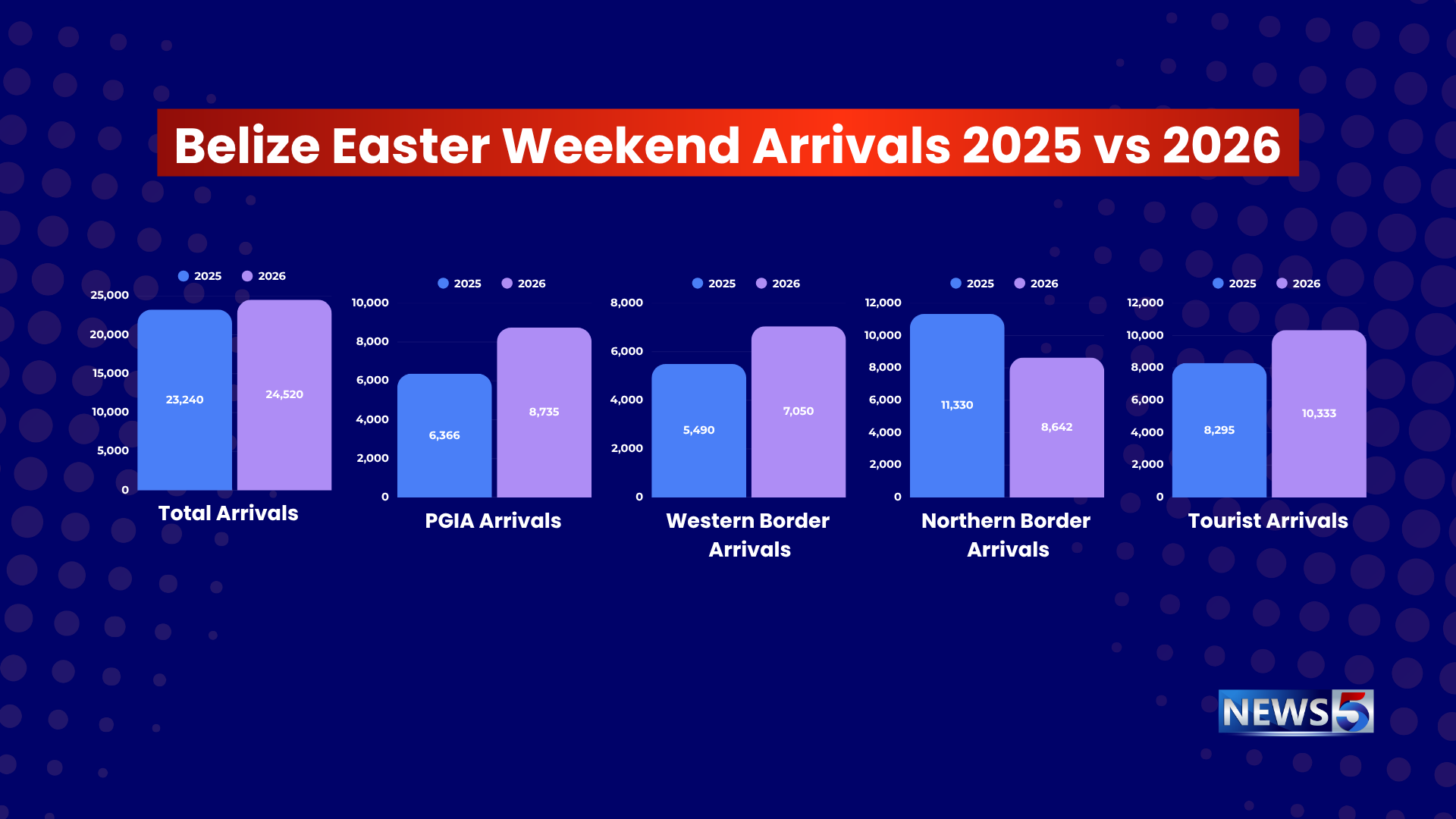
    As one of the peak travel periods of the year, the 2026 Easter holiday brought incremental but notable growth to Belize’s tourism sector, alongside striking changes in how visitors enter the country, new official data reveals. Figures compiled by Belize’s Ministry of Immigration, Governance and Labor show that total arrivals over the Easter weekend hit 24,520, marking a 5.5% increase compared to the same holiday period in 2025. Beyond the top-line growth, however, the data documents clear evolving travel patterns that signal shifting preferences among holidaymakers visiting the Central American nation.

    The most dramatic shift has been a growing preference for air travel over land entry. Arrivals at Philip Goldson International Airport, Belize’s main air gateway, saw a 37% year-over-year jump, rising from just over 6,300 visitors in 2025 to nearly 8,800 this Easter. This double-digit surge points to strengthening consumer demand for international travel to Belize, as more tourists opt to fly directly into the country for peak holiday getaways rather than crossing overland from neighboring countries.

    When it comes to land border crossings, the data tells a divergent story across Belize’s two main entry points. The western border with Guatemala at Benque Viejo del Carmen recorded a strong 28% rebound in arrivals, reversing previous declines and drawing far more overland travelers this year. In sharp contrast, the northern border crossing at Corozal, which connects Belize to Mexico, saw a steep 24% drop in holiday traffic. When combining figures from both border posts, total land crossings dipped slightly overall, revealing two key trends: a general decline in overland travel to Belize for Easter, and a clear shift in overland routes away from Mexico and toward Guatemala during the holiday travel rush.

    Breaking down arrivals by traveler type also highlights the tourism sector’s solid performance this year. While returning residents still account for the largest share of total entries into Belize, their numbers declined marginally year-over-year. The biggest gain came from international leisure tourists, who arrived in far greater numbers: tourist entries jumped nearly 25%, adding more than 2,000 additional visitors to the 2026 Easter tally, a clear indicator of a robust holiday season for Belize’s tourism industry. Smaller travel segments, including business trips, employment-related travel and official government travel, also saw slight incremental gains that contributed to the overall growth in total entries.

    Taken together, the latest arrival figures confirm that Easter travel to Belize is undergoing a quiet transformation. More visitors are choosing to fly in rather than cross by land, overland travelers are shifting between border crossings based on origin and route preferences, and overall visitor numbers continue a steady upward climb. These changes offer key insights for Belize’s tourism stakeholders as they adapt to evolving travel habits during one of the busiest travel windows of the year.

  • Riders Chase Glory in 96th Cross Country Classic

    Riders Chase Glory in 96th Cross Country Classic

    As dawn had yet to break over Belize on April 7, 2026, hundreds of cycling enthusiasts and elite riders gathered along the George Price Highway, ready for the kickoff of the nation’s most iconic and longest-running endurance cycling event: the 96th Holy Saturday Cross Country Classic. Held annually on Holy Saturday, this storied race blends decades of local tradition with world-class competitive spirit, drawing domestic athletes and international contenders alike to test their stamina, strategy, and mental grit across a grueling 70-plus mile route stretching from the George Price Highway to the nation’s capital Belmopan and ultimately finishing in Belize City.

    When the starting gun fired, the dense peloton surged forward, settling immediately into a steady, blistering pace that would hold for the race’s opening stretches. Veteran riders knew all too well that early speed would mean nothing if they burned through their energy reserves before the final push, setting the tone for a race defined by tactical pacing as much as raw speed. The first major break came early, when Ignacio Prado, a Mexican rider competing for Team Canel’s Java, pulled away from the main group, snatching 12 intermediate station prizes before reaching the 16-mile mark. Prado’s lead would not hold, however, as Costa Rican contender Sebastian Calderon and Mexican rider Heriberto Gutierrez reeled him in, then pushed ahead of the pack together. The pair held the front through the stretch leading into the town of San Ignacio, collecting a combined 40 intermediate station prizes along their breakaway.

    Shortly after entering San Ignacio, Calderon dropped Gutierrez, launching a solo effort that carried him all the way to the 46-mile mark just outside Belmopan, where he picked up an additional 30 station prizes alone. By the time the lead group rolled into the final stretch toward the finish line in Belize City, attrition had whittled the front pack down to just eight riders. The final mile unfolded at a measured, tense pace, with every rider conserving energy for the final sprint—until defending champion Jim Brown of Great Britain pulled away from the group, launching a late sprint that left the other seven contenders trailing in his wake. When he crossed the finish line, Brown secured his second consecutive victory at the classic, cementing his status as one of the race’s most successful recent international competitors. Prado crossed second to claim the runner-up spot, while Belize’s own Jyven Gonzalez rounded out the top three, finishing as the fastest domestic rider in the 2026 edition.

    This year’s race made history for its speed: 11 riders, three of whom hail from Belize, finished within eight minutes of the event’s all-time course record, marking an unprecedented showing of high-level competition. In post-race interviews, Brown spoke to the grueling conditions, noting that the tropical heat pushed his body to its limit. “Absolutely cooked, absolutely cooked. The heat just gets to me, but apart from that I am good,” he said. Brown added that he actually saw the strong headwind on the return leg of the race as an advantage. “Actually I did not mind it. I think the wind in the face cools you down a bit. And it made the race harder. If you made a bit of a gap people are less willing to chase,” he explained. When asked about his game plan for the final mile, Brown shared that while he has always trusted his sprint, he entered the final push uncertain of the outcome. “I am always confident in my sprint but I do feel like guys out here are fast. I was not super confident but I was by myself and it worked out,” he said. Echoing the longstanding passion that surrounds the event, Brown added that the energy of local spectators made the second win just as meaningful as his first. “Just as good as last time. The people are passionate here. It makes you feel good how passionate everyone is and how everyone loves the race. I am just proud to be here and proud to win again,” he said.

    For third-place finisher Jyven Gonzalez, the race was a testament to persistence in the face of adversity. The Belizean rider overcame not one but two tire punctures mid-race to secure a spot on the podium. “I love it because the country really take this race serious. This race just hard. It is super unpredictable. Anything could happen in the race. This is my fifth time riding the cross country and five out of five times I never ride this race and it goes smooth. But I signed up for this and it is cycling. Today was really tough for me and I never felt good at all,” he said. Gonzalez detailed his mid-race misfortunes: “I had a rear wheel puncture at mile thirty-five and as I caught back the field my front wheel puncture. I nuh wah like I blew my top for a while and I have to apologize with my service crew. I got frustrated with myself. But it is cycling and sometimes it is tough. Cycling wont be on your side all the time.”

    From the pre-dawn starting line to the dramatic final sprint, the 96th iteration of the Holy Saturday Cross Country Classic once again lived up to its reputation as Belize’s most anticipated annual sporting event. This report was filed by Paul Lopez for News Five.

  • 96th Cross Country Classic Under Anti‑Doping Watch

    96th Cross Country Classic Under Anti‑Doping Watch

    As one of the most anticipated annual sporting events in Belize, the 96th edition of the iconic Holy Saturday Cross Country Cycling Classic wrapped up in 2026 with stunning new course records and unexpected attention on anti-doping efforts designed to protect the sport’s integrity.

    This year’s competition delivered historic results: after a dominant wire-to-wire victory in the women’s division, Bermuda’s Gabriella Arnold claimed the top spot on the podium. Reflecting on her win, Arnold shared that the race was one of the most challenging she had ever competed in, particularly the brutal headwind that plagued the final 20 miles as she rode alone at the front. This marked only Arnold’s second race in Belize, following a second-place finish at the Caribbean Championships hosted in the country last October, and she confirmed she plans to return to compete again in the future.

    In the men’s race, eight cyclists broke the previous course record in an action-packed contest that came down to a final sprint. United Kingdom rider Jim Brown outpaced all seven of his rivals in the closing stretch to cross the finish line first. After the race, Brown spoke about the extreme heat that tested his endurance, though he noted the consistent headwind actually worked in his favor: any gap he opened up was harder for chasing riders to close, making his late surge more effective.

    While the dramatic on-course action and broken records have drawn widespread excitement across Belize’s cycling community, they have also sparked questions about performance integrity. That is why Belize’s National Anti-Doping Organization (NADO) implemented a comprehensive, structured testing program for this year’s classic, stepping up oversight to guarantee every victory is earned fairly.

    Charlie Slusher, director of Belize NADO, explained the organization’s testing protocol for top-tier events like the Cross Country Classic. NADO typically tests at least five riders per competition, using a mixed selection approach that includes top finishers, riders who turned in unexpectedly exceptional performances regardless of their final placement, and randomly selected competitors to ensure broad coverage. “It is about fairness. Everybody has an equal chance of winning,” Slusher emphasized. “Doping and using performance-enhancing substances is plain cheating, and it is unfair to sponsors who invest significant prize money and to fans who put their faith in clean competition.”

    Beyond upholding competitive fairness, NADO’s work centers on protecting the long-term health of participating athletes. Slusher noted that many athletes who use banned substances take unsafe, excessive doses that can lead to chronic health complications later in life, including kidney and heart damage, even after they retire from competitive cycling. The organization also runs educational programs to help athletes understand the ever-evolving list of banned substances, ensuring they avoid accidental violations that would cost them their eligibility for international competition.

    All samples collected at this year’s race are shipped to a World Anti-Doping Agency (WADA)-accredited laboratory in the United States for analysis, a process that takes up to 14 working days to complete. To enforce full transparency, all prize money is being held by event organizers until all test results are finalized and released publicly. Slusher stressed that the open, WADA-supervised process eliminates any opportunity to hide or alter results, reinforcing the race’s commitment to clean sport.

    For Belize’s most prestigious cycling event, maintaining integrity is key to attracting future participants and growing the sport across the region. NADO’s expanded oversight positions the organization as both a watchdog for fairness and a safeguard for athlete health, ensuring that the Cross Country Classic remains a event where speed, not cheating, takes the spotlight. This report was presented by Shane Williams for News Five.