标签: Belize

伯利兹

  • DOE Rejects Road Through Wildlife Corridor

    DOE Rejects Road Through Wildlife Corridor

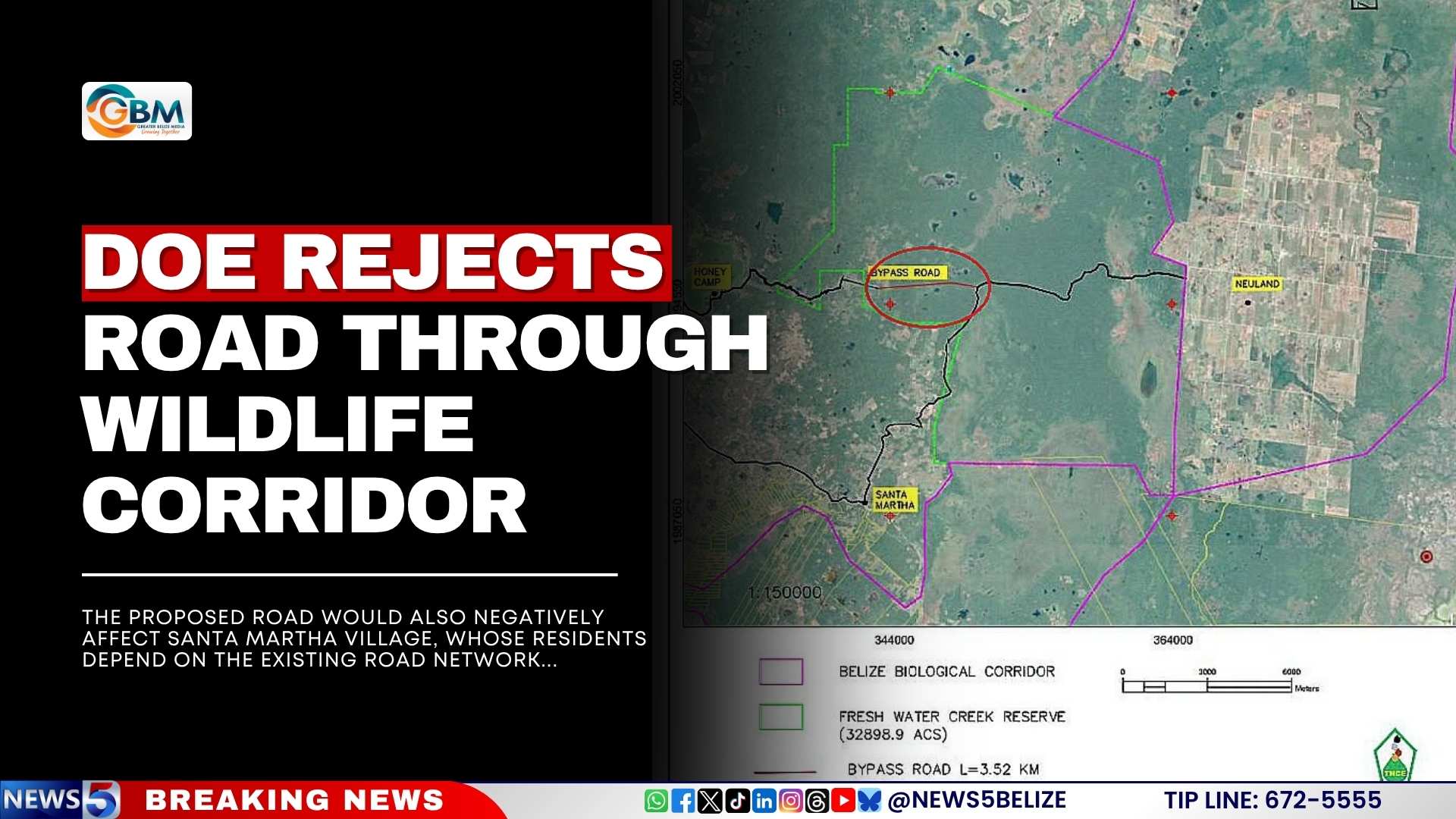
    In a landmark decision released on August 25, 2026, Belize’s Department of the Environment (DOE) has formally rejected a proposal to construct a 2.2-mile paved road cutting through the ecologically critical Northeastern Biological Corridor, a protected green space spanning the country’s Corozal and Orange Walk Districts. The project, led by local developer Honey Hub Limited, sought to connect the Honey Camp area to the existing Neuland community road, promising a five-mile reduction in local travel times for residents in the region.

    The rejection came after a rigorous July 30 assessment conducted by the National Environmental Appraisal Committee (NEAC), which reviewed an Environmental Impact Assessment (EIA) prepared by Tunich-Nah Consultants and Engineering on behalf of the developer. After a comprehensive evaluation, the NEAC advanced a formal recommendation to the DOE to deny environmental clearance for the project, a position the department ultimately adopted.

    Central to the committee’s opposition was the protected legal status of the Northeastern Biological Corridor, a key habitat linkage designed to connect fragmented forest ecosystems and support safe migration for native Belizean wildlife. The proposed construction would have required clearing approximately 13 acres of old-growth forest, a change that NEAC experts warned would split apart critical wildlife habitat, dramatically increasing the likelihood of wildlife-vehicle collisions and raising the long-term risk of injury or death for vulnerable species that rely on the corridor for movement.

    Beyond direct ecological harm, the assessment also identified major gaps in the developer’s EIA documentation. The report failed to verify that sufficient, environmentally compliant fill material was already secured for the road construction, leading experts to warn that additional unplanned land clearing would likely be required to source extra materials if the project moved forward. This would expand the project’s ecological footprint beyond what the developer had originally disclosed.

    The proposed route also raised significant concerns for nearby Santa Martha Village, whose residents depend on the region’s existing road network to carry out daily transportation and support their livelihood activities. While the project proponents highlighted the five-mile reduction in travel distance as a key benefit for the community, the EIA failed to provide evidence that this convenience would outweigh the tangible social and ecological harms the construction would bring to local residents and the protected ecosystem.

    Following its final decision, the DOE has formally notified Honey Hub Limited of the rejection. Department officials have encouraged the developer to revise their plans and explore an alternative route for the proposed connection that avoids the boundaries of the protected biological corridor, balancing infrastructure needs with the country’s commitments to environmental conservation.


  • Country Music Legend Dolly Parton Dies at 80

    Country Music Legend Dolly Parton Dies at 80

    Country music trailblazer and global cultural treasure Dolly Parton has passed away at the age of 80, her family confirmed in an official statement shared via social media.

    The news comes weeks after Parton postponed her highly anticipated October Las Vegas residency, amid unspecified ongoing health struggles. Her sister, artist Freida Parton, previously reached out to fans to request prayers ahead of planned medical procedures to address the singer’s recurring health issues. “Last night, I was up all night praying for my sister, Dolly,” Freida posted on Facebook. “Many of you know she hasn’t been feeling her best lately. Godspeed, my sissy Dolly. We all love you!” After the post sparked widespread anxiety among Dolly’s loyal fanbase, Freida later clarified that she had not intended to signal the situation was terminal at that time.

    The planned Las Vegas residency, scheduled to include six performances at The Colosseum at Caesars Palace this coming December, was set to be Parton’s first appearance on the Las Vegas stage since the 1990s, when she performed alongside her “Islands in the Stream” duet partner Kenny Rogers. Just last month, Parton also canceled a scheduled appearance at her namesake Dollywood theme park for a September event, after a painful kidney stone diagnosis left her unable to perform.

    Born in 1946 in Sevierville, Tennessee, Parton rose from extremely humble rural poverty to become one of the most decorated and beloved performers in modern music history. She launched her performance career as a child, earning a spot singing on local radio by the age of 10, cut her first single “Puppy Love” at 13, and made her debut at the iconic Grand Ole Opry that same year. After relocating to Nashville, Tennessee, in 1964, she first built a reputation as a skilled, in-demand songwriter before stepping into the national spotlight as a regular cast member on Porter Wagoner’s popular television variety show from 1967 to 1974.

    Parton’s solo career skyrocketed to legendary status in 1974, when she released two of her most iconic tracks: the haunting “Jolene” and the timeless ballad “I Will Always Love You” — a track that would later earn global acclaim when covered by pop superstar Whitney Houston for *The Bodyguard* soundtrack. Over the decades that followed, Parton successfully crossed over into pop music and Hollywood, leading the 1980 comedy classic *9 to 5* and producing the chart-topping soundtrack for the film.

    Beyond her entertainment career, Parton left a lasting mark on her home region and global philanthropy. In 1986, she opened Dollywood, a Pigeon Forge, Tennessee, theme park rooted in the celebration of Appalachian culture and heritage that grew into one of the most popular tourist destinations in the American South. Through the Dollywood Foundation, her Imagination Library program has delivered millions of free books to children across the world, working to close literacy gaps for low-income youth.

    By the end of her decades-long career, Parton stood as one of the most awarded female artists in country music history. She collected 11 Grammy Awards, three Emmy Awards, earned nominations for two Academy Awards, six Golden Globe Awards, and one Tony Award. Across her lifetime, she released 48 full-length studio albums, with total global record sales exceeding 100 million copies. Tributes from across the entertainment industry, politics, and global fan community are already pouring in to honor the singer’s extraordinary life and legacy.

  • Mother of Five Granted Bail After Three Months in Prison

    Mother of Five Granted Bail After Three Months in Prison

    Nearly three and a half months after being taken into Belize Central Prison for alleged violations of prior bail terms, 39-year-old Nichole Gilda McDonald, a mother of five children, has walked free from custody after a local magistrate granted her conditional release. The long-awaited bail ruling on August 25, 2026, comes ahead of scheduled trials for multiple pending charges against McDonald, who has repeatedly maintained her innocence on all counts.

    Escorted from the Belize Central Prison facility to the Belize District courtroom, McDonald learned her bail would be set at $800 Belizean dollars, with an additional surety bond required for the same amount. As part of her release conditions, she must check in with local law enforcement once every week and avoid any new arrest or criminal charge for the duration of her bail period. If she violates these terms, she will be immediately returned to custody to await trial.

    McDonald’s remand period dates back to June 8, when she was arrested following allegations that she assaulted a physician and a nurse at Belize’s Matron Roberts Polyclinic two days prior. That arrest violated the existing bail conditions she had been granted in an earlier common assault case, leading Magistrate Neshaad Mohammed to revoke her bail immediately and place her into full remand. Prosecutors have since provided McDonald with 10 pages of evidentiary disclosure related to the alleged wounding incident involving Dr. Andre Castillo, and the case is scheduled to go before a trial court on October 21.

    In an interview following her release, McDonald detailed her experience in custody, noting she spent a total of three months, two weeks and one day behind bars, including a period in isolation after receiving institutional sanctions. While held on remand, she voluntarily enrolled in the prison’s Ashcroft Rehabilitation Program and completed all required anger management coursework. Even as she continues to deny the accusations against her, McDonald acknowledged the program taught her valuable personal skills that she will carry forward as she works to reunite with her children.

    McDonald has also made unconfirmed claims that multiple attempts on her life were made during her time in custody, and says she has information identifying who is responsible for these alleged plots. These claims have not yet been independently verified by local law enforcement or independent journalists.

    The assault charge connected to the polyclinic incident is not the only legal matter McDonald is facing. She is also facing charges of assault, intentional wounding, property damage, and using insulting language connected to an alleged incident that took place on June 5, one day before the polyclinic encounter. Additionally, she faces a single cybercrime charge tied to allegations that she used a digital device to publish defamatory comments about former Belize Commissioner of Police Chester Williams. Williams has publicly pushed back on rumors that he has exerted any behind-the-scenes pressure to advance the cyberbullying case, denying any improper influence in the prosecution.

    In a rare step for criminal defendants in Belize, McDonald has chosen to represent herself in all three pending legal matters. She has entered not guilty pleas to every charge against her and confirms she plans to vigorously contest every allegation during her upcoming trials. Following her release, she expressed overwhelming eagerness to return home and reunite with her five children after months of separation.

  • 47 Killed in Overnight Gang Raid Near Haiti’s Capital

    47 Killed in Overnight Gang Raid Near Haiti’s Capital

    On a violent overnight incursion that has sent fresh shockwaves through Haiti’s already unstable security landscape, at least 47 people were killed and 22 others wounded in a gang raid on Kenscoff, a hillside community overlooking Haiti’s capital Port-au-Prince, the United Nations confirmed in a statement released Monday. Local human rights organization RNDDH has offered a slightly lower preliminary estimate, placing the death toll between 30 and 40 and the number of injured between 15 and 20, noting that a full, accurate accounting of casualties remains hampered by ongoing unrest and restricted access to affected areas.

    Kenscoff, which commands strategic views over critical supply and transit routes leading into Port-au-Prince and neighboring Petion-Ville — the current home of Haiti’s temporary government headquarters and numerous foreign embassies — has faced a persistent wave of gang violence since last year, with at least 12 separate attacks recorded that have forced thousands of residents to flee their homes to seek safety elsewhere.

    The Haitian government has labeled the latest attack an “heinous” act of violence and pledged to ramp up security deployments to the region, but the assault has sparked widespread public anger. Kenscoff residents are now calling for the local police chief to step down, arguing that armed officers failed to intervene even as the killings unfolded mere minutes away from the local police station. Vladimir Paraison, Haiti’s national police chief, has pushed back against the criticism, defending his personnel by stating “The police never gave up.”

    For many residents of the violence-stricken community, however, blame lands firmly on national authorities. “My family are victims,” said Coriolan Kendy, a local resident who spoke to reporters while standing beside the body of his slain cousin. “People in Kenscoff are suffering and the government is to blame.”

    This latest massacre is only the most severe in a years-long surge of bloodshed in the area: in the first two months of 2025 alone, more than 260 people were killed across Kenscoff. Since that wave of violence, nearly a dozen additional attacks have been recorded, including widespread reports of sexual violence, mass kidnappings, and deliberate arson attacks on civilian property.

    Beyond the immediate human cost, the attack has deepened long-running international concerns about Haiti’s ability to proceed with its long-delayed general election scheduled for December. The vote will be the first national election the country has held in a decade, and rising gang control of large swathes of territory has thrown the logistics and legitimacy of the poll into increasing doubt.

    A United Nations-backed multinational Gang Suppression Force, deployed to help Haitian authorities retake territory from armed gangs, currently aims to reach its full authorized strength of 5,500 troops by the upcoming autumn. As violence continues to escalate ahead of the election, however, questions are growing over whether the understrength force will be able to stabilize the country in time to allow for a safe, democratic vote.

  • Bowen & Bowen Offers $5,000 Reward After Robbery

    Bowen & Bowen Offers $5,000 Reward After Robbery

    On August 25, 2026, a violent robbery targeting the Hope Creek Supernetwork operated by Bowen & Bowen, one of Belize’s prominent business groups, has sparked a urgent public call for nationwide payment infrastructure reform. In the wake of the attack that left two company employees injured, Bowen & Bowen has announced a $5,000 reward for any information that leads to the arrest and conviction of the perpetrators.

    The company confirmed that no cash was ultimately stolen during the robbery attempt, but the two assaulted staff members required immediate medical treatment for their injuries. As of the latest update, both are currently in stable condition and recovering from the incident.

    Following the attack, Bowen & Bowen used the event to draw attention to a longstanding systemic vulnerability in Belize’s business ecosystem: the overreliance on physical cash transactions. The company argues that the continued need for employees to transport and handle cash along delivery routes puts workers across the country at constant risk of becoming targets for violent criminals. “Carrying cash makes delivery routes, drivers, salespeople and businesses attractive targets for criminals. In 2026, we should not have to operate this way,” a company representative stated.

    Bowen & Bowen explained that one of the key barriers to ditching cash-heavy operations is the failure of many local businesses to integrate modern electronic payment systems directly into their accounting frameworks. Without this integration, businesses are forced to rely on employees to manually track and reconcile every transaction, rather than leveraging automated digital systems that eliminate the need for cash handling.

    The firm emphasized that the technology required to fix this gap is already widely available in Belize. Modern payment infrastructures allow customers to complete digital transactions, with payments automatically and securely posted to corresponding customer accounts in real time. Beyond convenience, this shift would drastically cut down on the need for businesses to collect and transport large amounts of physical cash across public routes.

    To move this reform forward, Bowen & Bowen is issuing a formal call to action for all key stakeholders: the Central Bank of Belize, local commercial banks, private payment service providers, and the broader Belizean business community to collaborate on updating the country’s outdated payment systems. The company summed up the core case for change simply: “Less cash on our roads means less opportunity for crime. Belize has the technology. Now we need our payment system to catch up.”

  • Caribbean Braces for Severe Drought as El Niño Rapidly Intensifies, Belize Flagged as At Risk

    Caribbean Braces for Severe Drought as El Niño Rapidly Intensifies, Belize Flagged as At Risk

    As the El Niño weather phenomenon strengthens far more rapidly than regional climate scientists initially projected, the entire Caribbean basin is now bracing for a prolonged severe drought that threatens to disrupt agriculture, strain critical infrastructure, and endanger vulnerable communities through 2027, with Belize and Jamaica singled out as particularly high-risk areas.

    The Caribbean Institute of Meteorology and Hydrology (CIMH) has tracked a striking acceleration of El Niño conditions: the event shifted from a weak to moderate intensity by July this year, and current projections indicate it will reach *very strong* strength between October and December 2026, lingering well into the region’s peak Dry Season, which runs through March 2027.

    Dr. Cedric Van Meerbeeck, a senior climatologist at CIMH, emphasized that the timeline of this intensification is uniquely concerning. The period between August and October is already the Caribbean’s annual Heat Season, meaning pre-existing high temperatures will amplify developing dry conditions that could stretch into the first half of 2027. Looking to historical precedent, Van Meerbeeck pointed to devastating El Niño-driven droughts in 2009–2010 and 2014–2016, paired with the record-breaking heat recorded across the region in 2010, 2023, and 2024, as clear indicators of the danger this event poses.

    By October or November 2026, drought conditions are expected to take hold across a wide swathe of the Caribbean, including the Windward Islands, Leeward Islands, ABC Islands (Aruba, Bonaire, Curaçao), portions of Jamaica and Hispaniola, and the entire Bahamian archipelago. For nations reliant on rainfed agriculture—specifically Belize and Jamaica, the report’s named priority areas of concern—the combination of plummeting rainfall and steadily climbing temperatures puts food security for thousands of small-scale subsistence farmers at direct risk.

    Professor Michael Taylor, Co-Director of the University of the West Indies’ Climate Studies Group Mona, noted that the forecast risks are already beginning to unfold, describing the event as a slow-burning emerging climate disaster. “Unlike a hurricane, whose impacts hit suddenly and recede after the storm passes, the effects of this event will continue to build gradually over months,” Taylor explained, highlighting that the crisis combines overlapping threats: extreme heat, prolonged drought, and simultaneous marine heat extremes.

    Beyond agricultural losses, regional officials have warned of a cascade of secondary risks: deteriorating water quality that drives public health concerns, increased transmission of vector-borne diseases, higher rates of heat-related illness, additional strain on already stretched public water and energy distribution systems, and disruption to the Caribbean’s tourism sector, which forms the backbone of many national economies across the region.

    CIMH Principal Dr. David Farrell stressed that delayed action would only exacerbate harm, making proactive early intervention non-negotiable for protecting vulnerable groups. “Proactive measures are vital for mitigating the impacts of extreme weather events on climate-sensitive sectors, local communities, and national economies,” Farrell said.

    As the region prepares for the approaching Dry Season, officials are urging residents and stakeholders to follow the monthly climate updates published by the Caribbean Climate Outlook Forum to stay informed of changing conditions. Separately, the news comes as Belize recently passed its first-ever national climate change legislation focused on carbon credit regulation, marking a milestone in the nation’s climate action even as it faces imminent drought risk.

  • Belize, Taiwan Sign $3 Million Deal to Support Women and Youth-Owned Businesses

    Belize, Taiwan Sign $3 Million Deal to Support Women and Youth-Owned Businesses

    On August 25, 2026, Belize and Taiwan formalized a $3 million cooperation agreement designed to empower micro, small, and medium-sized enterprises (MSMEs) across Belize, with targeted support for businesses owned by women and young entrepreneurs.

    Dubbed the Belize Women and Youth MSMEs Development Project, the new initiative will be delivered as a joint effort between the Government of Belize and the Taiwan Technical Mission based in the Central American nation. This collaboration builds on a successful prior partnership between the two sides, which earlier supported approximately 2,000 women entrepreneurs and helped launch more than 100 new startup ventures across Belize.

    Under the terms of the fresh agreement, participating entrepreneurs will gain access to a comprehensive package of support tailored to their unique needs. This includes specialized skills training, one-on-one business mentorship, and assistance designed to strengthen daily operations, expand access to domestic and regional markets, generate new local employment opportunities, and lay the groundwork for long-term, sustainable business growth.

    Government officials in Belize have framed the project as a milestone investment in the country’s economic future, noting that it represents a critical step forward in building a more dynamic, inclusive, and shock-resistant national economy that benefits all segments of society.

  • BEL Points to Rising Temperatures, Consumers Want Proof

    BEL Points to Rising Temperatures, Consumers Want Proof

    As temperatures climb across Belize, a wave of consumer frustration over skyrocketing electricity bills has pushed the national power provider BEL and government officials to the table to address growing public discontent. The August 2026 gathering comes as BEL confirms a sharp year-over-year rise in customer bill disputes, with hundreds of residents questioning unexpected spikes in monthly energy charges that have stretched already tight household budgets.

    During a two-hour public explanation session led by BEL Executive Chairman Lynn Young alongside Public Utilities Minister Michel Chebat and Chief Executive Officer Dr. Leroy Almendarez, officials outlined multiple contributing factors behind the sudden bill increases. Young acknowledged that a small share of jumps stem from administrative and technical errors: some customers were hit with unexpected accumulated unpaid balances they had never been notified of, while inaccurate readings from old meters created a backlog of uncharged usage that only appeared on statements after outdated devices were replaced. In rare cases, the company also identified unauthorized meter tampering that led to catch-up charges appearing on subsequent bills.

    But Young, a trained mechanical engineer, repeatedly emphasized that rising seasonal temperatures are the dominant driver of higher energy consumption across the country. He explained that cooling-dependent appliances work far harder in extreme heat to maintain comfortable internal temperatures: air conditioning units can consume 50 to 60 percent more energy than they do during milder weather to offset the larger gap between indoor and outdoor temperatures. Refrigerators and freezers require extra power to keep food at safe storage temperatures, while even small devices like computers and internet routers have internal cooling fans that run more constantly and use more energy when external temperatures rise. Beyond electronics, increased hot weather also means more frequent water pump use as residents take more showers to cool off, adding to overall household energy demand.

    For many Belizean households already grappling with broader cost-of-living increases, the explanation has done little to ease the financial pressure of bills that have jumped by hundreds or even thousands of dollars in some cases. Minister Chebat acknowledged the severity of the burden facing residents, confirming that the government is not ignoring the growing crisis. “People are complaining that they are facing difficulties to pay these electric bills and it is a reality,” Chebat stated. “Government is not deaf and we are working to see what we can do to alleviate this. We have done a lot of things to try to help reduce the cost of living and burden that people are facing.”

    As the 2026 dry season continues to push temperatures higher, consumers remain skeptical of the official explanation and are calling for greater transparency around billing practices and meter accuracy. For families already stretching every dollar to cover basic needs, the question now is not just why bills are rising, but how many will be able to afford to keep the power on as temperatures continue to climb. This report, based on a televised broadcast from News Five, was filed by correspondent Paul Lopez.

  • BEL Admits Meter Errors, Denies Overcharging

    BEL Admits Meter Errors, Denies Overcharging

    As complaints over unexpectedly high electricity bills continue to flood in from consumers across Belize, Belize Electricity Limited (BEL) has broken its silence to acknowledge occasional human errors in meter reading while strenuously rejecting allegations of systemic overcharging of customers.

    In an official press interaction, BEL Executive Chairman Lynn Young emphasized that the utility maintains full confidence in its billing infrastructure, and urged consumers to trust the company’s invoicing processes. He explained that isolated instances of misread meters — such as when staff mistakenly log a 9 instead of a 6 — do occur, but the company has clear protocols in place to correct these mistakes promptly once identified.

    Young pushed back against claims that the company intentionally manipulates billing to inflate charges for select customers, noting that such a scheme would be functionally nearly impossible to pull off. “If you understand how our billing system works, it is entirely run through automated computer infrastructure,” Young explained. “Pulling off a targeted manipulation of the system to overcharge specific customers would take an extraordinary level of technical skill that simply isn’t being deployed here. Nothing is impossible, of course, but this scenario is not remotely plausible.”

    He also acknowledged that widespread public skepticism of large corporations is common across all industries, drawing a parallel to the scrutiny that media outlets like Channel 5, the reporter’s outlet, face for their coverage. “We are committed to being transparent and factual about any issues that arise,” Young said. “When we make a mistake, we own it immediately and fix it for consumers.”

    A core point of consumer frustration has centered on BEL’s ongoing rollout of new electronic smart meters, a decades-long modernization effort that the company aims to complete by 2028. To date, more than 40,000 old analog meters have already been replaced across the country, and many consumers have reported seeing their bills jump immediately after their meter is upgraded, leading to widespread speculation that the new devices are deliberately inflated readings.

    Young refuted these claims, instead arguing that the new electronic meters deliver far more accurate usage measurements than the aging analog units they replace. According to Young, electronic meters have a tolerance margin of just ±1.5%, compared to the ±3% accuracy range of older analog models. He added that when analog meters malfunction, they are far more likely to under-record energy use rather than over-record it, due to the design of their internal coil systems. When these inaccurate old meters are replaced with precise new devices, some consumers see their bills adjust to reflect their actual energy use — leading to an understandable but misplaced perception that the new meters are overcharging.

    This report is a direct transcript of an evening television broadcast, with Kriol language terminology transcribed using a standardized spelling system for accuracy.

  • BEL Faces Multimillion-Dollar Power Debt With CFE

    BEL Faces Multimillion-Dollar Power Debt With CFE

    As of August 24, 2026, Belize’s primary energy provider Belize Electricity Limited (BEL) is confronting a severe financial and operational crisis, anchored by a multimillion-dollar outstanding debt owed to Mexico’s state-owned energy utility Comisión Federal de Electricidad (CFE). The company’s top leadership has confirmed that current operating revenues are insufficient to cover all recurring costs, and that the Briceño administration has stepped in to provide emergency financial support to keep the national power grid operational.

    In a public press briefing, BEL Executive Chairman Lynn Young shared updated details on the scope of the debt, noting that the total obligation had fallen from $55 million in early January 2026 to roughly $30 million as of the latest reporting period, with approximately $20 million of that sum currently overdue. Young explained that the debt has mounted steadily over recent months due to a persistent gap between elevated wholesale power generation costs and regulated retail electricity rates charged to consumers.

    To illustrate the stark imbalance facing the utility, Young outlined the company’s weekly cash flow: BEL collects approximately $6 million in total weekly revenue, while diesel fuel costs alone currently run to $3 million per week. After accounting for non-negotiable payments to CFE, domestic hydroelectric provider Hydro Belize, full-time staff salaries, and contractor invoices, all available operating revenue is exhausted, leaving no buffer to cover the full cost of imported power. While a recently implemented COPA fuel price adjustment is intended to close this gap, Young noted it only covers a fraction of the increased costs. In one recent month alone, extra generation costs hit 4.5 cents per kilowatt-hour, while the COPA adjustment only added 1.5 cents to retail rates, leaving a 3 cent per kilowatt-hour gap that translated to a $5 million monthly shortfall – a gap that has been covered partially by government assistance.

    The ongoing debt crisis has pulled back the curtain on longstanding structural vulnerabilities in Belize’s national energy sector, which relies heavily on imported power from CFE while facing limited domestic power generation capacity. Young pushed back against criticism of past policy decisions that led to the country’s heavy reliance on Mexican imports, noting that decision-makers acted on the best available information at the time. CFE, as the national utility of an energy-rich nation, was long viewed as a cheap, reliable supplier, and no one could have predicted the operational instability it would face in recent years. “Everybody lose sometimes man,” Young noted, emphasizing that the focus now must be on moving forward rather than assigning blame for past choices.

    While BEL works to address its immediate cash flow crisis, a key long-term project intended to strengthen Belize’s energy independence remains stalled. In 2023, the Briceño administration signed an agreement with Saudi Arabia to fund a $77 million utility-scale solar project designed to boost domestic generation capacity and reduce reliance on imported power, but the funding has yet to arrive amid lengthy Saudi bureaucratic approval processes.

    Public Utilities Minister Michel Chebat explained that Saudi Arabia’s rigorous procurement process includes additional requirements, such as a mandate to use Saudi engineering teams for most core components of the project, which has extended the timeline. Chebat reaffirmed that the government is prioritizing the project and pushing for approval as quickly as possible, noting that the delayed solar investment is badly needed to address the country’s current generation shortfall. He added that the government recently secured a $125 million compact with the Millennium Challenge Corporation, a large portion of which is earmarked for reducing national power costs, as part of a broader push to stabilize Belize’s energy sector.