标签: Belize

伯利兹

  • Police Believe This Man Murdered a Teenage Boy

    Police Believe This Man Murdered a Teenage Boy

    A devastating act of violence has shaken two small communities in Belize District, leaving a 15-year-old student dead and an 18-year-old vocational graduate clinging to life after a shooting at a family gathering on Sunday. The incident, which unfolded at a barbecue in Gardenia Village, has prompted Belizean police to charge 34-year-old Dean Emerson Vaccaro of nearby Sand Hill Village with the murder of 15-year-old Rakeem Armstrong, a second-form student at Ladyville Technical High School.

    Preliminary law enforcement inquiries point to a disagreement over a motorcycle as the root of the conflict that escalated into gunfire. However, investigators have not yet publicly confirmed whether the two-wheeler was reported stolen, nor released additional granular details about the disagreement that led to the shooting. The second victim, 18-year-old Justin Young, a recent graduate of the IT vocational program at AC Level Two, remains in critical condition at Belize’s main public medical facility, Karl Heusner Memorial Hospital.

    In a harrowing phone interview with local outlet News Five on Tuesday, Young’s mother Kayla Young shared the grim reality of her son’s prognosis. “He’s on a life support machine in a coma because the whole gallbladder and the bowel was ripped up,” she explained. “They tell me that it is a slim chance and they’re not promising me nothing.” Young was scheduled to begin a new job training program just one day after the shooting, a future now hanging in the balance.

    News of the shooting has spread rapidly across Belizean social media, sparking fierce public debate and a range of reactions from community members. Many expressed outrage and grief over the death of Armstrong, with one local resident who knew the teen writing, “Rakeem was an innocent bystander that they mix up in a stolen bike… If this man thought these boys stole his bike, then take it up with the parents… now a sweet young boy is gone that had his future ahead of him… I watched him grow up. He goes to church every Sunday.”

    Other social media users questioned why Vaccaro did not involve law enforcement from the start, asking, “If the cycle was indeed stolen from him and he knew the people, why not call the police?” Still, a small number of commenters defended Vaccaro’s initial frustration, arguing that persistent theft in communities demands a hard line. “It’s not about material stuff. It’s about the hard work you put in to get your things. People feel sorry for these little thieves, but they are the same ones that are gonna grow up to be murderers,” one commenter wrote.

    As the investigation continues, local outlet News Five will air full updates on police’s latest findings during its 6 p.m. News 5 Live broadcast, bringing new details to audiences as they become available.

  • Google Wants to Start a “Mosquito Civil War”

    Google Wants to Start a “Mosquito Civil War”

    Alphabet Inc.’s Google is advancing an innovative public health initiative, dubbed the Debug Project, that leverages biological pest control to curb the spread of life-threatening mosquito-borne illnesses. The ambitious proposal from the global technology giant asks for U.S. federal regulatory approval to release up to 32 million specially modified male mosquitoes across regions of Florida and California over a two-year trial period.

    The target of the project is Aedes aegypti, the specific mosquito species responsible for spreading dangerous viral diseases including dengue, Zika, chikungunya, and yellow fever across tropical, subtropical, and increasingly temperate regions of the world. Unlike broad-spectrum insecticide treatments that can harm beneficial insect populations and leave chemical residues, Google’s approach relies on a natural biological mechanism to suppress wild Aedes aegypti populations without disrupting broader ecosystems.

    Every mosquito released under the program is a sterile male that carries Wolbachia, a naturally occurring bacteria commonly found in many insect species. This bacteria prevents the sterile males from producing viable offspring when they mate with wild female Aedes aegypti mosquitoes. Critically, only female mosquitoes bite humans to feed on blood, meaning the released sterile males pose no bite risk or harm to people.

    The core strategy is straightforward: by flooding local mosquito habitats with large numbers of these sterile males, researchers will outcompete fertile wild males for mating opportunities. Over time, this disruption of the species’ breeding cycle will cause the wild mosquito population to collapse, directly cutting the rate of human exposure to the diseases the insects carry.

    The Debug Project is not an untested concept. Small-scale trials have already been completed successfully in Singapore, and a larger rollout of the Wolbachia-based mosquito control method is already underway in the British Virgin Islands. If U.S. regulators grant the required approval, Florida and California will become the first two U.S. states to host the large-scale trial of Google’s approach, offering valuable data on how the method performs in large, geographically diverse U.S. regions at risk of mosquito-borne disease outbreaks.

  • PM Calls Chamber’s Fuel Tax Request “Embarrassing”

    PM Calls Chamber’s Fuel Tax Request “Embarrassing”

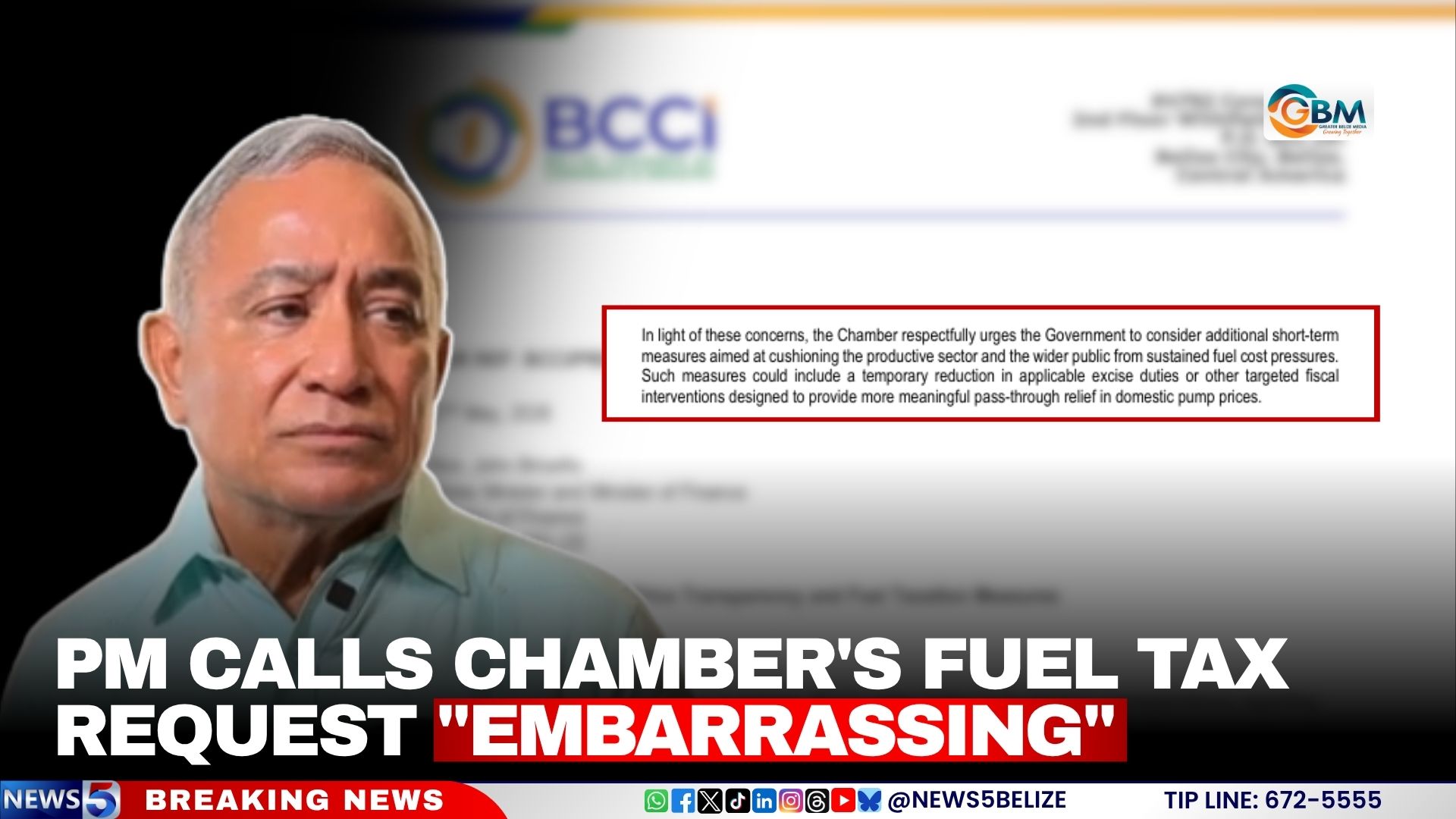
    A public dispute over fuel taxation has emerged between Belize’s top government official and the nation’s leading business advocacy group, after Prime Minister John Briceno publicly dismissed a call for fuel tax reductions from the Belize Chamber of Commerce and Industry (BCCI) as “embarrassing” in comments made to local outlet News 5.

    The confrontation stems from a formal letter BCCI delivered to the government on May 27, 2026, where the industry group praised the administration’s recent decision to resume public disclosure of detailed fuel price breakdowns, but argued that greater transparency alone cannot address the burden of persistently high fuel costs for consumers and businesses across Belize.

    In its letter, BCCI pointed out that while the proportional share of taxes included in retail fuel prices has dipped marginally in recent months, the total nominal tax amount charged per gallon has remained largely static. Even as global crude oil prices have trended downward, this taxation structure has prevented those international savings from reaching consumers at local fuel pumps, the chamber noted. BCCI explained that excise duties, one of the core components of fuel taxation, have stayed within a narrow consistent range regardless of swings in global commodity prices, creating a bottleneck that blocks price relief for end users.

    High fuel prices have cascading effects across Belize’s entire economy, the business group warned, pushing up costs for passenger and freight transportation, raising overhead for small and large businesses alike, and driving up the price of everyday consumer goods that most households rely on. To remedy the issue, BCCI called on the Briceno administration to implement short-term targeted measures, starting with a temporary cut to fuel excise taxes. The organization closed its letter by emphasizing its willingness to collaborate with the government to craft solutions that strike a balance between the nation’s critical revenue requirements and the need for broad economic stability.

    However, Briceno rejected the chamber’s proposal outright in his response, dismissing the core of the group’s argument as fundamentally flawed. The prime minister contended that reshuffling tax burdens across different tax categories – whether environmental levies, goods and services tax (GST), excise duties, or import taxes – does not reduce the government’s total overall tax take from fuel sales. “If you collect $100 in taxes… it doesn’t matter where you take it from. You could take it off environmental tax or the import tax or the excise tax. It’s still removing money from the whole amount,” Briceno explained. He went further to say that “it’s embarrassing sometimes to read such proclamations from the Chamber,” drawing a sharp line between the government’s fiscal position and the business community’s lobbying efforts.

  • ‘Despicable’ or Satire? PM Briceño Calls Alberto August’s Post ‘Disgusting’

    ‘Despicable’ or Satire? PM Briceño Calls Alberto August’s Post ‘Disgusting’

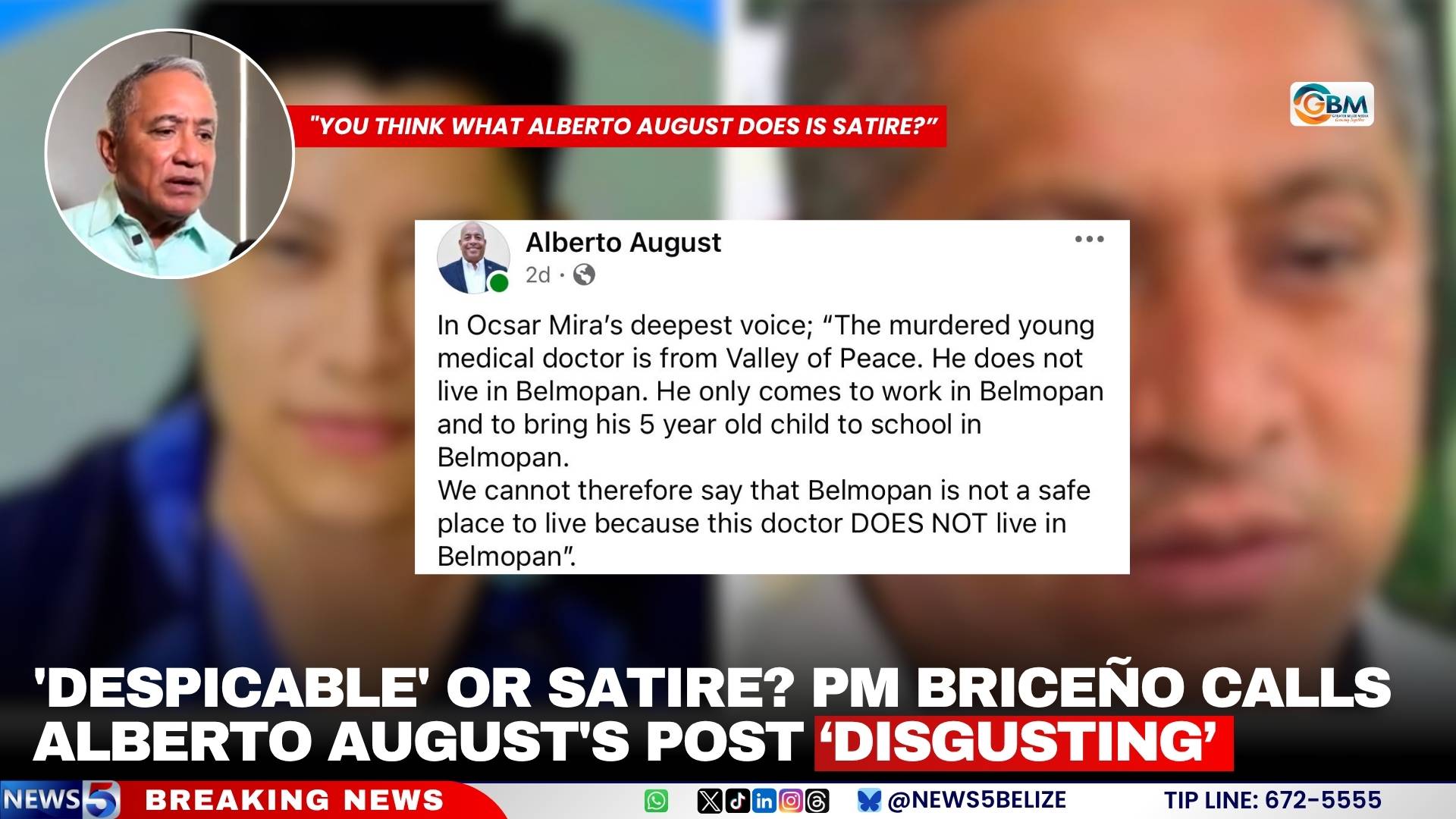
    A fresh political controversy has erupted in Belize, centered on a cyberbullying complaint filed by sitting Home Affairs Minister Oscar Mira against former United Democratic Party (UDP) Chairman Alberto August, and Prime Minister John Briceño has publicly weighed in to defend Mira’s actions amid rising concerns over political free speech.

    Speaking to reporters on June 3, 2026, Briceño made clear that he stands fully behind Mira’s choice to pursue the legal complaint, even as he acknowledged that he would not personally take the same step against his own political critics. The core of Briceño’s argument centers on framing Mira’s action as an assertion of individual constitutional rights, rather than an official government attack on political opposition. Briceño emphasized that Mira retains the same rights as any private citizen in the country: if he believes he has been the target of defamation and harmful slander, he is fully within his legal and constitutional rights to file an official report with authorities.

    Critics of the complaint have raised alarms that the arrest linked to the case sets a dangerous precedent that could stifle legitimate political criticism and erode protections for free speech in the country. Briceño outright rejected these concerns, pushing back against claims that August’s controversial social media post qualifies as protected political satire. In blunt terms, Briceño dismissed the satire framing, calling August’s conduct “disgusting” and accusing the former UDP chair of exploiting the tragedy of a grieving family to score political points.

    The pushback against Mira did not end with free speech arguments: on Monday, August’s attorney, Michael Peyrefitte, labeled the home affairs minister “thin-skinned” and publicly called on Prime Minister Briceño to remove Mira from his cabinet post. Briceño refused this demand, noting that all public figures have different thresholds for offensive speech and that Mira was justified in taking a formal stance against what he saw as harmful defamation. In a surprising turn, Briceño even joked that he himself might consider filing similar legal action against August, though he quickly downplayed the prospect.

    When asked if August’s frequent critical social media posts about Briceño personally have ever tempted him to pursue similar cyberbullying charges, the prime minister was dismissive. Briceño made clear that he does not consider August worth the time or effort of legal action, noting that the former UDP chairman can say whatever he wants about Briceño without causing any personal offense.

  • Belmopan Unites to Honor Dr. Nuan Bonilla and Demands Change

    Belmopan Unites to Honor Dr. Nuan Bonilla and Demands Change

    Four days after a beloved local physician was gunned down in broad daylight while dropping his 5-year-old daughter at school, thousands of Belmopan residents have turned collective grief into a determined public call for justice and sweeping action against rising violent crime in Belize.

    On Monday, family members, former patients, colleagues, and friends filled the city’s streets, clad in custom commemorative T-shirts and holding high signs printed with Dr. Nuan Bonilla’s portrait. What began as a vigil to honor his life quickly transformed into a unified demand for change, with chants of “Justice for Bonilla” echoing across the city center.

    For Maria Bonilla, the doctor’s widow, the loss is still unimaginable. Nuan dedicated 14 years of his life to training as a medical professional, and had only just begun to build the career he worked so hard for, practicing medicine for just seven years before his death. “I have met so many people who have told me, ‘I am alive because of Dr. Bonilla,’” Maria shared in an emotional interview. “I cannot believe someone took his life this way.”

    To those who knew him personally, Nuan was far more than a skilled physician—he was a quiet, caring presence who prioritized the people around him. “We are adamant about this rally because we know Dr. Bonilla would have done the exact same for any of us if our roles were reversed,” said Gianni Alamilla, a close friend of the deceased. “He didn’t speak much in crowds, but he paid attention. He noticed when you were off, he’d follow up with you one-on-one later. That’s just who he was.”

    Alamilla also shared that Nuan’s whole world revolved around his young daughter. His daily lunch break from 12 p.m. to 1 p.m. was non-negotiable—he spent every minute of that time with her, and the 8 a.m. to 9 a.m. school drop-off window was equally sacred. “His biggest fear was that his daughter would have to grow up without him,” Alamilla said. “That nightmare came true, and none of us can accept it.”

    The entire Belizean medical community has rallied around Nuan’s family, mourning the loss of a physician whose dedication to patient care set an example for the entire field. Dr. Jorge Hildago, an internist and critical care specialist, noted that Monday’s gathering was as much an act of solidarity as it was a call for reform. “We all came together to stand with the family, but we also want a safe Belize,” Hildago said. “We want to be able to go about our lives without fear, and it’s shocking to lose such a brilliant, young life to senseless violence.”

    Staff from the Belmopan Medical Imaging Center, where Nuan worked for nearly eight years, also joined the rally. Dr. Virginia Smith, the center’s director, said Nuan’s death has forced the entire community to confront a crisis that has claimed too many lives across Belize. “We are not the only family that has lost someone we love to violent crime,” Smith emphasized. “This cannot keep happening. We need a new approach to keep our people safe.”

    Smith added that while a government minister promised a resolution to attendees, the community is not waiting for top-down change. “Belize has so many brilliant, caring people who can come together to build solutions,” she said. “We need to act now, not let this conversation fade away.”

    The killing itself unfolded in front of Nuan’s young daughter, who was seated in the back of the family vehicle when the shooting occurred. The family is still processing the traumatic event, even as they push forward in their fight for accountability.

    Law enforcement officials have confirmed that investigators are closing in on a key lead in the case, and have not released further details as the investigation remains active. Despite the ongoing uncertainty, Nuan’s family says they are heartened by the overwhelming outpouring of support from Belizeans across the country, and they will not back down from their demand for justice and long-overdue change to address violent crime.

    Reporting by Britney Gordon for News Five.

  • Peyrefitte on Cybercrime Charge: “This Never Belonged in Criminal Court”

    Peyrefitte on Cybercrime Charge: “This Never Belonged in Criminal Court”

    A 2026 case centered on a satirical social media post in Belize has sparked intense public and legal debate over the boundaries of free expression, consistent application of the law, and potential political interference in criminal justice.

    The controversy began when former United Democratic Party (UDP) Chairman Alberto August posted an ironic commentary on Facebook mocking government minister Oscar Mira, referencing past comments Mira made regarding a widely discussed incident in Belmopan. August did not present the satirical content as a direct, quoted statement from the minister, but authorities nonetheless moved to criminally charge August under Belize’s Cybercrime Act following the post. In an unusually aggressive law enforcement action, six officers detained August at his home, holding him in custody for more than 24 hours before formal charges were filed.

    Prominent Belizean attorney Michael Peyrefitte, who has emerged as a leading critic of the government’s handling of the case, argues that the prosecution represents a clear overreach of state power. Peyrefitte emphasizes that even if the minister or his allies found the post offensive, the dispute should have been handled exclusively through civil litigation—most likely a defamation lawsuit—rather than being escalated to a criminal matter. “This never belonged in criminal court,” Peyrefitte stated in comments to local media, pushing back against the decision to pursue criminal charges rather than a civil remedy. He went on to detail the heavy-handed nature of the arrest, noting that law enforcement carried out the detention with what he described as “military precision,” intimidating August’s family in the process.

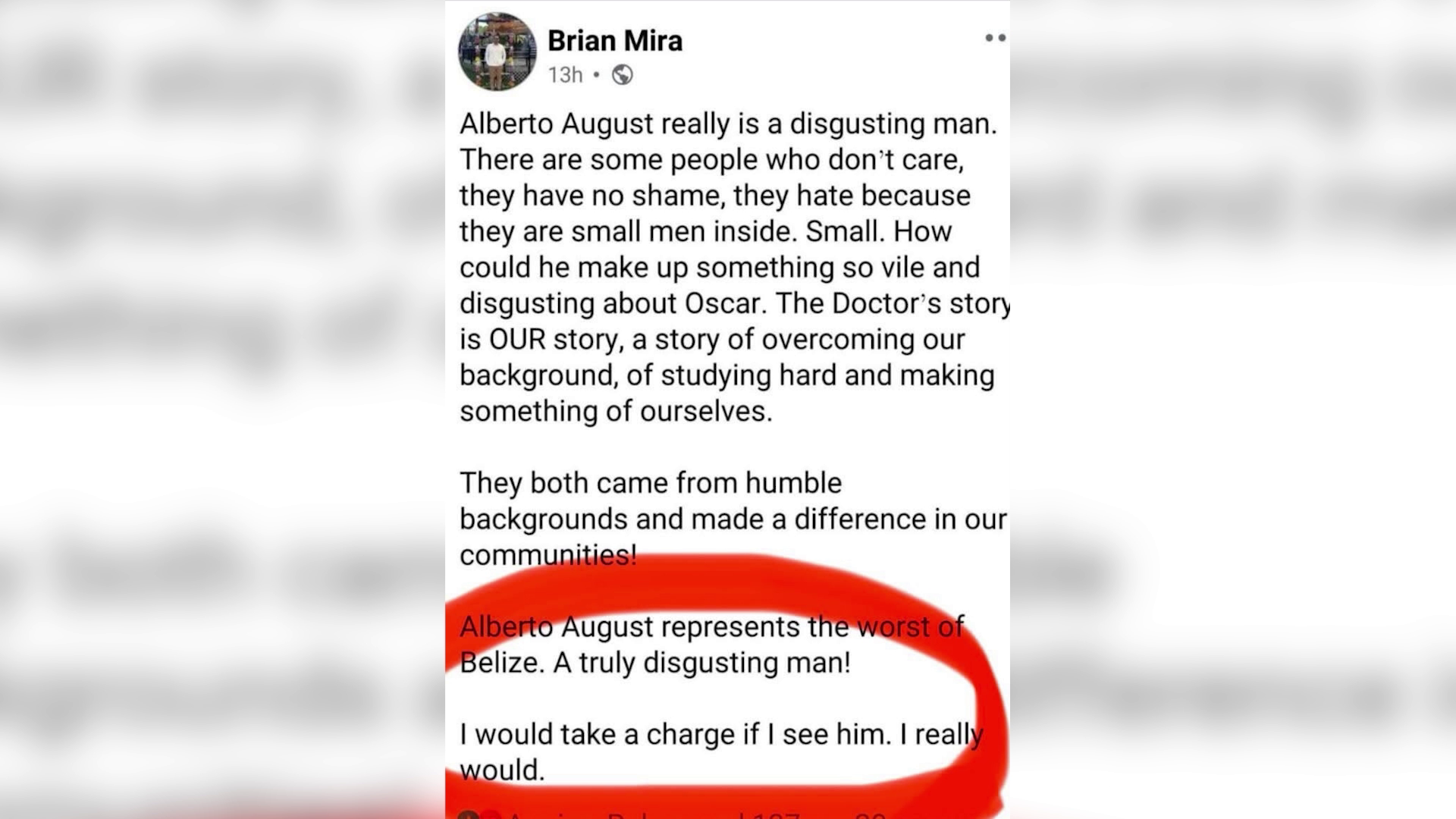
    Beyond the question of whether a satirical post merits criminal charges, Peyrefitte has drawn attention to a stark double standard in how Belizean authorities have approached similar online content, raising serious accusations of selective enforcement. He points to a separate social media post from Brian Mira, Minister Oscar Mira’s brother, that contained a thinly veiled threat of violence against August. In the post, Brian Mira wrote that he would “catch a charge” if he encountered August, a statement widely interpreted as a warning that he would commit a criminal act against the former UDP chairman. While the post was deleted hours after it was published, it remains public record—yet no law enforcement action has been taken against Brian Mira, and he has never been detained, questioned, or charged in connection with the threat.

    August has confirmed that he takes the threat seriously and has implemented additional safety measures to protect himself and his family from potential harm. Peyrefitte argues that the contrasting outcomes of the two incidents expose a deeply troubling imbalance in Belize’s justice system: a satirical political post leads to immediate arrest and criminal prosecution, while an explicit threat of violence against an opposition figure draws no response from authorities at all. “If we locked up every person who says something provocative or offensive on social media, every jail in the country would be overflowing,” Peyrefitte noted, pointing out that many Belizeans have posted far more extreme content online without facing any legal consequences.

    The case has reignited long-simmering concerns about the use of Belize’s Cybercrime Act to target political opposition, with critics arguing that the law is being weaponized to silence dissenting voices rather than address actual cybercrime. Questions about judicial independence and equal application of the law continue to circulate as the criminal case against August moves forward, with observers across Belize watching closely to see how the controversy will impact future discussions of free speech and political fairness in the country.

  • Urgent Plea for Blood After Deadly Gardenia Shooting

    Urgent Plea for Blood After Deadly Gardenia Shooting

    A quiet family gathering in Gardenia Village descended into chaos on a Sunday night in early June 2026, when an unidentified lone gunman opened fire without warning, killing 15-year-old Rackeem Armstrong and leaving his 18-year-old cousin clinging to life. The shooting unfolded shortly after 8 p.m. as the extended family gathered for a community barbecue, sending panicked relatives scrambling for cover as bullets flew, according to initial witness accounts.

  • One Claims Victim, One Charged with Attempted Murder

    One Claims Victim, One Charged with Attempted Murder

    A routine disagreement over vehicle audio repair payments has erupted into a brutal street confrontation in central Belize City, leaving one man hospitalized with life-altering injuries and a local electronics technician behind bars facing attempted murder charges, authorities confirmed this week. The violent clash unfolded at a commercial corner located at the intersection of Baymen Avenue and Saint Joseph Street, where the two men crossed paths by chance after nearly a year of simmering tension over the unfinished repair work.

    According to official police statements, the conflict traces back to a 2025 repair job for a car amplifier and sound deck. Thirty-five-year-old Nelson Nolberto told investigators he had already fulfilled his payment obligation for the work, but disputes over the quality and completion of the job lingered between the two men. When they encountered one another at the downtown Belize City location on the day of the incident, verbal disagreements quickly escalated into physical violence.

    Nolberto’s account alleges that 45-year-old Phillip Goff, the technician who completed the original repair work, retrieved a machete from his personal vehicle and launched an unprovoked attack. The assault left Nolberto with severe chop wounds across his body, including a critical injury to his neck that has placed him in serious medical condition as he receives treatment.

    Following the confrontation, Goff was taken into police custody and arraigned at a local court on June 2, 2026 on three separate charges: attempted murder, use of deadly means of harm, and dangerous harm. During the initial court hearing, Goff did not enter a formal plea. Magistrates denied his application for pre-trial bail, and he has been remanded to the Belize Central Prison, where he will remain in custody until his next scheduled court appearance on July 28, 2026.

    Notably, Goff presented a conflicting narrative of the event during his court appearance. The technician told the court he was actually the initial target of the attack, and that he only wielded the machete in self-defense to protect himself from imminent harm. Law enforcement officials have confirmed that the investigation into the full sequence of events remains ongoing, as investigators work to reconcile the two conflicting accounts and collect physical and witness evidence to clarify what transpired during the confrontation.

  • Garifuna Communities Fighting to Preserve Ownership of Traditional Lands

    Garifuna Communities Fighting to Preserve Ownership of Traditional Lands

    On Belize’s rapidly developing southern coast, a routine government project to map village boundaries has escalated into a high-stakes standoff over Indigenous sovereignty, cultural heritage, and land ownership, as Garifuna leaders warn that the formal demarcation process risks enabling the further loss of traditional territories to foreign investment and large-scale development.

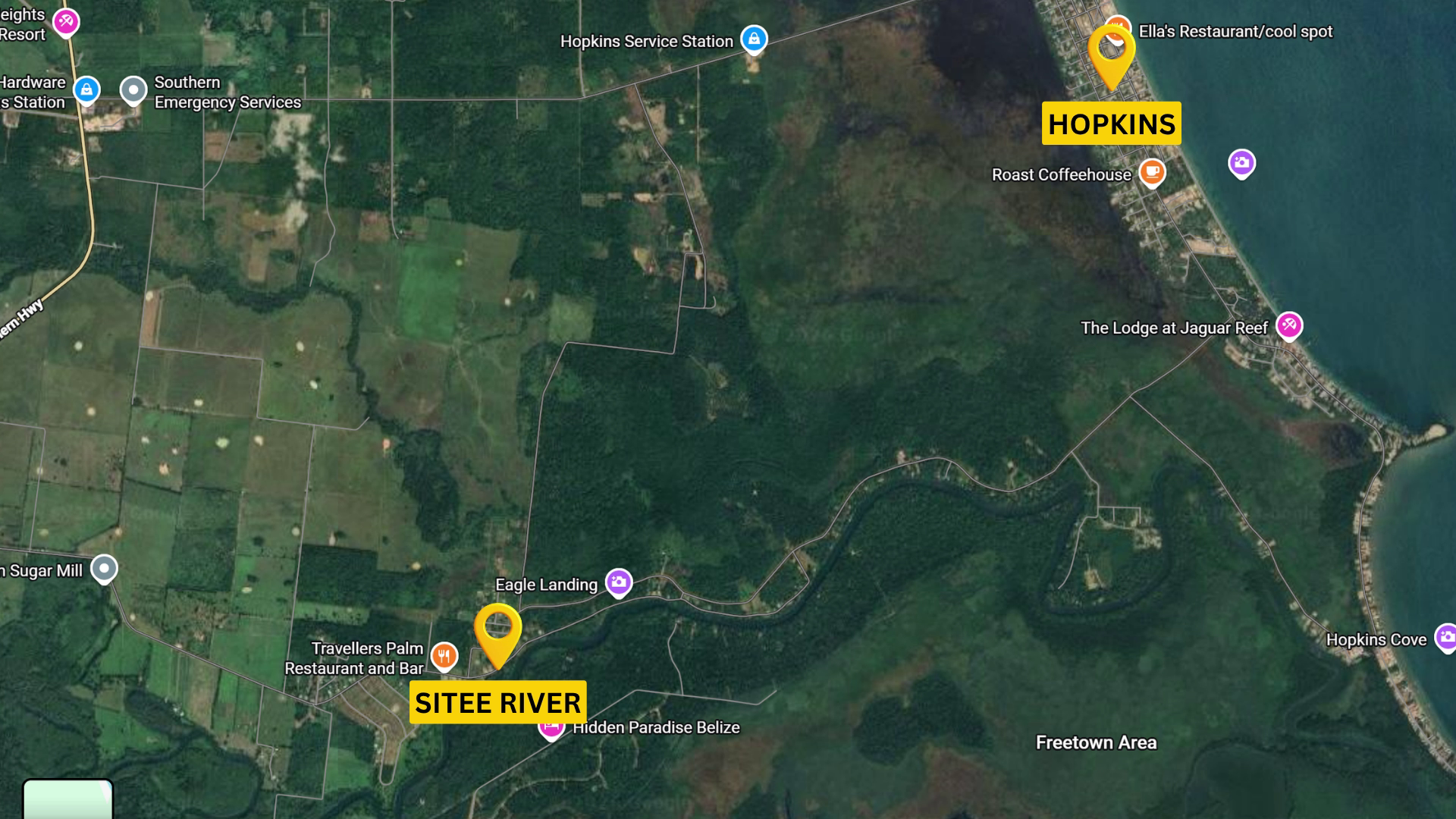
    The Belizean government launched the boundary initiative last October, tasking an independent multi-stakeholder commission with resolving long-running border disputes between neighboring communities along the Placencia Peninsula, including Sittee River and Hopkins, as well as Placencia and Seine Bight. Made up of representatives from government departments including the Elections and Boundaries Commission, the Ministry of Natural Resources, the Attorney General’s Ministry, plus representatives from the judiciary, the National Association of Village Councils, and the private sector, the commission is on track to wrap up its work and submit final recommendations to the government by August or September 2026, per Clifford King, Director of Local Government at Belize’s Ministry of Rural Transformation. King emphasized that while the issues of village boundaries and communal Indigenous land rights are connected, they require separate policy consideration.

    “The matter of village boundaries is in regards to the jurisdiction for a village council,” King explained in an interview. “The matter of communal land is an issue that is now being taken up by the indigenous people of Belize which is a related matter, as I’m saying, but it is a different matter. But again, these are kinds of things that I think the commission will certainly want to understand how they intersect, where they intersect, if they intersect.”

    For the National Garifuna Council, however, the boundary project cannot be decoupled from the broader crisis of land dispossession facing Garifuna communities across Central America. Garifuna people, a group of mixed Indigenous and African descent that has inhabited Belize’s coastlines since well before 1800, have a centuries-long tradition of stewarding land and marine resources in a sustainable, non-exploitative way, according to Ifasina Efunyemi, Assistant Treasurer of the National Garifuna Council. Efunyemi noted that this pattern of dispossession is not unique to Belize, pointing to ongoing displacement of Garifuna communities in neighboring Honduras and Guatemala.

    “After we have been stewards of these lands, and we have been stewards of these lands since before 1800,” Efunyemi said, “here come people now claiming” ownership of territories that have been managed by Garifuna for generations.

    National Garifuna Council President Alex Nolberto echoed this framing, arguing that attempts to separate the boundary mapping process from broader territorial rights are untenable. The organization is now ramping up its advocacy to demand holistic, permanent protection for all traditional Garifuna territories.

    “What I see happening is that they are trying to separate the issues of the territorial, traditional Garifuna territory and this village boundary conversation, and I don’t see how you can separate the two, right? They are one and the same in my view, and hence the reason why now this fight has to be elevated to address Garifuna territory, to look at traditional Garifuna spaces and to protect them,” Nolberto said. “So this has gone beyond a village boundary, in my view, and now it’s time to take the gloves off and deal with this situation with the greatest of surgical precision and holistically once and for all.”

    As the commission works to meet its end-of-year deadline, the stakes of the process extend far beyond lines on a map. For Garifuna communities already grappling with increasing amounts of their traditional coastal land falling into foreign ownership, the commission’s final recommendations will have long-lasting implications for their ability to preserve their cultural identity and retain control of the territories that have sustained their community for more than two centuries.

  • A Legal Defense Fund for Garifuna Land Rights Fight

    A Legal Defense Fund for Garifuna Land Rights Fight

    Decades-long tensions over Garifuna ancestral land rights along Belize’s southern coast are on the verge of a major legal confrontation, prompting the National Garifuna Council (NGC) to take formal action: the launch of a dedicated Legal Defense Fund to resource their upcoming court battle.

    The conflict centers on traditional Garifuna territories in three coastal communities: Hopkins, Sittee River, and Seine Bight. For generations, the Garifuna people have faced gradual displacement and loss of their ancestral lands, a cumulative crisis that has built up over many years rather than emerging suddenly. Now, as the dispute moves toward the judicial system, the NGC has made the strategic decision to crowd-source financial support from both domestic community members and Garifuna diaspora communities spread across the globe.

    Ifasina Efunyemi, Assistant Treasurer of the NGC, framed the initiative as a proven model for Indigenous advocacy, drawing parallels to the successful land rights campaigns waged by Belize’s Maya community. “These issues have not risen overnight, and they will not be solved overnight either,” Efunyemi explained in remarks to local media. “Over time, we have faced tremendous loss and displacement of our traditional lands. This fund gives our people and our allies the chance to stand with us, as we work to protect what land we still hold and restore what rightfully belongs to our traditional communities.” She emphasized that effective legal defense is impossible without sufficient financial backing, making the fund a critical step toward leveling the playing field for the Garifuna claim.

    Alex Nolberto, NGC President, expressed confidence in the campaign’s success, pointing to the large global Garifuna community that can back the effort. “There are more than 300,000 Garinagu both in Belize and across the diaspora, and we are calling on every one of them to contribute and stand with us in this fight,” Nolberto said. “This is not a struggle for only Belize-based Garifuna; it is a fight for the future of our entire people.” Nolberto added that the NGC, as the legally recognized representative body for all Garifuna matters, is mandated to develop a robust formal legal response to competing land claims, a process that requires covering significant costs including legal representation fees. Beyond courtroom proceedings, the fund will also support public education initiatives to spread awareness of the Garifuna land claim, a dispute that traces its origins all the way back to the 1800s.

    Garifuna leaders stress that the battle is about far more than physical territory: it is a fight to safeguard centuries-old Garifuna cultural heritage and secure a sustainable future for coming generations of the Indigenous community. As the legal process moves forward, the NGC intends to continue coordinating closely with its legal team to map out a clear strategy for advancing their claim in the courts.