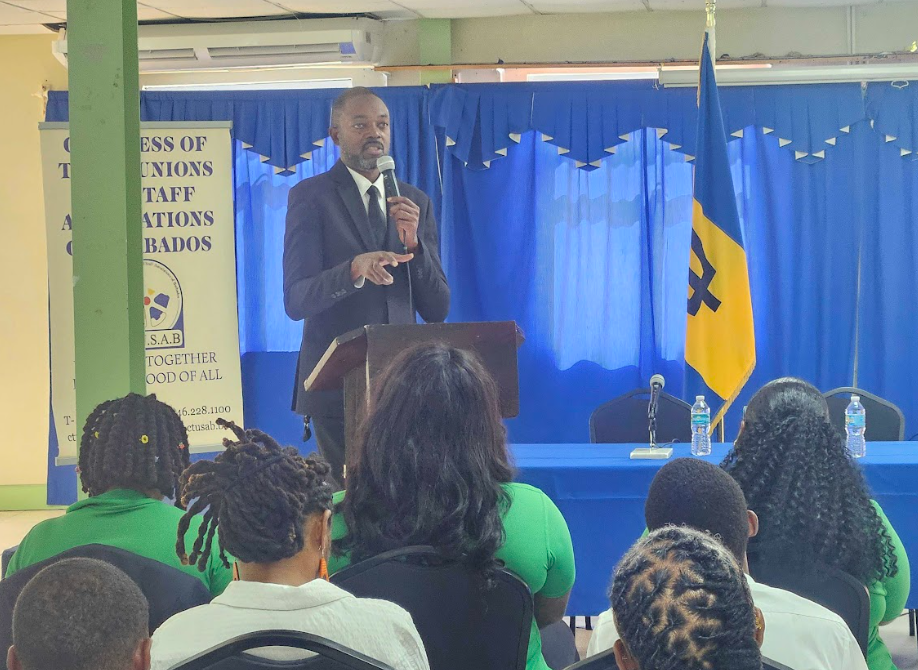
Barbados’ Minister of Labour Colin Jordan has issued a compelling call for policymakers, trade unions, and youth representatives to address the critical tension between workplace flexibility and worker protections in the island’s evolving employment landscape. Speaking at a specialized workshop organized by the Congress of Trade Unions and Staff Associations of Barbados (CTUSAB), Minister Jordan highlighted how modern employment patterns increasingly jeopardize job security and social safeguards for younger workers.
The forum, titled ‘Contract Work and the Future of Youth Employment: Rights, Risks and Real Paths Forward,’ brought together representatives from youth branches of the National Union of Public Workers, Barbados Nurses Association, Caribbean Youth Environment Network, and Barbados Youth Development Council at the NUPW headquarters in St. Michael.
Minister Jordan observed that the traditional model of lifelong employment with a single employer has largely vanished, replaced by short-term contractual arrangements ranging from six to twelve months. While acknowledging that younger workers increasingly prefer these flexible arrangements over rigid traditional systems, he emphasized that this shift must not compromise essential protections.
The minister identified significant challenges arising from this transition, particularly regarding financial planning and credit access. Fixed-term contracts create substantial obstacles for young workers seeking loans for vehicles, homes, or land, as financial institutions traditionally rely on permanent employment status and payslips as stability indicators. Jordan urged including financial institutions in labor policy discussions to address this growing disconnect.
Beyond financial concerns, the minister highlighted issues of job security, career progression, and social protection. Many contract and self-employed workers struggle to maintain consistent contributions to the National Insurance Scheme, potentially leaving them vulnerable without adequate safety nets.
In response to these challenges, the government is developing a comprehensive labor code through Barbados’ Decent Work Country Programme with support from the International Labour Organisation. This modernization effort aims to extend protections beyond traditional employees to encompass contract workers and independent service providers.
Minister Jordan emphasized that employment conditions affect not only individual workers but also their dependents and extended families. He encouraged young people and youth organizations to actively participate in policy consultations, stressing that their input is essential for developing balanced solutions that ensure worker dignity while maintaining business competitiveness.