标签: Bahamas

巴哈马

  • Mitchell tells PLPs ‘give more vouchers’

    Mitchell tells PLPs ‘give more vouchers’

    A political firestorm has erupted in the Bahamas over the distribution of Treasury-financed gift vouchers in Abaco that bear the names of non-government employed Progressive Liberal Party (PLP) election candidates and party officials, with Foreign Affairs Minister Fred Mitchell becoming the first sitting government leader to publicly endorse and defend the controversial program.

    Mitchell’s unapologetic support for the initiative puts him sharply at odds with many within his own party, where multiple PLP figures have privately voiced shock that more than $200,000 in taxpayer money was allocated to the voucher program. Prime Minister Philip Davis has also refused to publicly address the growing controversy, leaving Mitchell’s outlier stance even more notable in the context of intra-party dynamics.

    The decision to attach non-government PLP affiliates’ names to public-funded assistance has sparked intense debate over whether the program violates anti-electioneering laws. The Bahamas’ Parliamentary Elections Act explicitly criminalizes giving, offering, or funding gifts, cash or other benefits with the intent of swaying voter behavior or securing a candidate’s election to Parliament.

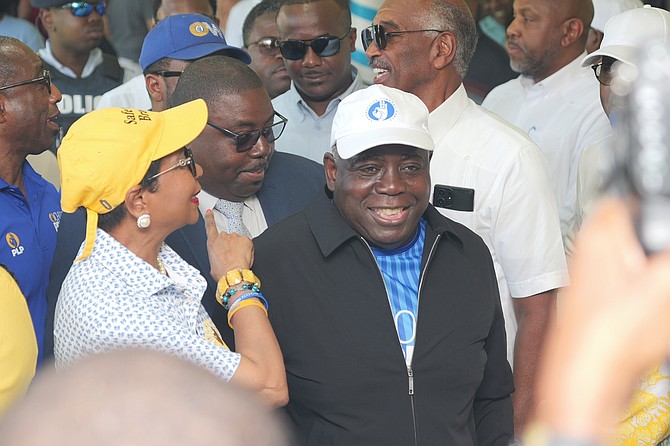
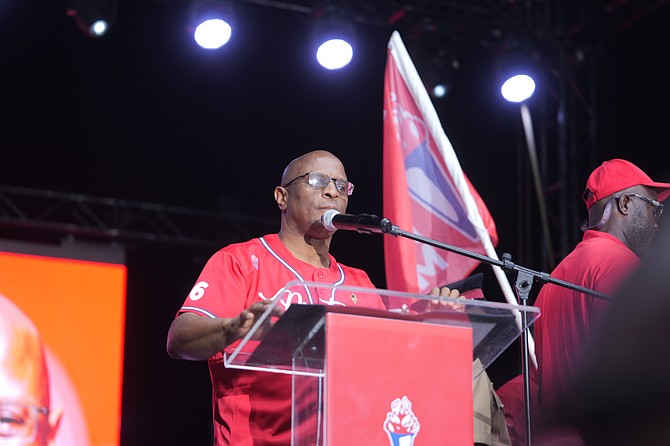
    Speaking at a raucous PLP campaign rally in Bimini Saturday night, Mitchell brushed off widespread criticism from the opposition, arguing that Abaco residents prioritize access to tangible assistance over quibbles over political branding on the vouchers. “Duane Sands is an amazing fella, he is complaining because vouchers were being given out in Abaco and he says the PLP is connected in giving out those vouchers,” Mitchell told the crowd. “Well, let me ask you this, you think the people in Abaco care whose name was on the voucher? They want the vouchers, they want the help, that’s all that is necessary, and I’m happy the PLP is connected with giving out the vouchers. Give out more vouchers, the more vouchers you give out, the better.”

    Mitchell also pivoted to attack the opposition’s own record of ethical missteps, pointing to a past court case involving former opposition figure Frank Smith where a judge cited a multi-million dollar contract awarded to a key prosecution witness. “He has no complaint to make about giving out vouchers and trying to influence voters,” Mitchell said of Sands.

    The foreign minister doubled down on his defense of the program, asserting the entire initiative was ethically sound and framing opposition pushback as a deliberate tactic to halt the PLP’s public outreach work. “The fact is, ladies and gentlemen, there is no offence connected with it,” he said.

    Opposition Free National Movement (FNM) leader Michael Pintard has strongly condemned the Davis administration, accusing the government of breaking national law by using public funds to distribute gift certificates branded with PLP candidates’ names. Pintard has called the action an “egregious” violation of election rules and is pushing for criminal charges to be filed against responsible parties.

    Chris Lleida, chief executive officer of Premier Importers, the firm handling the vouchers, confirmed that the certificates were issued at the formal request of the Bahamas’ Ministry of Finance, confirming the program’s official government backing.

  • PM: New airport to drive Cat Island trade, tourism

    PM: New airport to drive Cat Island trade, tourism

    In a landmark step toward spreading economic prosperity across The Bahamas’ outer Family Islands, officials have formally opened the renovated Arthur’s Town Airport on Cat Island, framing the infrastructure project as a cornerstone of the national government’s strategy to unlock new development outside major population centers.

    Speaking at the official commissioning ceremony, Prime Minister Philip Davis KC—who also serves as the Member of Parliament for Cat Island, Rum Cay and San Salvador—emphasized that the modernized facility will act as a catalyst for increased visitor arrivals, expanded cross-border trade, and new professional opportunities for local residents. He noted that while the government has laid the foundational infrastructure, the direction and benefits of future growth are ultimately in the hands of Cat Island’s community.

    “The opening of this airport will bring more people, more trade and more opportunity, but it is up to you, the people of Cat Island, to determine how you wish to expand that community, how you wish to share that tranquility, and how you wish to seize those opportunities,” Davis told attendees. Framing the project as an intergenerational investment, he added, “All that I’m looking forward to is that a good foundation is laid for the future. This is about the future, so my grandkids can be here to enjoy what I left behind.”

    Deputy Prime Minister Chester Cooper, who also holds portfolios for tourism, investments and aviation, described the upgraded airport as far more than a transportation hub, calling it a gateway to widespread economic renewal for Cat Island’s northern region.

    “This is the kind of investment that changes how people live, how they travel, how they do business and how they see the future of their own island. This airport is a major transformation,” Cooper said. He positioned the Arthur’s Town project as a key component of the most ambitious national airport expansion initiative in The Bahamas’ history, noting that the current administration has already delivered upgraded terminal facilities across multiple Family Islands.

    Infrastructure of this kind, Cooper explained, is the backbone of growing the country’s critical tourism sector and supporting small business expansion across outer islands. “These are not just airports. These are lifelines and engines for opportunity. They help our people move more easily. They help our visitors arrive more safely. They help our businesses grow. They help tourism to thrive,” he said.

    Cooper also confirmed that the project will deliver immediate connectivity gains, with the first scheduled international commercial air service set to launch on May 12. Makers Air will operate direct flights from Florida to Arthur’s Town twice weekly, on Tuesdays and Thursdays, opening direct international access to the island for the first time.

    Clay Sweeting, Bahamas’ Minister of Works and Family Island Affairs, added that the airport’s completion marks a fundamental shift in how the national government approaches infrastructure delivery for outer island communities. For decades, he noted, local residents had to adapt their daily lives and economic activity to inadequate, outdated infrastructure. Now, he said, the government has built infrastructure tailored to serve community needs.

    “Today is not just an opening of an airport. It’s about opening opportunities, because for far too long, Family Island communities like Arthur’s Town have had to work around infrastructure. Today, we are building infrastructure that works for you,” Sweeting said. He added that the improved facility will boost both connectivity and quality of life for local residents, bringing easier access to mainland services, safer travel, and stronger links to national and global markets.

    The opening of Arthur’s Town Airport caps years of planning and investment under the Davis administration’s flagship economic diversification strategy, which prioritizes spreading development beyond Nassau and Freeport to unlock the untapped economic potential of The Bahamas’ smaller outer islands.

  • Long wait times and scenes of confusion plague advanced poll

    Long wait times and scenes of confusion plague advanced poll

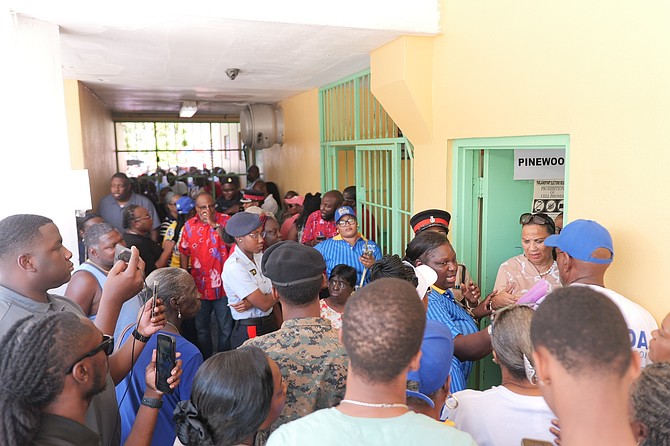
    Long queues, multi-hour wait times, and widespread confusion during the Bahamas’ recent advance poll have thrown the Parliamentary Registration Department (PRD)’s preparedness into sharp question, stoking growing fears that the far larger and more complex general Election Day could face similar catastrophic dysfunction.

    The final ballot of the day was not cast until 10 p.m. – a full four hours after the official scheduled closing time of 6 p.m., marking a dramatic breakdown of the electoral process that unfolded against a backdrop of weeks of criticism from the opposition Free National Movement (FNM). Prior to the advance poll, the ruling government had repeatedly dismissed opposition concerns, defending the PRD’s ability to manage the election. This week’s voting, however, laid bare severe operational strain across polling stations nationwide: some electors waited more than five hours to cast their ballots, while countless others abandoned the process in frustration, and multiple locations kept voting open far past the official close to clear massive backlogs. Even some candidates from the ruling Progressive Liberal Party (PLP) were forced to acknowledge major shortcomings in the advance poll’s organization.

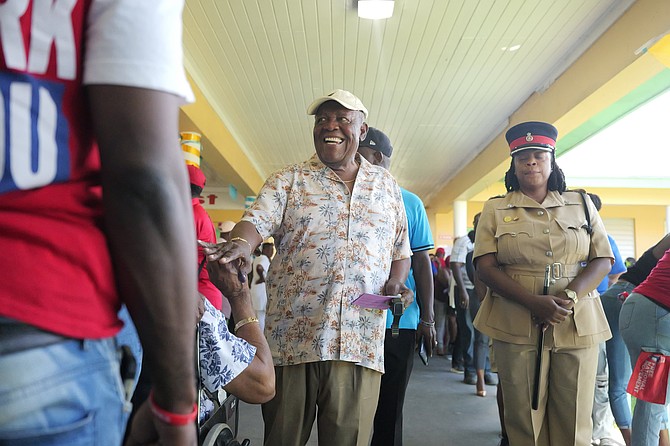
    Prime Minister Philip “Brave” Davis was visibly agitated during a visit to the Sadie Curtis polling location and declined to answer questions from press corps. Former PLP Cabinet minister and MP Leslie Miller, who accompanied Davis, told reporters he waited two and a half hours to vote at the Doris Johnson site, and called for a doubling of available polling space ahead of the general election. “It took me two and a half hours to vote today, okay, tremendous,” Miller said. Several other high-ranking PLP figures including Sebas Bastian, McKell Bonaby, Myles Laroda and Mario Bowleg echoed Miller’s call, noting that more space was urgently needed to reduce crowding, particularly for elderly and disabled voters. Bastian added that the problematic advance poll experience would guide necessary adjustments before Election Day.

    Operational issues were apparent from the moment polls opened at many locations. At Kendal Isaacs Gym, a site serving three major constituencies, delays began immediately when the exit door remained locked at opening, creating a massive bottleneck that sent lines swelling out into surrounding areas. Voter Tavia McIntosh said the check-in process inside the station functioned smoothly, but described the outdoor crowding as totally disorganized. “You see the crowd? It is unorganised,” she said. “I hope it [the general election] doesn’t be like this.” Commissioner of Police Shanta Knowles ultimately traveled to the site to intervene and restore order.

    At Thelma Gibson Primary School, voters reported widespread confusion over directional guidance, with many being sent to multiple wrong locations before finding their correct polling station. Seventy-six-year-old voter Cynthia Sealy told reporters she was redirected twice before reaching the correct spot. Other common complaints across sites focused on a lack of basic amenities for waiting voters, with many electors forced to stand for hours in direct sun without adequate shelter. At the CV Bethel polling location, FNM chairman Dr Duane Sands highlighted extreme overcrowding, noting that one advance polling room had been assigned to nearly 1,200 registered voters. “Perhaps one of the worst situations of the day is Bamboo Town has 1,200 people on the advanced poll, and one room,” Sands said. “One. One. One. So people have been waiting four, five, six hours. Okay?”

    Tensions boiled over at the HO Nash polling site after multiple people were permitted to cut in line, sparking loud protests from waiting voters who decried the process as unfair. Multiple elderly voters suffered medical distress amid the heat and long waits, with at least one voter fainting. A 75-year-old elector abandoned the line after just 45 minutes, saying he could not physically tolerate the conditions, and noted he had never seen such dysfunction in decades of voting. “This ain’t the first election these people been through,” he said. “They been through many and I ain’t never seen it like this.” Another voter, Michelle Dames of Mount Moriah, also left without casting a ballot, calling for systemic changes to better accommodate vulnerable groups. “Somebody just fell out over there from standing so long,” she said. “Even though some persons are trying to provide chairs, that ain’t cutting it.”

    Beyond basic operational management, FNM legal advisor Khalil Parker raised more serious procedural concerns. He pointed to reports of pre-signed ballots and completed counterfoils found before voters arrived at stations, the lack of a properly segregated voter list for advance poll participants, and a last-minute decision to allow electors with approved applications to vote even if their names did not yet appear on the official register. “So now, we have to deal with the fact that there’s going to need to be a reconciliation between those who voted, but were not on the register, and those who voted and were on the register to make sure that when we begin on election day, there is a mitigation or a correction or an updating of the official records at PRD, so that duplicating voters isn’t a substantive concern in that event,” Parker explained. He added that the FNM would demand an urgent meeting with PRD leadership to resolve all outstanding issues before the general election.

    Despite widespread cross-party criticism, the PRD has maintained it remains fully prepared for the upcoming general election, noting that Election Day will feature more polling stations, additional staffing, and expanded logistical support compared to the advance poll. The department acknowledged the delays and confusion, attributing the issues to an “unprecedented” level of voter turnout that outstripped official projections. “This is the first time in Bahamian history that this number of persons has participated in the advance poll, with especially strong participation among elderly voters,” the PRD said in a statement. The department added that it has launched an internal review to identify bottlenecks and will implement targeted adjustments to improve voter flow and inter-agency coordination before Election Day.

    Critics have already pushed back against the PRD’s turnout explanation, however, pointing out that all advance poll participants were required to pre-register, giving election officials an exact, advance count of how many voters were expected to cast ballots on advance polling day.
  • Questions raised over Fox’s conduct in campaign clash

    Questions raised over Fox’s conduct in campaign clash

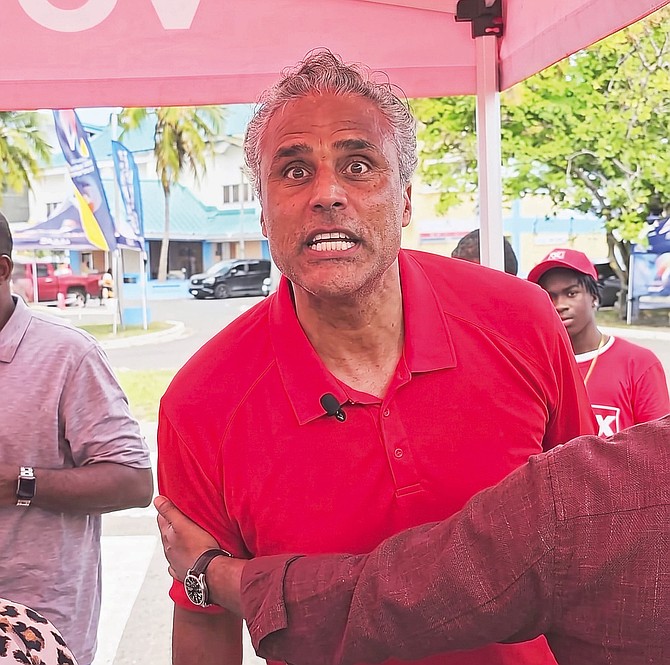
    A viral campaign-season clash has put former NBA player turned parliamentary candidate Rick Fox under intense public and political scrutiny, after circulating footage showed him lunging at a local man during a heated dispute over public space for campaign tents. The confrontation, which unfolded on Wednesday in Garden Hills where Fox is running for a seat as Member of Parliament, sparked widespread debate online after the footage was picked up by major U.S. entertainment outlet TMZ, drawing international attention to the altercation.

    The widely shared video, which circulated publicly one day after the incident, captures the moment tensions boiled over during a disagreement over a pre-reserved spot for a campaign tent. The man involved, wearing a blue-and-yellow long-sleeve shirt, told Fox’s campaign team that he had already claimed the location for his own use. When Fox questioned whether his claim followed local event guidelines, the man dismissed the rules outright with an expletive-laden rejection. In response, Fox moved aggressively toward the man, forcing his campaign manager Carlyle Bethel to physically step in and restrain him as the situation escalated.

    Even as Bethel struggled to hold him back, Fox broke free of his manager’s grip, shouting that the opposing group were nothing but bullies. He then turned toward the person recording the video, flexed his muscles, and issued a public challenge, saying he was “right here for y’all, all day long.” Throughout the rest of the footage, Fox repeatedly labels those involved in the disagreement as bullies, as shouting matches continue between members of both groups.

    In the aftermath of the video going viral, Fox addressed reporters to push back against criticism of his actions, arguing that the circulating footage omitted critical context that preceded the confrontation. He claimed the incident was triggered by the man making violent threats against him, his campaign team, and Bethel specifically, framing his outburst as an act of self-defense and protection for the people working with him. “If you’re going to swear and threaten people’s lives, then I’m going to react. I’m going to defend my team, I’m going to defend myself, I’m going to defend anybody who is in the area,” Fox told reporters, adding that some local actors are accustomed to acting as bullies during campaign season, and that his campaign would not tolerate intimidation tactics. He also claimed that law enforcement had responded to the scene and charged the man involved with criminal offences related to the threats.

    However, official police statements directly contradict Fox’s account of the incident. Chief Superintendent Sheria King, a police department spokesperson, confirmed that no arrests or charges were filed in connection with the confrontation, and no evidence has been brought forward to support Fox’s claim that death threats were made against him or his campaign manager.

    The incident has raised urgent questions about Fox’s temperament and ability to serve in public office, as voters and political observers assess his conduct ahead of the upcoming election. What began as a local dispute over campaign logistics has quickly become a high-profile controversy that could shape voter perceptions of the candidate in the tightly contested Garden Hills race.

  • Davis ducks questions on publicly funded PLP gifts

    Davis ducks questions on publicly funded PLP gifts

    As the Bahamas approaches its upcoming general election, a growing controversy over the misuse of hundreds of thousands in public funds for politically tied Hurricane Dorian relief has put Prime Minister Philip “Brave” Davis under intense scrutiny — and he has repeatedly refused to address questions about the incident.

    The scandal centers on more than $200,000 in taxpayer money that was used to issue gift certificates distributed to residents of Abaco, a island chain still recovering from 2019’s Hurricane Dorian. Critics have alleged the vouchers, which bear the names of candidates and officials from Davis’ ruling Progressive Liberal Party (PLP), amount to criminal vote-buying just two weeks before voters head to the polls.

    When reporters from The Tribune attempted to question the prime minister Wednesday after he cast his vote in advanced polling, Davis declined every request for comment. A prior statement from Davis’ Communications Director Latrae Rahming had indicated the prime minister would address the allegations when speaking to reporters, but that commitment went unfulfilled.

    The exchange unfolded in chaotic fashion outside the Garvin Tynes polling station: Davis was flanked by a crowd of supporters as he exited, and an employee from the Office of the Prime Minister physically blocked the Tribune reporter from continuing to ask questions, while other members of the prime minister’s entourage formed a barrier around him as he walked to his vehicle. Davis, who also holds the cabinet position of Minister of Finance, did not respond to direct questions about whether he personally authorized the public expenditure, and quickly left the area after casting his ballot.

    Before declining to address the voucher controversy, Davis told reporters that his own voting process had gone smoothly, urged all registered residents to cast their ballots, and described early voter turnout as encouraging.

    Details of the voucher program were first reported by The Tribune earlier this week. Chris Lleida, chief executive officer of Premier Importers — the company that issued the gift certificates — confirmed that the entire $200,000+ cost was covered by the Ministry of Finance. Lleida added that the vouchers were requested as part of post-Hurricane Dorian relief initiatives, and issued in denominations of $200, $300, and $500, totaling more than $200,000 in public spending.

    The fact that PLP political candidates and party officials were listed on and involved in distributing the publicly funded vouchers has sparked widespread outrage among political observers and opposition leaders. The timing of the distribution has drawn particular criticism: it comes more than six years after Hurricane Dorian devastated Abaco, and just a fortnight ahead of the national general election.

    Michael Pintard, leader of the opposition Free National Movement (FNM), has called the incident an egregious violation of the law and demanded criminal charges be filed against those responsible. Pintard emphasized that the misuse of public funds for this purpose qualifies as a criminal offense under Bahamian election law, and noted that the situation is made even more serious by the involvement of Bradley Fox Jr, the PLP candidate for Central and South Abaco, who participated in distributing the vouchers despite holding no formal government position.

    Under the Bahamas’ Parliamentary Elections Act, it is a criminal offense to offer, give, or provide any form of money, gift, or benefit to a voter for the purpose of influencing their vote, or rewarding voters for a specific voting outcome. The law also bans providing benefits to sway election results in a candidate’s favor, or to encourage third-party campaign activity on a candidate’s behalf. Additionally, the statute criminalizes funding or knowingly facilitating vote-buying activities, including the provision or reimbursement of funds used for voter bribery.

  • Ingraham calls fake documents ‘alarming’ but doubt stolen vote

    Ingraham calls fake documents ‘alarming’ but doubt stolen vote

    As the Bahamas approaches its upcoming general election, a growing wave of high-profile fraudulent document cases has thrown electoral integrity into the national spotlight, drawing divergent and cautiously worded reactions from the country’s most senior political figures. Former Prime Minister Hubert Ingraham, a stalwart of the opposition Free National Movement (FNM), emerged as one of the most prominent voices sounding the alarm after casting his ballot in the early advance polling. Speaking to reporters immediately after voting, Ingraham described the rising frequency of cases where individuals have been caught with counterfeit passports and voter registration cards as deeply alarming.

    While Ingraham echoed widespread concerns within the FNM that the national voter registry contains serious irregularities—including duplicate entries and incomplete records lacking valid birth dates—he stopped short of endorsing the opposition party’s more extreme claims that the election could be stolen through systematic manipulation. The former prime minister stressed that he does not believe the country’s electoral framework is vulnerable enough to be altered to flip a final election result, and urged all eligible Bahamian voters to turn out to cast their ballots regardless of the ongoing controversy. Still, he emphasized that the scale of fraudulent document access remained a pressing worry. “But I am concerned about how large numbers of people it appears have got access to Bahamian passports and other such documents, and that is a very concerning matter,” Ingraham told reporters. He added that he hopes the irregularities are rooted in bureaucratic incompetence rather than coordinated, intentional wrongdoing meant to skew the election.

    Another former Bahamian prime minister, Perry Christie of the ruling Progressive Liberal Party (PLP), pushed back on the opposition’s framing of the issue yesterday, arguing that existing safeguards built into the country’s electoral system make widespread election fraud effectively unachievable. Christie noted that organized large-scale fraud of the type being discussed by FNM figures has never occurred in the Bahamas’ electoral history, and rejected suggestions that it could take place this cycle. “It’s very difficult, if not next to impossible, to have the kind of fraud that they’re talking about in our voting system here and it hasn’t happened before, it’s not going to happen now,” Christie said. He characterized the focus on fraud as political posturing, noting that parties often elevate issues they believe will resonate with voters to gain an edge ahead of polling day. Christie also pointed to the Bahamas’ longstanding electoral trend—where single parties rarely win consecutive terms in office—as evidence that election results consistently reflect the unmanipulated will of the electorate, rather than tampering.

    The debate over document fraud has intensified in recent months following a string of high-profile arrests linked to counterfeit and improperly obtained identification. The most recent high-profile case came on April 27, when a Dominican national was charged with fraudulently acquiring a Bahamian voter card and multiple Bahamian passports, marking the latest in a series of similar incidents. Less than two weeks prior, on April 15, an employee of the country’s Parliamentary Registration Department was arrested for allegedly assisting a Haitian woman in obtaining an illegal voter identification card, and was found in possession of five blank official voter cards.

    In comments made earlier in April, National Security Minister Wayne Munroe, a member of the ruling PLP, stated that any public official convicted of involvement in passport fraud would face a maximum sentence of up to ten years in prison if the PLP wins a second consecutive term in office. For his part, FNM Leader and opposition chief Michael Pintard has repeatedly raised alarms about the scope of document fraud occurring under the current PLP administration, though he has yet to release a detailed plan outlining what specific policy or regulatory changes his party would implement to address the problem if elected.

  • Wiping BPL bills ‘makes no sense’

    Wiping BPL bills ‘makes no sense’

    A controversial decision by the Davis administration in the Bahamas to clear all outstanding electricity debts for residents of two remote islands has sparked fierce pushback from the country’s former top power utility executive, who is calling the policy inconsistent, unexplained, and potentially a violation of electoral rules.

    Whitney Heastie, who served as Chief Executive Officer of Bahamas Power and Light (BPL) until his 2022 resignation, has publicly rejected the government’s official justification for wiping the slate clean for Grand Cay and Moore’s Island residents. The move came shortly after Prime Minister Philip Davis toured the two islands and made a public promise of targeted relief to local households, with some residents confirming their accumulated debts – which reached as high as $13,500 for individual properties – were suddenly reduced to zero on their billing statements.

    Officials with the Davis administration have defended the debt cancellation by pointing to widespread financial and operational disruptions sparked by two major crises: 2019’s Hurricane Dorian, which devastated large swathes of the Bahamas, and the subsequent COVID-19 pandemic. The government claims that normal billing and debt collection processes were completely suspended throughout this period, as residents struggled with limited access to banking services, widespread travel restrictions, and crippled local business activity. The administration also has asserted that the preceding government had informally promised residents they would not be required to pay off accrued balances during the crisis, even as those debts continued to accumulate in BPL’s billing system.

    Heastie, who led BPL through the post-Dorian and early pandemic recovery, flatly denies this narrative. He insists that BPL’s board of directors never issued any directive to permanently forgive the outstanding debts of residents on either island. Instead, he says, the established policy at the time was a structured relief program that allowed for the postponement of arrears, while requiring households to stay current on all new monthly electricity charges.

    “The framework we put in place was straightforward: residents kept up with their current bills, and worked out a staggered payment plan to pay down back balances over time,” Heastie explained. “I don’t recall the exact timeline for deferral – whether it was 90 days, 120 days, or custom arrangements for individual households – but the core rule was always current bills had to be paid to keep service active while arrears were paid down gradually.”

    Beyond disputing the government’s background narrative, Heastie has raised two major unresolved questions about the timing and scope of the relief. First, he questions why the Davis administration chose to act on the debt issue now, years after taking office, rather than addressing it earlier in its term. Second, he argues that the selective relief for Grand Cay and Moore’s Island makes no sense when far larger communities on the Abaco mainland and East Grand Bahama suffered far more devastating damage during Hurricane Dorian, requiring a complete rebuild of BPL’s entire transmission and distribution network in northern Abaco.

    “If the government’s goal is to forgive all post-Dorian debt, why single out these two small island communities?” Heastie asked. “Why not extend the same relief to the thousands of households on the Abaco mainland that lost everything when the hurricane hit? I would have expected the government to step in for East Grand Bahama residents the same way they did for these cays.”

    Former Bahamian Works Minister Desmond Bannister has backed Heastie’s account of the previous administration’s policy, confirming that no formal or informal directive to forgive resident debts was ever issued. Bannister added that only the sitting prime minister or works minister could have authorized such a sweeping policy, and no such authorization was ever made.

    The Bahamian government has only offered vague details of how the debt forgiveness will be funded, saying only that eligible outstanding balances will be absorbed through an offsetting financial arrangement with BPL. Heastie has cast doubt on the sustainability of this plan, noting that BPL was already barely breaking even when he left the CEO post in 2022.

    “Nothing in public finance is free,” Heastie said. “If BPL is on the hook for these tens of thousands of dollars in forgiven debt, how can a company already operating on thin margins absorb that cost?”

    The sudden, targeted relief has also fueled widespread allegations of vote buying ahead of upcoming parliamentary elections. Critics point to clear provisions in the Bahamas’ Parliamentary Elections Act that prohibit any form of financial inducement intended to sway voter behavior. Bannister, a longtime political figure, called this election the worst he has ever witnessed for improper political handouts, saying social media platforms have been flooded with competing politicians one-upping each other with promises of financial gifts to voters.

    “What many politicians and even voters don’t seem to recognize is that these handouts cheapen the value of every vote, and create long-term, serious damage to the integrity of public policy in this country,” Bannister added.

  • Sebas reveals over 20 government contracts in election public filing

    Sebas reveals over 20 government contracts in election public filing

    As candidates vying for parliamentary seats in the Bahamas move to meet mandatory constitutional transparency rules, a comprehensive look at Sebas Bastian’s declared business interests has revealed an extensive network of over 20 active contracts and lease agreements with multiple Bahamian government agencies, as the aspiring Fort District MP positions himself for election.

    The mandatory disclosures, required under Article 48 of the Bahamian Constitution, demand that all political candidates publicly declare any direct or indirect financial interests tied to government work to prevent conflicts of interest. Bastian’s filing is among a series of similar public releases from senior ruling party figures, including Deputy Prime Minister Chester Cooper, who is also standing for election.
    Bastian’s declaration details both direct and indirect holdings spanning multiple core sectors of the Bahamian public sector. Direct arrangements include service agreements with Bahamas Power & Light (BPL), the Water & Sewerage Corporation, and the National Insurance Board for utility and employment-linked social insurance services. Beyond core service provisions, the filing outlines multiple commercial lease agreements that see Bastian-linked entities rent out office and warehouse space to major public bodies, including the Public Hospitals Authority, the National Insurance Board, and the Bahamas Bureau of Standards.
    Among the most substantial contracts listed are vehicle lease agreements tied to Bastian-controlled EV Motors Ltd. The company holds multi-year leases of up to 60 months with three public entities: the Ministry of Finance, BPL, and Bahamas Telecommunications Company (BTC). The single largest contract is an agreement to lease 62 vehicles to the Ministry of Finance, a major commitment for the public finance body.
    Insurance brokerage represents another key line of Bastian’s government-linked business, handled through his BMGIA Insurance Ltd. The firm acts as the broker of record for a range of public sector entities, from the Civil Aviation Authority and Ministry of Tourism to the Public Hospitals Authority, Nassau Flight Services, Sandilands Rehabilitation Centre, and the Bahamas Union of Teachers.
    The declaration also includes a 2022 heads of agreement linked to Bastian’s Venetian Village Holdings Ltd and its affiliate entities, granting a 20-year concession for the $200 million Venetian Village development project in western New Providence, a large-scale commercial and residential development previously reported by local business media. The filing also references a separate construction contract with the Ministry of Works and Family Island Affairs to build a public access road connected to the development project.
    In a rare added note to his declaration, included to reinforce his commitment to transparency, Bastian clarified that a large portion of assets connected to his family are held in pre-existing trusts valued at approximately $160 million, over which he holds no formal control. In his personal filing, Bastian declared a total of $28,945,545 in personal assets, $930,000 in annual income, and just $175,000 in outstanding liabilities, placing him among the candidates with the highest declared personal wealth in this election cycle. He explained that he is only a discretionary beneficiary of the trusts, holding no legal ownership or controlling interest over the assets, and thus is not required to include the $160 million in trust holdings in his personal asset declaration.
    Turning to other senior candidates, Deputy Prime Minister Chester Cooper’s own declaration revealed holdings in office space rental agreements and insurance-linked arrangements with multiple public entities, including the Ministry of Foreign Affairs, Nassau Airport Development Company, the Education Loan Authority, and the Disaster Risk Management Authority. Cooper, who is a principal owner of BAF Financial & Insurance (Bahamas) — the rebranded former British American Insurance Company of the Bahamas — has declared a current net worth of $28 million, a sharp increase from his 2021 declaration of $14.8 million and 2017 declaration of $7.9 million.
    Other candidates across the country have also filed their required disclosures, revealing their own government-linked business interests. Edward Whan II, the candidate for Marco City, has declared janitorial service contracts covering 14 different public locations, alongside warehouse and office rental agreements with Control Chemicals Freeport Ltd, Grand Bahama Health Services/Public Hospitals Authority, and the Ministry of Public Service. These contracts are set to run from July 2025 through June 2030. Whan II also disclosed a financial stake in Cash N Go Ltd, a company that holds debt collection service agreements with major public agencies including BTC, BPL, the Water & Sewerage Corporation, Bahamasair, Bahamas Immigration, and DigiPay.

  • Man shot and killed in Mount Pleasant ambush

    Man shot and killed in Mount Pleasant ambush

    A shocking act of gun violence has shaken the close-knit Mount Pleasant neighborhood, after a middle-aged man was killed in an ambush attack directly outside his residence on Monday evening. Local law enforcement confirmed that the victim, believed to be in his 40s, was gunned down by unidentified attackers who waited for him to leave his property.

    Emergency radio dispatches brought police cruisers to the Hamilton Road location within minutes of the first 911 calls placed shortly after 7 p.m. When first responding officers reached the scene, they discovered the victim unresponsive on the ground, with clear visible wounds from multiple gunshots. Emergency medical teams pronounced the man dead at the scene not long after their arrival.

    Early investigative findings paint a clear picture of the pre-planned attack: as the victim stepped out of his home, a small Japanese-made vehicle carrying the gunmen pulled up alongside the curb. The attackers immediately opened fire on the target before fleeing the area, leaving the man fatally wounded. No suspects have been named or arrested as of the latest update.

    Chief Superintendent Sheria King, the lead law enforcement official on the case, told reporters that investigators have not yet confirmed whether the victim had prior ties or interactions with police. She confirmed that the active investigation remains ongoing, with detectives working to trace the vehicle, identify the gunmen, and uncover a potential motive for the killing.

    The violence drew a prominent local political figure to the scene: Shanendon Cartwright, Deputy Leader of the Free National Movement and the party’s candidate for the St James constituency, arrived to speak with investigators and extend his sympathy to the victim’s grieving family. Cartwright, who has personal ties to the community and the victim, noted that the killing had deeply affected the entire area.

    “I grew up out here in Mount Pleasant. I knew the family personally and the person who was killed tonight, I knew him personally,” Cartwright told assembled reporters at the scene. “This really hit home tonight. This does not happen in a small community like Mount Pleasant village so this is something that has really touched the heart of every community and it is felt by every home here in Mount Pleasant.”

    According to ongoing murder tracking maintained by the Tribune, this fatal shooting marks the 22nd homicide recorded in the country so far this year, bringing the national violence toll to a new milestone that will likely reignite conversations about public safety and gun control in the region.

  • Pintard calls for arrests over $200k gift certificates

    Pintard calls for arrests over $200k gift certificates

    A brewing political scandal in the Bahamas has put the ruling Progressive Liberal Party (PLP) administration under intense scrutiny, after opposition Free National Movement leader Michael Pintard launched a scathing accusation that the Davis government broke national law by diverting public funds to distribute Hurricane Dorian relief gift certificates branded with PLP election candidates’ names. Pintard has labeled the action “egregious” and is calling for formal criminal charges to be filed against those responsible.

    The controversy stems from an earlier Tribune report that confirmed the Ministry of Finance covered the cost of gift certificates distributed to residents of Abaco, designated as post-Hurricane Dorian disaster relief, which bore the signatures of sitting PLP candidates and party officials. Chris Lleida, chief executive officer of Premier Importers – the entity that issued the vouchers – confirmed the distribution was carried out at the explicit request of the Ministry of Finance. Records show the total value of the distributed vouchers exceeds $200,000, with individual certificates issued in denominations of $200, $300 and $500.

    As of press time, Office of the Prime Minister representatives have not issued an official public response to the allegations. When contacted for comment, Communications Director Latrae Rahming confirmed that Prime Minister Philip Davis will address the matter with reporters at a future, unspecified date.

    Pintard argued that the misuse of taxpayer funds for this purpose constitutes a clear criminal offence under Bahamian law. “It is a crime because you’re using government funds for a narrow political perspective,” he stated, adding that “somebody to pay the price” for the violation. He drew a direct parallel between the current controversy and the so-called “Bermuda scandal”, a previous incident where a PLP delegation trip was initially funded through the Public Treasury before the party reimbursed the cost.

    The opposition leader further claimed that the scale of the $200,000 expenditure far exceeds the spending authority granted to the financial secretary, meaning the final approval for the spending would have required sign-off from Prime Minister Davis himself. He added that the situation becomes “even more egregious” with the involvement of Bradley Fox Jr, the PLP’s candidate for Central and South Abaco, who participated in distributing the vouchers despite holding no official government position.

    Voucher copies obtained by The Tribune show the e-vouchers distributed to local residents were signed by both Fox and Preston Roberts, the PLP’s national campaign coordinator who also serves as a board member of the government’s Disaster Reconstruction Authority. “You’re talking about somebody who has no standing in government at all and so on multiple levels, this is wrong,” Pintard said. “Somebody should be held to account, and charges should be brought against them or the sanctions, whatever the sanctions are, as outlined in the law, those sanctions should be carried out.”

    Under the Bahamas’ Parliamentary Elections Act, offering or distributing money, gifts or other benefits to voters to influence their ballot choice, reward specific voting behavior, or secure a candidate’s election is classified as a criminal offence. The law also penalizes anyone who funds or knowingly facilitates these activities, including the provision of funds intended for electoral bribery.

    Critics point out that the incident highlights a longstanding gap in Bahamian election regulation: the country still lacks a comprehensive, enforceable campaign finance framework. There are no binding, clear rules requiring full public disclosure of political campaign spending, nor formal regulations governing the use of public resources during election cycles. Both of the Bahamas’ major political parties have repeatedly pledged to implement a robust campaign finance system over the years, but none have followed through on that promise to date.