博客

  • Police ready for anything

    Police ready for anything

    For the first time since a 2024 cancellation driven by national security fears, Trinidad and Tobago is poised to host its full traditional 64th Independence Day celebrations on Monday, with law enforcement and defense officials confirming robust security plans are in place following a updated threat assessment that rated potential risks as “very low”.

    Trinidad and Tobago Police Service (TTPS) Commissioner Allister Guevarro announced the force’s preparedness to address any unforeseen situation during the national holiday, speaking to reporters Saturday following a full dress rehearsal at Port of Spain’s Queen’s Park Savannah, the traditional event venue. In total, 222 uniformed officers will be deployed directly to the main Independence Day parade, with more than 400 additional personnel assigned to contingency response and support roles across all event sites.

    Last year’s holiday looked drastically different: the national government scrapped the customary military parade, official state functions, and public fireworks displays after declaring a national state of emergency. The Ministry of Homeland Security justified the move with intelligence indicating a concrete threat to senior state officials, law enforcement personnel, and gathered crowds at the Savannah venue. To replace the canceled celebrations, officials hosted a National Day of Prayer and Reflection, and only permitted limited silent private fireworks displays. The 2024 cancellation was also projected to cut $2.6 million in public spending, with savings redirected to national crime-fighting initiatives — a decision that drew sharp criticism from Opposition Leader Pennelope Beckles, who questioned the government’s conflicting security messaging after the Prime Minister claimed just days earlier that citizens were safer than ever.

    Looking ahead to Monday’s events, Guevarro confirmed officers will be posted along the entire ceremonial parade route and at the evening cultural festival, with all traffic and parking rules enforced under two formal legal notices. Legal Notice 671 governs road and parking restrictions for the Independence Day parade, while Legal Notice 661 covers overlapping restrictions for ongoing Caribbean Premier League (CPL) cricket matches being held in the city this week. Restrictions vary by location and event, Guevarro emphasized, with the entire Savannah closed to all parking from 6 a.m. Monday through 2 a.m. Tuesday. He added that on-site officers will manage all traffic flow, and urged motorists and attendees to comply with all direction from personnel to avoid disruptions.

    TTPS’s security strategy for the celebrations centers on three core pillars: professionalism, visible presence, and event facilitation. Guevarro moved to reassure the public that all branches of national security are fully positioned to deliver one of the safest Independence Day parades in the nation’s recent history. Deputy Commissioner Suzette Martin, Gold Commander for the event, added that all entry and exit points to the Savannah will be strictly managed by law enforcement, and reminded attendees to check official TTPS communications and the full text of the legal notices for up-to-date details on restriction timelines for both Independence Day events and CPL matches.

    The Trinidad and Tobago Defence Force has already completed its final parade rehearsal, which continued uninterrupted even amid heavy rainfall Saturday. All armed and unarmed detachments took part in the practice run, said Defence Force public relations officer Lieutenant Sherron Manswell. This year marks a break from tradition: Chief of Defence Staff Commodore Don Polo will serve as parade commander, leading the procession on horseback, a role that has historically been filled by officers from other Defence Force formations. President Christine Kangaloo, the nation’s Commander-in-Chief, will formally inspect the parade, which will also include contingents from national protective services, youth organizations, and volunteer groups. Manswell framed the inclusive procession as a visible demonstration of national unity, saying the event offers an opportunity to share the nation’s story and its independent legacy with all citizens.

    Following the parade, the Ministry of Culture and Community Development will host a public cultural program at the Savannah starting at 5 p.m., featuring a dedicated children’s zone, performances from local artists, and family-friendly entertainment. Public fireworks displays will be held in Port of Spain at 6 p.m. and in San Fernando at 8 p.m. Ministry communications strategist Jerome Lewis urged attendees to plan ahead, comply with parking rules, follow law enforcement direction, and monitor updates on road closures to avoid traffic delays.

    Guevarro emphasized that this year’s celebrations are designed to bring together national security bodies and the Trinidad and Tobago public. His message for the nation ahead of the holiday centered on collective unity: “One celebration, unity of the national security forces, unity in Trinidad and Tobago.”

  • Iran stelt voorwaarden voor heropening Straat van Hormuz, diplomaten bemiddelen

    Iran stelt voorwaarden voor heropening Straat van Hormuz, diplomaten bemiddelen

    Tensions surrounding one of the world’s most critical strategic waterways, the Strait of Hormuz, remain locked in a volatile deadlock this week, after Iran’s top security official confirmed Tehran is drafting a formal list of preconditions to reopen the key passage. The announcement comes as Qatar, Oman and Pakistan work behind the scenes to broker a return to negotiations between Washington and Tehran, marking the latest chapter in a months-long standoff that has shaken global energy security.

    Mohsen Rezaei, secretary of Iran’s Supreme National Security Council, laid out the first of Tehran’s core demands on Thursday: an end to ongoing regional armed conflict. During a recent visit to Tehran by Qatari Prime Minister Sheikh Mohammed bin Abdulrahman Al Thani, senior officials from both sides discussed a range of confidence-building proposals, including a temporary temporary maritime transit corridor through the strait and a joint multinational mine-clearing initiative. According to regional diplomatic sources, Iran and Oman have already reached a preliminary agreement on a split corridor that would run through both nations’ territorial waters, allowing commercial vessels to use a central channel for transit if the U.S. meets all of Iran’s outlined demands.

    A separate statement from a spokesperson for the Islamic Revolutionary Guard Corps (IRGC) expanded on Iran’s requirements, clarifying that full reopening would only go forward after the U.S. lifts its ongoing blockade of Iranian ports, pays reparations for war-related damage inflicted on Iranian infrastructure and assets, and rolls back all sweeping economic sanctions imposed on Tehran.

    The strait has been effectively closed to most commercial traffic since February, when Iran made the decision to block passage following a joint bombing campaign targeting Iranian positions carried out by the U.S. and Israel. A brief, temporary reopening was brokered in June via a Memorandum of Understanding (MoU): under the terms of the deal, Iran committed to clearing maritime mines and allowing vessels free passage, while the U.S. agreed to lift its port blockade and ease some sanctions. However, Tehran quickly reversed course and reclosed the strait within weeks, accusing Washington of failing to uphold its end of the agreement.

    Speaking at the White House on the same day Rezaei made his announcement, former U.S. President Donald Trump claimed the strait is already “open for business”, asserting that U.S. military forces have already completed full mine-clearing operations in the waterway. He added that the White House sees no urgent need to restart formal negotiations with Tehran. A senior anonymous U.S. administration source later confirmed to reporters that the existing blockade of Iranian ports remains fully in place, and no official talks with Iranian representatives are currently scheduled.

    The standoff leaves the strategic waterway in a state of persistent uncertainty, as regional diplomats scramble to find a diplomatic off-ramp amid escalating mutual demands and deep-seated distrust between Washington and Tehran. More than 20% of global oil shipments pass through the strait on a daily basis, meaning any prolonged closure carries significant risks for global energy markets and economic stability worldwide.

  • Asabina wil grondige evaluatie fiscale afspraken met goudmultinationals

    Asabina wil grondige evaluatie fiscale afspraken met goudmultinationals

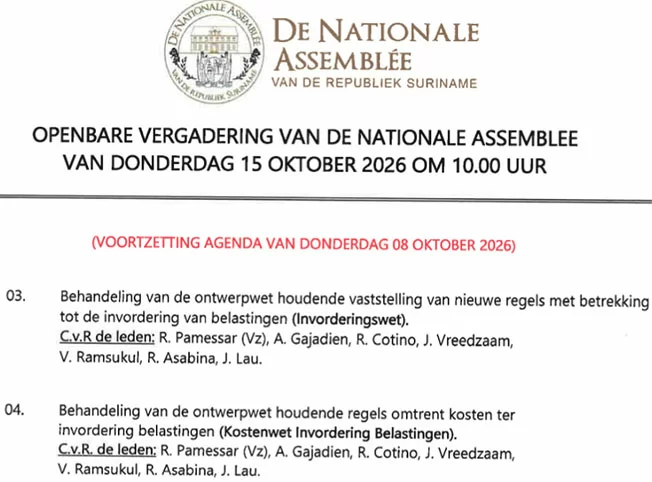
    During parliamentary debates on Suriname’s new General Tax Law, Ronny Asabina, parliamentary faction leader of the BEP party, has made a urgent, high-stakes call for the Surinamese government to launch a comprehensive re-evaluation of all existing contracts between the state and large multinational gold mining operators operating in the country.

    Asabina framed his demand within the broader context of ongoing national tax system reform, arguing that addressing tax avoidance and evasion cannot only target individual taxpayers and small local businesses. Long-standing fiscal agreements between Suriname and international mining giants must also be brought under rigorous scrutiny, he emphasized.

    The BEP leader warned that complex cross-border corporate and accounting structures are commonly used by multinational firms to shift profits generated in Suriname to offshore jurisdictions, depriving the country of critical public revenue. Critically, Asabina noted that Suriname currently lacks clear data on how much tax income it loses to these practices, stating bluntly, “We have no idea how much revenue we are missing out on.” To close this gap, he pushed the government to conduct a full, in-depth audit of all existing gold sector contracts.

    Asabina drew specific attention to fiscal clauses governing withholding tax on payments made by gold mining companies to foreign service providers. He pressed the government to confirm whether regular, rigorous audits are carried out to verify that required tax amounts are correctly withheld and remitted to the state treasury, and also called for clarity on how these existing special fiscal arrangements align with the new General Tax Law currently under parliamentary consideration.

    While he acknowledged that attracting and retaining foreign direct investment remains a key priority for Suriname’s developing economy, Asabina rejected the long-standing practice of giving preferential, soft treatment to multinational corporations. He argued that investment promotion must never come at the cost of weak oversight of companies’ fiscal obligations.

    Beyond tax compliance, Asabina also raised sharp questions about the Surinamese government’s failure to exercise its rights properly as a co-shareholder in major gold mining operations, pointing to Newmont Suriname as a key example. He argued that the state should not passively rely only on the public information published by the company, but must actively conduct independent, thorough reviews of the firm’s annual financial statements, full operating results, revenue streams, expenditure, investment plans and final profit distributions.

    “As a shareholder, I don’t just sit back and listen to what the company tells me,” Asabina said, asking how many independent financial experts the state has actually deployed to audit the multinational miners’ annual reports. He added that the state must also exercise close oversight over large-scale investment projects announced by gold companies, because investment costs directly impact final financial results – and therefore the revenues the state is owed from its equity stake.

    Asabina also linked the demand for greater oversight to tangible benefits for local communities living in mining regions. He cited the existing development fund for the Saramacca community, which has delivered tangible improvements including funding for education infrastructure in Brokopondo, as proof that fair, well-enforced natural resource contracts can deliver widespread public good.

    Against this backdrop, Asabina argued that the ongoing process of national tax system reform presents an ideal, timely opportunity to re-examine all existing fiscal agreements between Suriname and multinational mining firms. The government, he said, must be able to clearly demonstrate that Suriname is actually collecting every cent of revenue it is legally entitled to under existing contracts and national tax legislation.

  • OM geeft toestemming voor inzet Nederlandse reddingshonden bij zoektocht Leysner

    OM geeft toestemming voor inzet Nederlandse reddingshonden bij zoektocht Leysner

    On August 29, Suriname’s Public Prosecution Service (Openbaar Ministerie, OM) announced it has no objections to deploying specialized search and rescue dogs from the Netherlands to support the ongoing criminal investigation into missing person Rodney Leysner. The greenlight for the canine team comes after months of formal requests from Leysner’s family, who have pushed for additional resources to advance the stalled search operation.

    Under the terms of the approval, the entire search mission will remain under the full leadership and on-site supervision of the Korps Politie Suriname (KPS), Suriname’s national police force. The request to bring in the Dutch team was first submitted to OM through a senior police inspector, following the family’s outreach for international support.

    An internal review conducted by OM confirmed that the Dutch organization behind the canine unit, Stichting Reddingshonden RHWW, is a legitimate volunteer non-profit focused exclusively on locating missing persons across domestic and international sites. The organization’s track record and non-partisan mission cleared the way for OM to drop any potential objections to its involvement.

    Several binding conditions accompany the approval to uphold the integrity of the criminal investigation. Dutch handlers will only be responsible for conducting careful, methodical search operations, and any unusual findings or developments must be immediately reported to the on-duty KPS lead officer at the search site. Critically, all travel, logistics, and operational costs associated with deploying the search dogs will be covered entirely by Leysner’s family, the requesting party.

    This formal approval from OM opens the official door for the Dutch canine unit to join the next phase of search efforts for Leysner, bringing additional specialized tracking capabilities to an investigation that has continued to draw public and official attention in both Suriname and the Netherlands.

  • Jeugdcongres moet voorstellen opleveren voor nieuw jeugdbeleid

    Jeugdcongres moet voorstellen opleveren voor nieuw jeugdbeleid

    Two days of collaborative discussions between young Surinamese representatives and top government leaders wrapped up this weekend, as the country’s first-ever National Youth Congress works to turn grassroots youth ideas into formal national policy. Held at the nation’s Congress Hall under the central theme “Youth Build Suriname”, the event brought together delegates from all 10 of Suriname’s administrative districts, who spent days working through targeted solutions to the most pressing challenges facing young people across the country. The final outcomes of the congress will be compiled into a formal Youth Declaration, which will be officially presented to the Surinamese government for consideration.

  • PUP Prepares for Fiercely Contested Belize City Convention

    PUP Prepares for Fiercely Contested Belize City Convention

    With just 48 hours remaining until the People’s United Party (PUP) Belize City leadership convention, the outcome of the party’s mayoral nomination race rests entirely in the hands of fewer than 800 registered party delegates. What is already being billed as the most competitive internal PUP contest of the 2026 election cycle has come down to a head-to-head battle between incumbent Deputy Mayor Eluide Miller and three-term Councilor Allan Pollard, while 19 hopefuls compete for just 10 available councilor spots on the party’s general election slate. On August 28, News Five reporter Shane Williams spoke with both mayoral candidates about their final campaign pushes, and got an update from PUP leadership on preparations for what the party promises will be a smooth, transparent, and orderly voting process.

    Allan Pollard, a long-serving city councilor and former deputy mayor, has centered his campaign around his deep, long-standing ties to working-class Belize City residents, framing himself as the “common man’s candidate” with deep roots in the community. A native of South Side Belize City, Pollard argues that his decades of public engagement and accessibility to constituents have positioned him as the strongest contender to lead the PUP ticket into the March 3, 2027 general municipal election, where the PUP is widely favored to win control of Belize City government.

    “A lot of people are familiar with my journey. They know how challenging it has been over time, with the different advances and the setbacks, and being able to come here and now participate in this convention to right some of the wrongs that has happened in the past,” Pollard explained in an interview with News Five. “I think that has helped a lot. And also just that access, that accessibility that people have to me. I’m from the city. I’m always engaged in the community. So for me it’s really just building on the relationships that we have already made in the past and of course making sure that people turn out to vote at the end of the day.”

    His opponent, Deputy Mayor Eluide Miller, offers a vastly different career trajectory that he says makes him the best prepared candidate to take the helm at City Hall. Miller climbed the ranks of municipal governance from entry level, joining the council as an intern in 2019 before moving into a full-time staff role, then winning a councilor seat in 2024 and ultimately being elevated to deputy mayor. Miller is leaning into his hands-on experience at every level of city government and strong internal party support to convince delegates he is ready to lead.

    “I think my journey through the city council is a quite unique one,” Miller noted. “I came into this council back in 2019 as an intern and I think my years of service has shown constant growth and elevation through the council. And so I think people really like that, right? People like that story. People like the fact that I not only serve at the executive level, but I know the council from the ground up. I know of the opportunities and challenges that exist at each and every level of the council, and I think that has helped me to really serve in a way that people has been able to access services through me. People has been able to get assistance through me. And I just think it has really helped me to serve in a more impactful way over time, and so people are excited about that idea.”

    To ensure the contentious internal contest runs fairly, the PUP national secretariat has stepped in to oversee all voting procedures, with party Secretary General Collet Montejo leading the oversight effort. Montejo confirmed that a seasoned team of convention administrators from the national capital Belmopan will manage all on-the-ground voting operations, led by presiding officer John Bernard “JB” Wade, a veteran of dozens of internal PUP contests.

    “This Sunday, the secretariat is serving as a supportive role,” Montejo explained. “The team that will be conducting the election, running the election from start to finish, is coming out of the capital headed by our presiding officer Mr. John Bernard Wade. JB Wade will be leading the team coming out, all senior people who are battle-tested in relation to running conventions.”

    Voting will open at 9 a.m. at the ITVET polling location, with official vote counting expected to be completed by 6 p.m. Montejo emphasized that the party’s top priority is a peaceful, respectful contest that ends with a unified PUP slate ahead of next year’s general municipal election.

    “Keep it peaceful, keep it civil, keep it professional. Be respectful of each other,” Montejo said. “Everybody’s aspiring for the same thing, to be on Team Eleven. And when it’s all said and done on March third next year, we want a PUP city council established once again.”

    Remarkably, both leading mayoral candidates have echoed that call for unity, pledging to fully support whoever wins the nomination to ensure the PUP retains control of Belize City government. Pollard made clear that regardless of Sunday’s outcome, he will work wholeheartedly with the winning ticket.

    “My plan for me is to become the next mayoral candidate, and of course my job isn’t to choose who the councilor candidates are – that’s the job of the delegates, of course,” Pollard said. “But whoever is selected from this convention, then I commit fully to working with them. They have now become my slate, my team, and of course we have to work for the people going forward after March.”

    Miller echoed that commitment, stressing that internal party competition should never turn personal.

    “Regardless of how August 30th goes that is my commitment to finish the term off strongly,” Miller said. “And of course, at the end of the day, absolutely nothing in politics should be personal. And so whoever it is that comes out of the convention, I will work along with them. I will work side by side with them to ensure that the PUP slate is successful come March of next year.”

    With both candidates boasting strong public records and solid backing from different factions within the party, analysts and party insiders agree the race is too close to call ahead of Sunday’s vote. In the end, the decision will be made exclusively by the 787 registered PUP delegates eligible to cast ballots. News Five will be on location Sunday to cover the results as they are announced by PUP Chairman Henry Charles Usher.

  • Trade Unions Protest Briefly after PM Briceno Misses Deadline

    Trade Unions Protest Briefly after PM Briceno Misses Deadline

    On August 28, 2026, a brewing labor-government dispute in Belize moved to public protest after Prime Minister John Briceño failed to meet a self-imposed deadline to respond to a sweeping 11-point list of worker concerns submitted by the National Trade Union Congress of Belize (NTUCB) earlier that week.

    Union leaders confirmed that not only has the Prime Minister’s office failed to deliver a formal response to the outlined demands, it has not even issued any acknowledgment that the document was received. Compounding the frustration, Briceño is currently outside the country for personal leave, leaving no official communication from his interim successors in government.

    Unhappy with the total silence from the administration, the NTUCB partnered with the Christian Workers Union (CWU), which represents employees at Belize’s Social Security Board (SSB) and other state agencies, to stage a 15-minute symbolic protest during the lunch hour outside SSB’s headquarters in Belize City. The peaceful demonstration was framed as a “walk of demands” to draw public attention to the government’s inaction on labor concerns.

    In an on-site interview, NTUCB President Ella Waight emphasized that the absence of the Prime Minister does not excuse the lack of response. “We understand he is out of the country, but there is a deputy prime minister, and the work of the government must continue. Our letter should have been answered by now,” Waight stated. She also noted that the protest built on earlier labor action earlier that week, when the Public Service Union carried out a well-supported walkout at the country’s Income Tax department. The CWU’s participation, Waight added, extends the demonstration to cover SSB and Development Finance Corporation workers the union represents.

    CWU President Leonora Flowers echoed that frustration, noting that the Cabinet retains multiple senior officials, including the Deputy Prime Minister, who are capable of issuing even a preliminary response to the unions’ list. The deadline set by the unions extended to midnight on August 28, Flowers confirmed, and the small protest was an opening show of solidarity to demonstrate that Belizean workers expect official representation and engagement from their elected government. “Every great thing begins with a small effort, and as workers of Belize we need to show ourselves out there that we should be represented by the government,” Flowers said, calling for continued worker solidarity as the dispute moves forward.

    This report is adapted from a transcript of an evening television news broadcast from the region.

  • Two Weeks of Union Pressure, Still No Answers From GOB

    Two Weeks of Union Pressure, Still No Answers From GOB

    As August 2026 enters its final week, organized labor in Belize has built two straight weeks of sustained public pressure on the Briceño administration, with no official response to their collective demands leaving unions poised to ramp up mass action across the country.

    The standoff began when major labor groups joined forces to formally present a list of priority concerns to Prime Minister Briceño, following a public, two-hour press conference that laid out their shared demands. First the Public Service Union took demonstrations to the streets, and the National Trade Union Congress of Belize (NTUCB) quickly followed with its own coordinated protest actions. With no clear policy or administrative response coming from the Government of Belize (GOB), questions have grown over whether the administration prioritizes the concerns of organized labor and working citizens.

    Union Senator Glenfield Dennison emphasized that grassroots labor movements rely on deliberate momentum to push for change, noting that the high-profile Digicel controversy had already sparked public anger that the unions are building on. Beyond that high-profile issue, Dennison pointed to a range of long-simmering problems the movement is working to highlight, including the longstanding SARA issue and growing concerns over pension security raised by the Communication Workers Union (CWU). Dennison argued that political power only responds to pressure when forced, confirming that unions have a graduated action plan to continue building momentum, with the Belize National Teachers Union (BNTU) set to join the movement as the next major phase of escalation. When BNTU joins, Dennison said, cross-union unity will draw widespread public participation, forcing the government to engage rather than ignore the demands.

    NTUCB President Ella Waight called the Prime Minister’s ongoing silence not just disappointing, but outright disrespectful to all Belizean citizens. Waight stressed that the unions’ demands are not arbitrary or self-serving – they are rooted in concerns collected from rank-and-file union members, ordinary citizens across the country, even leaks from sitting cabinet members. With public frustration already spilling out across social media, Waight urged Belizeans to move beyond online commentary and join physical protests to demonstrate the strength of public discontent.

    She called out so-called “Facebook warriors” who only voice anger from behind computer screens, noting that current protest participants are already sacrificing their lunch breaks to stand in the sun and demonstrate their commitment to change. Waight argued that visible, in-person public action is the only way to force the government to acknowledge and address the widespread concerns that have brought the unions to the streets.

    This report is based on a transcript from a local Belizean evening television broadcast, with all statements from speakers preserved accurately.

  • Union Senator Glenfield Dennison Warns of Gathering Storm

    Union Senator Glenfield Dennison Warns of Gathering Storm

    In a stark warning issued to Belize’s government and public, senior union senator Glenfield Dennison has raised alarms that simmering public discontent over current economic and political pressures could snowball into mass national protests on a scale that would outstrip the widespread demonstrations the country saw in 2005.

    During an interview with local media on August 28, 2026, Dennison was asked whether the rising frustration across organized labor and the general public could push the nation into a repeat of the 2005 mass uprising, when widespread opposition united different sectors against the ruling government. The union senator drew direct parallels between current tensions and the conditions that preceded the 2005 protests, stressing that those historic demonstrations did not emerge spontaneously.

    Dennison reminded audiences that the 2005 movement built gradually over months, as anger accumulated across multiple layers of Belizean society around a series of unpopular government policies. He traced the slow groundwork back to 2003, when early opposition blocs began to form, and civil society groups slowly aligned to push back against national policy, particularly tax measures. Even when the early organizing stage was dismissed as mere talk by critics, the movement continued to gain momentum until it erupted into mass action.

    Drawing comparisons to earlier tensions over the BTL (Belize Telecommunications Limited) dispute, Dennison noted he first began to see echoes of 2005 months ago, when opposition lawmakers blockaded a bridge in protest over the detention of political figure known as Yellowman. Today, he argued, the slow build of discontent is already underway, with small coalitions of frustrated groups forming across the country just as they did two decades ago.

    By his assessment, current conditions have left the nation primed for a mass movement that will make the 2005 protests look like a minor public demonstration. This warning comes as Belize faces sustained economic and political pressures that have fueled growing dissatisfaction with the national government across multiple sectors, from organized labor to ordinary working households.

    This report is adapted from a transcript of an evening television newscast, with local Kriol language remarks standardized in spelling for clarity.

  • NTUCB Warns: Remove Lizarraga, or BTL Faces Trouble

    NTUCB Warns: Remove Lizarraga, or BTL Faces Trouble

    On August 28, 2026, a high-stakes labor standoff is unfolding in Belize, as the National Trade Union Congress of Belize (NTUCB) insists its demand to oust Markhelm Lizarraga from the post of Belize Telemedia Limited (BTL) Board Chairman is far from an empty threat. The union’s self-imposed deadline for the Briceño administration to act expires on the same day the warning was amplified, even as Prime Minister John Briceño has repeatedly stood by Lizarraga and the entire BTL board, maintaining they committed no wrongdoing during their backing of the company’s collapsed acquisition deal.

    NTUCB President Ella Waight emphasized that the push for Lizarraga’s removal is not driven by union leadership alone, but by the rank-and-file BTL employees who are the backbone of the nation’s primary telecommunications provider. Waight warned that sustained inaction from the government could trigger severe operational disruptions that would impact internet and connectivity services across the country.

    “This is not just NTUCB’s demand — it comes directly from BTL’s workers, the same people who hold the power to keep BTL operating seamlessly or allow it to break down,” Waight stated in remarks during the protest. “When the workers who deliver your internet service, the people who keep the network online, are specifically calling for the chairman’s removal, that should be a major cause for concern. They can deliver good connectivity, spotty service, or no internet at all. We urge the prime minister to take this demand with the seriousness it deserves.”

    Waight added that most of the NTUCB’s other outstanding demands are straightforward, low-effort asks that could be resolved in a single day. A core unaddressed request is the appointment of a dedicated liaison in the Prime Minister’s Office that the union can contact directly. Currently, Waight explained, union leadership is forced to send correspondence to every general inbox and random official just to get a response, and even then, they rarely receive even a basic acknowledgment.

    “If we even got a simple reply saying ‘We received your letter, I’m traveling abroad and will respond when I return on X date,’ we would not be out here protesting in the heat,” Waight said. “We are fully willing to sit down and negotiate in good faith, but we will not be ignored.”

    If the Briceño administration refuses to meet with NTUCB leadership to resolve the dispute, Waight confirmed the union is prepared to launch a national general strike, a move that veteran union observers note could echo the mass labor unrest that shook the country in 2005.

    In the immediate aftermath of Wednesday’s protest, Cabinet Secretary Stuart Leslie reached out to NTUCB to confirm that the union’s full list of demands will be placed on the agenda for an upcoming Cabinet meeting scheduled for Wednesday, offering a small opening for dialogue before the situation escalates further.