博客

  • Regering: Ingrijpen bij 21 Bergi moet levensgevaarlijke situatie beëindigen

    Regering: Ingrijpen bij 21 Bergi moet levensgevaarlijke situatie beëindigen

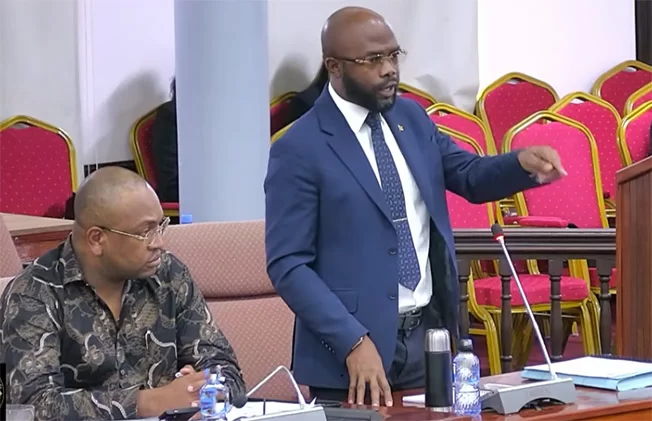
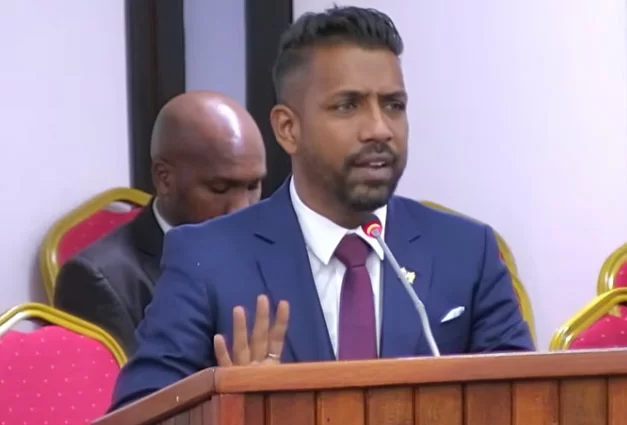
    On June 19, a planned law enforcement and regulatory operation targeting unregulated gold mining at 21 Bergi in Suriname’s Matawai region is set to launch, with the explicit goal of eliminating life-threatening working conditions and bringing order to the country’s informal mining sector. Minister of Justice and Police Harish Monorath outlined the full details of the operation during an address to the National Assembly Thursday evening, responding to repeated calls for clarity from BEP party faction leader Ronny Asabina.

    Monorath explained that the 21 Bergi area has been plagued by unsafe, unregulated mining activity for years. He reminded legislators that a major landslide several years ago killed 15 miners working in the region. Just weeks before the planned operation, another severe incident occurred when a sand bank collapse buried four workers. Two of those workers faced fatal injuries before being successfully rescued, highlighting the ongoing danger in the area.

    According to the minister, informal miners in the region have constructed an extensive network of dangerous underground tunnels, some stretching up to two kilometers in length and reaching depths of hundreds of meters. This unapproved infrastructure creates constant lethal risk for every worker on site, Monorath emphasized.

    The push for government intervention did not originate from national officials, the minister clarified. Local traditional leadership and the district commissioner requested government action to address the unsafe conditions months ago. Following that request, interministerial delegations from the ministries of Justice and Police, Defense, Regional Development, and Natural Resources conducted an on-site assessment alongside local police to review conditions and plan next steps.

    After reviewing the assessment, the national cabinet approved a plan to regulate and restructure gold mining activity in the region. All miners currently working in the high-risk zones will be temporarily relocated, and will be required to complete an official re-registration process. Once the process is complete, miners will be able to resume their work in safer, organized designated areas.

    Monorath stressed that all relevant local and national stakeholders have spent weeks proactively notifying miners in the region of the upcoming measures, clearly communicating that all workers must evacuate the high-risk, unregulated tunnel sites ahead of the operation. Starting Friday, clearing operations will begin in the dangerous zones, and the re-registration process for gold miners will get underway immediately after the evacuation is complete.

    The discussion was brought to the floor of the National Assembly after Asabina raised concerns over circulating rumors claiming the entire region would be fully evacuated, displacing all local miners. He asked the government to confirm its official stance on the operation, warning that lingering public uncertainty over the plan could trigger unnecessary social tensions in the mining community.

    ABOP Member of Parliament Edgar Sampi, who participated in earlier negotiations between the government and local traditional leadership, confirmed that the operation does not involve a full evacuation of the entire area. Instead, it is a targeted restructuring of mining activity that prioritizes worker safety, and no miner will lose their livelihood as a result of the intervention, Sampi said.

    Following Minister Monorath’s detailed briefing, Asabina expressed his appreciation for the clear, transparent response from the government, stating he was satisfied that the administration recognized the importance of accountability and transparency to the national legislature.


  • Column: Kwestie Van ‘t Hogerhuysstraat vraagt om open en transparant bestuur

    Column: Kwestie Van ‘t Hogerhuysstraat vraagt om open en transparant bestuur

    What was meant to be a straightforward infrastructure upgrade has morphed into a high-stakes political and governance crisis gripping Suriname, with the Van ‘t Hokerhuysstraat asphalt project becoming a flashpoint for partisan blame, public frustration, and a seemingly intractable institutional dilemma.

    As debate around the stalled project grows louder by the day, the National Assembly has devolved into a back-and-forth of partisan recrimination. Political parties trade accusations of mismanagement, each shifting responsibility to the other: the current administration points fingers at the previous government, while opposition parties pin the gridlock on today’s ruling coalition. Even local construction firm Baitali NV has come under fire, with critics claiming the company is deliberately delaying project delivery by launching a second court challenge. While the political arena grows increasingly chaotic and the narrative around the crisis becomes ever more muddled, for ordinary Surinamese road users, the unfinished street remains nothing more than a persistent source of daily irritation and unmet expectation. Above all else, the public just wants one clear answer: when will construction resume, and when will the long-promised road upgrade finally be completed?

    This lack of clarity has spilled over into social media, where the absence of consistent, official information has allowed facts, partisan opinions, and unsubstantiated speculation to blend into one unnavigable mess. Most residents can no longer distinguish what is actually happening with the project, all because the government has failed to deliver clear, honest, and transparent communication to the public.

    In reality, the core issue is far more complex than the superficial political debate suggests. The Surinamese government is trapped between two competing, non-negotiable obligations, squeezed between pressures that are growing tighter by the day.

    On one side, there is an irrevocable court ruling. In a democratic constitutional state, respecting and upholding judicial decisions is not an optional choice—it is a foundational principle of the rule of law that the government cannot simply ignore. On the other side stands the Inter-American Development Bank (IDB), the primary financier of the asphalt project. From information that has already entered the public domain, it is clear the IDB has serious objections to the government implementing the court ruling, over fears that such a move would put the entire project’s funding at risk. Beyond this immediate crisis, the bank has also raised concerns that a breach of its funding terms could jeopardize future IDB financing and development projects across Suriname.

    This is the government’s real dilemma—not the petty political sniping, personal attacks, and cross-party blame that dominate daily headlines. To press its case for enforcement of the original ruling, Baitali NV has indeed launched a second legal procedure, asking the court to increase a daily penalty for non-compliance from just 5,000 Surinamese dollars to 1 million Surinamese dollars. This is not a new dispute: the company is simply pushing the government to enforce a final ruling issued more than ten months ago. Whether Baitali’s demand is ultimately justified will be for the court to decide, but the existence of this new legal action does nothing to resolve the underlying impasse: the government remains caught between two weighty, conflicting obligations that it cannot easily reconcile.

    It is for this exact reason that the government should choose to bring the full complexity of the situation to the public. The Surinamese people have a right to answers to core questions: What exact agreements were struck with the IDB? What legal risks does the government face from all possible outcomes? What potential solutions are currently being explored? What consequences will every available option have for taxpayers and future national development projects? Answering these questions openly would also lay the groundwork for a more substantive, balanced public debate, rather than the unproductive mudslinging that dominates today.

    This crisis has already exposed a deeper flaw in Suriname’s governance culture: the country’s domestic legal order and its international funding agreements do not always align seamlessly. When the two clash, it creates a governance dilemma for which no simple, perfect solution exists. But good governance requires more than just careful decision-making—it requires that difficult choices and trade-offs are explained honestly to the public. Transparency is not a sign of uncertainty or weakness. On the contrary, it builds and strengthens the trust that citizens are entitled to place in their government. As long as the full context of the dilemma remains hidden from view, there will always be room for speculation, political spin, and cross-party blame. That outcome benefits no one: not the government, not the contractors, not the IDB, and certainly not the public, which will ultimately bear the consequences of whatever decision is reached.

    There may be no perfect solution to this impasse. Every possible outcome will carry financial, legal, or governance trade-offs. That is precisely why the Surinamese public deserves a government that chooses to speak openly, not stay silent. The government has no reason to be ashamed of the dilemma it faces. In fact, it would demonstrate real strength to openly acknowledge the situation: “We are caught between an irrevocable judicial ruling and the funding requirements of our international financier. Both carry significant weight, and we are carefully exploring a path that allows Suriname to honor both its rule of law commitments and its international obligations.”

    Today, the Van ‘t Hogerhuysstraat project is about far more than just a public road tender. It has become a critical test of good governance for Suriname—and that test begins with radical openness.

  • Derde helft WK 2026: Mexico boekt moeizame zege op Zuid-Korea en zet grote stap richting achtste finales

    Derde helft WK 2026: Mexico boekt moeizame zege op Zuid-Korea en zet grote stap richting achtste finales

    The 2026 FIFA World Cup on home soil continues to deliver positive results for host nation Mexico, which claimed its second consecutive group stage victory on Monday, sealing a hard-fought 1-0 win over South Korea at the iconic Estadio Azteca. The three points moved El Tri to a maximum six points from two Group A matches, putting them on the brink of qualification to the tournament’s round of 16.

    Both sides entered the clash with full confidence, having picked up opening match wins: Mexico opened its campaign with a 2-0 defeat of South Africa, while South Korea pulled off an upset against Czech Republic to also claim three points ahead of kickoff. With both teams already off to strong starts, the top spot in Group A was on the line in this pivotal second group fixture.

    From the opening whistle, Mexico seized control of possession, backed by a raucous crowd of more than 80,000 passionate home fans that packed Estadio Azteca, pushing to overwhelm the South Korean defensive block early. But South Korea put on a masterclass in organized, disciplined defending, holding a compact shape, transitioning quickly to counterattack, and cutting off passing lanes to deny Mexico any clear-cut goal-scoring chances. The two sides went into the halftime break locked at 0-0, in what quickly became a tight tactical chess match where neither side was willing to take unnecessary defensive risks. While Mexico held the majority of ball possession, South Korea stayed compact at the back and remained dangerous on rapid transitions, keeping the host side on its toes for the entire first half.

    After the interval, Mexico upped the intensity of its attack, shifting to a wider game plan and increasing the pressure on South Korea’s defense. That sustained pressure finally paid off around the hour mark, when Mexico broke the deadlock to take the 1-0 lead, sparking wild celebrations among the packed home crowd. The goal gave the host side the confidence to see out the rest of the match in controlled fashion, limiting South Korea’s space to build attacking momentum.

    South Korea pushed for an equalizer in the final minutes of regulation with a late all-out attacking push, but Mexico’s defense held firm, conceding almost no dangerous chances and seeing out the narrow but deserved victory. The result left Mexico with one of the strongest positions in the group stage, with qualification for the knockout round entirely in its own hands heading into the final group fixture. South Korea, meanwhile, remains on three points and will need a positive result in its final group match to secure a spot in the round of 16.

    While the match was not defined by end-to-end attacking spectacle, the victory showed Mexico’s ability to grind out results when patience and defensive organization are more critical than flashy attacking flair. For head coach Javier Aguirre, the performance and three points are a major boost of confidence ahead of the later stages of the tournament, where Mexico can expect to face far tougher opposition as they pursue a deep run on home soil.

  • Misiekaba verdedigt intrekken hoger beroep in kwestie Van ‘t Hogerhuysstraat

    Misiekaba verdedigt intrekken hoger beroep in kwestie Van ‘t Hogerhuysstraat

    A long-simmering infrastructure dispute has sparked fierce debate in Suriname’s National Assembly, centered on a 2025 decision by then-acting Minister of Public Works and Spatial Planning André Misiekaba to withdraw an appeal in the legal case over the troubled Van ‘t Hogerhuysstraat project.

    Misiekaba, who currently serves as Minister of Public Health, Welfare and Labor, told the assembly Thursday that he took on the acting public works portfolio temporarily at the president’s request back in 2025, as the post had not yet been filled by the new administration. He defended his choice to pull the appeal, arguing that the project was already a legacy crisis left by the previous administration when his government took office. At the time of the decision, the roadway had already fallen into severe disrepair, marked by large potholes that disrupted travel for local residents.

    To break the years-long deadlock over the project, Misiekaba explained, the administration convened all relevant stakeholders, including contractor Baitali NV, and made the decision to withdraw the appeal based on the information available at the time. He pushed back against criticism that the government should have let the appeal proceed, noting that the judiciary is an independent body, and no official could have predicted how the High Court of Justice would rule on the case. His actions, he insisted, were taken in good faith to normalize the stalled infrastructure project and resolve a years-long problem. Misiekaba added that after current Public Works Minister Stephen Tsang took office, he took over full oversight of the case, reiterating that the current administration inherited the problem and is committed to finding a resolution, even if the process requires additional time.

    But VHP parliamentarian Krishna Mathoera rejected Misiekaba’s justifications, arguing that the core issue is not how the court might have ruled, but the fallout of the appeal withdrawal decision in a democratic rule of law. She explained that when a contracting award is issued and an established company disputes the decision through the legal system, the government undermines due process by choosing to voluntarily withdraw a pending appeal, allowing the lower court ruling to take immediate effect.

    Most critically, Mathoera emphasized, the administration waited a full 10 months after the appeal withdrawal to reconvene talks with all involved parties. This prolonged stagnation, she said, has created unnecessary disruptions to public services, leaving local residents to deal with the damaged roadway and the project’s ongoing uncertainty for far longer than required.

    The debate also devolved into a heated verbal exchange between Misiekaba and fellow parliamentarian Van Samson. Misiekaba claimed Van Samson had implied he knew ahead of time the government would have won the appeal if it had proceeded, a claim Van Samson immediately denied, stating he never made any such assertion.

    National Assembly Speaker Ashwin Adhin stepped in to de-escalate the exchange, urging both government representatives and lawmakers to stick strictly to verifiable facts. Adhin intervened specifically to prevent the ongoing budget proceedings from descending into a personal argument before the session resumed as scheduled.

  • Enriquez Has Right to Information Under FOI Act – Says Panton

    Enriquez Has Right to Information Under FOI Act – Says Panton

    During a press briefing held by the United Democratic Party (UDP) on Tuesday, Belize’s Opposition Leader Tracy Taegar-Panton launched sharp criticism of the sitting Briceño administration, accusing it of rolling back on public transparency commitments. Panton pointed to local activist Jerry Enriquez’s prolonged legal battle to obtain unreleased government documents as tangible proof of the government’s growing reluctance to share public information with citizens.

    Enriquez’s push for access to requested records has already garnered formal backing from Belize’s former Ombudsman, who affirmed the activist’s legal right to the documents under the country’s Freedom of Information Act. Panton emphasized that the legislation is far more than a symbolic ceremonial law: it is a binding legal mechanism created explicitly to guarantee public access to government information. “The Freedom of Information Act is not a decoration you hang on a tree. It is a legal tool,” she stated in the press conference.

    The Opposition Leader argued that despite the Briceño administration’s repeated campaign promises to prioritize open governance and accountability, Belizeans from all walks of life — including working journalists, opposition representatives, and ordinary residents — are now forced to formally file Freedom of Information requests just to access basic public records that should be proactively disclosed. This shift, she noted, creates unnecessary barriers for anyone seeking insight into government operations and public spending.

    Alongside calling out the administration’s lack of openness, Panton used the press conference to announce two new Freedom of Information requests filed by the UDP. The first request seeks full access to government contracts tied to entities linked to cabinet Minister Oscar Mira, while the second asks for unreleased records related to the country’s National Health Insurance programme.

    Panton closed her remarks by reaffirming that transparency and accountability are non-negotiable obligations for any public government, rather than optional actions that sitting officials can choose to provide or withhold. All public institutions, she stressed, remain fully answerable to the Belizean citizens that they are mandated to serve.

  • Opposition Seeks Talks with PM on Crime, Corruption

    Opposition Seeks Talks with PM on Crime, Corruption

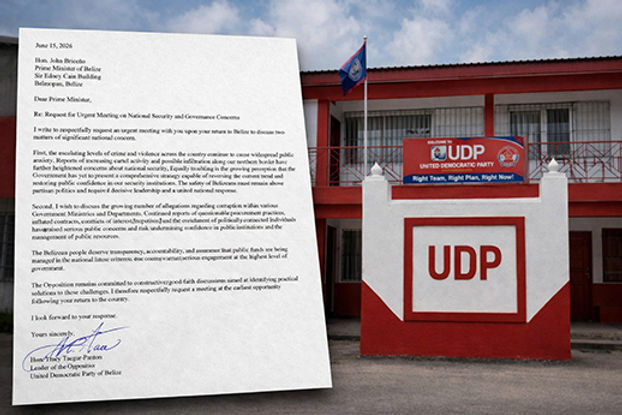
    Belize’s political opposition has officially submitted a formal request for an emergency sitting with Prime Minister John Briceño, aiming to address three pressing national issues: a sharp upward trend in criminal activity, growing threats to national security, and persistent claims of official corruption. Opposition leaders warn that ongoing failures to tackle these challenges are steadily eroding public trust in the country’s core governing institutions.

    The formal request came via a written correspondence dated June 15, delivered by Opposition Leader Tracy Taegar-Panton directly to the prime minister. In the letter, Taegar-Panton frames two issues as particularly critical to national stability: the steady surge in violent crime across the country, and multiple corruption allegations that have surfaced across government ministries and administrative departments.

    Taegar-Panton’s letter notes that the continuous rise in crime and violent incidents has sparked deep unease across Belizean communities. It specifically highlights recent intelligence pointing to expanding operations by transnational criminal cartels, and potential illicit infiltration along Belize’s northern border as key factors amplifying existing national security risks.

    In her official statement included in the correspondence, Taegar-Panton emphasized: “The personal safety of all Belizean citizens must always take priority over partisan political interests. Addressing these threats demands decisive, clear leadership and a unified, country-wide response that transcends political divides.”

    Beyond security concerns, the opposition leader also outlined growing worries over persistent reports of problematic governance practices within the current administration. These include questionable public procurement processes, overinflated government contracts, unaddressed conflicts of interest, widespread nepotism, and illegal enrichment of individuals with close political ties to ruling party officials.

    Per the text of the letter, these unaddressed allegations pose a serious threat to public confidence in both government institutions and the responsible stewardship of public tax resources. “The Belizean people are owed full transparency, meaningful accountability, and a clear guarantee that public funds are being managed strictly to advance the national good, not private interests,” the letter reads.

    Taegar-Panton concluded by reaffirming the opposition’s commitment to constructive, collaborative problem-solving rather than purely confrontational politics. She requested the urgent meeting be scheduled as soon as Prime Minister Briceño returns to Belize from his current travel.

  • Panton Links Swaso Case to Oversight Concerns

    Panton Links Swaso Case to Oversight Concerns

    A high-stakes constitutional dispute over the independence of Belize’s government oversight bodies has placed new pressure on the incumbent administration, with Opposition Leader Tracy Taegar-Panton warning that ongoing interference is rapidly eroding public confidence in the country’s key public institutions.

    Panton shared her concerns during a Tuesday press briefing held by the United Democratic Party, when she was asked to respond to a legal claim filed by former Ombudsman Major Gilbert Swaso against the Government of Belize. Swaso launched the court proceedings in early 2026, arguing that the government’s decision not to renew his appointment, which expired at the end of December 2025, violates the constitutional independence of the Ombudsman’s Office.

    Court documents detail the sequence of events that preceded the non-renewal: Swaso issued a landmark Freedom of Information Act (FOIA) ruling ordering the government to release records detailing legal fees paid to private attorneys hired for redistricting-related litigation. The ruling came in response to a request from public-interest litigant Jerry Enriquez, who had fought for months to access the public records. The Attorney General’s Ministry immediately challenged the ruling at the Court of Appeal, where the case remains unresolved.

    Following the FOIA ruling and additional reports Swaso completed on a separate government matter, senior government officials raised objections to his decisions during a December 2025 meeting with Minister of Public Service, Constitutional and Political Reform Henry Charles Usher. Just two days after that meeting, Swaso was formally notified that his appointment would not be extended when his term ended that month. The former ombudsman argues this action amounts to unlawful retaliation and unlawful interference with a constitutionally protected independent office, and he is asking the court to issue formal declarations confirming the independent protections the office is owed under Belize’s constitution. He is also challenging decisions related to compensation during his tenure and raising questions about the legality of actions taken against his office.

    As of when the lawsuit was filed, the ombudsman position had sat vacant for more than 160 days following the expiration of Swaso’s term. This prolonged vacancy has disrupted core operations of the office, which acts as the country’s primary independent avenue for citizens to file complaints against government departments and public authorities, including resolving disputes under the FOIA.

    Panton declined to directly comment on the specific legal merits of Swaso’s claim, but emphasized that the broader issue at stake is the ability of all Belizean oversight institutions to operate without political interference. She named the Ombudsman’s Office, the Office of the Contractor General, the Integrity Commission, the Joint Public Accounts Committee, and the Office of the Auditor General as five critical bodies tasked with upholding government accountability and transparency.

    Panton stressed that these oversight mechanisms must function at optimal capacity and within their established legal frameworks to protect Belize’s democratic institutions and guarantee citizens the right to be heard on issues that impact their daily lives. She argued that without autonomous oversight, the public cannot access critical government information or seek redress through official channels without relying on political favor or intervention.

    “The trust and confidence that Belizeans have in our public institutions are fading, and fading quickly, because the public institutions are not working in the interest of the people,” Panton told reporters. “These oversight mechanisms must be able to function with some autonomy, must be able to function within the confines of the law that governs that office, so that the people of this country can have direct access and be able to ask the questions.”

  • Creation of the Haiti’s School and Vocational Guidance Unit

    Creation of the Haiti’s School and Vocational Guidance Unit

    Haiti’s Ministry of Education is taking a landmark step to transform its national education system, announcing the creation of a dedicated national support body aimed at tackling persistent academic failure, lifting up struggling students, and unlocking the potential of gifted learners across the country.

    In an official circular dated June 18, 2026, Education Minister Vijonet Déméro framed the new initiative around a core principle: that every student, regardless of their learning profile, deserves tailored psycho-educational support that matches their unique needs. To turn this commitment into action, the ministry has formally established the School and Vocational Guidance Unit, known by its Haitian Creole acronym UNOSP, which will operate as a central body under the Ministry’s Directorate General, led by a coordinator appointed by senior government authorities.

    UNOSP carries three defining core missions designed to address gaps that have long hampered Haitian education. First, the unit will target students facing learning challenges or at risk of dropping out of school, leading systematic identification, diagnostic assessment, and the development of customized psycho-educational remediation plans to keep students engaged and on track. Second, it will create formal, standardized pathways for supporting children with High Intellectual Potential (HIP), rolling out official identification protocols and designing enriched or accelerated learning tracks to help gifted students reach their full potential. Third, UNOSP will deliver structured career and vocational guidance, supporting students as they choose secondary, vocational, and university study paths, and helping them build personalized “Future Plans” that align both with their individual abilities and the current and emerging needs of Haiti’s labor market.

    To ensure accessible, localized support reaches every corner of the country, UNOSP has built a decentralized operational structure rooted in Haiti’s regional education system. Each of the nation’s Departmental Directorates of Education (DDE) will launch a local Departmental School and Vocational Guidance Service (SDOSP), which will act as the on-the-ground operational arm of the national unit. These local services will be staffed by a multidisciplinary team of qualified professionals including career counselors, educational psychologists, and social workers, who will collaborate closely with local school principals and education inspectorates to deliver seamless support at the community level.

    As the central coordinating authority, UNOSP has formalized collaborative partnerships with key stakeholders across the Haitian education ecosystem to deliver holistic, integrated support. It will work hand-in-hand with the School Health Directorate (DSS) to cross-reference medical diagnoses of visual, auditory, neurological, or psychological disorders with reported learning difficulties, ensuring students receive comprehensive care that addresses all root causes of academic challenges. It will also partner with the Ministry’s technical directorates covering curriculum, preschool, basic, and secondary education, as well as the Commission for School Adaptation and Social Support (CASAS), to co-design adapted curricula, structured guidance pathways, and enrichment programs that meet diverse student needs. Regional education bodies including DDEs and School District Offices (BDS) will implement national guidelines at the local level, with BDS and zone inspection offices providing on-the-ground monitoring, technical oversight, and critical data collection. Ultimately, local public and private schools serve as the first point of contact for identifying at-risk or gifted students and implementing individualized support plans, creating a layered support system that starts in the classroom.

    UNOSP has been granted formal regulatory and final decision-making authority over all matters related to educational guidance and support across Haiti. All assessments, psycho-educational reports, and guidance proposals submitted by school psychologists, principals, or DDE technical services must undergo formal review by UNOSP before taking effect. It is the only government body authorized to officially validate, approve, or reject high-stakes decisions affecting a student’s educational trajectory, including grade skipping or placement in accelerated programs for gifted learners, admission to technical, vocational, or specialized education tracks, and placement in remedial or adapted education programs. Critically, no final placement or educational adjustment can be imposed on a student or their family without the explicit official approval of the UNOSP Coordinator or their authorized departmental representative, protecting student and family autonomy in educational decision-making.

    In the final provisions of the circular, the Ministry ordered immediate implementation of the new structure, with the Directorate General, Human Resources Directorate, and all regional education authorities tasked with rolling out the framework within their jurisdictions. All affected bodies have a 90-day window from the circular’s publication to submit their full staff deployment plans to the Minister’s Office and the Human Resources Directorate, setting the stage for the new unit to begin operating across Haiti by the end of September 2026.

  • Derde helft WK 2026: De verborgen onderscheidingen op de WK-shirts van 2026

    Derde helft WK 2026: De verborgen onderscheidingen op de WK-shirts van 2026

    The 2026 FIFA World Cup brings far more than just 48 teams competing for the sport’s most coveted trophy – it introduces a groundbreaking new tradition that turns every player’s jersey into a walking narrative of football history. For the first time in World Cup history, FIFA has approved a series of specialized commemorative emblems that players wear on their sleeves, small in size but profound in meaning, each marking a unique milestone in a player’s or nation’s football journey.

    The most exclusive of these honors is the Legacy Patch, an award only granted to players who have stepped onto the pitch in five or more World Cup final tournaments. This elite group includes global icons such as Lionel Messi, Cristiano Ronaldo, and Luka Modrić, but Messi holds a singular distinction: the Argentine superstar is the first player in World Cup history to compete at six different editions of the tournament, spanning an incredible 20 years of World Cup history. Far from just decorative stitching, the Legacy Patch stands as a tribute to extraordinary longevity, consistent elite performance, and unrivaled international class.

    For first-time World Cup competitors, the new Debut Patch celebrates the realization of a lifelong dream. Every player making their first World Cup appearance in this tournament wears this special badge, a visible marker of years of sacrifice, qualifying battles, injury comebacks, setbacks, and relentless hard work that have led to their first minutes on the world’s biggest football stage. This honor extends not just to individual debutants from established football nations, but also to players from debutant countries including Jordan, Curaçao, Uzbekistan, and Cape Verde, marking their nations’ first ever appearance at a World Cup finals.

    Individual past excellence is also recognized with specialized honors. The Golden Boot Patch is worn by former World Cup top goal scorers, reminding fans of their status as the most clinical finishers in a previous tournament. Similarly, former Golden Glove winners, awarded to the best goalkeeper of a past World Cup, carry their own dedicated badge. For supporters, these badges provide an immediate, visible connection to the historic achievements that have shaped the tournament’s legacy, letting them identify standout players from past editions at a glance.

    Commemoration extends beyond individual players to the historic achievements of competing nations. Countries that have previously won the World Cup now wear a gold version of the official 2026 World Cup logo on their kits, highlighting their rich football heritage. This elite group includes Argentina, Brazil, Germany, France, Spain, Italy, England, and Uruguay, with Argentina also carrying an additional gold champion badge as the current defending World Cup title holder. The gold logo, positioned on the right sleeve, immediately distinguishes past champions from nations that have never lifted the trophy.

    No player’s kit at this tournament carries as much symbolic weight as Lionel Messi’s. The Argentine captain wears multiple commemorative badges at once: the historic Legacy Patch for his unprecedented sixth World Cup appearance, Argentina’s gold champion badge, the gold World Cup logo marking his nation’s past titles, and a special honor recognizing his status as the best player of the 2022 Qatar World Cup. What could have been just another match jersey becomes a concise visual summary of one of the most remarkable international careers in the entire history of football.

    Where traditional football jerseys once served the simple purpose of distinguishing teams and nations, the 2026 World Cup has reimagined the garment as a carrier of stories. Every badge represents a distinct chapter in global football history: the first-time debutant finally turning a childhood dream into reality, the former top scorer returning to chase new goals, the legendary goalkeeper who once dominated the penalty area, and the living legends stepping onto the World Cup stage for what may be their final appearance.

    Many see this small, thoughtful innovation as the most meaningful improvement of this 2026 World Cup – not new technology, not bigger stadiums, not even the expansion to 48 teams, but a subtle, powerful recognition that every jersey has a story worth telling.

  • Home Affairs Minister Mira Dodges Tough Questions Before Abrupt Exit

    Home Affairs Minister Mira Dodges Tough Questions Before Abrupt Exit

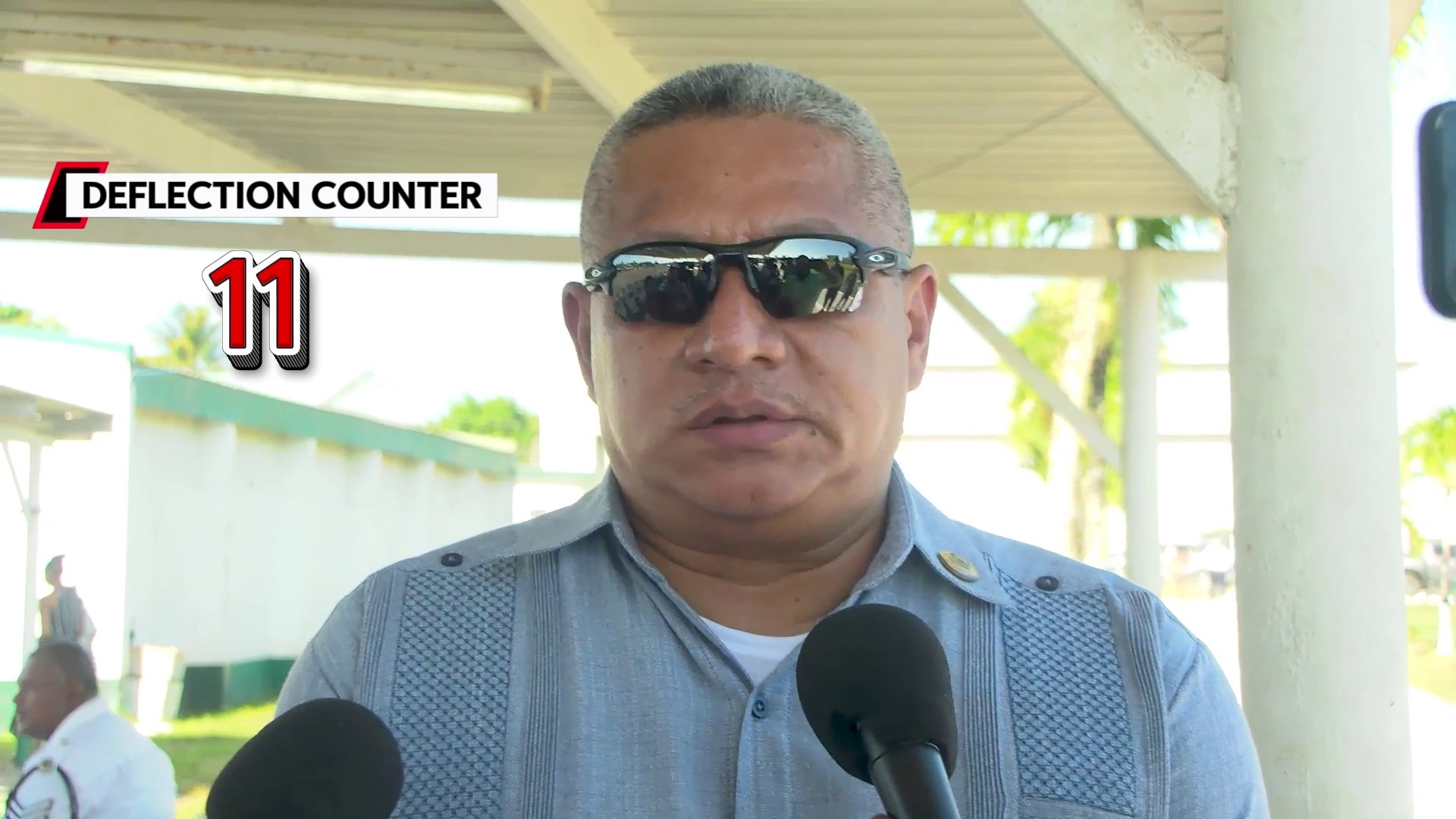
    On Wednesday, June 18, 2026, Belizean Home Affairs Minister Oscar Mira broke weeks of public silence to address mounting controversy surrounding questionable procurement contracts at the Ministry of Defense, where he also holds a position as Minister of State. What was supposed to be a transparent press interaction to ease public concerns ended in chaos after just 10 minutes, when ministry staff twice interrupted the briefing and abruptly escorted Mira out before reporters could dig into the core allegations.

    The scandal centers on revelations that Mira’s immediate family members, specifically his siblings, have secured multiple high-value, taxpayer-funded contracts through the Ministry of Defense procurement process, raising widespread accusations of nepotism and improper influence. When pressed by reporters on these claims, Mira repeatedly denied any involvement or knowledge of the deals, emphasizing that he has never sat on any government procurement committee and holds no decision-making authority over contract awards.

    Over the course of the abbreviated briefing, Mira repeated this denial more than a dozen times, declining to address specific questions about how his relatives came to win the lucrative public contracts under his oversight. “Let me just make clear that I sit on no procurement committee. I had no say, I had no influence and I had never in my ministry or any other ministry try to influence the decision of that committee,” Mira told reporters. “I have nothing to do with how government pays their contractors or suppliers. That is not my decision, I don’t know.”

    When reporters pushed for further clarification on why he had not launched an internal review after learning of his family’s links to the contracts, Mira declined to engage, cutting off the question before staff intervened. Stacy Smith, a senior staff officer at the ministry, interrupted the briefing twice to remind the press that Mira was expected at a post-medal ceremony reception, and that the press interaction had run over its allotted time.

    The abrupt exit has done little to defuse public anger, instead intensifying scrutiny of the government’s procurement oversight mechanisms and Mira’s claimed lack of awareness. Speaking to News Five, Infrastructure Development and Housing Minister Julius Espat weighed in on the controversy, saying that senior ministers bear ultimate responsibility for knowing what happens within the portfolios they oversee.

    “The truth is the minister needs to be advised, that is why he has a CEO, that is why he has an FO, an AO – everyone has a role to play,” Espat said. “If you are seeing something happening that you are not comfortable with, it is your responsibility to report it. None of us are perfect, but we have to take our jobs seriously. If you don’t know you ask and if you still don’t know then you go study. You have to be able to be aware of the product you are administering, so that the product is a good one.”

    As of Wednesday evening, Mira has not offered any additional comment on the allegations, and no official government investigation into the procurement deals has been announced. The truncated press conference has left members of the public and press with more unanswered questions than it resolved, fueling ongoing calls for full transparency and a independent audit of the Ministry of Defense’s recent contracting awards.