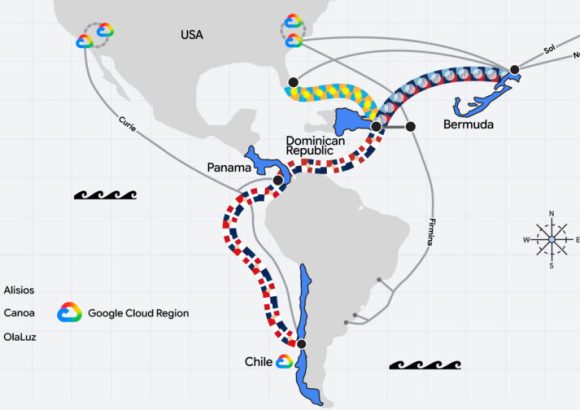
Tech giant Google has unveiled an ambitious expansion of its trans-American submarine cable network, bringing the Dominican Republic into a new web of four international connectivity routes that will link the Caribbean nation to the United States, South America, the broader Caribbean region and Europe. As part of Google Cloud’s high-profile Americas Connect initiative, the infrastructure upgrade includes three entirely new cable systems dubbed Alisios, Canoa and OlaLuz, alongside a brand-new branch extension of the company’s existing Firmina cable route. The core goal of the project is to boost overall network capacity, route diversity and long-term resilience for digital infrastructure across the Western Hemisphere.
Each of the new routes is designed to fill critical gaps in regional connectivity. The Alisios system will create a direct data pathway between the Dominican Republic, Panama and Chile, establishing the first dedicated direct corridor connecting the Caribbean and South America along this route. Meanwhile, the Canoa cable will link the Dominican Republic straight to Bermuda, and OlaLuz will connect the country directly to Florida, significantly increasing data transmission capacity between the Caribbean basin and the U.S. East Coast. Beyond the three new systems, Google is also extending its Firmina submarine cable to reach the Dominican Republic; when paired with the company’s existing Nuvem and Sol cable systems, this new infrastructure will open up redundant, additional connection pathways between Latin America, the Caribbean, the U.S. and Europe.
Google officials emphasize that diversifying these routes serves a key functional purpose: by spreading data traffic across multiple independent cables, the network reduces overreliance on any single line, drastically improving resilience if a cable experiences an outage or external disruption. Submarine cables form the invisible backbone of the global internet, carrying roughly 99% of all international data traffic that powers core modern digital services, from cloud computing and artificial intelligence model training to e-commerce platforms, cross-border communications and telemedicine. Today, Google maintains more than 10 million kilometers of combined terrestrial and submarine fiber infrastructure across the globe.
Dominican Republic President Luis Abinader has publicly praised the move, welcoming his country’s inclusion in the expansion project. Abinader noted that enhanced cross-border digital connectivity will help the Dominican Republic narrow its domestic digital divide, nurture homegrown technological talent, and unlock new economic opportunities in the fast-growing global digital economy. The expansion announcement was made official by Brian Quigley, Vice President of Global Network Infrastructure at Google Cloud. Beyond the benefits for the Dominican Republic, the project will also cement Panama’s status as a leading regional connectivity hub, thanks to its new strategic link to both the Dominican Republic and Chile via the Alisios cable system.