博客

  • Epicurean Workers Secure Wage Increase and Enhanced Benefits Under New Collective Bargaining Agreements

    Epicurean Workers Secure Wage Increase and Enhanced Benefits Under New Collective Bargaining Agreements

    Workers at Antigua and Barbuda-based pastry firm Pastry Ltd., which operates under the trade name Epicurean, are set to see tangible improvements to their compensation and working conditions after the company finalized a new three-year collective bargaining agreement with the Antigua & Barbuda Workers’ Union (ABWU).

    The landmark deal, which will take effect July 1, 2025 and run through June 30, 2028, delivers structured annual pay increases for both frontline line staff and supervisory personnel. Entry-level and frontline line employees will gain a $0.50 hourly raise each year of the agreement, a adjustment that works out to an annual pay increase of nearly 4 percent for most workers. For supervisory staff, the annual hourly raise is set at $0.80, which also delivers an annual average pay increase close to the 4 percent mark.

    Beyond base salary adjustments, the agreement expands a range of supplementary benefits designed to ease workers’ job-related costs and improve work-life balance. Both worker cohorts will see upgrades to their meal allowances and call-out pay, while supervisory staff will receive an increased uniform allowance to cover the cost of work attire. One notable policy update expands paternity leave for eligible workers from three days to five full days, giving new fathers extra time to care for their newborns and build early bonds with their growing families.

    The deal also addresses transportation safety and convenience for workers working late shifts. Under the previous company policy, workers ending shifts after 9 p.m. only received transportation to a local bus terminal; the updated agreement guarantees direct private transport from the workplace to employees’ homes, eliminating the need for late-night public transit connections.

    A new death-in-service benefit has also been added to the contract, providing critical financial support to the families of employees who pass away while still actively employed by the company.

    Kem Riley, who serves as both ABWU President and Senior Industrial Relations Officer, characterized the negotiations as collaborative and productive. “We are pleased to conclude these negotiations which resulted in a fair package of benefits for the workers,” Riley said in a statement following the signing. He added that the union’s core priority throughout the bargaining process was to ensure worker compensation kept up with the country’s rising cost of living, while supplementary benefits would cut down on out-of-pocket job-related expenses and reduce daily inconveniences for employees.


  • Veerverbinding Albina-St-Laurent blijft beperkt; nieuwe veerboot pas in september operationeel

    Veerverbinding Albina-St-Laurent blijft beperkt; nieuwe veerboot pas in september operationeel

    One of the most vital cross-border connections linking Suriname and French Guiana is facing severe and prolonged service disruptions, joint authorities from both nations have confirmed in a shared update on cross-river transit across the Marowijne River. The key ferry route connecting Albina, Suriname, and Saint-Laurent-du-Maroni, French Guiana, has been grounded since June 18 after the only active ferry La Gabrielle suffered a critical hydraulic pump failure. Compounding the mechanical outage, Suriname’s port authority has declared the floating docking pier on the Albina side of the river structurally degraded to the point that it can no longer be operated safely, forcing a full suspension of all regular cross-river sailings indefinitely.

    Authorities are currently evaluating options to resume a limited version of the service before the end of the month. If the partial restart moves forward, sailings will operate on a reservation-only basis for approximately three hours per day during low tide, and only light passenger vehicles will be permitted to cross. Heavy goods and cargo transport will remain barred from the route even under the limited service model.

    In their joint statement, officials from both France and Suriname openly acknowledged that even a limited resumption would fall far short of meeting existing demand for cross-border travel and trade. To address the gap, multiple long-term and short-term alternative solutions are under active review, including emergency temporary repairs to the damaged Albina docking pier, modifications to existing mooring spots, and the temporary deployment of pontoons and smaller auxiliary vessels to handle excess traffic.

    Officials have pinned their long-term hopes for restoring full service on a second ferry, the Malani, which is currently undergoing scheduled maintenance and final technical preparations ahead of its launch. Before the vessel enters official operation, it will complete a roughly one-month-long pilot testing phase, with a full commercial launch targeted for early September 2026.

    Infrastructure upgrades for docking facilities on both the French and Surinamese sides of the Marowijne River have already been completed since February 2026. Under the current configuration, however, the Malani will only be able to operate at full capacity during high tide. Additional construction work is scheduled to wrap up by March 2027, which will allow the ferry service to operate continuously regardless of tide levels.

    The Albina-Saint-Laurent-du-Maroni ferry link serves as a core economic and social artery connecting Suriname and the French overseas department of French Guiana. Hundreds of travelers, commercial traders, and transport operators rely on the crossing daily for work, family visits, and cross-border trade. To keep stakeholders updated and advance restoration efforts, French and Surinamese authorities have agreed to hold regular coordination meetings to track the progress of infrastructure repairs and service improvements. Both sides have reaffirmed their shared commitment to significantly boosting the long-term reliability of this critical cross-border connection.

  • Haïti – Actualité : Zapping…

    Haïti – Actualité : Zapping…

    A collection of the latest developments from Haiti, dated June 23, 2026, covers a range of topics across aviation, culture, public service, legal affairs, sports, and anti-corruption initiatives.

    One month after an aborted launch of its new route, Haitian carrier Zed Airlines has announced it will restart scheduled passenger flights between Haiti and Montreal, Quebec, Canada. David Jean Charles, chief executive officer of the airline, confirmed the resumption of the service. Currently, Zed Airlines operates multiple international routes: services to Brazil depart from Port-au-Prince’s Toussaint Louverture International Airport, while flights to Miami and Atlanta run out of Cap-Haïtien. The airline has active expansion plans to add new routes to additional U.S. cities and Cuba, and is evaluating launching domestic services connecting Port-au-Prince, the Haitian capital, to Jacmel, Jérémie, and Les Cayes.

    In a cultural ceremony held Sunday, June 21, 2026, at La Réserve Resto in Pétion-ville, Roi St Clou was formally elevated to the rank of National Roi-Ati in Haitian Vodou tradition.

    To mark the United Nations’ World Public Service Day, which falls on Tuesday, June 23, 2026, Haiti’s Office of Management and Human Resources (OMRH) will host an honors ceremony at Hôtel Montana. Eighty public servants, nominated by more than 70 Haitian government institutions, will be recognized by the country’s Prime Minister during the event. All cabinet ministers, agency directors general, and other senior public figures have been invited to attend the official ceremony, where the Prime Minister will deliver a keynote address to attendees.

    In a high-profile legal development, attorneys for prominent Haitian businessman Dimitri Vorbe filed an emergency motion on Monday, June 22, 2026, accusing U.S. Immigration and Customs Enforcement (ICE) of violating a federal court order. Vorbe, 52, has been held in U.S. custody since September 2025. Following severe wildfires in southern Florida, ICE transferred Vorbe from the Krome detention center in Miami to the Natchez, Mississippi correctional facility — a move that directly contradicts a formal order from a U.S. federal judge barring Vorbe from being moved outside the Southern District of Florida. The businessman is facing an expedited expulsion proceeding initiated by U.S. Secretary of State Marco Rubio on foreign policy grounds, which he has repeatedly contested amid his challenge to his prolonged detention. Vorbe’s legal team is demanding his immediate return to Miami ahead of his scheduled July 10 court hearing, or alternatively, his immediate release from custody.

    Haiti’s national men’s football team, nicknamed the Grenadiers, held their first training session in Atlanta on the morning of Monday, June 22, as they make final preparations for their decisive final group stage match against Morocco on Wednesday, June 24. The squad reported that players are training with full determination to secure the best possible outcome in the critical upcoming fixture.

    Haiti’s Anti-Corruption Unit (ULCC), in partnership with the United Nations Office on Drugs and Crime (UNODC), has opened applications for the second edition of its annual anti-corruption summer school. The two-week training program will run from August 10 to August 21, 2026, and is open to undergraduate students enrolled in recognized Haitian universities. Eligible candidates must submit a completed application via the online portal at https://bit.ly/ecoledeteanticorruption, alongside a resume, cover letter, valid government-issued ID, and official proof of university enrollment. Applications will be accepted from June 22 through July 6, 2026, and all participants must be available to attend the full duration of the training program.

  • PM Browne Speaks on Third-Country Deportees to the Caribbean

    PM Browne Speaks on Third-Country Deportees to the Caribbean

    As the Organisation of Eastern Caribbean States (OECS) marks its 45th year of advancing regional cooperation, the bloc is confronting a growing roster of unprecedented challenges that test the sovereignty and resilience of its small island member states. At the 78th OECS Authority Meeting held in St. John’s, Antigua and Barbuda, Prime Minister Gaston Browne delivered a blunt, unflinching address calling out coercive foreign pressure from the United States over the forced acceptance of third-country deportees, a crisis that threatens to destabilize the small Caribbean nation.

    For nearly half a century, the OECS has anchored integration and progress across the Eastern Caribbean, building shared institutions from the Eastern Caribbean Supreme Court to the Eastern Caribbean Civil Aviation Authority that have lifted development outcomes for all member states. But in 2026, shifting global power dynamics have created a new set of cascading pressures that regional leaders cannot ignore. Browne framed the current global moment as a period of profound transformation: marked by intensifying great power competition, regional conflicts with global spillover effects, fractured global supply chains, a growing retreat from multilateral cooperation, and the increasing use of economic coercion as a tool of international statecraft.

    The most pressing immediate challenge Browne highlighted is the U.S. push to force OECS nations to accept hundreds of third-country deportees, many of whom have criminal records. Browne confirmed that small island states across the region have been pressured into accepting the deportees, with implicit threats of punishment if they refuse to comply. Many Caribbean governments have already begun pushing back to prevent the influx of criminal individuals that would strain local resources and undermine public safety.

    Speaking directly to U.S. authorities, Browne made clear that his government would not compromise Antigua and Barbuda’s national interest for foreign demands. “I cannot willingly cooperate with any other power, any country, to destroy our beautiful Twin Island state,” he stated, adding that his administration has drawn a clear line: it will not accept any criminal deportees, and will cap the total number of deportees allowed into the country at a level the nation can support.

    Originally, U.S. proposals called for Antigua and Barbuda to accept up to 120 deportees, a figure Browne’s administration rejected outright as completely unacceptable. In its place, the government tabled a counterproposal to accept a maximum of just 10 deportees per year, a limit aligned with the nation’s small population and limited administrative, social and law enforcement resources. Browne emphasized that he hopes the United States will respect the nation’s sovereign right to set its own policies on entry and resettlement, avoiding acrimony or punitive measures in response to Antigua and Barbuda’s position.

    Beyond the deportation crisis, Browne used the OECS meeting platform to draw attention to another existential threat facing small island developing states across the Caribbean: skyrocketing living costs driven largely by global energy price volatility and external economic shocks beyond the region’s control. For small, import-dependent Caribbean nations, Browne noted, these overlapping economic and geopolitical challenges are not just policy issues—they threaten the livelihoods and stability of communities across the subregion.

  • Haïti – Politique : Formation sur les «Fondamentaux des marchés publics» au bénéfice de cadres du MENFP

    Haïti – Politique : Formation sur les «Fondamentaux des marchés publics» au bénéfice de cadres du MENFP

    In a push to strengthen transparent public resource management across Haiti’s government institutions, Haiti’s National Public Procurement Commission (CNMP) has launched a three-day specialized training program focused on core public procurement fundamentals, designed exclusively for senior technical staff at the country’s Ministry of National Education and Vocational Training (MENFP).

    The training kicked off on Friday, June 19, 2026, with sessions scheduled across three non-consecutive Fridays: June 19, June 26, and July 3, 2026. Around 20 participants are taking part in the program, most of whom are members of MENFP’s newly established ministerial public procurement commission (CMMP) and senior leadership from the ministry’s Procurement Implementation Unit (UPM).

    The curriculum covers a broad range of critical topics aligned with Haiti’s evolving public procurement framework. Key modules include a deep dive into the country’s legal and regulatory structure governing public contracts, step-by-step guidance on procurement solicitation, monitoring, and contract execution processes, and a breakdown of special regulatory frameworks for different contract types, including client service contracts, supply contracts, and contracts issued during officially declared public emergencies. To ensure participants can apply new skills in real-world scenarios, the program also includes hands-on practical case study analysis, procedural simulation exercises, and applied problem-solving activities built to boost frontline operational capacity.

    Speaking at the official opening of the training, CNMP commissioner Elgo Eugène welcomed MENFP’s recent decision to establish an in-house public procurement commission, a move the CNMP actively encourages. Eugène emphasized the central role that well-regulated public procurement plays in upholding transparency in public sector management. “This work is essential to guarantee consistency, full traceability, and above all, credibility for our entire national procurement system,” he told attendees.

    The new MENFP CMMP, formally established on June 1, 2026, comprises five appointed members: Lutherking Emmanuel MARCADIEU, Jean Astrel MAGLOIRE, Myrlène Jean-Baptiste SÉIDE, Rigaud MATHURIN, and Ardine PLAISIR.

    Woodly Simon, Chief of Staff to MENFP Minister Vijonet Déméro, framed effective public procurement as a core lever of functional public action. “At the ministry, transparent, efficient, rule-compliant management is non-negotiable to ensure we get the most value out of every public resource,” Simon explained. He added that upskilling the ministry’s procurement leadership is a strategic investment that will improve activity planning, streamline program execution, and advance responsible stewardship of public funds.

    Lead trainer Marie Aurore Élisabeth Barthélemy Dalencourt further emphasized the broader societal and economic impact of well-managed public procurement. “When public procurement is governed by the principles of transparency, equity, and efficiency, it directly strengthens good governance and improves the quality of services delivered to all Haitian citizens,” she said. “Every actor involved in public contracting has a responsibility to uphold regulatory standards and best practices to ensure public resources are used to their maximum potential.”

  • Derde helft WK 2026: Noorwegen overleeft Senegalese storm in zinderende WK-thriller

    Derde helft WK 2026: Noorwegen overleeft Senegalese storm in zinderende WK-thriller

    The 2026 FIFA World Cup delivered one of its most enthralling matches to date on Monday night, as Norway edged out Senegal 3-2 in a nerve-wracking, edge-of-your-seat encounter at the sold-out MetLife Stadium in East Rutherford, New Jersey. The result leaves Norway on the cusp of qualification for the knockout round, while Senegal faces an early tournament exit despite a heroic second-half fightback that had fans on their feet for the full 90 minutes.

    Both sides came out of the gates with relentless intensity, determined to claim three critical points in Group D. Norway’s attack revolved around the creative magic of playmaker Martin Ødegaard, who constantly probed for link-ups with star striker Erling Haaland, who entered the match as one of the tournament’s top performing forwards. On the Senegal side, manager’s tactics relied on the blistering pace of winger Ismaïla Sarr and the veteran leadership of forward Sadio Mané to unlock Norway’s defense. For most of the first half, both backlines held firm, repelling every attacking threat, but Norway broke the deadlock just before halftime. Right-back Marcus Holmgren Pedersen capitalized on a rare lapse in concentration from Senegal’s defensive unit to slot home the opening goal, sending Norway into the break with a 1-0 advantage.

    Less than five minutes after the restart, Norway extended their lead, delivering a seeming knockout blow to the African side. As has been the case repeatedly through this World Cup, Haaland found himself in exactly the right place at the right time. The prolific Norwegian goalscoring machine pounced on a loose ball in the box to double his side’s lead, putting Norway 2-0 up and putting the result seemingly out of reach.

    But Senegal refused to fold. Where many top international sides would have dropped their heads after conceding two early second-half goals, the African champions threw all caution to the wind and threw themselves forward in search of a comeback. Their aggression paid off quickly when Sarr found the back of the net to cut the deficit in half, injecting new life into the Senegalese side and turning the entire tide of the match. Suddenly, Norway was pinned deep in its own half as Senegal won more duels, claimed second balls consistently, and bombarded the Norwegian penalty area with wave after wave of attack.

    Just as Senegal looked set to grab an equalizer, Norway struck on the counterattack, and once again Haaland was at the center of the action. He played a key role in the build-up to Norway’s third goal, restoring the Scandinavian side’s two-goal advantage and appearing to seal all three points. But even then, the drama was far from over. Senegal rallied once again, scoring a second to bring the deficit back to one goal, and threw every outfield player forward in stoppage time for a last-ditch push for an equalizer. Norway survived multiple scares in the final minutes, holding on to claim the full three points when the final whistle blew.

    With this victory, Norway sits on six points from two group stage matches, level with France, who defeated Iraq 3-0 earlier on Monday. The two group leaders will face off in their final group match, a clash that will almost certainly decide who claims the group’s top spot heading into the round of 16. For Senegal, the path to qualification is now all but closed: after back-to-back defeats to France and Norway, the side remains stuck on zero points with just one match remaining. Despite the disappointing result, the fighting spirit the side displayed on Monday night proved why the country remains one of the most respected football powerhouses on the African continent.

    For Norway, this 2026 World Cup marks a long-awaited return to the game’s biggest stage, with the nation qualifying for the first time since 1998. Led by a golden generation of talent including Haaland, Ødegaard, and Alexander Sørloth, the Scandinavian nation is openly dreaming of a deep, historic run in the tournament. For neutral fans, Monday’s clash will go down as one of the most memorable group stage matches in recent World Cup history, a game that blended end-to-end attacking football, nonstop tension, raw emotion, and relentless fight from both sides. Even for Norway, the match made clear that every step of a World Cup run requires a full battle, even against an opponent that enters the knockout round with its back against the wall.

  • PM Benches Mira, Orders Audit Amid Mounting Payment Questions

    PM Benches Mira, Orders Audit Amid Mounting Payment Questions

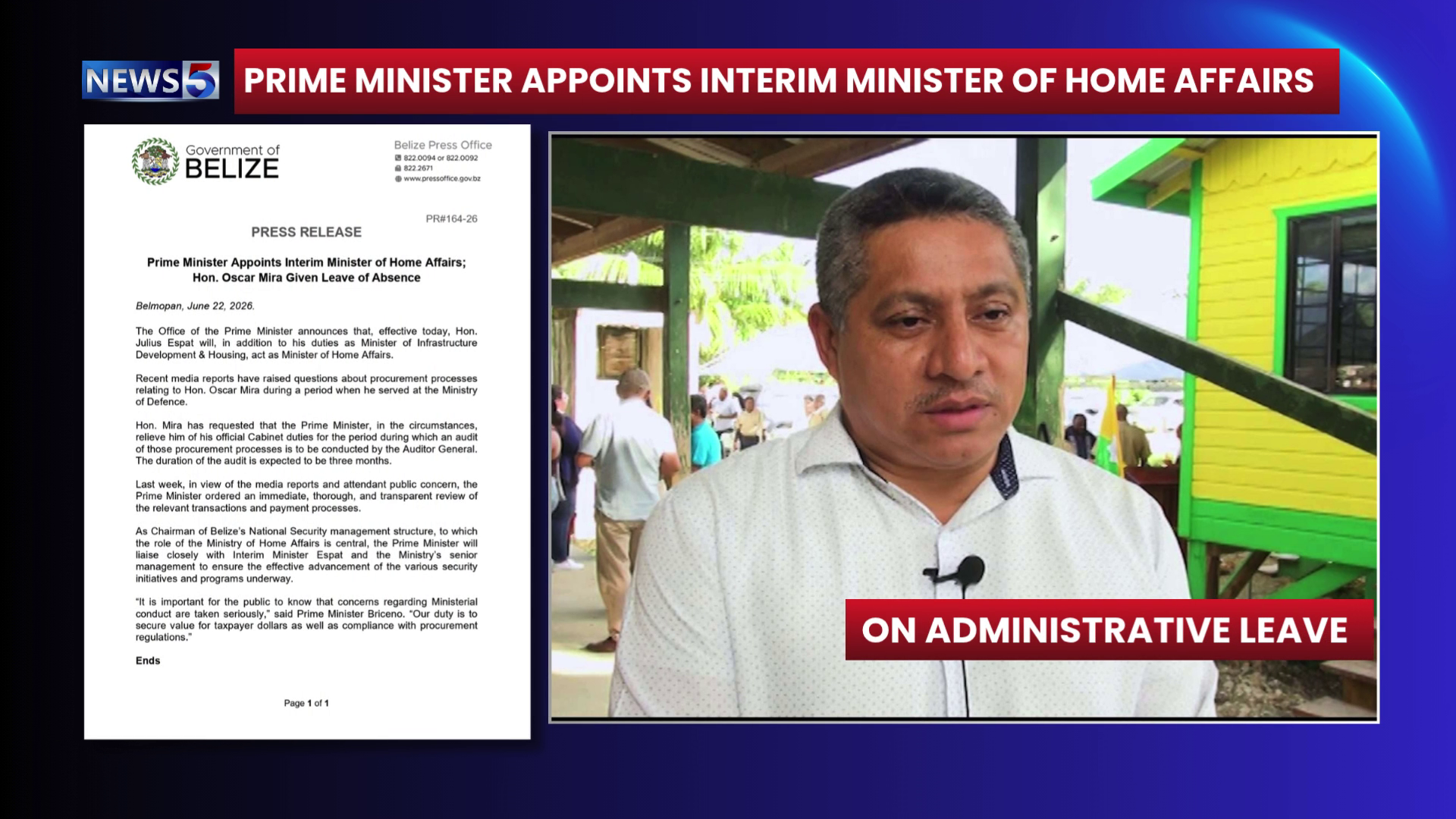
    In a significant reshuffle of Belize’s government triggered by growing controversy over public procurement, Prime Minister John Briceño has placed Cabinet Minister Oscar Mira on administrative leave and ordered a full independent audit into contracting practices during Mira’s tenure at the Ministry of Defense. The development marks the most high-profile fallout to date from the ongoing Smart Stream revelations, which have already forced sweeping changes to the country’s governing structure.

    To ensure no disruption to core public and national security operations, Briceño moved swiftly to fill the temporary vacancy, appointing senior Minister Julius Espat to serve as interim head of the Ministry of Home Affairs. The decision did not come out of the blue: it follows weeks of intensifying public scrutiny and critical media reporting that has raised serious questions about the awarding and payment of government contracts linked to Mira’s portfolio. Those unaddressed concerns ultimately prompted the Auditor General of Belize to launch a full formal investigation into the allegations.

    Per an official statement released from the capital Belmopan, Mira personally requested to step aside for the duration of the audit, a process that is projected to take approximately three months. The Prime Minister framed the voluntary exit and subsequent audit as a cornerstone of his administration’s commitment to transparent governance. “We take concerns about ministerial conduct seriously,” Briceño explained in a phone interview with reporters, emphasizing that the government has a non-negotiable obligation to guarantee taxpayer funds deliver full public value and that all procurement regulations are strictly followed. Briceño also praised Mira’s decision to step aside voluntarily, noting that the move should be admired as the right choice to protect the integrity of the investigation.

    “Mira said stepping aside would eliminate any perception that he could interfere or influence the audit process, and that the decision was in the best interest of his portfolio, his constituents, Cabinet, and the entire country,” Briceño recounted.

    When selecting an interim successor, Briceño said he ultimately settled on Espat for his proven track record and strong existing leadership team, noting that Espat is well-positioned to continue the core work Mira had overseen without interruption over the 90-day audit period.

    The stakes of the reshuffle are far from low: the Ministry of Home Affairs holds a central role in Belize’s national security framework, which Briceño personally chairs. The Prime Minister confirmed he will maintain close oversight of the ministry’s day-to-day operations throughout Espat’s interim tenure. Right now, the government is working to project stability and maintain normal public services even as the investigation ramps up behind closed doors.

    The outcome of the entire controversy will hinge entirely on what the audit uncovers. For the moment, the Government of Belize is walking a careful line: keeping critical public services running, reassuring an anxious public, and demonstrating a willingness to act swiftly when questions of impropriety arise. But with the audit now underway and political pressure continuing to build, this story is far from reaching its conclusion.

  • Inside the Payments: $5.7 Million to Minister Mira’s Family Business

    Inside the Payments: $5.7 Million to Minister Mira’s Family Business

    An independent investigative probe by Belize-based outlet News Five has uncovered a two-year pattern of undisclosed government payouts totaling $5.7 million in taxpayer funds to a private agribusiness with direct ties to the family of sitting cabinet minister Oscar Mira. The investigation’s findings, drawn from more than 60 direct screenshots extracted from the government’s own internal financial management platform Smart Stream, paint a troubling picture of unorthodox financial processing that has sparked intense scrutiny over public procurement protocols and potential conflicts of interest.

    A deep dive into 620 recorded transactions confirms that the repeated payments were directed to MP Farms, a company officially owned by Mira’s brother Stanley Mira, with a second brother, Brian Mira, listed as the primary point of contact for the business. The payments stretch from September 2024 through June 2026, with the overwhelming majority of the funds – approximately $5.6 million of the total $5.7 million – originating from the Ministry of Defense and Border Security, the department overseen by Mira. An additional $139,000 was disbursed across 11 separate invoices from the Prime Minister’s Office, earmarked for what are listed as grocery supply services.

    Analysis of the transaction data reveals clear, unusual spikes in payout activity, with the three largest monthly disbursements recorded in May, September, and December of 2025. September 2025 alone saw 103 invoices processed for a total of $901,899.83, followed by December 2025 with 78 invoices summing to $704,808.44, and May 2025 with 76 invoices totaling $691,225.99. Even more alarming to oversight observers is the volume of invoices cleared for payment in single business days: on September 25, 2025, 54 invoices worth a combined $482,751.45 were processed; on December 1 of that same year, 49 invoices totaling $446,661.36 were approved; and just six months prior on May 30, 2025, 46 invoices adding up to $418,836.84 cleared the system. Combined, these three single-day payouts exceed $1.3 million, nearly a quarter of the total two-year disbursement.

    This bulk processing pattern has raised urgent questions about whether required financial reviews were actually conducted before approval, or if the payments were simply signed off in mass batches without appropriate oversight. One particularly unusual transaction saw an identical payout of $152,834.28 processed twice: once on December 3, 2024, and again on January 16, 2025, both sent directly to MP Farms via the Smart Stream system.

    The overall growth in payouts also raises flags: between September and December 2024, total payments to the company hit just over $461,968. That figure surged dramatically to nearly $4 million in all of 2025, with more than $1.7 million of that total disbursed in the second half of the year. As of June 2026, payments have already reached approximately $1.3 million, putting the current year on track to exceed 2025’s disbursement levels.

    Investigators also noted a deliberate pattern of structuring invoices to avoid mandatory oversight protocols: out of the 613 total processed invoices, 600 were issued for amounts under $10,000 – the official threshold that triggers additional review from the Ministry of Finance and requires a competitive formal tendering process. Only 13 invoices exceeded the $10,000 threshold, and 7 were later marked as cancelled for unstated reasons.

    In response to the publication of the investigative findings, News Five reached out to Prime Minister John Briceño for comment on the mounting public concerns over the transactions and their impact on public trust in government. When asked how he reacted to learning that close to $6 million in taxpayer funds had been directed to a sitting minister’s family business over two years, Briceño acknowledged that the situation merited investigation, but urged the public to avoid jumping to conclusions before a formal review is completed.

    “Of course it is something to question,” Briceño stated in a phone interview. “But let us not get carried away by the number. Let us look at ensuring that there was value for money. That to me is even more important than the appearance. But let us wait until we get the report.” When pressed whether the transactions amounted to nepotism, Briceño said that Minister Mira has denied any involvement in securing the contracts, and that he accepts Mira’s denial at this stage. “When he came to see me this morning, Minister Mira says he was not involved in anyway with any of these issues,” Briceño explained. “And so, it is easy to cast aspersions, point fingers, but when he is telling me that he is not anyway involved then I think it is difficult to say that he was the one behind it, because he wanted his family to get these contracts.”

    The investigation is ongoing, with public accountability advocates calling for a full independent audit to determine whether proper protocols were followed and whether public funds were misused.

  • Can One Minister Handle Two Major Portfolios?

    Can One Minister Handle Two Major Portfolios?

    In a sudden political shift that has put Belize’s governing apparatus under close public scrutiny, senior minister Julius Espat has been appointed to oversee two critical government portfolios simultaneously, following the resignation of Oscar Mira who stepped down amid mounting public controversy.

    The appointment, formalized after a private conversation between Espat and the prime minister on the evening of June 21, 2026, tasks Espat—already the incumbent minister for Infrastructure Development and Housing—with serving as acting Minister of Home Affairs for a minimum three-month term. For Espat, the new role represents one of the steepest political challenges of his career, a burden he has acknowledged openly while framing the appointment as a matter of loyalty and public duty.

    “It was a shock when I got the call,” Espat shared in a phone interview with reporters. “The prime minister asked me to take on this additional responsibility, and after discussion, I accepted. It is one of the biggest challenges I believe I will have in my life. But we are here to serve. I am loyal to the party, the government, and our prime minister, so I saw it as my responsibility to at least give it a try.”

    Mira’s exit came after weeks of sustained public and political pressure over unsubstantiated controversies, details of which have not yet been released to the general public. Espat pushed back against narratives that frame Mira’s departure as a major political failure for the ruling administration, emphasizing that personal decisions amid public pressure must be respected.

    “I don’t think it is a downfall,” Espat said. “Nobody has the full details as yet. He has been under sustained onslaught, no doubt. But he is a smart man, and I wish him all the best. Decisions politicians make are not only for ourselves—they affect our families, our constituents, our colleagues, our party, and the entire country. We have to respect that each person handles pressure differently, and decisions can’t be taken lightly.”

    Espat added that he had not received full details of the circumstances surrounding Mira’s exit, noting only that the appointment was offered at Mira’s suggestion. Moving forward, he says his first priority is to receive a full departmental briefing to map out institutional responsibilities, chain of command, and ongoing priorities before laying out a public agenda.

    The stakes of the appointment could not be higher. Espat is the third minister to lead the Ministry of Home Affairs in less than 12 months, a rapid turnover that has fueled public concern over institutional stability and leadership at a time when Belize is grappling with a sharp spike in violent crime. Just recently, the fatal shooting of a pregnant woman near Hattieville sent shockwaves across the nation, and dozens of homicide cases remain unsolved, leaving many communities demanding urgent action to restore public safety.

    With Espat now tasked with juggling two of the government’s most demanding portfolios at once, political observers and ordinary citizens alike are watching closely to see if he can steady the embattled ministry and deliver tangible progress on public security. The three-month acting appointment will offer an early test of whether the government can restore public confidence amid ongoing turbulence.

  • NTUCB Demands Mira’s Immediate Resignation

    NTUCB Demands Mira’s Immediate Resignation

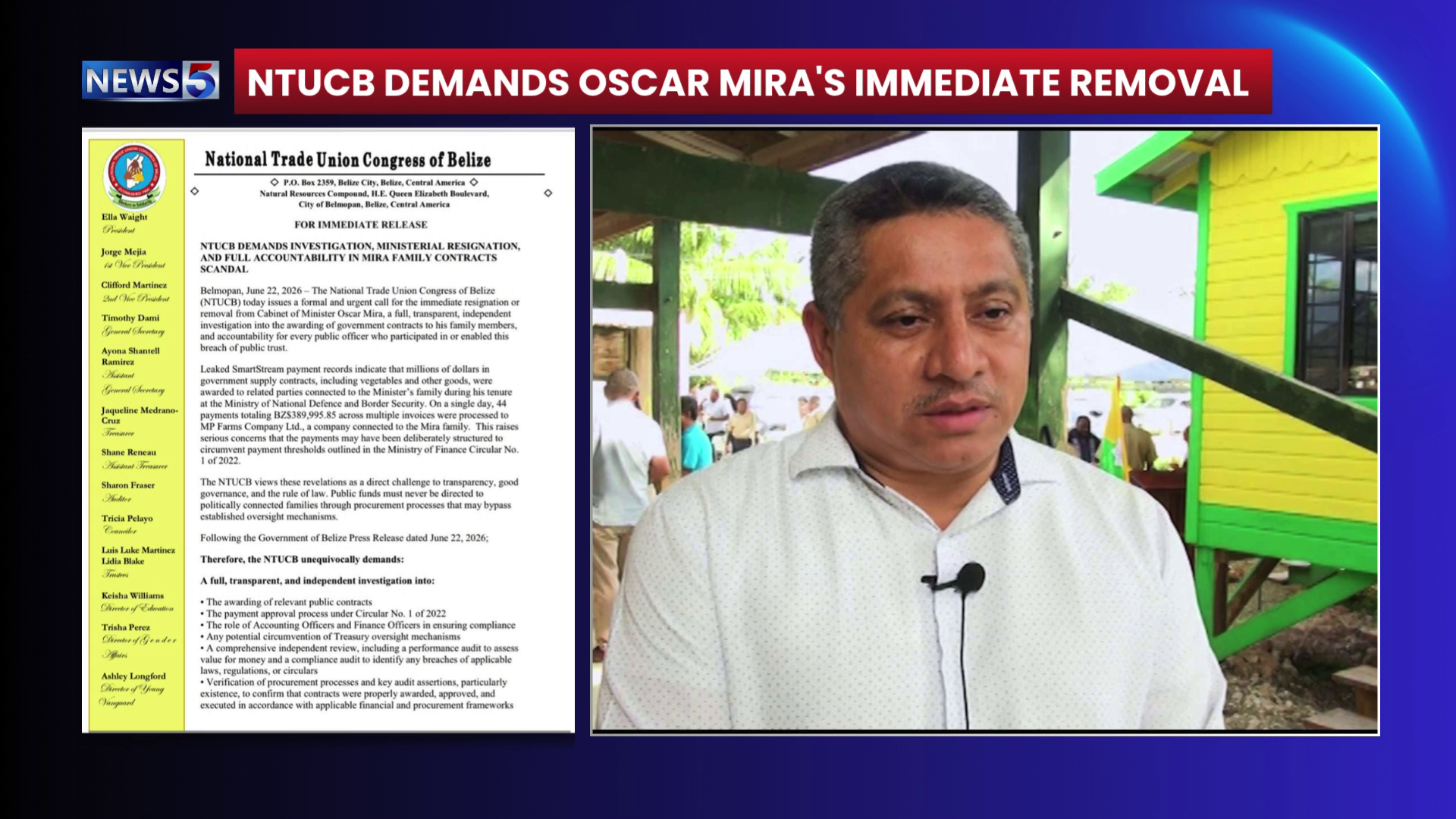
    As public outrage builds over a widening contracting scandal tied to a Belizean cabinet minister, the nation’s largest labor umbrella organization has added its powerful voice to calls for urgent accountability, joining the Public Service Union in demanding immediate action. The National Trade Union Congress of Belize (NTUCB) is publicly calling for Infrastructure and Home Affairs Minister Oscar Mira to step down immediately, alongside a full, independent probe into millions in public contracts awarded to firms linked to Mira’s immediate family. The investigation, the union says, must dig into alleged irregularities exposed by leaked documents from Smart Stream Technologies, Belize’s government financial management platform. These leaked records, NTUCB argues, reveal suspicious contracting patterns that appear designed to intentionally evade the nation’s financial oversight regulations, putting hundreds of thousands in taxpayer dollars at risk of improper use.

    In a strongly worded official statement, the national labor congress stressed that the controversy extends far beyond the actions of a single sitting minister. At its core, the dispute has become a test of the current government’s commitment to upholding public trust, institutional transparency, and the integrity of guardrails put in place to protect public funds from misuse. Beyond Mira’s resignation, NTUCB is also calling for full accountability for any senior public officials found to be complicit in the irregularities, as well as sweeping legislative and regulatory reforms to close what it describes as systemic loopholes in Belize’s government procurement process. For Belize’s labor leaders, the outcome of this scandal will serve as a critical benchmark of how seriously the government takes its commitments to good governance.

    The opposition United Democratic Party (UDP) has thrown its full support behind NTUCB’s demands, amplifying pressure on the ruling People’s United Party (PUP) administration to take decisive action. Opposition Leader Tracy Panton has publicly derided the government’s recent decision to grant Mira a temporary leave of absence as nothing more than a bad joke, arguing that the half-measure falls far short of the full accountability Belizean voters deserve.

    Panton forcefully pushed back against the government’s incremental response, saying: “This is so offensive and such a slap in the face to the Belizean people. This administration promised, through a motion passed in the National Assembly, that they would embed good governance, transparency, and accountability into every level of public office. Here we have a sitting member of the executive, a core cabinet minister, and the evidence of wrongdoing is staggering—it’s overwhelming. In my view, a temporary leave of absence is the bare minimum. Mr. Mira must do the honorable thing: he should not wait to be stripped of his executive responsibilities. He should have voluntarily stepped down from cabinet and surrendered all his ministerial appointments long before this.”

    She went on to criticize Prime Minister John Briceño for failing to uphold his own stated zero-tolerance policy on corruption, adding: “The prime minister went on record, he introduced a motion in the National Assembly that amounted to a legal commitment to zero tolerance for corruption. Yet when corruption has reared its ugly head, this administration refuses to act in the best interest of the Belizean people, their own government, and the nation as a whole. That is wholly and completely unacceptable.”

    As pressure builds both in public and within government circles, cabinet is set to convene a high-stakes meeting on Tuesday that will place the Mira controversy at the top of its agenda. Deputy Prime Minister Julius Espat, who stepped in to take over control of the Ministry of Home Affairs after Mira’s leave was announced, has already publicly stated he is pushing for full, unflinching answers into the contracting irregularities. Cabinet Minister Anthony Mahler has also confirmed that the scandal is a formal item on the meeting’s agenda, confirming that the controversy will not be swept under the rug despite internal government pressure to downplay the issue.

    Speaking to reporters ahead of the closed-door meeting, Mahler noted: “For my own ministry, I can speak clearly: I have a very competent, capable CEO with impeccable integrity who oversees all our procurement processes. I don’t get involved in day-to-day contracting work—the government system is too slow for my patience, so she handles all of that properly. But we will have a full discussion of this controversy in cabinet tomorrow, as far as I’m aware. I’ve been out of the country for a week and a half, so we’ll wait to see where the conversation goes.”

    As tensions rise ahead of the cabinet meeting, the unfolding scandal has put the PUP administration’s commitment to anti-corruption and good governance to its most high-profile test, with the public and organized labor watching closely to see what actions emerge from Tuesday’s closed-door discussions.