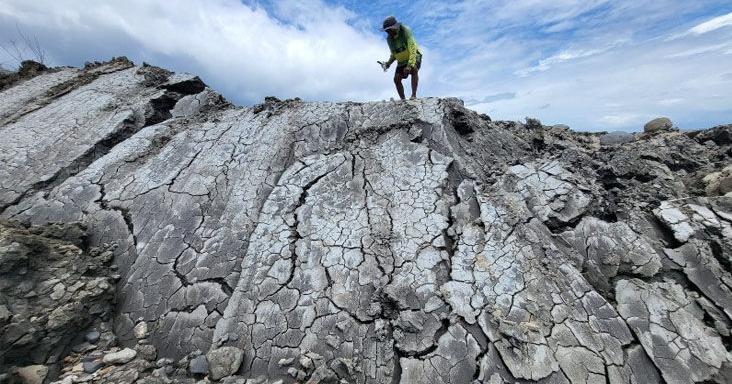
Last week’s pair of powerful back-to-back earthquakes that devastated northern Venezuela triggered an extraordinary geological shift hundreds of kilometers away, pushing a remote stretch of Trinidad’s southwestern Galfa coastline upward by nearly 20 feet in seconds. The sudden uplift left hundreds of marine species trapped on the newly exposed seabed, where most perished quickly.
博客
-
Hadeed’s search warrants reveal conspiracy to murder probe
A prominent Trinidadian businessman and his wife have hit a legal roadblock in their bid to secure release from police custody, after the High Court dismissed their habeas corpus application earlier this week, amid an ongoing investigation into allegations of conspiracy to commit murder.
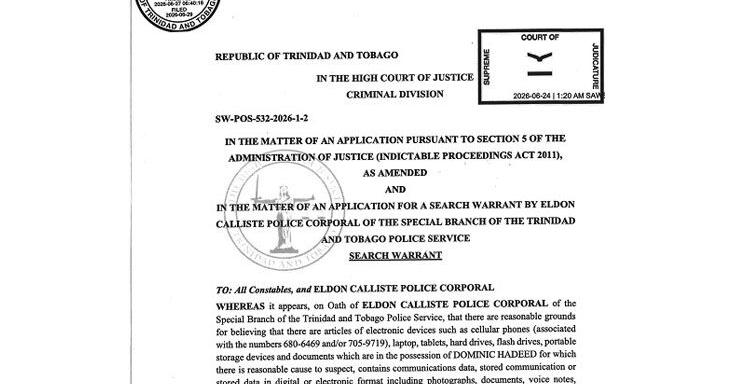
The case centers on Dominic Hadeed, a well-known local businessman, and his spouse Genevieve Hadeed, who were taken into police custody following the execution of court-approved search warrants at multiple properties linked to the couple, carried out by officers from the Trinidad and Tobago Police Service’s Special Branch. Issued on June 24 by Master Valene Guerra-Abraham under Section 5 of the 2011 Administration of Justice (Indictable Proceedings) Act, the search warrants explicitly authorized law enforcement to seize and forensically examine a broad spectrum of electronic devices and stored digital data tied to the conspiracy probe.
The investigation itself is being conducted under Section 5(a) of the Offences Against the Person Act, Chapter 11:08, which criminalizes conspiracy to commit murder as an indictable offence. Separate warrants for each spouse laid out the specific locations to be searched: Genevieve Hadeed’s properties at #2 Orange Grove Estate in Trincity and #47 Western Circle in Westmoorings, while Dominic Hadeed’s locations were #1-3 Golden Grove Road in Piarco and #23 Pine Avenue, Bayshore in Westmoorings, plus the Blue Waters offices in Orange Grove. Officers were granted permission to enter the premises at any time, seize all relevant devices, extract stored data, and submit the collected evidence to the High Court for review.
Per the terms of the warrants, police were authorized to seize every type of digital device, including smartphones, laptops, tablets, external hard drives, portable flash drives, and physical paper documents. The scope of the data extraction covered all potentially relevant information: communication logs, stored messages, photographs, voice notes, audio and video recordings, closed-circuit television footage, text messages, GPS location history, and application-specific data. A handwritten inventory attached to subsequent court documents confirms law enforcement seized a range of devices, including multiple Apple iPhones, Samsung handsets, Apple laptops, iPads, a Dell Latitude laptop, multiple flash drives, and a full computer processing unit from the searched locations.
Representing the couple, senior counsel Faris Al-Rawi filed the habeas corpus application with the High Court, attaching copies of the executed search warrants to his supporting affidavit. Al-Rawi’s core legal argument centered on the claim that the Hadeeds were arrested during the execution of standard search warrants tied directly to the conspiracy to murder investigation, not under the 2026 Emergency Powers Regulations. He contended that the police’s subsequent use of emergency powers to extend the couple’s detention was legally invalid. “The Applicants were not arrested or detained under Regulation 13(1) of the Emergency Powers Regulations, 2026, nor under those Regulations at all. They were arrested in the execution of ordinary search warrants in respect of the offence of conspiracy to murder, which is not an offence against the said Regulations. The only basis advanced by the Respondent for the continued detention of the Applicants appears to be the Emergency Powers Regulations, which do not apply to the Applicants,” Al-Rawi stated in his affidavit.
After hearing initial arguments, Justice Frank Seepersad ruled to dismiss the habeas corpus application seeking immediate release of the couple from custody. However, the judge issued a formal directive to Police Commissioner Allister Guevarro to deliver official clarification on whether the Hadeeds are currently being held under a Preventive Detention Order (PDO). The next stage of the legal proceeding has been scheduled for a virtual hearing to be held at 9 a.m. the following day, as the court works to resolve the dispute over the lawfulness of the couple’s detention.
-
US$6.7b in damage
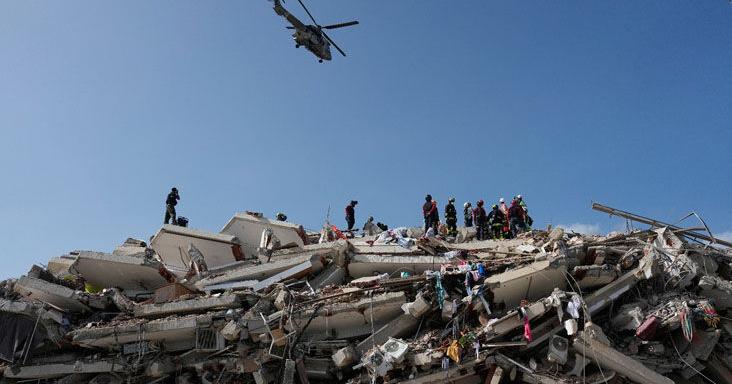
Just hours after a pair of powerful earthquakes struck Venezuela’s northern coastline last Wednesday, the United Nations Development Programme (UNDP) completed a rapid satellite-powered damage assessment that paints a stark picture of the disaster’s scale. The preliminary Rapid Digital Assessment (RAPIDA) pegs direct physical damage from the magnitude 7.2 and 7.5 quakes at an estimated US$6.7 billion – a sum equal to roughly 6% of the South American nation’s total annual gross domestic product.
The twin tremors were felt across Venezuela’s most densely populated and economically critical regions, including the capital city of Caracas and the coastal and inland states of La Guaira, Carabobo, Miranda, Yaracuy, and Aragua. According to the UNDP’s analysis, released publicly this week, approximately 8.6 million people across northern Venezuela were exposed to at least moderate shaking, with 2.1 million experiencing stronger, more destructive seismic activity. As of June 26, the official national death toll stands at 920, though UNDP officials note that casualty numbers are likely to climb as search-and-rescue teams continue working through damaged and collapsed structures.
In total, around 1.7 million buildings sit in the affected zones, with large concentrations located in the hardest-hit states. The UNDP’s mid-range estimate for direct damage puts the figure between US$4.7 billion and US$8.7 billion, with the majority of losses tied to destroyed or damaged residential housing and critical economic assets. Importantly, this preliminary figure does not account for damage to public infrastructure, broader national economic disruptions, or long-term reconstruction costs. Historical disaster data shows that total disaster impact typically lands between 1.5 and 3 times the value of calculated direct damage, meaning the final overall cost could reach as high as $26 billion. Satellite analysis also detected measurable reductions in night-time light output across parts of Carabobo, La Guaira, Caracas and Aragua, indicating widespread, persistent power outages in those regions in the immediate aftermath of the quakes.
Luis Francisco Thais, UNDP Resident Representative in Venezuela, emphasized that rapid, data-driven assessments are foundational to effective disaster response planning. “The speed and accuracy of early assessments are essential for an effective response,” Thais explained. Unlike traditional on-the-ground assessments that can take days or weeks to compile initial data, RAPIDA leverages artificial intelligence, high-resolution satellite imagery, and Geographic Information Systems (GIS) technology to deliver a comprehensive situational overview within 72 hours of a crisis. The tool helps response teams quickly map damage, identify at-risk vulnerable populations, and coordinate cross-agency interventions. Thais added that disasters also present an opportunity to reframe long-term development: “Every crisis is an opportunity to rethink development strategies with resilience at their core. This ensures that recovery not only restores what was lost but also builds a more sustainable future.” The UNDP is continuing to refine its assessment as higher-resolution satellite imagery becomes available, with Venezuelan authorities still working to count displaced persons and map full infrastructure damage.
Beyond the damage assessment, regional development bank CAF – Development Bank of Latin America and the Caribbean – has moved quickly to support recovery efforts, announcing the launch of a dedicated Venezuela Recovery and Reconstruction Fund this week. The new fund is designed to pool public and private donations from around the world, channeling resources directly to the reconstruction priorities identified by the Venezuelan government. The mechanism aims to cut through fragmented aid delivery to speed up recovery in impacted communities.
CAF is kicking off the fund with an initial US$1 million in seed capital, added to the $300,000 in humanitarian assistance the bank previously pledged. Critically, the bank will not charge any administrative fees for the fund, ensuring 100 percent of all donations go directly to emergency response and reconstruction work.
“Acts of nature are met with acts of humanity and solidarity, and Venezuela needs us today more than ever,” said Sergio Díaz-Granados, CAF’s executive president. As a founding member of CAF and the host country for the bank’s headquarters, Venezuela holds a unique place in the institution’s history, he explained. “We are launching this fund for reconstruction: an agile and transparent mechanism that we invite governments and the private sector to join, so that their contributions, together with ours, become part of an effective response. Our commitment is to accompany the Venezuelan people not only during the emergency, but throughout the entire path of recovery and reconstruction that lies ahead.”
The fund will roll out in three sequential phases, aligned with the progression of disaster recovery. The first phase focuses on immediate emergency relief and life-saving humanitarian aid. The second phase prioritizes restoring core essential services, including healthcare, water and sanitation, energy access, education, and digital connectivity. The final phase will focus on long-term infrastructure rebuilding, restoring local livelihoods for displaced and impacted communities, and upgrading construction standards to improve resilience against future natural disasters.
To ensure full transparency and accountability, all fund resources are held separately from CAF’s own operating capital, with full traceability for every individual intervention, regular public financial reporting, and independent third-party audits. Donations can be made in either U.S. dollars or euros, and resources can be deployed flexibly through pre-vetted implementing organizations or managed directly by CAF when that structure proves more efficient. In a statement, CAF reaffirmed its long-term commitment to leveraging its technical and financial capacity to mobilize regional and international solidarity in support of the Venezuelan people through the entire recovery process.
-

More Than a Music Festival: St. Kitts Music Festival 2026 Ends on a High Note – WIC News
From June 25 to 27, 2026, the Caribbean island of St. Kitts played host to one of the region’s most anticipated annual cultural gatherings, drawing thousands of global music fans to Basseterre’s Warner Park Stadium for the 28th iteration of the St. Kitts Music Festival. Far more than a simple series of concerts, this year’s event blended top-tier international talent, beloved regional Caribbean acts, heartfelt cultural tributes, and innovative new attendee experiences to deliver a three-day celebration that left audiences eager for the next edition.
Headline performances delivered the high-energy moments that quickly went viral across social platforms. Soca icon Machel Montano’s opening weekend set dominated post-festival conversation, with thousands of attendees dancing and singing along to every track from the artist’s first step on stage to his final encore. Local St. Kitts radio personality Sweet Sister Sensia summed up widespread fan reaction in a viral Facebook post, writing, “If there was ever any doubt why he’s called the King of Soca, tonight was your answer. From start to finish, Machel tore up that stage – the energy, the vocals, the crowd connection, it all earned a perfect 10/10. He didn’t just perform, he gave us an experience we’ll talk about for years.”
Day two of the festival brought R&B favorite Kehlani to the main stage, where the multi-platinum artist earned rave reviews from local and international attendees alike. Local resident Olivia summed up the crowd’s response, noting, “Kehlani was incredible from the moment she entered the stage till she left. It was smooth, soulful, just perfect – I absolutely love her.”
While international draws drew large crowds, regional Caribbean music emerged as one of the festival’s standout highlights. Dominica’s Signal Band brought the infectious rhythm of bouyon music to the stage, with performance clips spreading rapidly across Caribbean social media. Fans repeatedly described bouyon as “more than music, it is a movement,” praising the genre’s irresistible energy. St. Kitts own Nu Vybes Band International also earned a perfect 10/10 rating from most attendees, with their seamless pacing, skilled musicianship, and infectious crowd engagement turning their set into one of the weekend’s biggest success stories. Viral social media posts from the performance were dominated by fire emojis and the band’s breakout lyric “Ah cyah behave meh self,” which perfectly captured the electric atmosphere inside the stadium. Rucas H.E. Empire and V’ghn kept the momentum going through the weekend, delivering nonstop high-energy sets that won glowing praise from both in-venue and online audiences.
One of the festival’s most talked-about moments was not a headlining performance, but a heartfelt tribute to a local legend. The All Star Band’s homage to the late King Ellie Matt, one of St. Kitts and Nevis’ most influential musical icons, drew tearful, heartfelt reactions from attendees. Many called the tribute a “masterclass” in cultural remembrance, and the crowd’s unified reaction to the performance of Matt’s hit track “Drop It” quickly became the festival’s most shared moment, with thousands of attendees erupting in unison as the first notes played across the stadium speakers.
Organizers also won praise for innovative new additions that improved the overall attendee experience. This year’s launch of the Fete Land entertainment zone eliminated long lulls between main stage set changes, giving local DJs and emerging performers a space to keep crowds engaged while the main stage was reset. Attendees took to social media to applaud the new concept, noting it kept the festival’s energy consistent from the first act to the last. Pre-festival excitement also reached a fever pitch thanks to a creative promotional campaign from Jamaican dancehall artist Shaneil Muir, who launched a social media talent contest inviting fans to upload original singing and rap clips for a chance to win a VIP festival experience. The campaign generated massive fan engagement and built widespread anticipation ahead of the festival’s opening night.
The festival wrapped its 28th iteration on a high note with a grand finale night blending smooth R&B, soul, and timeless reggae. Headliner Fantasia delivered a showstopping performance, captivating the crowd from start to finish with her powerhouse vocals, raw heartfelt emotion, and commanding stage presence. Fans left the performance calling it a fitting capstone to the weekend, noting it would be remembered as one of the festival’s best closing sets for years to come. Reggae legend Beres Hammond followed with a soulful set of his most iconic timeless hits, reminding attendees why his voice remains one of reggae’s most beloved. By the end of the final night, attendees were already sharing their excitement for next year’s festival, cementing the St. Kitts Music Festival’s reputation as one of the Caribbean’s premier cultural and musical events.
-
Aardbeving Venezuela: Dodental loopt op tot 1.430, nieuwe beving zaait angst
A devastating double major earthquake that struck Venezuela earlier this week has left more than 1,400 people dead, with rescue teams across the globe scrambling against time to pull any remaining survivors from the rubble as the critical 72-hour post-disaster survival window nears its end.
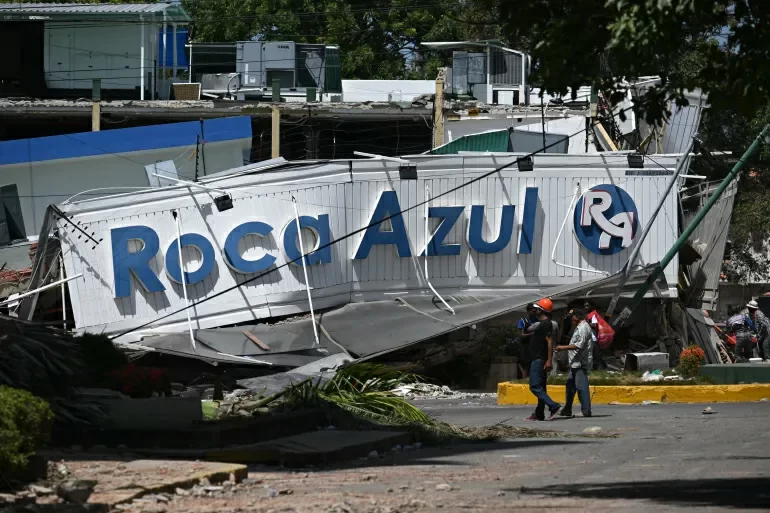
On Wednesday evening, two powerful back-to-back earthquakes measuring magnitude 7.2 and 7.5 hit just under a minute apart, leaving widespread destruction across the northern coastal state of La Guaira and parts of the capital Caracas. Hundreds of structures have collapsed, and tens of thousands of people remain unaccounted for, according to official updates.
The already desperate relief effort was disrupted on Saturday, when a new 4.8-magnitude tremor shook the affected region, adding to the hundreds of aftershocks that have rattled the area since the initial quakes. Seismological officials from Venezuela’s national institute Funvisis have recorded more than 300 aftershocks following the initial disaster, some as strong as magnitude 5.5. The Saturday tremor, registered by both the European-Mediterranean Seismological Centre (EMSC) and the U.S. Geological Survey (USGS), hit offshore of northern Aragua state at 3:20 p.m. local time, roughly 70 kilometers west of Caracas. No major damage was immediately reported from this latest shake, but the constant seismic activity has not only stoked widespread fear among local residents, it also puts rescue workers searching unstable rubble piles at severe risk.
International aid has poured into the country to support the search and rescue mission. The United Nations reports that more than 1,600 foreign rescue personnel, 100 search canines, and 39 specialized response teams from dozens of countries have already deployed to the disaster zone. Major nations including the United States, Mexico, Spain, Russia, and the United Kingdom have contributed personnel and resources to the operation. UNICEF has allocated $2.5 million in emergency funding, while the World Food Programme has pre-positioned food supplies to support more than 10,000 displaced families.
Despite the massive international support, chaos and desperation grip the hardest-hit areas. Local residents have criticized the Venezuelan government for poor coordination of rescue efforts, with many families taking recovery into their own hands, digging through debris with their bare hands in La Guaira, which is now under military control. The crisis is compounded by widespread mobile phone and internet outages, making it nearly impossible for separated families to reconnect. “People are still terrified to go back to what used to be their homes,” said Loyce Pace of the International Committee of the Red Cross.
Amid the widespread tragedy, one small moment of hope has emerged: an 18-day-old newborn was pulled alive from rubble in La Guaira after being trapped for 32 hours. Rescuers believe the infant was protected by its mother, who was pulled alive from the debris an hour after the baby was rescued.
Venezuelan officials have warned that the confirmed death toll will continue to climb as search teams clear more debris. The United Nations estimates that total infrastructure damage from the quakes will reach between $4.7 billion and $8.7 billion. As hopes of finding more survivors fade, response efforts are already beginning to shift from search and rescue to providing emergency shelter and basic aid to the tens of thousands of people left homeless by the disaster.
-

Canada, CARICOM Renew Strategic Partnership with Focus on Security, Climate and Trade
In a high-stakes diplomatic gathering that underscores deepening North American-Caribbean cooperation, Canada and the Caribbean Community (CARICOM) have formally renewed their long-standing strategic partnership, aligning their shared priorities around three critical pillars: regional security, climate change resilience, and expanded bilateral trade. The renewed agreement, struck during high-level talks between Canadian officials and leaders of CARICOM’s 15 member states, builds on decades of collaborative engagement while updating the framework to address 21st-century challenges that have grown increasingly urgent for both blocs.
On the security front, the partnership commits both sides to enhanced information sharing, joint capacity-building for Caribbean law enforcement agencies, and coordinated action to disrupt transnational criminal networks trafficking drugs, weapons, and people across the Caribbean region. Canada has pledged targeted technical support and training to help CARICOM nations strengthen border control and counter illicit activities that undermine regional stability.
Climate action stands as a central, urgent pillar of the renewed agreement, reflecting CARICOM members’ status as some of the world’s most climate-vulnerable nations, despite contributing minimally to global greenhouse gas emissions. Canada has reaffirmed its commitment to scaling up climate finance for adaptation and mitigation projects across the Caribbean, ranging from coastal infrastructure protection against rising sea levels to support for transitioning to renewable energy sources. Both sides also agreed to deepen collaboration on international climate negotiations to push for more ambitious global emissions reduction targets.
On trade, the updated partnership aims to remove existing barriers to bilateral commerce, expand market access for Caribbean goods and services in Canada, and unlock new opportunities for Canadian investment in key Caribbean sectors including tourism, renewable energy, and agriculture. Leaders from both sides emphasized that deeper economic integration will support inclusive growth and job creation across the Caribbean, while opening new commercial avenues for Canadian businesses.
Diplomatic observers note that the renewed partnership comes at a time of shifting global geopolitical dynamics, strengthening the bond between Canada and the Caribbean bloc as they work to address shared challenges that no single nation can tackle alone. Both sides have committed to holding regular high-level review meetings to track progress on the joint priorities and adjust the partnership as new challenges emerge.
-
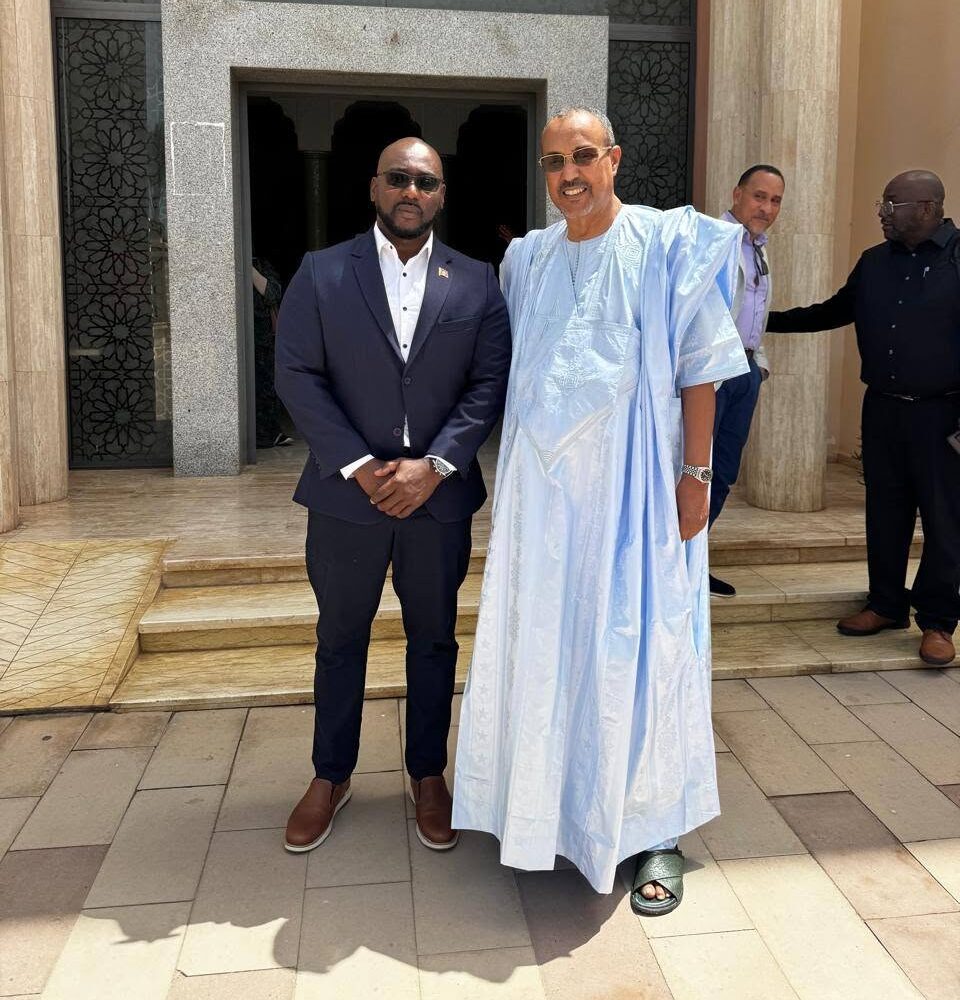
Senator Lamin Newton Represents Antigua and Barbuda at Morocco-OECS Economic Forum
Amid growing global momentum for expanding South-South economic collaboration, Senator Lamin Newton has stepped forward to lead Antigua and Barbuda’s official delegation at the high-profile Morocco-OECS Economic Forum, a landmark gathering designed to bridge North African and Caribbean economic interests.
The Organization of Eastern Caribbean States (OECS), which brings together 11 small island developing states across the Eastern Caribbean, has partnered with Moroccan authorities to organize the forum, with a core focus on unlocking new mutually beneficial partnerships across key sectors including tourism, renewable energy, agricultural innovation, blue economy development, and trade facilitation. For small island nations like Antigua and Barbuda, which face persistent economic vulnerabilities from climate change and global market volatility, building new diversified economic alliances is a strategic priority to drive sustainable growth and build resilience.
As the official representative of Antigua and Barbuda, Senator Newton is expected to outline the country’s key investment priorities, particularly in climate adaptation technology, sustainable tourism infrastructure, and offshore services development, while engaging in bilateral talks with Moroccan government officials and private sector delegates. The forum creates a rare structured platform for OECS member states to connect directly with North African economic stakeholders, opening pathways for knowledge sharing, technology transfer, and increased market access for Caribbean export products.
Diplomatic observers note that the forum marks a deepening of engagement between Morocco and the Caribbean region, aligning with both sides’ goals of reducing overreliance on traditional trading partners and expanding economic cooperation across the Global South. For Antigua and Barbuda specifically, participation in this dialogue offers an opportunity to advance its national development agenda while contributing to collective OECS efforts to strengthen regional integration and global economic influence.
-

Derde helft WK 2026: Spanning tot het einde; 3-3 Thriller in Groep J
Kansas City hosted one of the most thrilling group stage matches in recent tournament memory on June 28, as Algeria and Austria battled to a chaotic 3-3 draw that secured both nations a spot in the knockout round, eliminating Iran in heartbreaking fashion.
The entire contest carried high stakes from kickoff: the two sides went into the final group fixture locked in a direct battle for second place, where a loss for either would end their tournament run. A draw, however, would see both advance – Austria as group runners-up courtesy of a superior goal difference, and Algeria locking in third place.
Austria controlled possession in the opening exchanges, pressing high and probing Algeria’s defensive block for early gaps, though clear-cut chances remained elusive. In the 9th minute, Xaver Schlager tried his luck from long range, but his effort lacked both power and placement to trouble Algerian goalkeeper Abderrahmane Benbot. Two minutes later, veteran striker Marko Arnautovic picked up an early yellow card that kept him on thin ice for the rest of the match.
For the opening 15 minutes, Austria maintained sustained ball control, but Algeria’s backline held firm to block every attempted breakthrough, forcing a mid-quarter hydration break amid the intense Kansas City conditions with the score still locked at 0-0.
The deadlock finally broke in the 28th minute, when Arnautovic ran onto a perfectly weighted through ball, kept his cool under pressure, and slid the ball calmly under Benbot to put Austria 1-0 up. At that point in the virtual table, Austria looked set to advance, while Algeria sat on the brink of elimination.
Algeria responded quickly to going behind. After Rafik Belghali wasted an early equalizing chance, the North African side found the net just before halftime. A clever passing sequence down the right flank sent the ball bouncing off the corner flag back into play, and Belghali cut inside before unleashing a powerful left-footed strike into the near corner to level the score at 1-1.
After four minutes of stoppage time, Austria pushed one last time for a halftime lead, but Algeria held firm, and the two sides went into the break level – a result that all but guaranteed both would move on to the knockout stage.
Austria made three substitutions to start the second half, while Algeria opted to keep its starting XI on the pitch. The pace of the match slowed considerably, as a draw remained a mutually acceptable result for both camps.
That lull was broken in the 56th minute, when Konrad Laimer delivered a pinpoint cross to Marcel Sabitzer, who struck a controlled, firm finish past the goalkeeper to put Austria back in front 2-1. Once again, Algeria slipped into a virtual elimination spot.
Just as they did in the first half, Algeria fought back immediately. Five minutes after falling behind, Riyad Mahrez – the team’s star playmaker – scored a clinical equalizer after a clever build-up from Houssem Aouar, firing an unstoppable shot into the near corner to make the score 2-2.
Play settled back into a steady rhythm after the second equalizer, though Algerian substitute Rayan Ait-Nouri created several dangerous moments down the left flank. A second hydration break was called halfway through the second half to let players recover from the heat.
As the match entered its final minutes, both sides began pushing for a winning goal that would secure a higher knockout stage seeding, and it looked like the game would end with the score level – until Mahrez struck in the third minute of stoppage time. Combining once again with Aouar, Mahrez slotted home his second goal of the game to put Algeria ahead 3-2. The late strike sent Algeria’s fans into delirium, as the result would have eliminated Austria and sent Iran through to the knockout round in their place.
Algeria’s joy lasted less than three minutes. In the 96th and final minute of stoppage time, Austrian substitute Saša Kalajdžic rose above the defense to power a header into the back of the net, leveling the score at 3-3 and capping off one of the most dramatic finishes in tournament history. The late equalizer secured advancement for both Algeria and Austria, sending Iran home.
Mahrez was named Man of the Match for his two-goal performance that dominated the entire contest. Following the result, Austria will face Spain in their upcoming knockout round fixture, while Algeria will take on Switzerland.
-
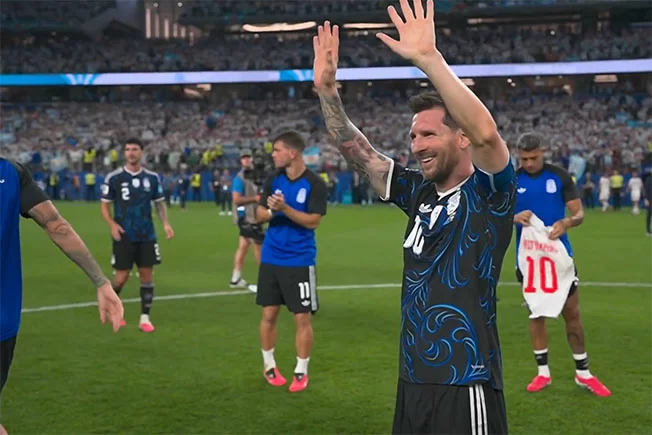
Derde helft WK 2026: Argentinië met volle winst naar eliminatiefase
DALLAS — World Cup debutant Jordan faced off against defending champion Argentina in a packed Dallas stadium on matchday three of Group J play. Heading into the fixture, Argentina had already secured back-to-back wins in their first two group matches, sitting comfortably atop the group standings with six full points. For Jordan, the encounter offered little at stake: the side had failed to pick up any points across their earlier two outings, and were playing just to fulfill their final group stage obligation.
Looking ahead to the knockout round, Argentine manager Lionel Scaloni opted to field a completely changed starting lineup, giving his star core much-needed rest after two intense opening matches. With talisman Lionel Messi having been responsible for almost all of Argentina’s goals in the tournament to date, many pundits and fans questioned whether the rotated side would still find the back of the net. Another storyline heading into kickoff was Argentina’s unbroken defensive record: the defending champions had not conceded a single goal through the first two matches, and Jordan was determined to become the first side to breach that line. Romanian referee Istvan Kovacs took charge of the contest.
The opening half got off to a fast start, with Giovani Lo Celso seeing an early goal ruled out for offside. The Tottenham midfielder did not let the setback slow him down, and in the 19th minute, he converted a perfectly placed free kick to put Argentina ahead 1-0, earning a nod of approval from Messi watching from the bench. In the 28th minute, Julian Alvarez was struck in the face after looping a header over Jordan’s goalkeeper, and a VAR review awarded Argentina a penalty. Inter striker Lautaro Martínez stepped up and buried the spot kick to double Argentina’s lead to 2-0 heading into halftime. Controversy struck before the break, however: VAR failed to award Jordan a penalty for a handball by Lo Celso inside his own penalty area, leaving Jordan trailing at the break without the chance to pull a goal back.
After halftime, Jordan emerged reinvigorated, carving out several clear scoring chances that failed to find the mark in the final third. In the 55th minute, Musa Al-Taamari became the first player at the 2026 World Cup to beat Argentine goalkeeper Emiliano Martínez, slotting home a consolation goal to cut the deficit to 2-1. Just over five minutes later, with the game still in the balance, Messi was brought off the bench to steady the ship and bring control back to Argentina’s play. In the 80th minute, after being fouled just outside Jordan’s penalty area, Messi stepped up to take the resulting free kick. He curled a clinical effort past goalkeeper Yazeed Abulaila to restore Argentina’s two-goal lead, extending his historic record by becoming the first player in men’s World Cup history to score in seven consecutive tournament matches.
The full-time whistle left Argentina with a 3-1 win and a perfect three wins from three group stage matches, securing their place in the knockout round where they will face World Cup underdog Cape Verde. The result confirms that even without Messi starting every match, Argentina has enough depth in attack to pick up results, with other talented players stepping up to contribute goals in the star’s rested absence. For Jordan, Al-Taamari’s goal proved that Argentina’s previously unbeatable defense is not unbreachable, giving the debut nation a historic milestone to take home from their first ever World Cup campaign.
-
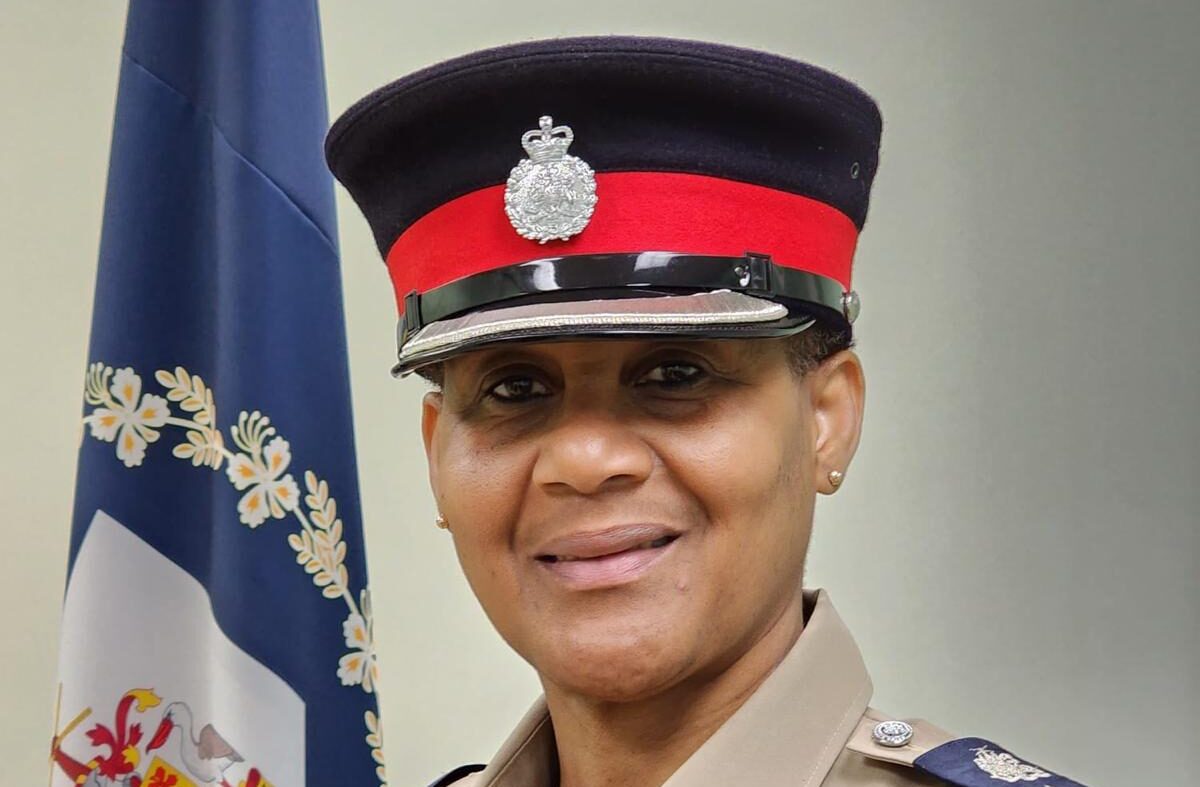
Deputy Commissioner Sonia Boyce to be appointed Commissioner of Police
A generational leadership transition is set to take place at the top of Barbados’ national law enforcement agency, with veteran officer Sonia Boyce formally tapped to succeed outgoing Commissioner Richard Boyce as the new head of the Barbados Police Service (TBPS). Her five-year appointment will officially go into effect on July 3, 2026, timed to align with Richard Boyce’s upcoming retirement that will open the agency’s top leadership post.