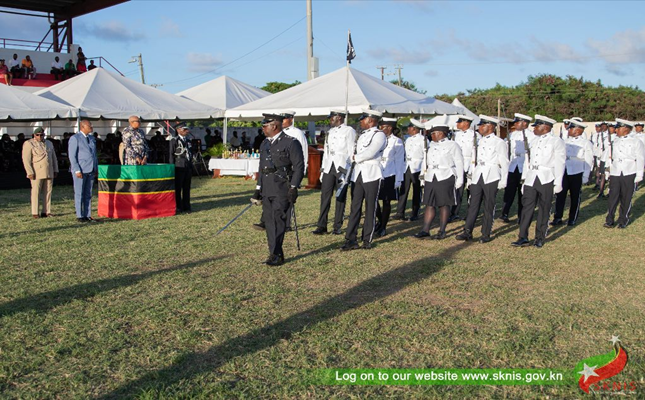
Basseterre, Saint Kitts – A new cohort of 28 trained police officers has officially joined the ranks of the Royal St. Christopher and Nevis Police Force, capping off half a year of demanding physical, mental, and academic training designed to prepare them for modern law enforcement challenges. The 20 men and eight women of Police Recruit Course #47 marked their achievement at a formal Passing Out Ceremony held October 8 at Newtown Playing Field, one day before the official public announcement of their graduation.
The passing out parade followed traditional police ceremonial protocols: the 28 recruits split into two platoons for inspection by Governor General Her Excellency Dame Marcella Liburd, then executed precision marches in both slow and quick time. Inspector Marvin Thompson, Commandant of the Police Training School, served as parade leader. Platoon One was commanded by newly minted Police Constable D’Angelo Thompson, while Cadet Cwana Francis led Platoon Two. Francis, who will turn 18 in the coming days, will officially transition to the rank of Woman Police Constable once her birthday passes.
Course #47 first began training on March 16, 2026, with a curriculum that balanced grueling physical conditioning, mental resilience building, and in-depth academic study of core police practices. Thompson outlined that the Police Training School’s core mission is to develop officers who are not only highly skilled and physically fit, but also dependable and equipped to tackle the evolving complexities of 21st-century law enforcement.
“We release them to go forth into the world of professional policing,” Thompson said in remarks following the parade. “We release them not to make a name for themselves, but to make a positive difference in the communities they serve. We release them as a vanguard of a young generation of officers who will serve their nation with pride, professionalism and dignity.”
The ceremony also included awards to recognize top-performing recruits throughout the training period. Constable Zavian Harris, badge number 500, claimed the honor of Best Recruit, taking home the Baton of Honour from Police Commissioner James Sutton, the Prime Minister’s Plaque from Acting Prime Minister Dr. Geoffrey Hanley, and the Best Recruit Trophy. Harris also won additional awards for excellence in weapons training and pistol marksmanship.
Other award winners included D’Angelo Thompson (badge 488), who took top honors for self-defense, drills, and kit preparedness. Tejohn Braide (badge 484) won the Best Rifle Shot award, while Tyrese Anderson earned recognition for top performance in police subject exams, and Cwana Francis claimed the award for highest scores on the final graduation exam. Nathan Huggins (badge 492) was named Most Improved Recruit, the Best Physical Training honor was split between K’Quancia Fraser (badge 489) and Raheim Browne (badge 482), and Ian Lewis (badge 491) and Gerisha Grant (badge 496) shared the Most Disciplined award.
In his congratulatory address to the graduating cohort, Commissioner of Police James Sutton urged the new officers to carry the lessons and core values of their training into every part of their new roles, noting that a career in law enforcement will bring no shortage of difficult moments. Sutton offered the new constables guiding principles for their service: “Be courageous but not reckless, be firm but always fair, be confident but remain humble, be vigilant but also compassionate.” He emphasized that the police badge carries a responsibility to maintain the public trust that is foundational to community safety.