
WASHINGTON, DC – A new wave of upward pressure is hitting global food markets, as climbing global temperatures and increasingly erratic weather patterns linked to climate change threaten agricultural output across major producing regions. Climate-driven extreme heat, prolonged drought and other environmental risks have emerged as key stressors for supply chains, stirring widespread concern among policymakers and industry stakeholders.
博客
-

iciHaiti – Education : Closing of the «Back to School» Camp
On September 4, 2026, Haiti officially concluded its week-long government-sponsored “Back to School” mega summer camp during a closing ceremony held at the Delmas Municipal Palace. The event brought together top officials from multiple national government bodies, including Pythagore Dumas, the country’s Minister of Youth, Sports, and Civic Action (MJSAC), alongside representatives from the Ministry of National Education and Vocational Training, Ministry of Public Health and Population, Ministry of Women’s Affairs and Women’s Rights, Institute of Social Welfare and Research, Haitian National Police, National School Feeding Program, and Dignité School Transportation Company.
Running from August 31 to September 4 under the official patronage of Haiti’s Prime Minister’s Office, the socio-educational initiative operated across four municipalities in Haiti’s capital region: Delmas, Port-au-Prince, Pétion-Ville, and Kenscoff. It drew more than 2,000 young participants between the ages of 7 and 17, drawn from both local communities across the Port-au-Prince metropolitan area and temporary settlements that house families displaced by ongoing instability in the country.
Aligned with the national government’s core campaign theme, “Every child in school is the Government’s priority,” the camp was designed to support vulnerable young people amid a period of widespread economic and social hardship that has left many Haitian families struggling to access stable education and basic support services. Beyond academic preparation for the upcoming school year, the program used organized sports activities to teach participants foundational life values including personal discipline, mutual respect, fair play, collective solidarity, and social cohesion, bringing together young people from varied backgrounds to connect and collaborate.
During the closing ceremony, Minister Dumas delivered a keynote address to assembled participants, stressing that the momentum and lessons of the camp must be carried forward into the new school year. He also called on parents across Haiti to step up investment in their children’s protection and development, emphasizing the critical role of safe, respectful, and trusting home environments in supporting young people’s success.
Pedrica Saint Jean, Haiti’s Minister for the Status of Women, also addressed the crowd, urging all students to return to their classrooms with courage, self-discipline, and unwavering determination. She encouraged participants to respect their teachers and peers, reject violence in all forms, and commit to their educational goals. In a special message directed at the camp’s young female participants, Saint Jean challenged girls to embrace their full potential, telling them, “Never let anyone make you believe that you are incapable.”
The closing ceremony wrapped up in a joyful, celebratory atmosphere. Young campers took the stage to perform a series of original dance and poetry pieces for the gathered audience before popular local entertainment group “La bande à Pipo” led interactive games and activities for attendees. The event concluded with the distribution of complete school supply kits to every participant, providing them with the essential materials they need to start the new school term prepared.
-
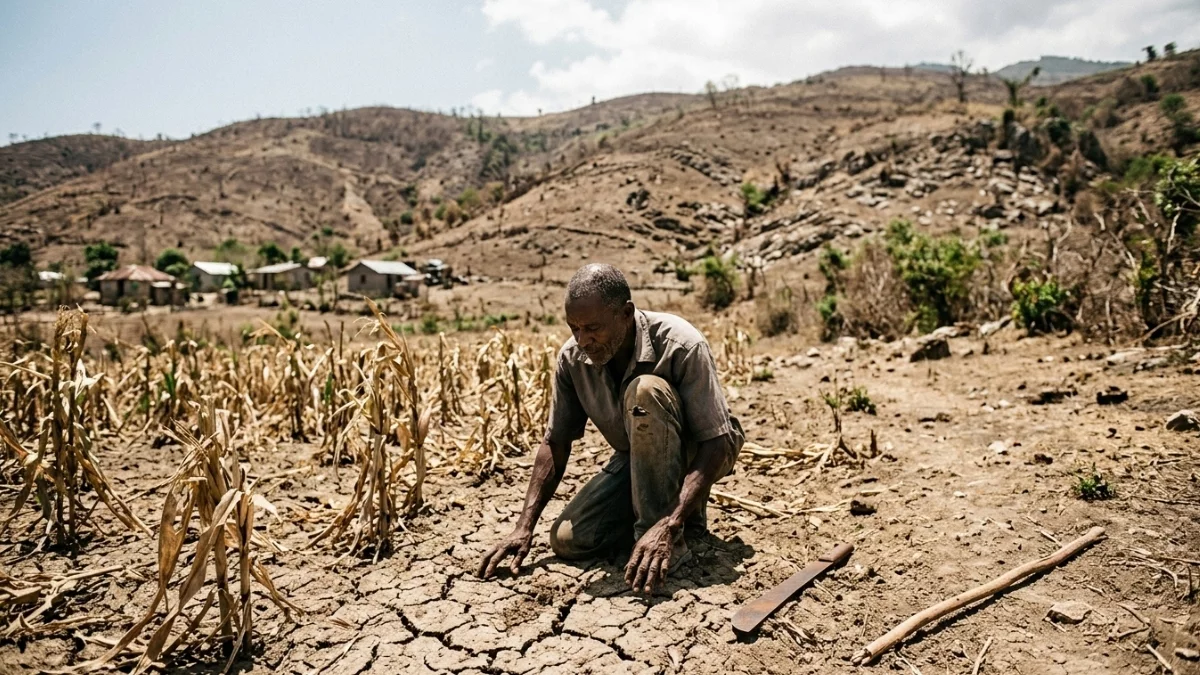
Crisis : Haiti faces the collapse of its agriculture
The Caribbean nation of Haiti, despite holding abundant natural resources and a resilient local workforce, is currently grappling with one of the most severe agricultural crises in its modern history, a collapse that has pushed the country into deepening food insecurity and dependence on international markets.
Multiple interconnected crises have fueled this downward spiral, ranging from systemic governance failures and incoherent national policy frameworks to widespread environmental degradation and a chronic lack of targeted technical support for small-scale producers. Today, more than 60 percent of all food consumed by Haitian communities is imported from overseas – a statistic that has completely eroded the country’s long-held goal of national food sovereignty and left the population extremely vulnerable to volatile swings in global commodity prices and supply chain disruptions.
Domestic agricultural output has continued to plummet, driven by a toxic mix of widespread gang-related insecurity, accelerating climate change impacts, chronically low public investment, crumbling agricultural infrastructure, and persistent mismanagement. The country can no longer produce enough staple food to meet the needs of its growing population, locking it into a crippling cycle of import dependence that shows no signs of reversal.
Beyond the collapse of crop production, Haiti’s critical livestock sector is also facing an unprecedented meltdown. Beef, goat, sheep, pig, and poultry production have all seen sharp, worrying declines, fueled by insecurity, rampant livestock theft, underfunded and weak veterinary services, widespread shortages of animal feed, degradation of grazing lands, and the complete absence of a coordinated national strategy for livestock development.
This collapse hits particularly hard because livestock represents one of the most important economic assets for Haitian rural households. For many families, farm animals act as a form of living savings that can be drawn on to pay for children’s school fees, cover unexpected medical costs, fund agricultural investments, and weather sudden emergencies. As the national livestock population gradually disappears, household livelihoods are further eroded, and access to affordable, locally produced animal protein has dropped dramatically across rural communities. The decline of the domestic livestock sector has also pushed up imports of meat, dairy products, and eggs, worsening Haiti’s already strained trade deficit and deepening its overall food dependence.
Water scarcity represents another crippling barrier to agricultural recovery. Water, the most essential input for productive farming, is chronically scarce especially in rural Haiti, and decades of inadequate water management have undermined production capacity and limited farmers’ ability to irrigate crops effectively even during periods of adequate rainfall.
A chronic lack of technical assistance compounds these challenges. Most smallholder Haitian farmers have no access to ongoing technical support or agricultural training, leaving them unable to update outdated farming practices or adopt more productive, climate-resilient sustainable methods that could boost output.
Widespread insecurity, fueled by the proliferation of armed criminal gangs across large swathes of the country, has had particularly devastating consequences for the agricultural sector. Farmers regularly face threats and violent attacks, leaving them unwilling to invest time, money, or labor into planting and maintaining crops out of fear for their personal safety. Beyond suppressing production, insecurity also blocks farmers from reaching local markets to sell their harvest, restricts travel needed to purchase seeds, fertilizers, and other critical farming inputs, and has discouraged collaborative cooperative initiatives that could strengthen smallholder resilience. As a result, large areas of arable land remain underutilized, and Haiti’s significant untapped agricultural potential remains severely constrained.
Compounding these systemic challenges is a catastrophic environmental crisis that continues to undermine agricultural productivity. Decades of unchecked deforestation, accelerating soil erosion, and widespread water pollution have degraded soil fertility and lowered quality of life for rural communities. The absence of sustainable natural resource management has further amplified the negative impacts of climate change, leaving Haiti’s agricultural sector even more vulnerable to extreme weather events and slow-onset environmental shifts.
In response to the deepening crisis, Haitian agricultural development organizations ALLO AGRO and PROMODEV have put forward a sweeping set of seven targeted recommendations to reverse the collapse and rebuild a more resilient national food system:
First, the groups call for urgent strengthening of agricultural and environmental governance, including efforts to rebuild public trust in the Ministries of Agriculture and Environment. Key reforms include increasing institutional transparency, improving clear communication with the public, and expanding meaningful participation for key stakeholders, including smallholder farmers and civil society organizations, in policy design.
Second, they propose the establishment of a National Sentinel Commission, made up of representatives from farmer associations and environmental organizations, to ensure all stakeholders are included in the country’s socio-economic development process. The commission would play a formal advisory role to shape national agricultural and environmental policy.
Third, the groups highlight the urgent need to invest in modern, sustainable irrigation infrastructure. This will require coordinated collaboration between the Haitian government, international development organizations, and local communities to guarantee equitable access to water for all smallholder producers.
Fourth, they call for targeted support for rural women, widely known as *Madan Sara*, who play a central role in Haitian food production. The organizations say specific programs are needed to provide rural women with expanded access to technical training, credit, and the productive resources they need to boost output and strengthen their own economic security.
Fifth, they recommend transferring regulatory management of the country’s eel fishery to the Ministries of Commerce, Interior, and Environment, a shift that requires formal approval from the Prime Minister, to reduce regulatory burdens on the agricultural sector. Publishing formal harvesting and export permits in Haiti’s official gazette, Le Moniteur, would also improve transparency and regulation of this valuable natural resource.
Sixth, the organizations urge greater investment in promoting sustainable agricultural practices that protect the natural environment and preserve biodiversity. This includes expanded training for farmers in modern, eco-friendly production techniques that boost output while reducing environmental harm.
Finally, they call for broad public awareness and education campaigns to inform the Haitian population about the critical importance of national food security and environmental protection. Educating young people about agricultural and environmental issues, they argue, will build long-term collective awareness and encourage civic action to support sustainable agricultural development.
-

Warriors extend unbeaten run victory over Kingsmen
In the latest fixture of the 2026 Republic Bank Caribbean Premier League (CPL) hosted at Providence Stadium on September 5, the Guyana Amazon Warriors delivered a clinical, commanding performance to defeat the Jamaica Kingsmen by eight wickets, extending their flawless unbeaten run on home soil this season. The result leaves the Kingsmen facing an urgent battle to reset their form and retain their chances of qualifying for the tournament’s playoffs.
Having been sent in to open the batting by Warriors captain Shai Hope, the Kingsmen struggled to find any consistent rhythm against a tight, disciplined Warrior bowling attack from the first over. South African all-rounder Dwaine Pretorius got the hosts off to a flying start, claiming two key wickets in his three-over spell, both via lbw: he dismissed opener Kirk McKenzie for just 1 run before removing top-order batter Keacy Carty for 18. Spin bowler Khary Pierre also picked up a pair of scalps, first bowling Usman Khan before trapping Maaz Sadaqat in front to claim his wicket for 35 runs off 34 deliveries.
Wickets tumbled steadily through the middle overs, putting the Kingsmen firmly on the back foot. In the 13th over, the side collapsed to 83 for 5 after Keemo Paul (15) and Rovman Powell departed in consecutive deliveries, with Powell falling for a golden duck to veteran Afghan spinner Mohammad Nabi. It was left to lower-order batter Hassan Khan to salvage the Kingsmen’s innings, and he delivered a sensational late surge, hitting an unbeaten 62 runs from only 29 deliveries that included six towering sixes. His solo effort dragged the Kingsmen to a final total of 159 for 7 from their 20 overs. Odean Smith chipped in with a useful 13 runs before being run out in the penultimate over, while Vitel Lawes held firm at the non-striker’s end to see out the innings.
For the Warriors, the 160-run chase never looked like anything other than a routine victory once opening batter Rahmanullah Gurbaz found his range. Gurbaz and opening partner Mavendra Dindyal put on 46 runs in less than five overs, putting the game well beyond the Kingsmen’s reach inside the PowerPlay itself. Dindyal departed to Hunain Shah for a rapid 33 off 17 balls, an innings that featured four sixes, but Gurbaz continued his aggressive charge, reaching a half-century of 54 runs off 35 balls with five fours and three sixes. He was finally caught out off the bowling of Maaz Sadaqat in the 13th over with the score at 114, handing the Kingsmen their second wicket of the innings.
That left captain Shai Hope and star batter Shimron Hetmyer to close out the win, and the pair required less than five overs to seal the eight-wicket victory. Hope anchored the chase with an unbeaten 39 off 35 deliveries, while Hetmyer accelerated to an unbeaten 30 from just 17 balls, wrapping up the win in the 18th overs with 16 deliveries still to spare. The Warriors chased the target at a run rate of 9.23 runs per over, with only Hunain Shah and Maaz Sadaqat managing to take a wicket each for the Kingsmen. Overall, the Kingsmen’s bowling attack leaked nearly nine runs per over, unable to slow the Warrior charge at any point in the chase.
With the win, the Guyana Amazon Warriors stretch their unbeaten home run this CPL season, cementing their position as one of the tournament’s top contenders. For the Jamaica Kingsmen, the defeat creates added pressure to regroup quickly ahead of their upcoming fixtures if they hope to keep their playoff qualification hopes alive.
-

Pageant Committee bids farewell to former Carnival Queen
The tight-knit Carnival community of Saint Lucia is enveloped in grief this week, after news broke that Patrika Evence, the island nation’s 1999 National Carnival Queen, has passed away. Evence died last Friday, and the announcement immediately triggered a wave of heartfelt tributes that flooded social media platforms across the country.
What made the outpouring of mourning so widespread is that Evence’s impact stretched far beyond the single year she wore the coveted carnival crown more than 24 years ago. For members of the Carnival Planning and Management Committee (CPMC), the governing body that oversees the country’s annual Carnival celebrations and the national pageant, Evence remained a beloved and influential figure decades after her reign.
In an official public statement released following Evence’s death, the CPMC honored both her legacy as a pageant titleholder and her character as an individual. The committee emphasized that Evence’s crown was never just a symbolic award — it was a reflection of the poise, natural beauty, and quiet confidence that defined her public persona, and that left an indelible mark on the history of Saint Lucia’s Carnival. Throughout her time as queen and in the years that followed, she carried her title with unwavering pride, gentle elegance, and a warm, generous spirit that resonated with everyone she met.
Close friends, fellow pageant participants, and community members who worked with Evence over the years have shared their own personal memories, remembering her as a trusted confidante to many young pageant aspirants and a steady guiding mentor who continued to lift up other members of the Carnival community long after she stepped off the stage. Many shared stories of how she supported emerging titleholders, helped new participants navigate the pageant process, and nurtured a culture of mutual support within the Saint Lucia Carnival Queen Pageant community.
The CPMC extended its deepest condolences to Evence’s family, friends, and all those who counted her as a loved one in their personal lives. While the community mourns the loss of one of its most cherished members, the statement concluded, the light Evence brought to the celebration of Carnival, the countless memories she created with those around her, and the enduring legacy she leaves behind will never be forgotten. Her memory will continue to hold a special place in the hearts of all who knew her, and in the history of Saint Lucia’s beloved Carnival tradition.
-

Back to school : A set of concrete measures from the Government
With the 2026-2027 academic year set to begin across Haiti on September 7, the administration of Prime Minister Alix Didier Fils-Aimé has stepped forward with a comprehensive suite of concrete initiatives to remove barriers to education for vulnerable communities, reaffirming its promise that no family will navigate the challenges of back-to-school season alone.
The full package of measures was formally presented to the public during an official press conference held Friday, September 4, 2026, crafted to address three core priorities: easing the financial strain on caregivers, upgrading learning infrastructure across the country, and ensuring a safe, secure environment for students and staff as classes resume.
Leading the financial support component is a cross-agency collaboration between the Ministry of Social Affairs and Labor (MAST), the Ministry of National Education and Vocational Training (MENFP), and the National Education Fund (FNE). Through this partnership, direct financial assistance will be distributed to 130,000 school-aged children’s parents and an additional 30,000 at-risk households. For many low-income Haitian families, back-to-school costs force an impossible choice between covering educational expenses and putting food on the table; this program frames direct support as an act of national solidarity to eliminate that terrible tradeoff.
Beyond direct financial aid, the government is investing in physical upgrades to create more dignified, functional learning spaces for students. The plan includes major rehabilitation work at 52 public primary and secondary schools, the completion and opening of newly built educational facilities, the distribution of 8,000 new pieces of classroom furniture, and sustained operational support for school canteen programs that provide critical daily nutrition to students from food-insecure households. All told, these infrastructure and support measures are expected to benefit tens of thousands of members of the national educational community.
Student safety remains a top strategic priority for the administration as classes resume. The Haitian National Police (PNH) has deployed 10,750 specially assigned officers as part of a dedicated year-long security operation focused on the new school year, tasked with patrolling school zones and maintaining safe conditions for students and staff across the country. Complementing this security effort, the Ministry of Public Works is carrying out targeted infrastructure improvements to ease traffic congestion around school campuses, mitigate hazards linked to severe weather events, and enhance overall public safety in areas surrounding educational institutions.
In outlining the full package of initiatives, government officials emphasized that the program is designed to send a clear, unifying message to Haitian students, their families, and the entire education sector: school remains a fundamental space of hope, human dignity, and future opportunity for the nation’s next generation.
-

Ready for Carnival 2026? News 5 Brings the Road March to You
One of Belize City’s most anticipated annual cultural celebrations is just hours away, as the 2026 Carnival Road March prepares to transform the streets of the nation’s former capital into a vibrant sea of color, music, and soca rhythm this Saturday, September 5. For festival-goers who cannot make it to the parade route in person, local media group Greater Belize Media (GBM) is delivering a front-row experience straight to screens at home and abroad, with uninterrupted live coverage of every moment of the event.
GBM’s broadcast will kick off earlier than the parade itself, going live at 1:30 p.m. to capture all the pre-event excitement ahead of the official start. The road march will officially step off at 2:00 p.m. from Lord Rhaburn Plaza located at Memorial Park, before weaving its way through central Belize City, ending at a grand finale performance at Marion Jones Stadium. It is at this final venue that competing junior and senior Mas bands will deliver their closing performances for judges, who will determine this year’s category winners. Results will be announced by the Belize Carnival Association on Sunday, September 6.
To deliver comprehensive, multi-angle coverage to viewers, GBM has assembled a team of five hosts positioned across the entire parade route. Opening the broadcast live from Memorial Park will be lead host Paul Lopez. As the parade progresses through city streets, on-route hosts Benita Keme-Palacio and Bryan Gabb will provide running commentary, alongside exclusive live interviews with participants and crowd reactions. Two additional hosts, Immanuel Westby and Kenall Morgan, will also be stationed along the route to capture close-up footage that puts viewers right in the middle of the action.
Regardless of where audiences tune in from — whether they are watching from overseas, relaxing at home, or waiting curbside for the parade to pass their spot — the GBM broadcast will bring the full, high-energy soca atmosphere of the event directly to them. Viewers can expect unfiltered access to behind-the-scenes moments, interviews with revelers and spectators, and detailed close-ups of the intricate, vibrant costumes designed for this year’s celebration.
The 2026 parade line-up features a diverse range of participants, starting with official security and marshaling led by the Belize Police, followed by the Escuela Secundaria Mexico Marching Band. Seven competing junior Mas bands will take part: JumpStreet Posse, Soca Massive, Sunshine Masqueraders Jr., Collet Royals, Black Pearl Carnival Band, and Rhythm Rockers, with medical support from an on-course ambulance and an official service truck from the Belize Carnival Association following the junior division. Next in the line-up is the fan-favorite Belize Uprising Drum Corp, leading into the five competing senior Mas bands: Mother Nature Creation, Soca Moca Carnival Band, Fort Street Revelers, Trench Town Masqueraders, and Pulse Nation Marching Band.
Five non-competing senior bands will also join the procession to add to the festive energy: Kriol Haat Beat, Fantasy Explosion, Belizean Jewels, Sunshine Masqueraders Sr., and Titans Mas Band, with a second ambulance following this group to ensure participant safety along the route. Closing out the parade are the featured floats and supporting entries, including the Mighty Blue Jaguars marching band from Caye Caulker, and branded floats from sponsor partners ICB, Desho Music Truck, and Belikin.
-

Wharton leads UWI to commanding win
Barbados Netball Association league matches delivered lopsided results across two divisions on Wednesday, headlined by a historic perfect shooting display from UWI star Shonica Wharton that propelled her side to a dominant 47-28 triumph over the Wolverines in the Diamonds Division.
Wharton turned in a near-unprecedented performance in front of onlookers, converting every single one of her 29 shot attempts to keep UWI’s scoreboard ticking consistently throughout the contest. She was not the only standout offensive player for the winning side, however: teammate Rynia Ifill added a solid 18 goals from 31 attempts to pad UWI’s lead and lock in the comfortable final margin.
The Wolverines put up a competitive offensive effort of their own, with both starting shooters Kianna Harte and Tyesha Trotman matching each other’s production. Each player sunk 14 goals from 25 attempts, combining for 28 total points — but the side could not overcome Wharton’s perfect accuracy and UWI’s balanced offensive attack, ultimately falling 19 points short of the winning mark.
In concurrent action in the league’s Opals Division, Vauxhall pulled off an even more one-sided victory, cruising to a 26-4 rout of the Panthers. Vauxhall’s offense operated smoothly for most of the match, with leading shooter Janai Harvey notching 11 goals from 18 attempts, while secondary shooter Francia Drakes chipped in nine goals from 14 attempts to build an insurmountable lead early on.
Panthers’ offense struggled severely to find its rhythm on the night, hampered by inconsistent shot conversion that left the side far off the pace. Starting shooter Zanae Holder converted just one of her two total attempts, while teammate Amara Primus managed three goals from six attempts, resulting in a final four total points for the underperforming side.
-

Football : The new coach of the Grenadiers in Haiti
In an official press conference held Friday, September 4 at Port-au-Prince’s Karibe Hotel, the Haitian Football Federation (FHF) formally introduced 51-year-old Spanish tactician David Badia as the new head coach of Haiti’s senior men’s national football team, widely known as the Grenadiers. Badia has signed a binding two-year contract to lead the Caribbean side through upcoming international competitions, and was on the ground in Haiti to attend the unveiling in person.
During the press event, Badia laid out his core strategic vision, long-term mission, and planned adjustments for the Grenadiers program. He framed his appointment as an opportunity to build on the national team’s recent momentum rather than execute a full reset. “My priority mission is to drive this group forward and build on the solid standing we currently hold,” Badia told reporters. “We are already performing at a good level, but that is never the ceiling. Our work will focus on forging a clear, distinct national team identity as we push for consistent progress.”
The newly appointed coach outlined a playing philosophy centered on controlled possession and proactive, attacking football, noting that he expects intensity from his players both when they hold the ball and when they are working to win it back. He shared that he already has strong confidence in the talent available to the Grenadiers, saying he is certain the squad will adapt to his tactical requirements and meet his performance expectations.
Badia also reflected on the warm welcome he received upon arriving in Haiti, highlighting a moment that underscored the nation’s deep connection to its national team. “When I drove into the city, I was genuinely struck by how many people I saw wearing the Grenadiers jersey on the street,” he said. “It was surprising to see so many fans rocking the national team’s colors on a non-matchday, and it really drove home how incredible and passionate the fanbase here is. That energy means a lot to me.”
When asked about roster plans, Badia confirmed that he intends to slowly transition the squad toward a younger generation of talent, rather than forcing a rapid, disruptive overhaul of the current group. “We will bring new young blood into the national team, but this process will happen step by step,” he explained. “The existing core of the squad will remain intact — I have full confidence in what this group has already achieved. We will gradually integrate new players who can raise our overall level of play, and there are no arbitrary barriers to who can earn a call-up. The door is open to any eligible player, whether they currently play their club football in Haiti or overseas.”
The appointment marks a new chapter for the Grenadiers as they prepare for upcoming CONCACAF qualifying cycles and international tournaments, with Badia set to begin his tenure immediately ahead of the team’s next scheduled fixtures.
-

Education Ministry mourns death of top scholar in Taiwan
BASSETERRE, St. Kitts – September 5, 2026 – The Ministry of Education of the Federation of St. Kitts and Nevis has issued an official statement of condolences following the passing of one of the nation’s most promising young academic scholars, Zidane Soleil Knight, who died while completing her higher education in Taiwan.
As of Saturday evening, specific details surrounding the circumstances of Knight’s death have not been released to the public. Even so, news of her unexpected passing has quickly spread across the twin-island nation, triggering a widespread wave of sympathy and support from educational communities, loved ones, and members of the public alike.
In a formal media statement released Saturday afternoon, the Ministry extended its deepest sympathies directly to Knight’s parents, Mr. and Mrs. Stanley Knight. “The news of her passing has been received with profound sadness,” the statement read.
Knight was a recipient of a prestigious Taiwanese government scholarship that enabled her to pursue advanced academic goals overseas. The Ministry praised her as a driven young scholar who consistently showed exceptional dedication to her studies and unwavering commitment to building a bright future, noting she carried enormous promise for both her own career and contributions to her home country.
“The Ministry of Education shares in your grief and recognizes that no words can adequately ease the pain of losing a child,” the statement added. “We pray that the memories of Zidane, the impact she made, and the promise she carried will provide you, your family and close friends with strength and comfort in the days ahead.”
Beyond her academic pursuits abroad, Knight had already earned national recognition early in her educational journey: she was named an honouree of St. Kitts and Nevis’ 25 Most Remarkable Teens program, a distinction that celebrates young people demonstrating outstanding achievement and character. She delivered exceptional results on the Caribbean Secondary Education Certificate (CSEC) examinations, solidifying her reputation as one of the Federation’s most standout young academic talents. Those impressive academic accomplishments directly paved the way for her to receive the competitive Taiwanese Scholarship, opening the door for her to advance her studies overseas.